
With over 1000 rifugios, the hut system in the Dolomites is arguably the best in the world and I think that if you are planning a holiday here, you should plan at least one night at a Dolomiti hut.
When completing my Alta Via hiking project during the summer of 2019 I met a considerable number of international backpackers who seemed to be very misinformed about mountain huts.
The majority of them carried too much equipment and packed for every eventuality or came unprepared because they thought the huts were like hotels. Very few people I met knew exactly what to expect.
12 frequently asked questions about mountain huts in the Dolomites
In this post, I’m going to try and give you comprehensive answers to frequently asked questions such as how to make a reservation, what’s included in half board, and what kind of facilities you can expect when staying in a mountain hut in the Italian Dolomites. Plus loads more.
1. When do the huts open in the summer season?
The majority of the huts in the Italian Dolomites don’t open until mid to late June, with the third week of the month being the most common opening time. You may wonder why they remain closed for so long.
It is because there is still a lot of snow in the mountains in May and June making it impossible to get to the refuges. The huts are built at high elevations, often above 2500 meters (approx. 8000 feet) and the avalanche danger is often too great to reopen earlier. Besides, the paths leading to them are often still impassable at this time of the year.
Saying that the snow doesn’t completely disappear until July, so if you were planning a hiking holiday in the Dolomites in the spring then I would recommend that you reconsider it, especially if you plan on exploring at higher elevations! The ski season doesn’t usually end until the end of April!
Most huts remain open until the third week of September when you can already expect the first snowfall. I’ve noticed that the SAT huts* in the western part of the Dolomites stay open later, often until the start and some even mid-October.
As a general rule, the private huts stay open a bit longer than the ones belonging to the Alpine clubs do.
*More on Alpine Club Huts, SAT huts, and private huts later in the article.
2. How to make a reservation in a Dolomiti mountain hut
Making a reservation outside of the summer season
Unfortunately, making a reservation in a Dolomiti Rifugio isn’t as easy as opening a booking engine, followed by a few mouse clicks, typing in your credit card details, and instantaneously receiving an email confirmation.
If you are planning your trip a few months in advance and the huts are still closed for the summer season you need to email. 99% of the huts have a website where you can find the contact details.
Don’t expect the answer within the next couple of hours of sending the email. Speaking from my own experience it usually takes a day or two to receive an answer but it’s also not uncommon to wait for a few weeks!
Making a reservation during the summer season
If you are making a reservation during the summer season when the hut is already open you need to call the hut directly. There is usually at least one staff member in the refuge who speaks English and will be able to assist you.
You will be asked for your name and dates but nothing else. Don’t expect to receive any email confirmation. All you need to do is show up. I have made this call many times before and my booking was always there when I arrived.
Due to the huts often being in remote places, the phone reception can be pretty bad. If your name is really difficult to spell or pronounce I suggest that you make it as short and as easy as possible.
3. Do huts require deposits?
It’s not uncommon to be asked to pay a deposit to secure your booking. It is usually anywhere between 10-20 Euros per person. This amount is subtracted from your total bill at the end of your stay.
You will be asked to send it directly to the business’s bank account. Make sure to put your name and dates in the reference field when depositing so it can be assigned correctly.
TIP: If you don’t have a European bank account I recommend that you sign up for Wise. It’s the best online tool for making international transfers. Get the debit card and download the app too. Wise has the best exchange rates and always saves me a lot of money when I travel. I have been using it for years.
Deposits are generally refundable to a certain date (for example 2-4 weeks before arrival) or non-refundable at all. Bad weather forecasts or personal injuries are not taken under consideration if you try to cancel at short notice.
4. How much does it cost to stay in a hut in the Dolomites?
I think a lot of people don’t stay in the huts thinking they are way out of their budget! There’s nothing further from the truth. The backcountry huts are one of the most affordable accommodation options in the Dolomites.
The huts belonging to the Italian Alpine Club usually cost between 55-65 Euros per night for half board. The private huts usually range between 70-80 Euros for half board or 30-40 euros for bed and breakfast.
It’s worth mentioning that drinks (apart from the morning tea or coffee and water served at dinner) are not included in the price. The huts serve a variety of alcohol including local beers, wine, and famous Italian grappa!
5. What does half-board mean?
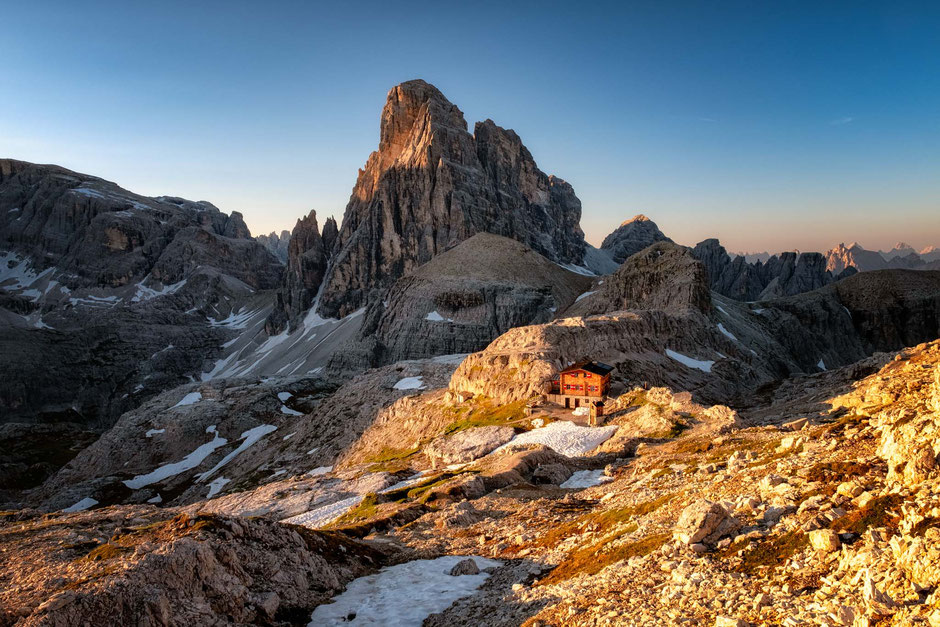
Half board is the combination of accommodation, breakfast, and dinner (usually a three-course dinner) which you will be served at the restaurant. That’s right, all huts have their restaurants!
It’s also possible to not choose half board and to pay for accommodation and meals separately. I always go for this option because I am never able to finish the three-course dinner and they are served a bit late for my liking.
The whole dinner usually starts at 6:30 or 7 pm and finishes at 8 or later meaning you end up stuffing your face right before bedtime. Yes, I go to bed early and wake up very early.
However, price-wise, it’s normally cheaper to pick the half-board option. After all, you do need to replenish all those calories burnt after a day of hiking!
The half board menu is set on the day and you have to confirm your choices usually before 5 pm. The majority of the time you will receive between 2 and 3 choices for each course. Vegetarian options are always available and usually, the cooks can accommodate something for vegans too.
It’s worth mentioning that some private huts only offer bed and breakfast with a la carte dinner.
6. Alpine clubs and memberships
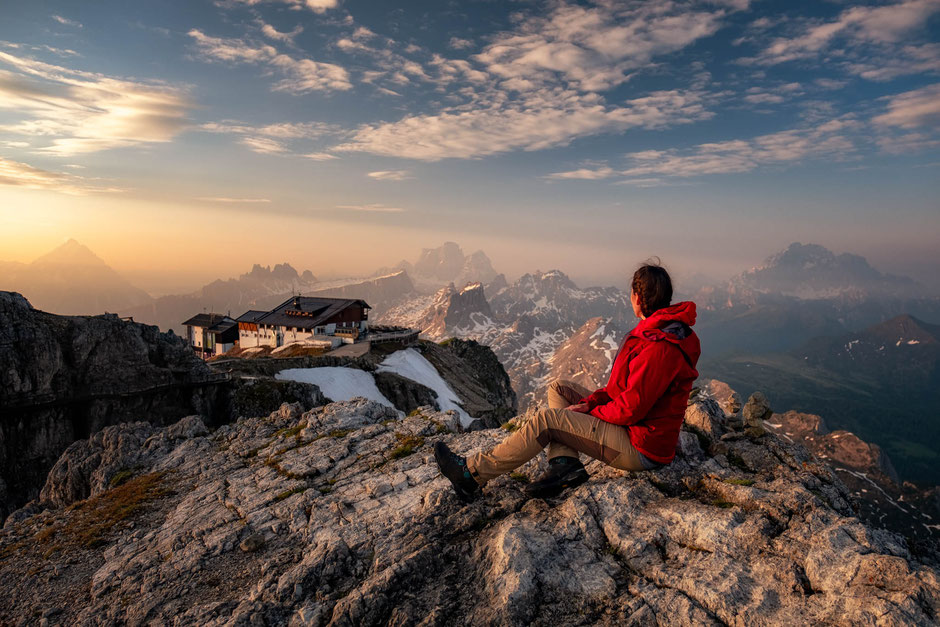
The Italian Dolomites’ two most famous mountain clubs are Club Alpino Italiano, known simply as CAI, and Società degli Alpinisti Tridentini (SAT).
The huts belonging to either of those clubs often sport blue or red shutters, making them recognizable from afar.
Being a member of these organizations means you receive discounts at the club’s huts. You don’t need to be a member of an Italian Alpine Club to receive a discount either. I have met plenty of travellers from Germany, Austria, or Ireland (plus loads of other countries) whose National Alpine Club cards gave them a discount. I think this reciprocal agreement is fantastic.
Moreover, the member huts offer accommodation discounts of up to 50% to overnight visitors. The yearly cost of membership starts at around 50 Euros for CAI. I’ve learned that becoming a member usually pays off if you plan on staying in at least 5 Alpine Club member huts in the Dolomites.
The privately run huts in the Dolomites do not offer discounts with the memberships.
To find out which hut belongs to an alpine club and which doesn’t, visit their websites and be on the lookout for the emblems of CAI or SAT, a sign of belonging to a club.
I have also included that information and the prices of what I consider the most photogenic huts in the Italian Dolomites in my separate post.
7. Can I reserve a bed and bring my food?
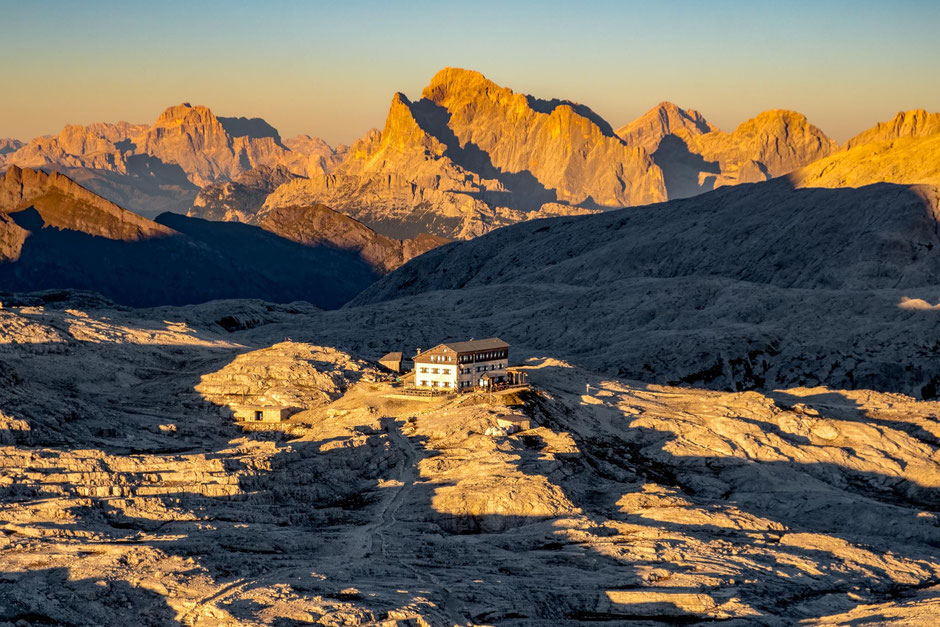
It varies from hut to hut, but generally speaking, yes, you can. The beds in Alpine Club member huts usually cost 30 Euro per night (you receive a discount of up to 50% with the Alpine Club member card).
If you bring your food, however, you will have to consume it away from the hut, ensuring that you don’t take away the table space from other restaurant paying customers.
You should also know that bringing your food can often be frowned upon. The people who run the huts usually make their income from running the restaurant and can see you as a ‘wasted customer’ who doesn’t spend any money at the hut. You’ll also have to bring your cooking equipment, eating utensils, etc.
8. What kind of facilities can I expect in the huts?
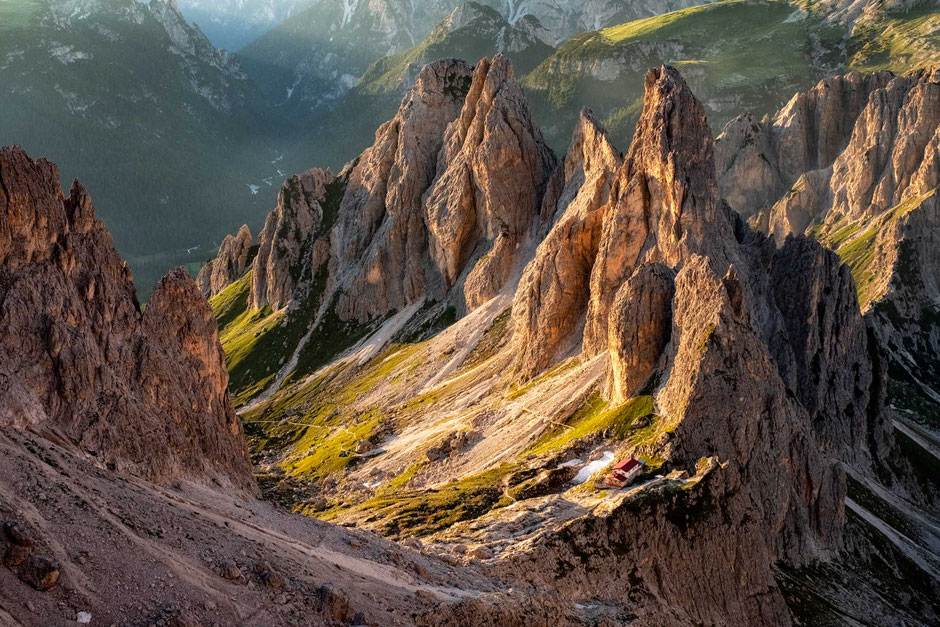
After staying in the alpine huts in New Zealand and Canada, I can say with good conscience that European Alpine Huts (including the ones in the Dolomites) are very luxurious and provide a great refuge to tired trekkers.
The rooms have bunk beds and usually hold between 4 to 10 people. The largest room I have stayed in had 24 beds. My friend and I were assigned to the same room as 20 Italian men on a weekend getaway! The amount of snoring didn’t allow us much sleep that night. Most huts also offer private rooms, but those book out far in advance.
The huts have running water and often offer showers (for additional cost) and electricity. The more frequented the hut, the more facilities you can expect. Some even started offering WIFI, although I am unsure how I feel about that.
You can expect to pay between 5 and 8 euros for a shower, which is commonly limited to only a few minutes. The most expensive one I have encountered was a 5-minute shower at Rifugio Locatelli, which cost 8 Euros.
Sometimes,, electricity to charge phones and other electronics you have brought along is only turned on at certain times of the day, so make sure to check with the refuge’s staff if that’s the case.
As mentioned before, all huts also have restaurants where you can order food and drink. I think this is brilliant and significantly lowers the volume of things you must carry in your backpack on a multiday excursion, making it much more enjoyable!
9. What type of food is served at the huts?
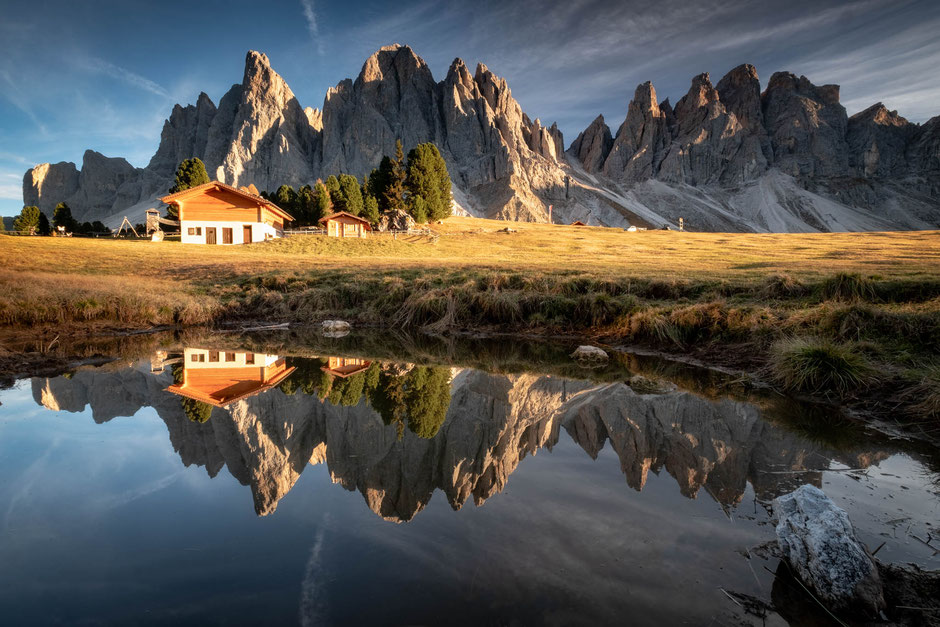
After staying in over one hundred different huts in the Dolomites I concluded that the menus offered at the huts are very limited and for the most part all look the same.
You can expect pasta (you are in Italy after all), usually three types: bolognese, spaghetti aglio e olio, and carbonara. If you are lucky you will also see gnocchi and of course, it wouldn’t be the Dolomites if polenta wasn’t on the menu!
With the latter, it can be a real hit-and-miss. It can range from a soft mush to a hard loaf. For those of you who haven’t heard of it, polenta is a dish of boiled cornmeal. It is usually served with some type of meat, mushroom sauce, or grilled cheese.
I’ve only enjoyed polenta dishes a handful of times and whenever possible I chose to avoid them.
Fresh vegetables aren’t usually a thing during meal times as they are difficult to store or transport without bruising and have a limited shelf life.
You can also expect a selection of freshly baked local cakes with apple strudel, linzer torte, and chocolate cake being my favorites. The thought of having one often kept me walking on tougher days!
10. What do I need to bring when staying in an alpine hut?
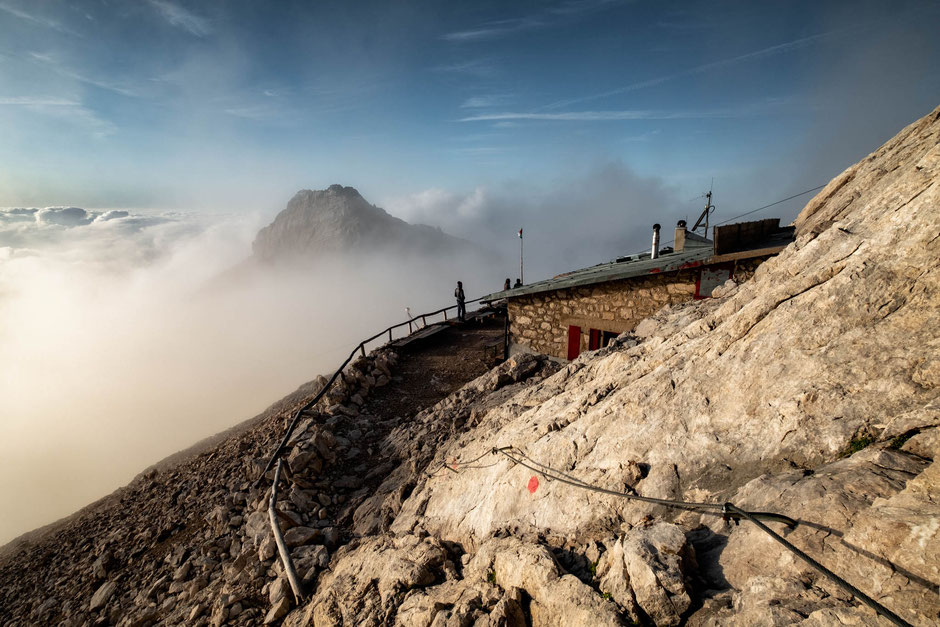
There is one thing that you absolutely must bring when staying in the huts – a sleeping bag liner.
Blankets (or sometimes even proper duvets) and pillows are provided in the huts, but because they are not washed after each guest, it’s mandatory to bring a liner ensuring you are not in direct contact with the sheets or blankets.
If you forget, huts sometimes offer to rent or purchase one of them, but it’s not worth it. I recommend bringing your own. I use a Sea to Summit silk liner, which fits into the palm of my hand when stowed in the bag.
On the huts websites you can often see information about bringing a sleeping bag, but don’t be thrown off by this, because what they mean is a sleeping bag liner and it’s just an incorrect translation. In all the huts I have stayed in, there were always blankets and pillows provided and they have always been thermally sufficient.
I have also written a comprehensive packing list for multi-day hikes in the Dolomites to ensure you don’t overpack or forget something important.
11. Is there potable water in the huts?
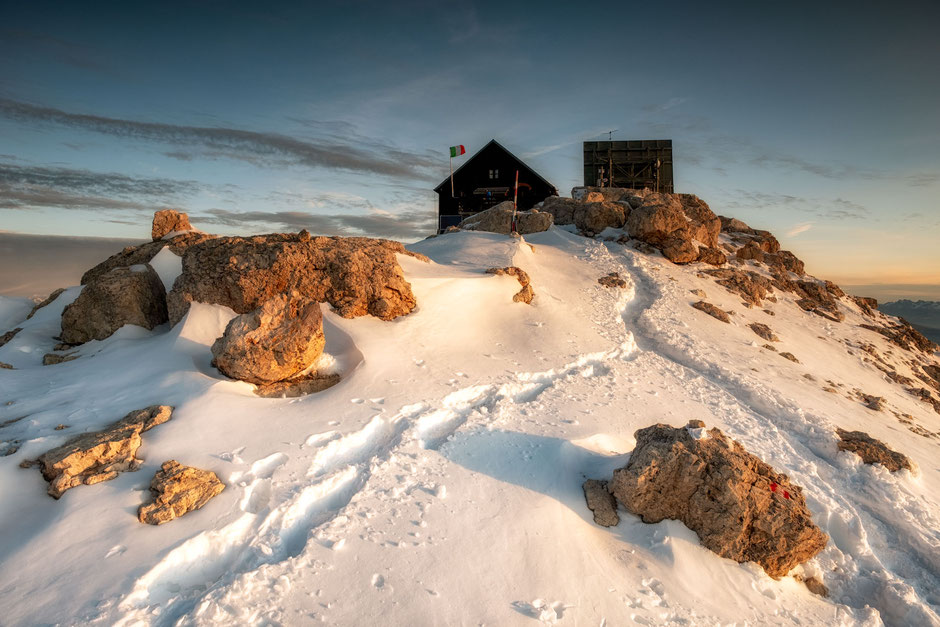
Water is a very precious resource in the Dolomites, especially in the huts. For the most part, the water running in the taps is snow melt or rainwater collected in huge nearby tanks. By September the tanks run low and some of the huts simply don’t have enough water to keep running.
I’ve stayed in huts before where they asked their guests to only flush toilets after number 2 to preserve the water! Don’t worry though, this only happened twice!
Often in the bathrooms, you will find signs saying “agua nonpotable” meaning the water is not potable. After having a conversation with a few hut owners and asking why the water isn’t potable I’ve received a unanimous answer.
Because the water comes from snow melt it doesn’t contain minerals and instead of quenching your thirst, it flushes the minerals out of your body. It’s like drinking distilled water. Secondly, the owners make extra money from selling the water to you. Going back to the first argument, I can’t say I blame them.
You can buy mineral water bottles at the hut, but they all come in plastic and cost a small fortune. I also don’t like contributing to plastic pollution and choose to drink the water from the taps.
Each time I carried rehydration tablets with me and mixed them with the water, I never once got sick. More options to make sure the water won’t make you ill include sterilization pens or sterilization tablets
12. Can I stay in the hut after the season ends?
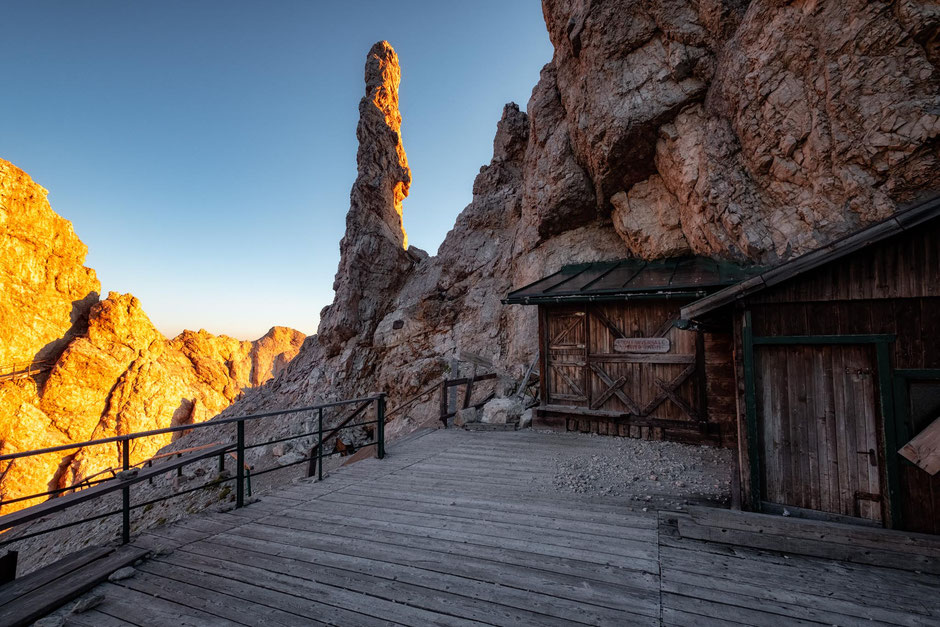
Yes, you can. After the summer season ends and the huts close you can still overnight in the hut in the winter room (Italian: locale invernale; German: winterraum).
Winter rooms are just basic rooms with separate doors. Their purpose is to provide shelter to climbers and mountaineers who venture into the backcountry in the winter season.
Usually, there are just a few beds and a few blankets available, which is enough to survive if you become stranded in harsh conditions.
When staying in the winter rooms you will, however, need to bring your own sleeping bag, food, and cooking equipment. Also don’t expect to find any water. You can either get it from nearby streams or lakes (providing there are any), bring enough with you, or boil some snow (if it’s available).
So far I have stayed in two winter rooms. Firstly when I was tackling the via ferrata Marino Bianchi. The second time I stayed in the winter room of the rifugio Alberto Primero after completing the via ferrata Passo Santner, just after the official season ended and the hut closed.
Both times I shared the room with other hikers and there weren’t enough beds for all of us providing for a rather uncomfortable but funny night.
I experienced it only once when both the main hut and the winter room were closed. It was the day the summer season ended and the winter room wasn’t open yet.
Due to the lack of facilities, no toilets, no water, and no other amenities, the winter rooms are free of charge to stay in.
I hope this comprehensive guide to staying in the mountain huts in the Dolomites will help you plan your holidays! If you think there is something I forgot to cover in my post, please leave your question in the comment section below. No comments are left unanswered!
Support my website!
Hi Reader! If you found any of my articles about the Dolomites useful please consider using the affiliate links below (at no extra cost) when booking your holiday. Thank you
- Reserve your hotel with Booking.com
- Book your rental car with Discover Cars
- Buy your outdoor gear with Backcountry.com (US readers)
If you have any questions, leave them in the comments below!
Hi Marta,
What an amazing guide! I want to do AV2 in September next year and I use your guide together with Gillian Price AV2 cicerone book to plan my trip and I am so excited now to go.
But I have a question for you please. I want to became a member of the CAI, but I am unable to find way how to do it online. I am a member of Czech club, but the reason becoming the CAI member is mainly for the insurance which does not come with my Czech membership.
I will be grateful for your help.
Kind regards
Pavla
Hi Pavla. I became a member when I was in Italy. I just walked into a visitor centre. I would recommend that you join the Austrian Alpian Club (AAC). It is the biggest in the World and the website is a lot more user-friendly. They also have worldwide insurance. All details are here. https://www.alpenverein.at/portal/service/mitgliedschaft/mitgliedervorteile/membership-english-version/0100_insured-worldwide.php I now live in Tirol Austria so I am a member here, but anyone can join. I met people from Ireland in the Dolomites who were AAC members.
Hi! Thanks a lot for your blog, it’s been really helpful!
We’re doing the Rosengarten traverse and have booked huts along the way. And we were also planning to have lunch at the mountain huts. Would you suggest to take cash for all the expenses (which will add up to quite a bit)? Or should we expect to be able to pay with card in some?
Hi Sara. The huts love cash. Some do accept cards though (Alpe Di Tires). It is safer to just assume it is cash only though. I once carried cash with me on a 13 day hike hut to hut hike. Never felt unsafe.
Hi Marta,
Thanks for your answer.
In case it helps others, we were finally able to pay with card in all huts but Antermoia (we stayed at Paolina, Fronza, Re Alberto, Antermoia and Alpe Di Tires).
Woohoo! That’s great news! Thanks so much for sharing this. I will make sure to include that info when I update the post.
Hi, just to update on this – I just stayed in Antermoia two nights ago and was able to pay with card!
That’s great to hear, however I do believe Antermoia has a limit for cards. If you are only a day guest they prefer for people to pay cash.
Hi Marta. Excellent info on this page and all the other articles too. I have bookmarked them for our 2026 summer. We have just come back from a 7-day TMB for 2025. I was wondering if you had any views on vegetarian food options at the Refugios?
Hi Marta
Great post!
I have a rather ambitious plan to hike between Tarvisio and somewhere around the Mount Blanc in 2027 across a couple of months. Obviously i could do this at valley level and stay in villages more easily but would certainly like to do some sections at altitude in the dolomites (my favourite place and somewhere i’ve been a bunch).
In your experience, do you think the chance of booking say, 10-15 rifugios independently in the order i need is going to provide challenging?
Because with a specific route, missing even one would require a descent and re-climb the following day of course.
Or should i be ok as long as i plan/book a year in advance?
Thanks a lot
Hi James. What a great plan. Now I am gonna be honest, I have a little trouble understanding your question. What do you mean by booking 10-15 rifugios independently?
Amazing site–so helpful! I am thinking of doing a hut-to-hut hike of maybe 4 nights in late June/early July 2026 with my 10 and 15 year old kids. I have a question about the weather. I gather that there are often afternoon storms and it is best to get your hiking done before lunch. If we were caught in a storm, would it be dangerous at all? And is there much chance we’d have to cancel a day’s hiking on account of a storm? I imagine it would create a lot of problems if we couldn’t make it to our next hut due to weather issues. Thanks in advance for your insight!
Hi Suzanne. Yes hiking in the storm is not an ideal situation. The storms happen more in the afternoon than in the morning/Lunch time. They also don’t happen daily. I just returned to the Dolomites for two weeks this June and we had afternoon storm 3 times only. I had a lot more of them when I hiked the Alta Via 1.
There are also often huts in between where you can shelter if the storm does come earlier than expexted. It is all about planning with the weather on a day to day basis. Meteoblue is a great app for weather, where you can check the cloud radar. I found it to be the most reliable.
Thanks so much for your helpful reply!
Hey Marta,
Thanks for keeping up this blog and being responsive. What a resource! There is so much good information in here.
I am planning to spend time in the Dolomites in mid-October. I was wondering if you could shed some more light on the “winter rooms.” Do you think they will be open in mid-October, or is that a buffer period between summer/winter? I’d love to take advantage of these if possible. Thank you!
Hi Stephen. THanks for your kind words.
I stayed in a few winter rooms in October and they were open, but quiet busy with other people. I think generally by law they have to be accessible, however I also did run into one closed one and one that was still not open (but used temporarily as storage) although the hut was already closed to guests. The staff at the refuge were still there and preparing the whole refuge for winter. We ended up sleeping outside in our sleeping bags and on top of an emergency blanket 🙂
So to put is shortly I really cannot give you a straight answer. It can be a hit or miss. Some huts in the Rosengarten group still operate until mid-October so I would simply recommend timing your visit so you can still stay at the hut.
Hi Marta! Thanks for your awesome blog! I was wondering a couple of things…
– do the huts provide towels? Or should you bring your own for lake swimming?
– can you purchase lunch and snacks from the guys for the day?
– do you recommend hiking boots or would trail runners or normal good quality sneakers do?
Thanks so much!
Hi Emily.
The first two answers are covered in the text 🙂 and I have a pull packing list for hut to hut hikes. which should come very handy.
So to give you a quick answer
1) No (sometimes it is possible to rent) but generally no
2) Yes.
3) This is a very personal decision. I used to hike in hiking boots, now I go in trail runners. If I know that there will be a via ferrata along the trail then I wear low-ankle approach shoes.
I hope you have a wonderful time
Hi Marta!
Thanks so much for this, it was super helpful. We would like to do Dolomites in June. Anywhere betwween 12th-22nd of June. Which routes do you think we could do where refugees might not be booked up yet?
Hi Shannon. The huts usually start opening around mid-June. it really depends if you want to have via ferratas or not, but I would recommend you look into the Rosengarten Traverse or PAle Di San MArtino Traverse (you can search for both on my site).
Hi! Can you recommend huts on the Tres Crime hike? We are doing the Cadini di Misurina extension! I tried booking Rifugio Auronzo, but the site seems to be down so I can’t see rates/ availability. Are there any others on this trail that you recommend?
Hi Lindley. In My Tre Cime Circuit guide you can find a section with all huts enlisted. I also recommend that you check out my post about Croda Fiscalina Circuit.
Hi Marta
Thanks you so much, it’s a great guide and so helpful.
I am preparing a trip in the Dolomite in 2025. I would love to camp but still enjoy the luxury of diner (and maybe shower) at the huts so i don’t have to carry so much weight. Do you know if it is possible to camp next to the huts? Does it requieres booking in advance?
I am so greatful for uour advises
Hi Auriane. Thanks for stopping by and for your lovely feedback. I know that camping within Nature Parks is not allowed. I have stayed in hundreds of huts in the Dolomites and have never seen a tent being pitched anywhere nearby. You can certainly eat at the huts without staying there, but I don’t know about the shower.
Hi Marta,
Thank you for the information. Eight of us are planning to do Adolf Munkel trail hike, Cadini Di Misurina hike, Cinque Torri Loop, Tre Cime di Lavaredo Loop, Marmolada Glacier Hike, Col Raiser-Seceda hike. All will be round trip, looping hike, completed in few hours time. We will be hiring 2 cars to get around. I am wondering if we should stay in the mountain hut or hotel/hostel nearby. Is it worth staying in some mountain hut for the sunset or sunrise view? Since we are moving from trail to trail, our next day hike may be delay. What is your suggestion? Thank you.
Regards
Leroy
Hi Leroy. Thanks for stopping by. If you are on a budget then I reckon booking an apartment in the valleys for a bigger group will work out to be cheaper then the huts. If you want to experience a hut at least once then book Rifugio Firenze and stay there for one night when doing the Col Raiser – Seceda hike. The hut is only a 30 minute walk from the Col Raiser gondola so you can get back to the gondola in the morning without loosing much time.
FYI Cadini di Misurina is just a short extension to the Tre Cime Circuit. I am not sure about the Marmolada Glacier hike and what do you mean by it. I hope that helps!
Hi there,
Thanks for the low-down. Thinking of doing a few day hike with my 65 year old mom next year. She strongly prefers for us to have a private room. Do you have a list of the huts that offer private rooms? And that might not be “as rustic”?
Thanks!
Hi Teresa. Thanks for visiting. Many huts offer private rooms but they do book out the quickest. there are hundreds of huts in the Dolomites so unfortunately I can’t have a whole list of them. A few of the top off my head that are a bit more posh are SassoPiatto, Alpe Di Tires, Molignon (they connect nicely too). I hope that helps!
Hello,
I am trying to plan a trip for next year, and your site has been so helpful! I read through many of the comments (though not all, I must admit), but I didn’t see anything about getting to the start of the trails.
I think I’d like to do the full Alta Via 1 start to finish, however that would entail getting to Lago di Braies and then getting back to….somewhere urban-ish (?) after finishing Belluno. Is there (relatively) easy public transport in each location? If so, what would you recommend? I am trying to figure out how I’d get home at the end of the trip and what the easiest airports might be.
Thank you!!
Hi Louise. Thanks for visiting. I have the info about public transport in individual posts. Check out Alta Via 1 for example. To check for bus schedules just look at google maps or Sued Tirol Mobil website (depending on the trail that you are doing). At the end of Alta Via 1 there is a bus stop that takes you to La Pisa then Belluno. You can fly to Munich or Innsbruck or Venice. It is possible to get to Lake Braies by public transport from all 3.
Hi there, I was curious how much of a problem bed bugs are in the huts (either from experience or just second-hand knowledge)? Obviously they could show up anywhere you stay, but with bedding not being washed seems like it could be worse, yet that may just be a bad assumption. Thanks!
Hi Jim. I have been staying in mountain huts for years and never had a single issue. Bringing your own sleeping bag is not allowed you can only use a sleeping bag liner. which prevents you from coming into contact with the sheets. I would also suggest getting a liner that extends and also covers a pillow case. I hope that helps!
Hello! My friend and I are looking at doing alta via 1 in summer of 2025 and are already starting to plan. I know some huts book out well in advance – do you know when they begin taking reservations for the upcoming summer? When should we aim to have our huts booked by?
Hi Kara. You can usually start booking in January. That’s when I did my reservations. I hope that helps!
Thank you for the helpful post. We have booked and paid deposits online or two nights in different refuges this summer. Would you be able to advise how to settle final bill? Assuming cards/online payment may not be reliable so best take cash?
Hi Lou. Some huts take cards, some don’t. It’s hard for me to tell without knowing what huts you booked, but having cash on you is always a good idea. You usually have to settle your bill the evening before the check out. I hope that helps!
Hey Marta,
Such comprehensive information on the Dolomites – thank you so much! I have just booked flights and will be there 16-23rd October. I have rented an AirBnB but I’m hoping to use a winter room for one overnight hike so I can get a sunrise in. Do you know if all Rifugios have winter rooms or is it only a select few?
All the best,
Laura
Hi Laura. Thanks for visiting. If you are going in October I would recommend you look into my autumn itinerary. Most huts have winter rooms but they are meant to be use in the winter. You can look up rifugio Alpe Di Tires which last year stayed open until the end of October or rifugio Palmieri on the Croda Da Lago Circuit which stays open until the start of November!
One last thing. Please refrain from using AirBnBs in the Alps. As a local who struggles with rent prices I always encourage people to stay in proper hotels rather than renting from greedy private owners.
I hope that helps!
would any huts be open in the dolomites in the the 2nd week of may that u know of
Hi there, no unfortunately I don’t know any huts that open that early. Maybe in Lake Garda area, where it is further South and warmer, and where the snow melts a lot quicker. In the central Dolomites most don’t open until mid – June.
Hi Marta! Do you happen to know if either of the alpine clubs honour Canadian Alpine Club memberships for discounts? I didn’t apply last time I was in the Dolomites but thinking of getting a membership before an upcoming trip the latter half of June as the discounts seem quite good if applicable.
Hi Paula. Normally it is a worldwide reciprocal program. I used my one in New Zealand and it was honoured. Not all huts are alpine club huts though. Private ones don’t offer any discounts so you have to work it out if you are staying at least 6-7 nights in Alpine clubs that belong to the Italian Alpine Club for the card to pay for itself. There are other perks for getting the Alpine Club though. Discounts in outdoors stores, very cheap rates for organized day tours with a guide and last but not least search and rescue insurance in the mountains. To me that alone makes it worth it being an Alpine Club member. I would recommend to reach out to one alpine club hut and ask them directly.
Hi Marta,
My husband and I are coming to the Dolomites this September and want to do a 3-day hut-to-hut hike. We would like to know if there is a reputable company that can book the huts for us as this will be our first time, and we would like some help.
Hi Ellaine. Thanks for stopping by. Unfortunately I don’t but what I can tell you is that it is very easy to book your own huts. Most of the time it involves sending out an e-mail or filling out a booking form on a hut’s website. If you need any help with deciding what huts to book then I offer this kind of trip planning advice and you can check my rates here.
Thankyou for great post. Baggage transfer for some rifugios Via Alta 1- for independent traveller ??
Hi Jane. I am sorry, but I don’t know any luggage transfer companies that do that.
Hello, great site. Is there a link to all the huts. I am trying to plan something but dont know where exactly to go to find and book the huts.
Fanes
Scoiatolli
Palafavera
Vazzoler
San Sebastiano
Pian De Fontana
Any helo would be greatly appreciated, keep up the travels.
Hi Jason. Thanks for visiting. Looks like you are planning AV1. Check out my guide to AV1. Particularly part 2 where I enlisted the huts. As for bookings it really is hut to hut depending. The best is to visit each hut’s website and follow their instructions. Most of them have their own sites. Unfortunately contrary to Austrian or Swiss huts, the huts in the Dolomites don’t have a cohesive booking system.
Hi
Thanks for all the info, its a good insight when planning. Do you know if the huts are able to accommodate coeliacs in their dining options as I cant tolerate wheat (and very limited on dairy too)?
Many Thanks
Hi Becky, Thanks for visiting my site. I reckon some would, some would find it very hard. There are some huts that have full a la carte menus, where you could pick your own meal. It’s usually those that are easier to reach which means they have more options for food deliveries. I won’t sugarcoat things though, the food in Italy is very much wheat oriented. If you want to be on the safe side then bring your own ready meals, where you can just add hot water.
Hi Marta –
My daughter is hiking the Alta Via 2 route right now. Unfortunately, she bought new shoes (trail running shoes) right before her trip and they are really hurting her feet. She is trying to figure out how to get a different pair of shoes.
I’m sure it varies between the different Refugios, but do you know if it possible to ship something (via DHL or something like that) to a Refugio? Perhaps that is a question for a shipping company, but when I saw your webpage, I thought I’d ask.
It looks so beautiful there…I hope to do this hike sometime in the future!
Thanks,
Karl
Hey Karl! Thanks for stopping by and I am sorry to hear about the shoe troubles. Definitely not possible to ship something to a hut. Most of their deliveries are done by helicopter, but what I would recommend is that when she is crossing a mountain pass (depending on the day) for example on day 3 from rifugio Puez she can walk down to the town in Val Gardena, where there are plenty of outdoor shops, get some shoes, then take a bus back to Passo Gardena and continue with the hike. Or just do the same thing and just get lots of bandaids from a pharmacy 🙂
Hi Marta,
Do you know if we would need to reserve half board or dinner in advance at the rifugios? I’m assuming lunch can be purchased adhoc but not sure about dinner?
Thanks!
Hi Susan. You are usually asked if you want half board at the check in, unless you booked half board straight away when booking your stay. It really is hut-to-hut based. Some huts started doing Bad and Breakfast only with lunch and dinner a la carte only, some let you stay only if you book half board etc. There is no one answer for all the huts.
Hi Marta!
Your article was so helpful! I didn’t even know there were huts all around the Dolomites. I’ll be staying in that area 4-5 days. Any routes/huts you recommend to make the most of my experience?
Hi Jon. There are hundreds! You just discovered a whole new World for yourself! I recommend that you check out my article about best hut to hut treks in the dolomites and start from there.
Hi, I’m planning to do a bivacco/rifugio trek out of season this fall. Is there a winter room in every rifugio?
Hi Renald. For the most part yes, but I would still double-check with the huts. Unfortunately, I can’t give you a straight answer because most of the time I hiked during the season when the huts were open and only stayed in a few winter rooms. There are so many huts in the Dolomites that it is impossible to know that.
Hey Marta! Great content you’ve gathered here, thanks for that! I’m thinking about doing Alta Via 2 this July solo and a few question poped out in my head… first of all why are the routes for each day so short? like why would you stop after just 4 hours, you have still 10 more hours of sunlight and warmth to go! (I’m really used to spending the whole day marching, even if that was with 25kg backpack on me!). Is it because everybody there likes to take it slow or is it because of the storms? Or is it just too hot to hike around noon?
And hut-wise – what time is the breakfast served? and is there an option to get free boiled water in the shelter in the morning or I would need my own jetboil to make myself breakfast if I would like to start the hike really early?
Hey Jędrzej. Thanks for stopping by. Your question is highly subjective. You asked why I stopped after just 4 hours, others would ask if there is a way to break down the trail into even shorter stages. To me, and many others marching the whole day for 12 days straight would be torture. Another thing is the elevation gain. Most people are used to doing 800-1000 meters of elevation gain and loss per day. If you combine the days you will be doing double that, and again that would be very hard. Weather is definitely an important factor too. It gets really hot by 10-11 am which can get exhausting then you have the afternoon storms. In the end, though it all boils down to personal choice, personal limits, and risk aversion. If you think you can do it, then by all means go for it. Breakfasts are usually served between 7-8 AM in the huts. If you want to start really early then you would have to provide for yourself as the kitchen areas stay closed and are not for use for anyone apart from staff. On a few occasions when I left the hut at 5 AM I bought breakfast to go which was usually a packed sandwich, an apple and some snacks. I hope that helps!
Hi Marta,
Thank you so much, you are such a wonderful resource while I’m planning 1st photography trip in the Dolomites. I’m thinking of travelling in the month of September and sunset seems to be around 7:30pm which I understand is the time at which dinner is served. I would imagine being out taking photos before and some time after 7:30pm. My question to you is how would you manage having dinner at the rifugi (huts) while trying to catch sunset? Thank you!
Hi Veronique. Thanks for stopping by. It would probably be best for you to not get half-board options and just eat a la carte and just have a huge lunch. The huts don’t really like to cater to separate needs. It’s a basic accommodation and the service is definitely different from hotels. They are often very straightforward 🙂 Some huts serve dinner earlier, some later. It’s really on a day-to-day hut-to-hut basis.
Hello! I was wondering how you manage lunch when out in the mountain huts? Do the mountain huts serve lunch that you can stop at? Or are they not placed frequently enough that this would be an option? Or do you carry that food with you?
Hi Callie. Thanks for visiting. I usually eat lunch when I get to the hut by 1 PM. Huts do offer lunches a la carte, but only until a certain time during the day. Usually, 2-3 PM depending on the hut. After that, they close the kitchen to prepare dinner for the guests who stay overnight.
You can also buy cakes, coffee, and snacks at the hut. I hope that helps!
Hi Marta
Myself and my boyfriend are planning a trip to the AV2 this summer, however we have opted to stay in a hotel in Bressanone, and do day hikes. We were hoping to get lunch at various riffugi – is this possible to purchase a la carte if you are not staying there?
My second question is how well the route is connected to public transport – is it possible to get buses/trains from bressanone to various parts of the route? Many thanks.
Hi Rebecca. Thanks for visiting. Yes you can have lunch a la carte at the huts. The kitchens are usually open for lunch between 12-3PM then they close so the chefs can prepare dinner for the hut’s guests. As for day hikes from Bressanone, you will be able to do a couple of the first stages of AV2, but not he last stages which are over hundred kilometres south of Bressanone. I am not sure why you decided to stay in Bressanone in the first place, but if I was to recommend I would book stays in smaller and more central towns in the Dolomites which offer great access to many different day hikes. Check out my post about best places to stay in the Dolomites to find out more
Hi Marta – Thank you for all the super useful information. I am planning to hike the Alta Via 2 solo at the very end of June. Do you think I can just show up at the huts? Would you recommend doing advance reservations during that time of the year which is the start of the hiking season?
Hi Jeet. Thanks for visiting. 4 years ago I would have said sure go for it, but in 2023 I would recommend pre-booking at least between Rifugio Genova and Passo San Pellegrino. It does get quieter the further you go. After Passo Cereda especially so towards the end, you can probably wing it, but within the busiest part just prebook.
Great info Marta, thank you! And stunning photos (maybe I don’t need to go anymore haha). As a solo hiker is it still recommended to book ahead (last week off Aug/1s of Sept), or will there always be a spot? Would you recommend bringing emergency food for a vegan, or do you think I’ll be ‘safe’:)?
Hi Erika. Thanks for visiting. It’s a hit or miss really. I personally would book. International tourism in the Dolomites blew up in the last few years. As for your second question. You always have vegetarian choices in the huts, breakfasts are usually buffet-style food with bread, cereal, cold cuts, jams etc. Milk and yoghurt served is always dairy so you might be limited to very few choices as a vegan.
Hi Marta! Thank you for the tips. We’re planning a shorter trek of 4-5 days at the beginning of our Italian adventure and wondering about the best place to store our non-backpacking luggage. I know hotels will sometimes hold it but we’re trying not to go back north after hiking south. Thank you!
Hi Sara. The only thing I can think of is to ship your luggage to the hotel, where you will be staying at the end. Otherwise, I do not know of any luggage transfer services which operate in the Dolomites.
You can also just first travel to the end location where you plan on finishing the trip and leave the non-essential luggage yourself, before traveling to the trailhead the next day.
Hi! Great blog, very useful! Just a quick one — did you send your emails in English or Italian? I’ve just sent off a bunch in English and then read it’s often better to do in Italian eek! Thank you 🙂
Hi Lara. Thanks for stopping by. I sent all my requests in English. I had no problems making reservations but i would sometimes receive a confirmation in either Italian or German 🙂
Hi, Marta
Any place to park my rental car if I stay at one of those huts, like Locatelli? Thx.
Hi Tyler. Yes, there are plenty of parking opportunities. Head directly to my post about the Tre Cime Circuit or the Val Fiscalina hike (both lead to rifugio Locatelli). Choose the hiker you want to do. In both guides, you will find info about parking opportunities. Let me know if you have more questions.
Hi Marta,
Your blog has been incredibly helpful, thanks for taking the time! I would love to take my family on a trek in the Dolomites, we hike quite a bit and backpack as well. My kids are 12 and 14yrs. I was looking at going for 4-5 days. Is there a route/trek you recommend?
Thanks, April
Hi April! Thanks for your awesome feedback. I have a whole category for hut-to-hut hikes which I recommend that you check out also an article about the best multiday hikes in the Dolomites. It links to separate guides for each of the multi-day hikes. Most of them have some via ferratas incorporated. My personal favourites are AV4 and Dolomiti Brenta traverse, but they are demanding due to the amount of via ferratas incorporated. I did see families with kids on both. If you just want to hike consider doing a section of Alta Via 1. Even though it’s a 10-day-long traverse you can just do half of it. At the end of my AV1 guide, you will find the late entry or early escape possibilities which will give you an idea of where to start and finish. Let me know if I can help any further!
Hi there, due to go to do some of Alta Via 1 and have booked three nights — my question is, weather looks dreadful (rain and thunderstorms)..Do you know best course of action regarding delaying a day – are the huts likely to accommodate that at all? (have paid a deposit in 2 places). They were all very fully booked up when we reserved
Hi Kate! Thanks for stopping by. I hope I am not late with my answer. Here is the thing. The weather forecast pretty much looks like that the whole summer. I had the exact same forecast when hiking AV1 and you can see from my pics which were all taken in the morning that we had beautiful weather in the mornings. The storms don’t arrive until the afternoon so it’s very crucial that you always hike early in the morning and make it to the next refuge before the afternoon storms arrive. I hope that helps! Happy hiking
Hi Marta, I’ve read through a number of your articles to help with planning a hut-to-hut hike in Tre Cemi in September of this year. There is so much great info, thank you for sharing! Just wondering, what weather app did you use on your hikes to determine whether certain days were safe for hiking / via ferrata? We’re traveling from Canada and I’m just wondering if there’s any local weather apps or resources that were useful for that. Thanks!
Hi Rachael. I used to use the regular weather app that came with my smartphone. Recently I started using the windy app and yr. But in all honestly, I have not come across a single weather app that would be accurate. I also don’t recommend checking further than 24 hours in advance. In general, September is a calm month in the Dolomites. Not much rain, bluebird skies and thunderstorms subside. Mornings are usually better than afternoons. I am keeping my fingers crossed for good weather! Let me know how your trips goes!
Ok, thank you for the info Marta! We’re so excited!
As you should be! 🙂 have fun!
Hey, thanks for writing such a thorough blog! I’m planning a trip and thinking of camping/bivvy at least some of the nights. (I know it’s technically not allowed, but seems acceptable if you leave no trace).
Is it possible to eat evening meals at the refuges but sleep out? I prefer my own tent, but happy to not carry food for the trip. Wondering if this would this be frowned upon or simply not doable?
Thanks in advance!
Hi Jessie. Thanks for stopping by. You can definitely eat lunches but seems like evenings are all organized around the staying guests, as the restaurant is quite busy to feed them all. My guess would be that it either depends on the hut or no it is not. However, I cannot answer your question with 100 % assurance. I’d suggest contacting the huts directly and asking.
I am looking forward to my first rifugio hike in a month. I’ve had a hard time finding huts that have space on the days and routes I have tried so far. I have one now at a hut in the Marmaroles, but haven’t heard back from the second hut. What happens if we get there and we don’t have a reservation and there is no space? I don’t want to show up unprepared, but want to go for more than one night. Thank you for all your insight.
Hi Vicki! Have you tried calling the huts directly? During the summer season getting an email response is rare, but the phone is tended to so just call directly. There is always someone who can speak english good enough to take a reservation. They usually just ask for your name and that’s it. I can’t imagine the huts in the Marmarole group are already booked out. I wouldn’t show up with a reservation but the chances that a hut is fully booked (unless it’s a very famous hut like Locatelli or Vandelli) are quite small. I once got to the hut where my reservation wasn’t noted even though I booked it, but they found space for me. I also once got to the hut and my reservation was noted for a different date, which was in the past and they accommodated me without a problem too. There are also often no-shows due to weather etc etc. My advice is – call them! Let me know how it goes!
Our two hut stays were wonderful – Sassopiatto/Platkofel and Demetz in the Dolomites outside of Bolzano. We did have reservations for those via email. They and others that I asked about along the way had space for more on the nights we were there. Most people seemed to be calling ahead a day or two ahead when they knew their route, or as they adjusted their route to how they were feeling.
Hi Vicki. Thanks for your feedback. I am glad you had wonderful stays. as for the huts it really depends which hut you are staying at. Sassopiatto and Demetz are relatively quiet because they are close to mountain passes so those two are often visited by day hikers.
Some huts on the popular traverses like AV1, AV2 or AV4 were booked out for the summer long before the season kicked off. Better stay safe than sorry! 🙂
Thanks so much for your super helpful blog. I was wondering if you know whether it is possible to buy packed lunches from the huts to eat the following day? Or would we either need to bring food with us for lunches or plan the route so that we stop at a hut for lunch to order and eat in there?
Many thanks!
Hi Louise! Thanks for stopping by and your lovely comment! Yes, absolutely it is possible to buy a packed lunch, but to me, they were always quite disappointing and usually consisted of a dry piece of bread with ham or cheese. Often without any spread. If lucky you would also receive a chocolate bar to go with it.
What I always bring with me are protein bars and nuts to keep me going before I make it to the next hut. Once I do I usually order lunch from their menu. There are a few options available and it is always a warm lunch. I always leave huts early in the morning, straight after breakfast for 2 reasons. 1 is to make it to the next hut before they stop serving lunches (usually around 2-3PM depending on the hut, because then they start preparing dinner for their guests which is served between 7-8PM. The second reaseon is the afternoon storms which in the summer season often arrive in the afternoon. I hate being out in the mountians during a storm. I hope that answers it for you. Let me know if you have any more questions!
Hi Marta,
Thank you so much for all the information on your site. We have used it to plan an upcoming trip on the Alta Via 4. It has been invaluable! One question I haven’t seen answered: Do the rifugios provide lunch? And if not do people bring their own food? Thanks for clearing this up if you have the time.
Caroline
Hi Caroline, thanks for stopping by. A very valid question indeed. You can purchase sandwiches to go to if you want to hike along the way. I normally make it to the next rifugio for lunch time or cake time and I just order it there. Lunches cost extra. Half-board includes dinner and breakfast. You can normally also purchase chocolate or chocolate bars in each hut, but I tend to bring a supply of protein bars with me along with other snacks (mostly nuts and dry fruit). I hope that answers your questions
Yes, thank you!!
No worries! Do let me know if you have any more questions!
Hi Marta, i do Alta via 2 and by email, they said that the liner is enough on 2022
Yey! That’s great news. Thanks for the update!
Hi Marta,
I saw your comment ‘2021 COVID UPDATE’ about the sleeping bag. Do you know if in 2022, we just need a sleeping bag liner liner or a sleeping bag ?
Thanks for all the information that you give in your article. Good job !
Hi Jean! Thanks for stopping by. I would double-check with the huts. Last year many of them had that info on their website. So check the websites and if they only mention the liner now, then I would just bring the liner.
Hello,
Thank you for your great advice.
We will be hiking in the dolomites this summer, for the first time. We will be bringing our dog, do you have any knowledge on that subject, specifically about sleeping arrangements in the huts with a dog?
We usually bring our tent when hiking, are there any possibilities of sleeping in our tent in the hut perimeters so we can use their facilities(toilet/shower/restaurant) ? We ofcourse don’t expect it to be free..
We hope you can help or know where we can ask 😊
Hi Sonja. Whilst there are some huts who accept the dogs they have certain rules that apply to that (for example extra charge or only staying in a private room). I am afraid you would have to email and ask directly. Most of the huts however don’t accept dogs. As for camping, it is prohibited in the National and Nature parks around the Dolomites. You also won’t be able to set up close to the huts and use their facilities. Shower facilities are for guests only but you can always ask on an individual basis. You could use the toilets and eat in the hut’s restaurant when stopping along the way on your hike. That isn’t a problem.
Hi Marta,
Thanks for all of the thorough information. We have an upcoming hut to hut trip planned and I am curious what you normally do for lunch? Do you bring some snacks with you to eat between breakfast and dinner or are there items that can be purchased at the huts to take with you for the day?
Thanks!
Hi Ashley! Thanks for stopping by. I usually just carry snacks with me (lots of nuts and protein bars) and I have lunch when I get to the hut. When I leave a hut right after breakfast at around 8am f I usually make it to the next one at 1 max 2 PM and have lunch there then dinner is served at around 7-8PM. Huts also serve cakes and other snacks. You can also purchase a packed lunch from the hut, but I am never really a big fan of those because they usually consist of a sandwich with some kind of ham and cheese and often dry bread, then a candy bar and an apple if you are lucky. I hope that helps!
Hi Marta, thanks for the information and great photos. I’m thinking of doing the alta via 2 this summer, but have a bit of a weird question. I have a handicap which means I need a sit-down toilet (not a squatting one), and need to use it for about 40 minutes every day. Do most huts have those facilities?
Thanks!
Hi Simon. Thanks for stopping by. I’d say 99.9% of public restrooms in the Dolomites have regular toilets. The squatting ones are rather an exception. I do not recall that any huts on AV2 had a squatting toilet. I hope that helps! Have a safe trip and let me know if I can help any further!
HI Marta,
Thank you for sharing all this valuable knowledge! I am interested in bringing my two young sons on a one night stay at Averau, but wondering what we do with all of our bags. Is it safe to simply leave them in the car overnight? Many thanks!
Hi Tia. Thanks for visiting. Yes, you can leave your bags in the booth of your car, just don’t leave any valuables. I always did that with my van and never had any troubles.
Hello. I am planning a Dolomites trip for this summer. I originally started planning this for 2020 and then had to cancel due to covid. I’m hoping it actually happens this time. I’ve done an insane amount of research, and your site has absolutely been the most helpful out of everything I have read. Thank you!!!!
I do have one question though – when making a rifugio reservation, how do you make the deposit when they provide their banking info? Some are using paypal, but some are just sending me their bank account info. Do I need to wire transfer the funds, or is there an easier way with lower fees?
Thanks for all your fantastic insights!
Hu Kim! Thanks so much for your awesome feedback and fingers crossed you actually get to go. I am not sure where you are from. I am European so we have a very good banking system interconnected between the countries, but yes I normally did a wire transfer for them. I recommend that you look into ‘Wise’ transfers (wise.com) I always use it for international money transfers. Here is my referral link if you would like to use it https://wise.com/invite/ath/martak19
Hey-
Firstly, amazing insight and pictures. In depth blogs like these are truly a wonder of the internet.
I’m trying to plan a trek, around 5 days in the Dolomites in early May. According to my research, the refugi will be closed, but the huts open for those with sleeping bags and carrying their own equipment. I am wondering if you have any experience hiking the Dolomites in early May, and how to plan accordingly. If I can’t do the dolomites simply due to logistics/weather/closures, I am wondering if you know of any alternative 4-5 day affordable treks in Europe? Thanks for your great work!
Hi Deejay! Thanks for your great feedback. I am sorry to disappoint you, but unless you have mountaineering experiences and are prepared to carry an ice axe, avalanche gear and crampons, I would not recommend venturing on a hut to hut hike at the start of May. Yes, there are winter rooms open for use to ski tourers and mountaineers, which by the way is quite popular in May. There is still a lot of snow up in the mountains above 2000 meters and it won’t be another 2 months until it all melts. There is a good reason why the huts only open in the third week of June. I am heading to the Dolomites myself at the start of May for the first time and I plan on checking out what hikes might be available at this time of the year. I will be sticking to the southern slopes though. As for your other question, check the area around Lake Garda, which is quite a lot lower and might already have some hut to hut hikes available for you! Whilst I am not familiar with any myself I hope you will be able to find some online information. Buying a Tabacco map for the Lake Garda area will be helpful too, as mountain huts are marked on them.
Hi Marta,
Wonderful, comprehensive articles and beautiful photography! Thank you so much for sharing your knowledge and talent. We are planning a short section of Alta Via 2 in reverse in early July starting in Val Gardena and ending in Bressanone. Day 1: Val Gardena to Rifugio Genova/Schluterhutte. Day 2: Rifugio Genova/Schluterhutte to Rifugio Plose. We are excited to add in some of the side excursion you discuss! We are staying at the Forestis Dolomites in Bressanone and are planning to just walk there from the trail. What do you think of this itinerary? Do you have a suggestion/contact for how to get our rental car moved from Hotel Tyrol in Val Gardena to Forestis Dolomites in Bressanone? Thank you for any insights you can share!
Hi Laura! Sounds like you have your itinerary planned. I love rifugio Genova when hiking AV2 and I do highly recommend heading out to the summit of Sass de Putia. I stayed two nights in rifugio Genova so I could do the summit really early in the morning. We left before sunrise! As for car relocation services I am really sorry, but I don’t know of any. One of your party members could relocate it the day before you start the trek then catch a bus back to Val Gardena. Sorry I couldn’t help further! Happy hiking!
Hi Marta,
Thanks for all this detail. For those interested in doing a day hike around a rifugio and wanting to stay overnight just for the experience, how far is the parking from the huts? Would you have to park a mile or two away from the hut and either walk or take a cable car to get there?
Hi Stephanie. Thanks for visiting my site. There are huts that require a few hours of hiking to get to and huts that can simply be reached with a gondola. Check my post about the most photogenic huts in the Dolomites. If you just want the experience of staying in a hut then Rifugio Lagazuoi or Rifugio Averau are both great to start with. Lagazuoi is right at the top of the Gondola which leaves from Passo Falzarego. Avearu is a 30 minute walk from the top of the 5 Torri chairlift. Rifugio Scoiatolli is right at the top of that chairlift. Another few, just of the top of my head are rifugio Pomedes, rifugio Son Forca, Rifugio Paolina (all can be reached with chairlifts) or rifugio Pratto Piazza which can be reached with a car. Let me know if that helps!
Hey,
great article. One qustion regarding the winter rooms. Do all huts have those winter rooms? also the private ones?
Hi Julian. Most of them do, but you would have to contact them all individually (sometimes that information is on hut’s website). I know that during the pandemic a lot of the rooms remained closed due to the spreading issues.