
Via ferratas Masarè and Roda di Vaèl are exciting iron paths in the Rosengarten Nature Park in the Dolomites. They can be tackled separately or together. This was the last via ferrata on my multiday traverse through the Rosengarten group, and because I wasn’t feeling well, I decided to sit this one out. However, my friends pushed on, and this is their account of their experience, along with tips and info on the route.
7 Things to know about via ferratas Masarè and Roda Di Vaèl
1. The Stats (counting from Rifugio Roda Di Vaèl)
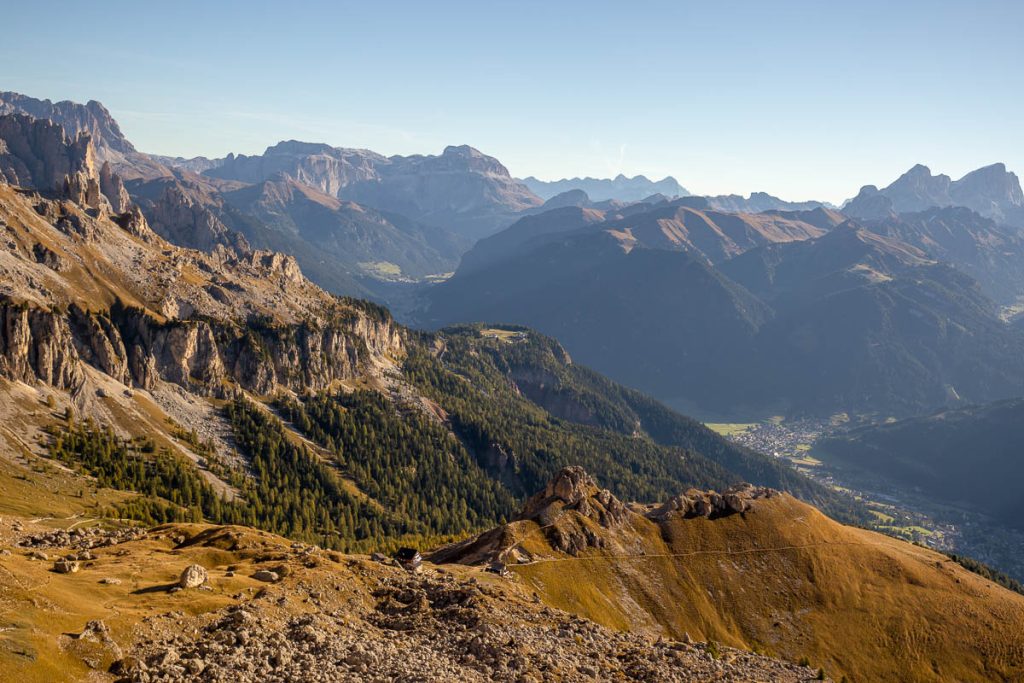
- Start/End: Rifugio Roda Di Vaèl (Rotwandhuette)
- Alternative End: Rifugio Paolina
- Distance: 5.2 km / 3.23 mi
- Elevation gain: 405 m / 1329 ft
- Time required: 3-4 hours
- Route difficulty: intermediate
- When to go: June – mid-October
- Map required: Tabacco map no. 029 (Rosengarten) or Tabacco map no. 06 (Val Di Fassa)
2. The map of the route
- Yellow: Via Ferratas Masarè and Roda Di Vaèl
- Blue: Approach from Rifugio Paolina to Rifugio Roda Di Vaèl
- Red: Early escape route from Passo Vajolon to Rifugio Paolina
TIP: Click on the individual trail, and a window will open showing the name, distance, and elevation gain for each route.
3. Getting to the trailhead
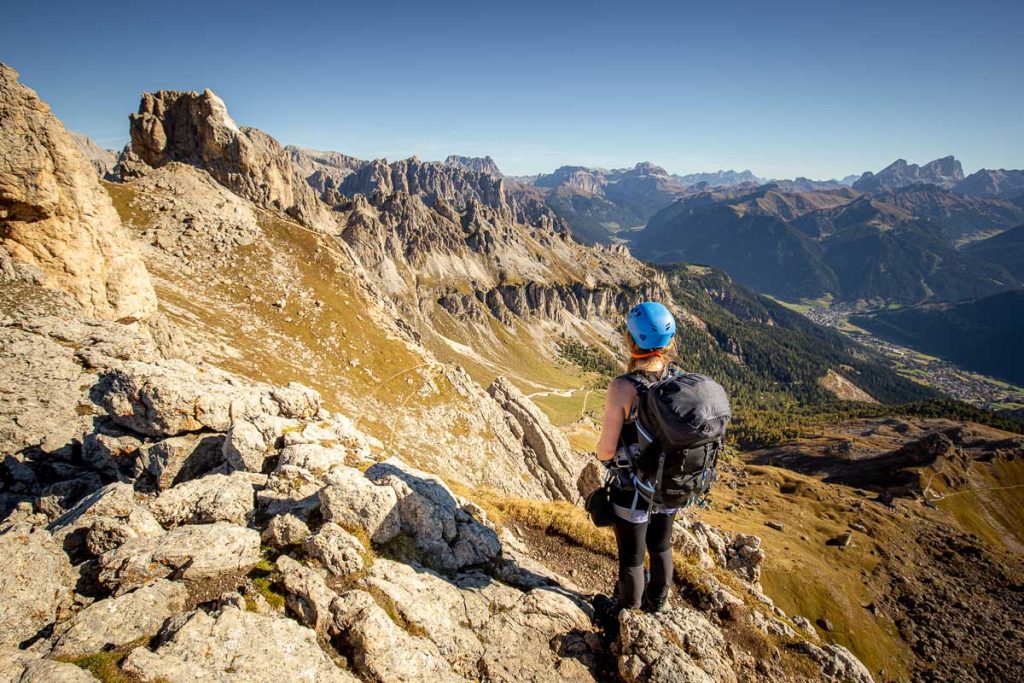
The fastest and most logical way to get to Rifugio Roda Di Vaèl is to take the Paolina chairlift from Carezza to Rifugio Paolina. The opening times and prices of the chairlift can be found here (click on the Carezza tab). During summer, the lift operates from the end of May until mid-October
By car
It takes 40 minutes to drive from Bolzano, the nearest city, to the bottom of the chairlift. If you are staying in any town in Val Di Fassa, you can reach the parking lot within 10-20 minutes. A parking area is at the bottom of the chairlift. It’s OK to leave your car there overnight as long as you are not camping in it
By bus
The bus stop for the Paolina chairlift, where the Rosengarten Traverse starts, is aptly named Paolina. Bus numbers 180, 184, and N180 operate on this route.
Find the nearest bus stop to your accommodation by zooming in on it on Google Maps. Then, type in your point of departure and destination on the Sued Tirol Mobil website. If you are travelling from Bolzano, the journey takes approximately one hour.
4. The approach from Rifugio Paolina to Rifugio Roda Di Vaèl
- Distance: 1.95 km / 1.2 miles
- Time required: 30-40 mins
- Total climb: 189 m / 620 feet
- Total descent: 29 m / 95 feet
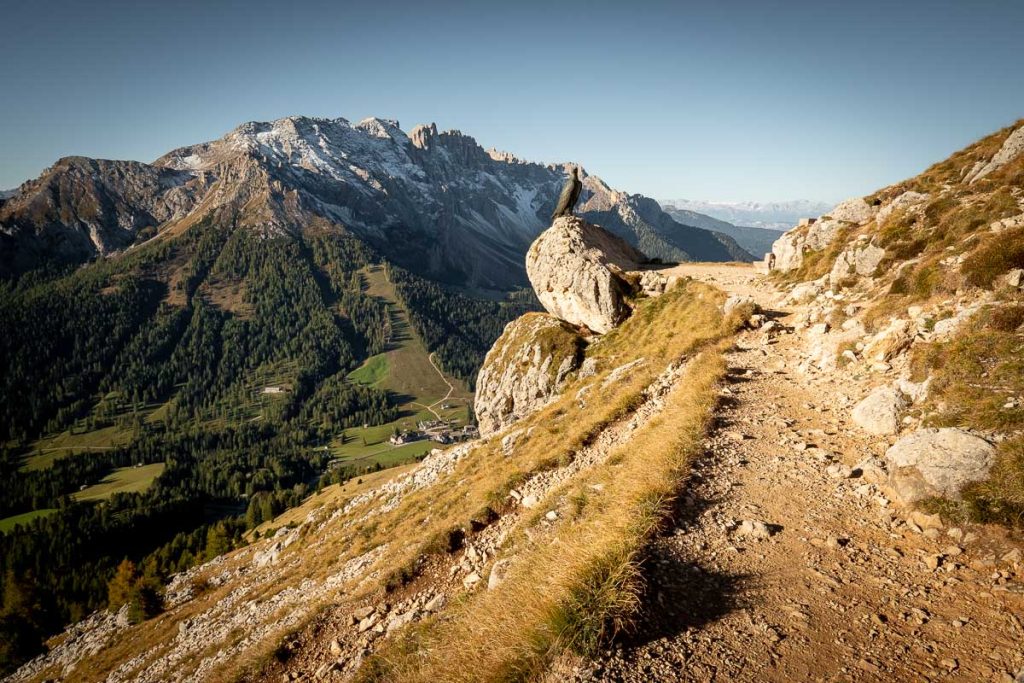
From Rifugio Paolina, take paths no. 539 and 549, which circle the southern end of the Rosengarten group. This is an easy walk with a gentle incline. You should reach Rifugio Roda Di Vaèl within 40 minutes.
5. Via ferratas Masare and Roda Di Vael: route description
The climbing is straightforward and should pose no real problems, but the exposure can be significant at times. A head for heights will be useful.
Although the summit of Roda di Vaèl can get busy, the rest of the route, including Via Ferrata Masaré, was relatively quiet.
Stage 1: Rifugio Roda Di Vael to Unnamed Peak
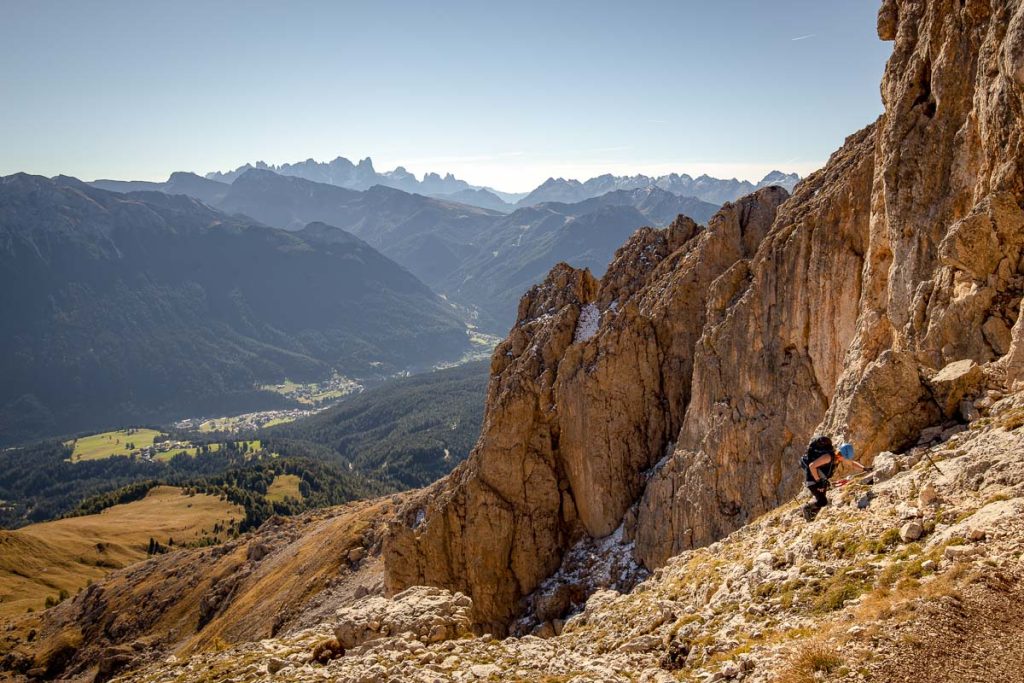
Follow the signs away from Rifugio Roda di Vaèl (2283m) posted for Via Ferrata Masarè and start heading uphill. Although there is a main path, desire paths scar the scree slopes and grassy plateaus. If you are heading to the left of the ridge (looking from Rifugio Roda di Vaèl), then any path will do.
This part of the track gains elevation quickly and offers excellent views of the cliffs that you’ll soon be traversing. After roughly 1 hour, you’ll be switchbacking your way up to the first significant peak – the unnamed peak (2585m)
Stage 2: Via ferrata Masarè
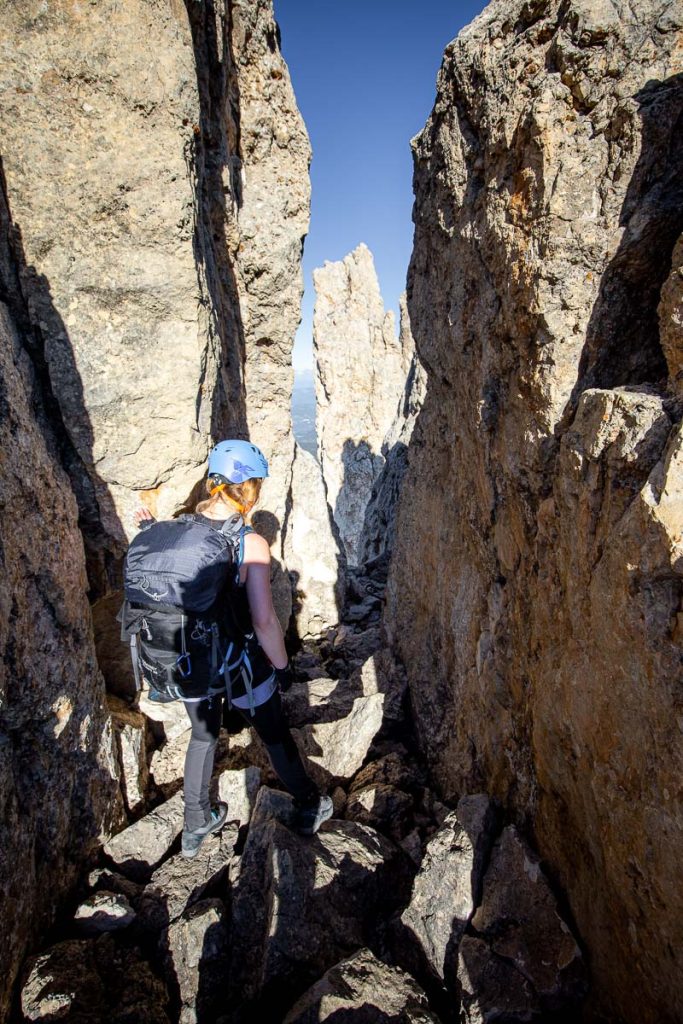
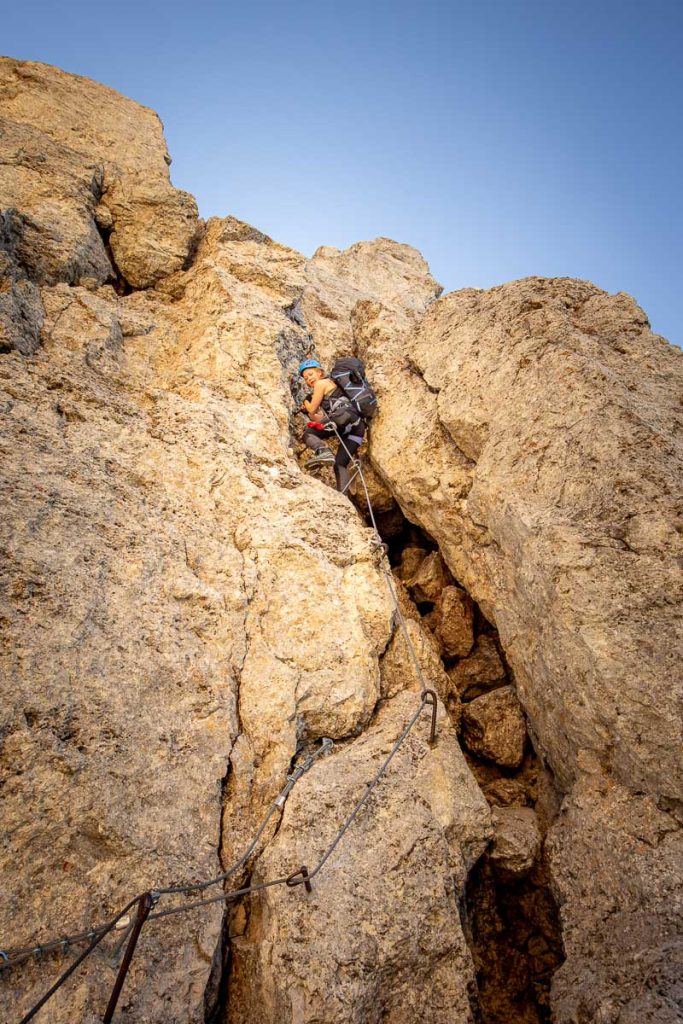
Once you reach it, the route undulates, quite severely at times, along several ledges. Cable use is extensive and necessary. Exposure is sometimes significant, but good handholds, staples, and bars have been well-positioned to make the climbing relatively stress-free.
When you get past a small hollowed-out cave filled with crucifixes and Mother Mary (trust me, I know how it sounds, welcome to Italy), you’re passed halfway on the first of the two ferratas.
Soon, you will start a short descent to the fork 20 minutes downhill from Forcella del Diavolo. This fork marks the end of Via Ferrata Masaré and should take roughly 2 hours.
TIP: At the junction, you can turn right and head back to Rifugio Rodi da Vaèl (totaling ~3 hours) which is nothing but a tiny dot in the distance.
Stage 3: Via Ferrata Roda Di Vaèl
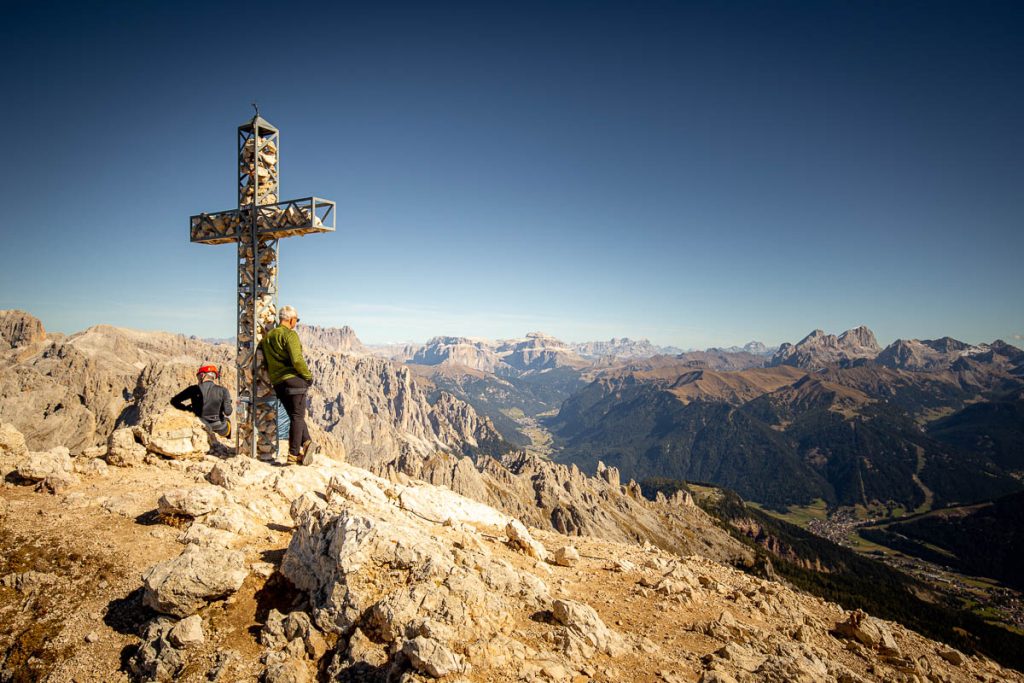
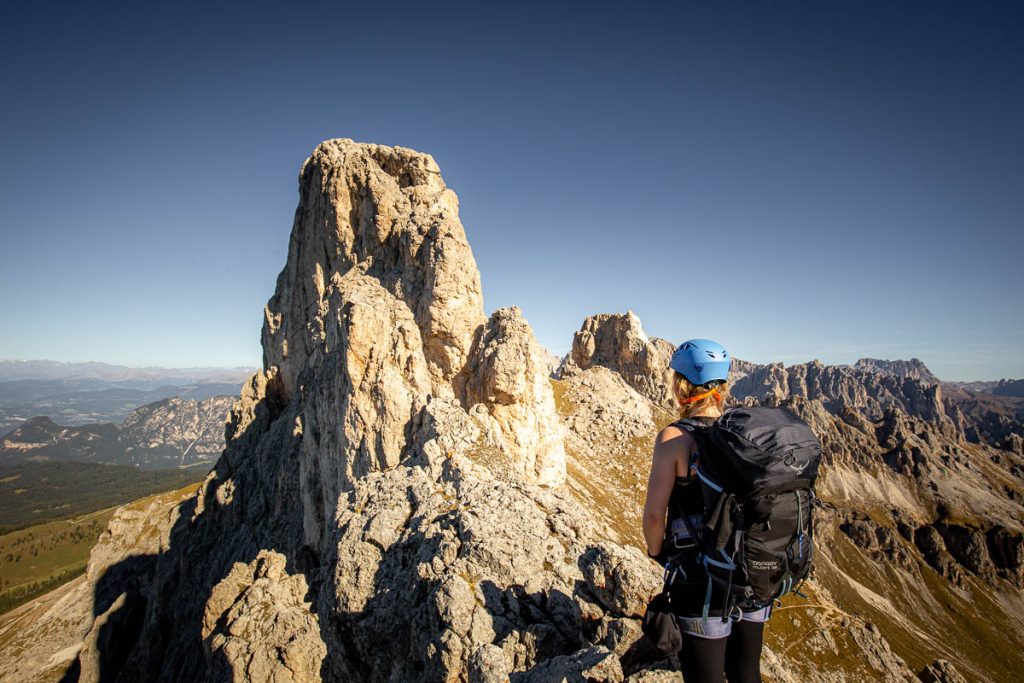
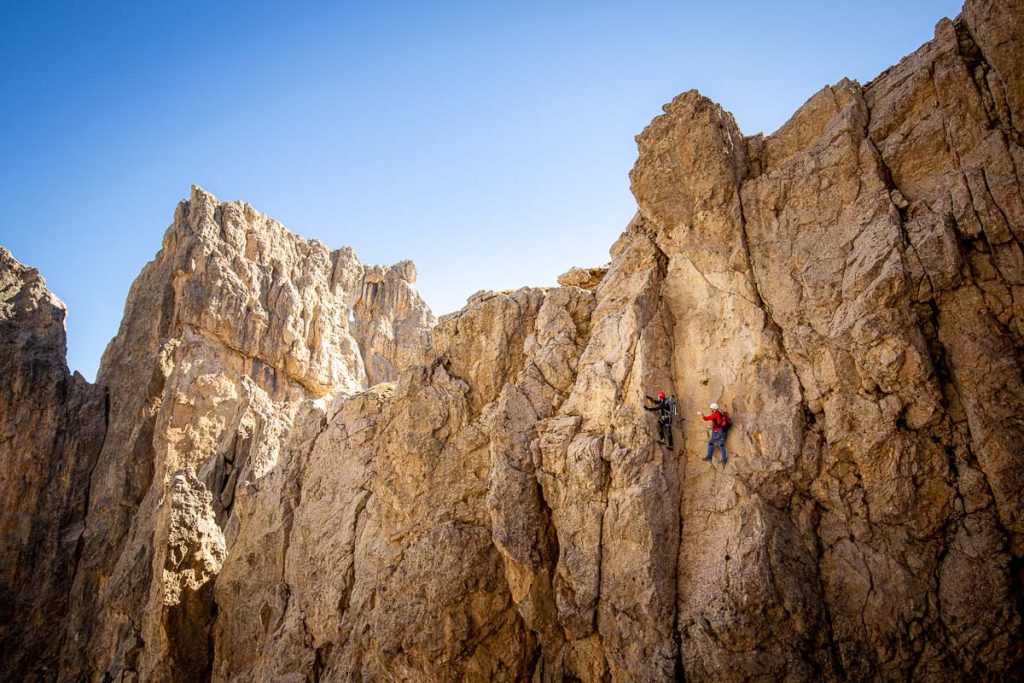
For better views, however, continue up gravel switchbacks until you reach the most exposed part of the loop, Forcella del Diavolo. All routes are well-signposted and easy to follow.
The face traverse (pictured below) at the Forcella connecting the Cresta de Masaré and Mount Roda da Vaél is not too demanding (if you’re a full-grown adult).
There are plenty of good handholds, ladders, and well-placed iron rods. However, if heights scare you, the closest ground below is a sheer drop tens of meters below you.
This small section of the route strictly prohibits passing. If someone has already started on the wall, do not attempt to pass them. Let them finish and then proceed.
Once you’re on the other side, you can sigh with relief and watch other keen adventurers tackle the wall.
From here, most of the route to the summit of Roda de Vaèl (2806m) is switchbacks on an exposed, well-trodden scree face. The summit is a great place to stop for a snack.
Stage 4: The descent
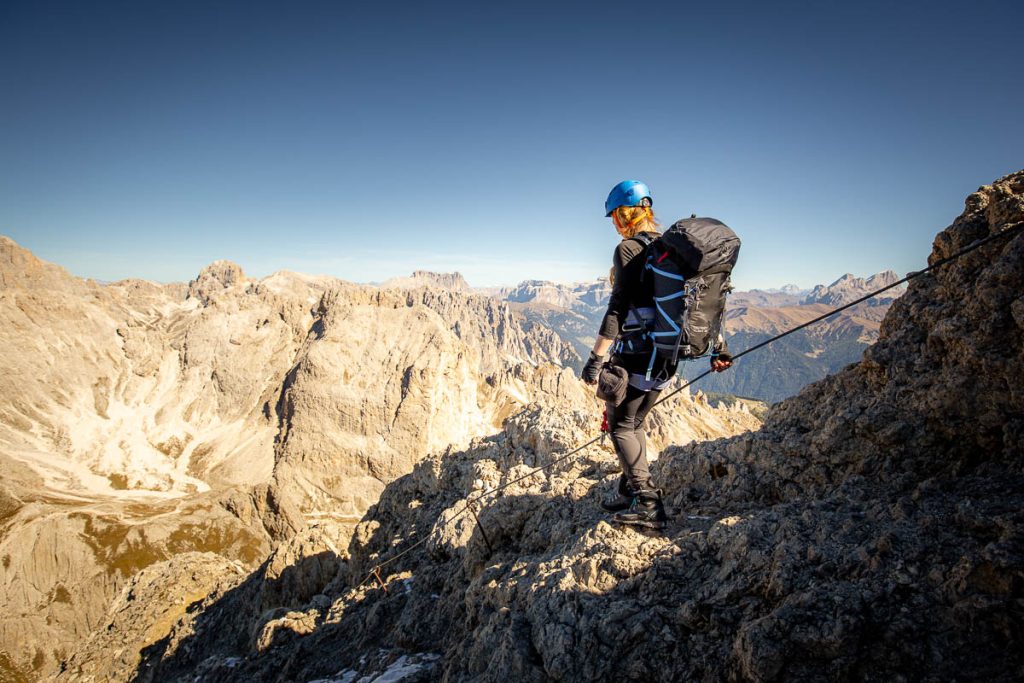
The descent starts on the opposite side of the Roda De Vaèl summit. This part of the route is more of a protected walk for more experienced hikers. Due to its popularity amongst people of all ages and abilities and the proximity of the König Laurin and Paulina chairlifts, cable protection is prevalent.
From Passo Vajolon, there is another 45-minute descent back to Roda di Vaèl Hut (Path 551, then 541).
TIP: Alternatively, you can descend westward from Passo Vajolon on path no. 9 toward path no. 552 which leads southward to Paolina Hut (I marked this route in red on the map.
6. Where to stay overnight
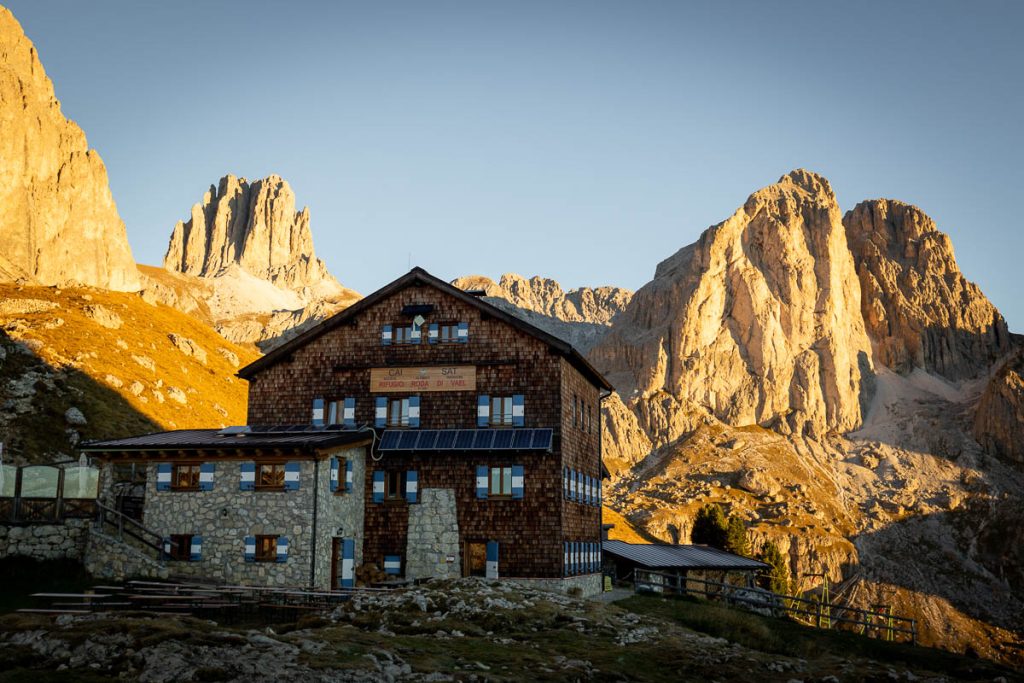
Option 1: Rifugio Roda Di Vaèl (Rotwandhuette)
Rifugio Roda Di Vaèl (Rotwandhuette) was built on the Ciampaz saddle and belongs to the Italian Alpine Club. The hut offers 59 beds spread across multiple rooms. The refuge is usually open from the start of June until mid-October (opening times vary year to year and depend on snow).
Option 2: Stay in a town in Val Di Fassa
Canazei, Vigo Di Fassa, Pozza di Fassa, Moena, or Campitello are just a few towns in the famous Fassa Valley in the Italian Dolomites. They all lie within a few minute’s drive of one another and are great places to make a base for exploring the trails in the Dolomites. If you are tackling Via Ferratas Masarè and Roda Di Vaèl as a day excursion, you can return to your hotel on the same day. Here are a couple of my recommendations for hotels in Val Di Fassa
Best Value
Self-catering apartments are only a 10-minute walk from the centre of Canazei in the Fassa Valley.
Top Rated
Locanda degli Artisti Art Hotel
This lovely hotel has a fantastic bar and restaurant. It is a great place for art lovers, and the hotel boasts some quirky art decorations.
7. Via ferratas Masare and Roda Di Vael as part of multi-day hut-to-hut traverse
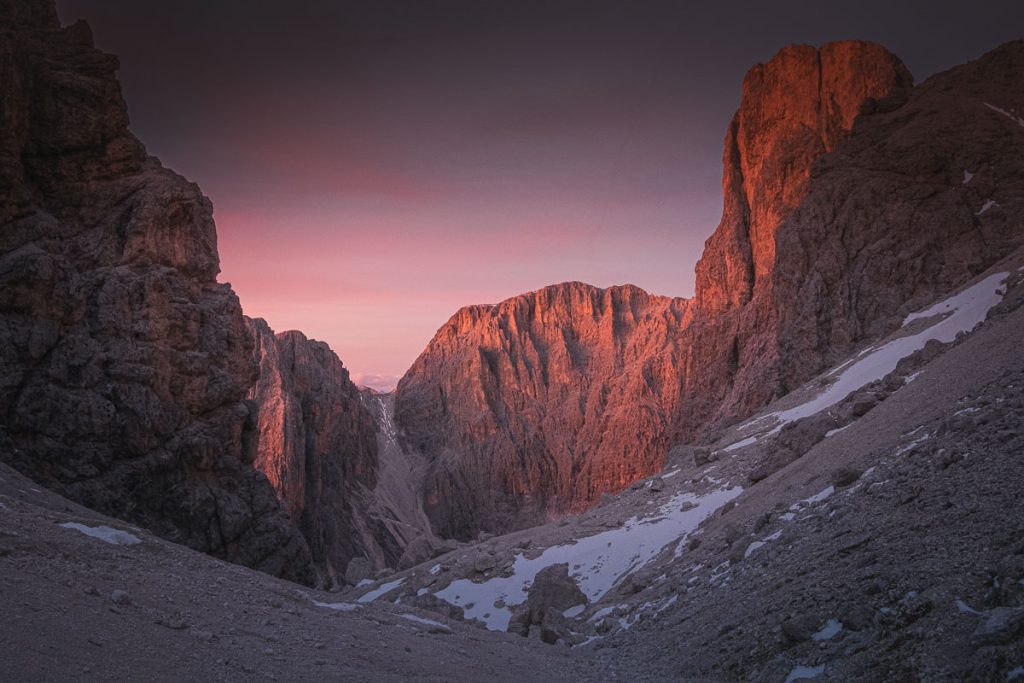
The Rosengarten Nature Park is an excellent mountain group for a hut-to-hut traverse. Tackle six different via ferrata routes over five days and see other highlights of the Rosengarten group, including the Vajolet towers and Principe Pass, and stay overnight in one of my favourite huts – Rifugio Alpe Di Tires. Via ferratas Masarè and Roda De Vaèl come right on the first day of the traverse.
READ MORE: 3-5 day traverse across the Rosengarten Group.
Other via ferratas in the Rosengarten Group
- Via Ferrata Passo Santner
- Via Ferrata Catinaccio D’Antermoia
- Via Ferrata Sentiero Massimiliano
- Via Ferrata Laurenzi
Shop my via ferrata gear essentials
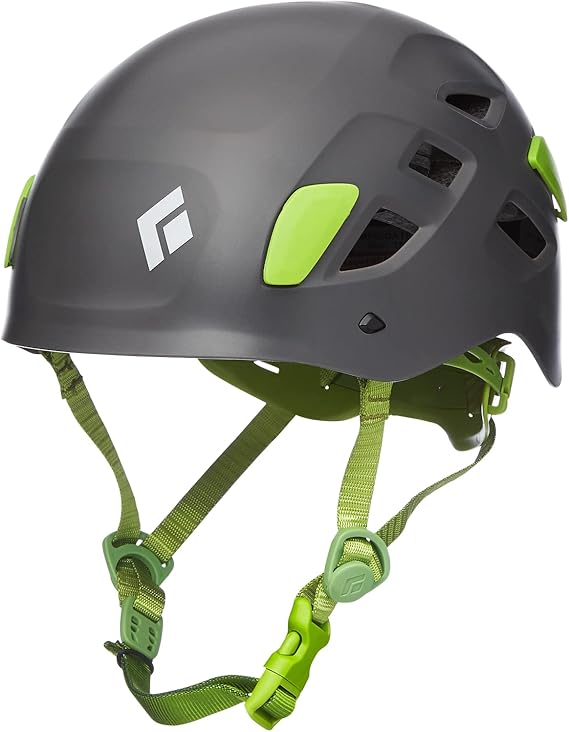
Black Diamond Helmet
Rockfall is a significant concern on via ferrata routes. Unbeknownst to you, other climbing groups above you may accidentally dislodge a small rock and send it down the mountain. If it hits you on the head, it could have serious consequences. A helmet on your head (not inside your backpack) is necessary.
Shop on: Amazon (Worldwide) / Backcountry (US)
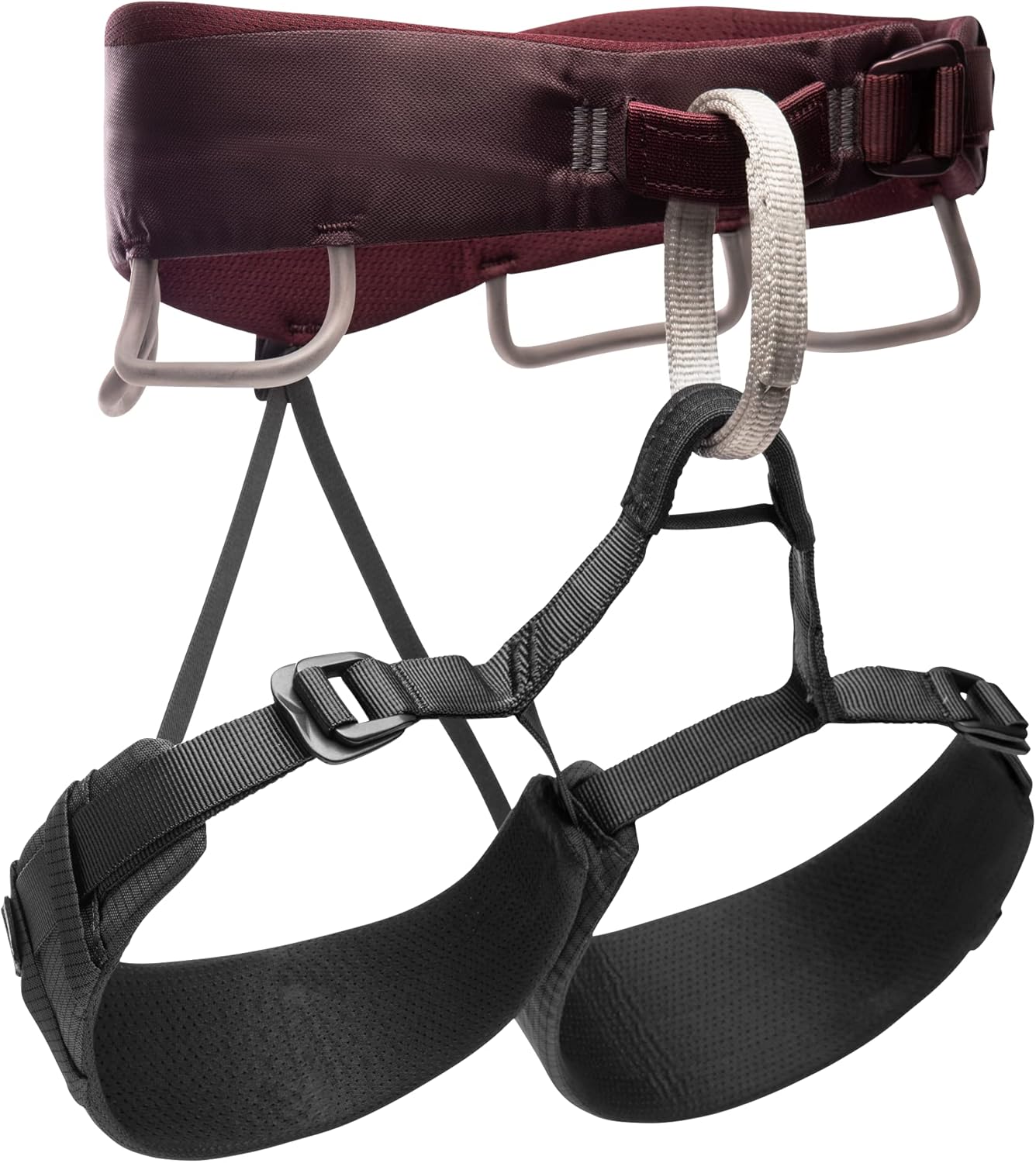
Black Diamond Momentum Harness
Another must-have on a via ferrata route is a climbing harness. A harness works as an anchor point for your via ferrata lanyard. Try it before your trip to ensure it fits snugly without limiting your movements. Aim for a lightweight harness that will be comfortable to wear between the cable-protected sections when hiking.
- Shop Women’s on Amazon (Worldwide) / Backcountry (US)
- Shop Men’s on Amazon (Worldwide) / Backcountry (US)
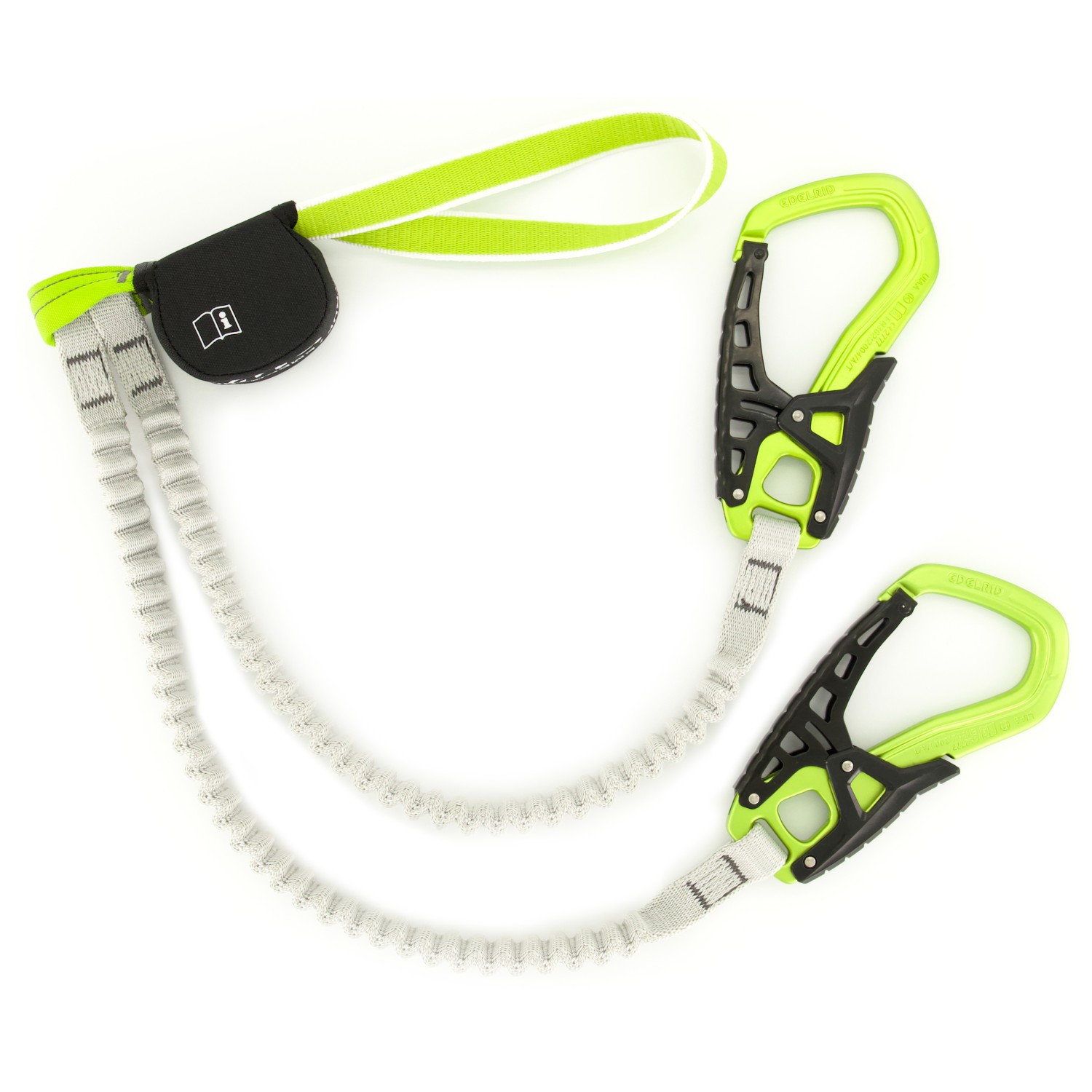
Edelrid, Camp or Black Diamond Via Ferrata Lanyard
A via ferrata lanyard connects the climber and their harness to the cables along the route. Its two arms and a hidden extra coil work as an energy absorption system in case of a fall. The two carabiners at the end of the lanyard clip into the cable. Make sure the carabiners are equipped with the palm squeeze mechanism. It’s the safest and most comfortable.
Shop on Amazon (Worldwide) / Backcountry (US)
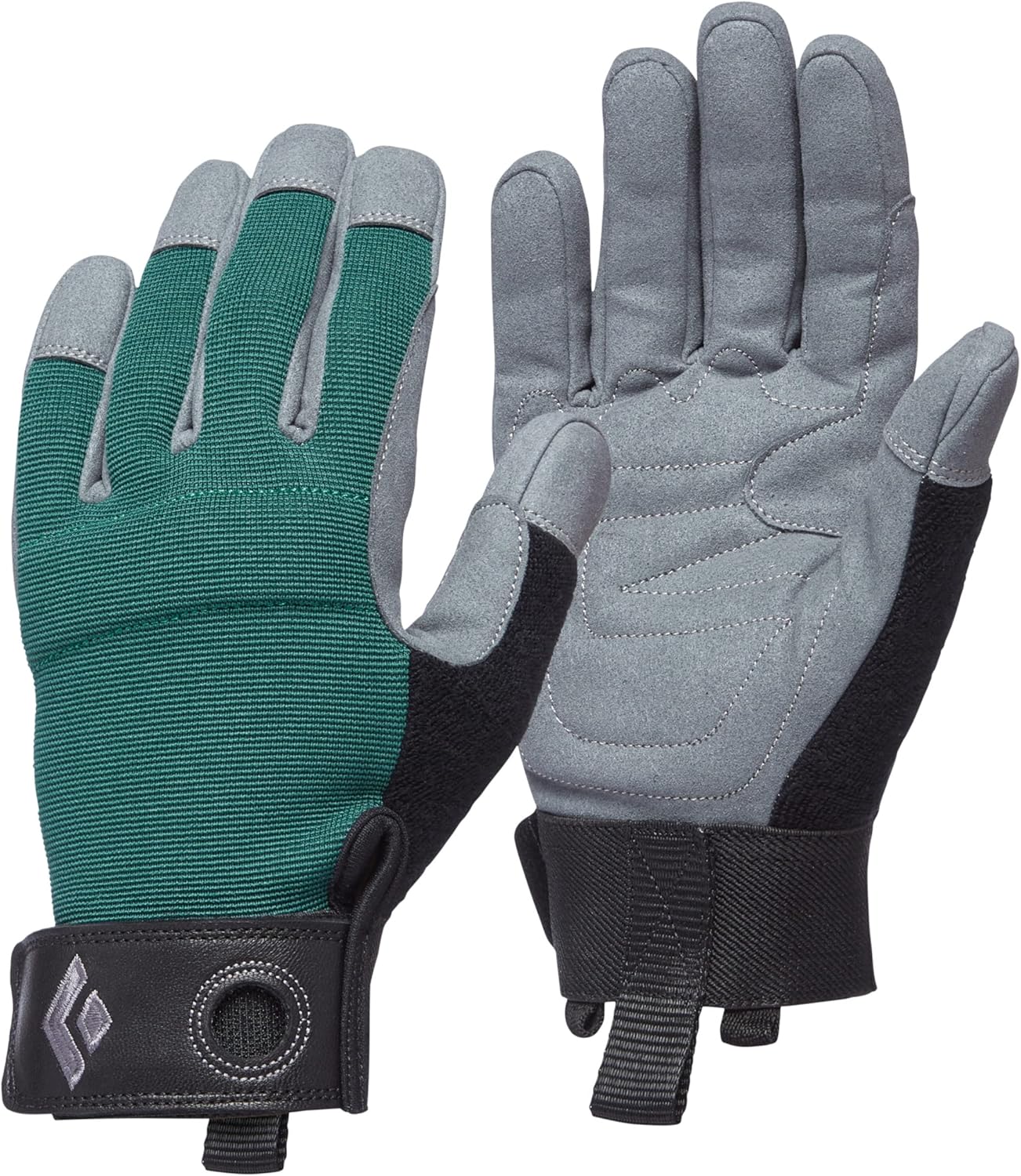
Black Diamond Crag Gloves
The gloves protect your hands from cuts and scratches you may otherwise get if you haul yourself on the cable without them. I prefer full-finger gloves for extra protection against blisters. If your hands sweat quickly, go for the fingerless version.
Shop on: Amazon (Worldwide) / Backcountry (US)
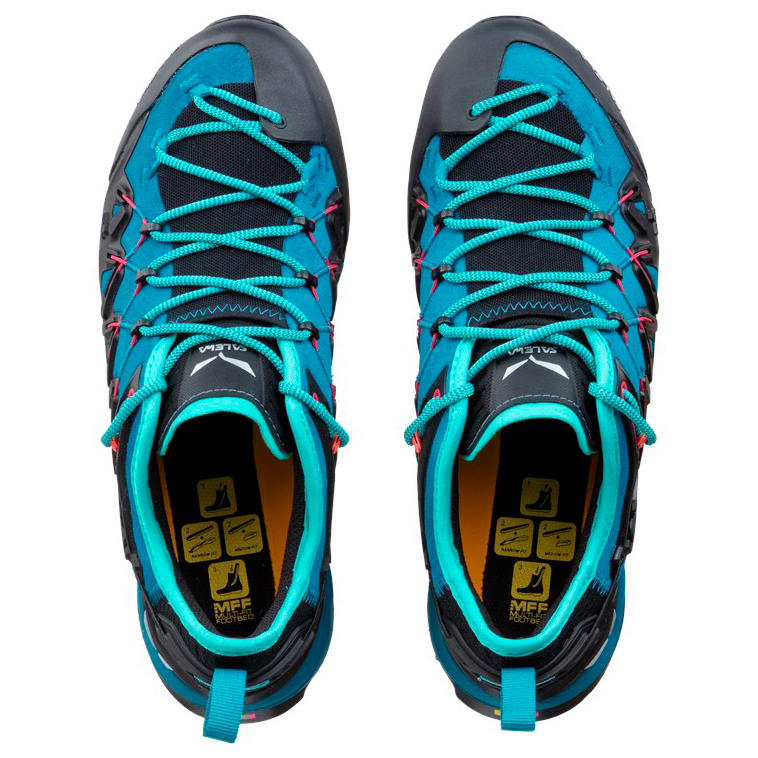
Salewa Wildfire Edge Approach Shoes
This is my go-to pair of hiking shoes for more accessible trails or via ferrata, where I don’t need extra ankle support. They provide excellent grip on the rock and are very durable.
Shop on: Amazon (Worldwide) / Backcountry (US)
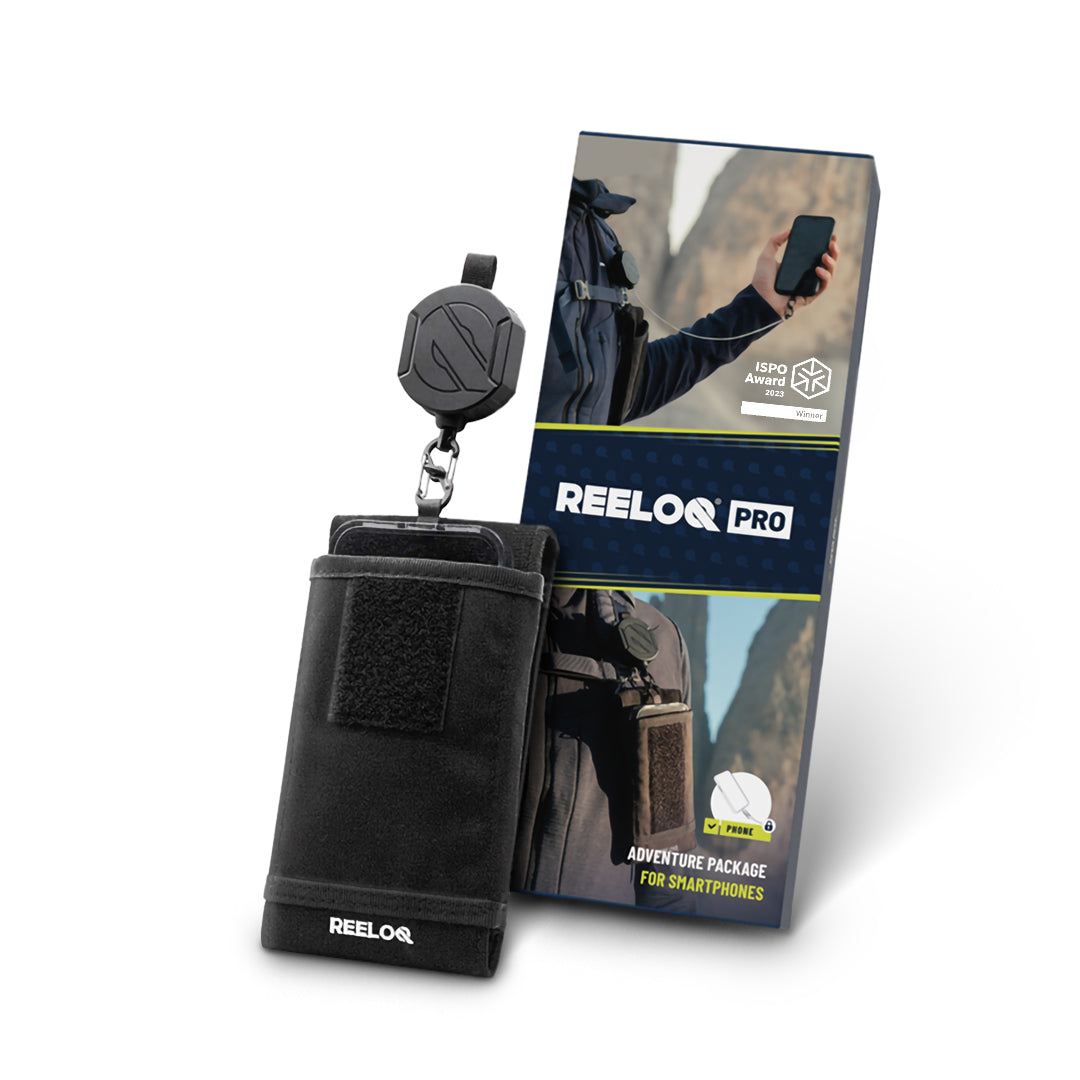
Reeloq Smartphone Securing System
If you want to take great photos on a via ferrata without worrying about losing your phone, Reeloq is the best tool for it. It’s a smartphone-securing system that allows you to use your phone on any adventure. This has been a great addition to my tool arsenal.
Shop on: REELOQ
More travel and hiking resources in the Dolomites
- Photography spots in the Italian Dolomites
- Regions in the Italian Dolomites
- Itineraries for the Italian Dolomites
- Via ferratas in the Italian Dolomites
- Day hikes in the Italian Dolomites
- Hut-to-hut treks in the Italian Dolomites
Support my website!
Hi Reader! If you found any of my articles about the Dolomites useful please consider using the affiliate links below (at no extra cost) when booking your holiday. Thank you
- Reserve your hotel with Booking.com
- Book your rental car with Discover Cars
- Buy your outdoor gear with Backcountry.com (US readers)
If you have any questions, leave them in the comments below!