
Val Di Fassa is a mountain valley in the Trentino region of Northern Italy. It is surrounded by the Dolomites’ famous mountain groups, including Rosengarten, Sassolungo, Marmolada, and Sella. The endless hiking, via ferrata, and photography possibilities are why I return to Val Di Fassa every time I visit the Dolomites.
Best Towns To Stay In Val Di Fassa
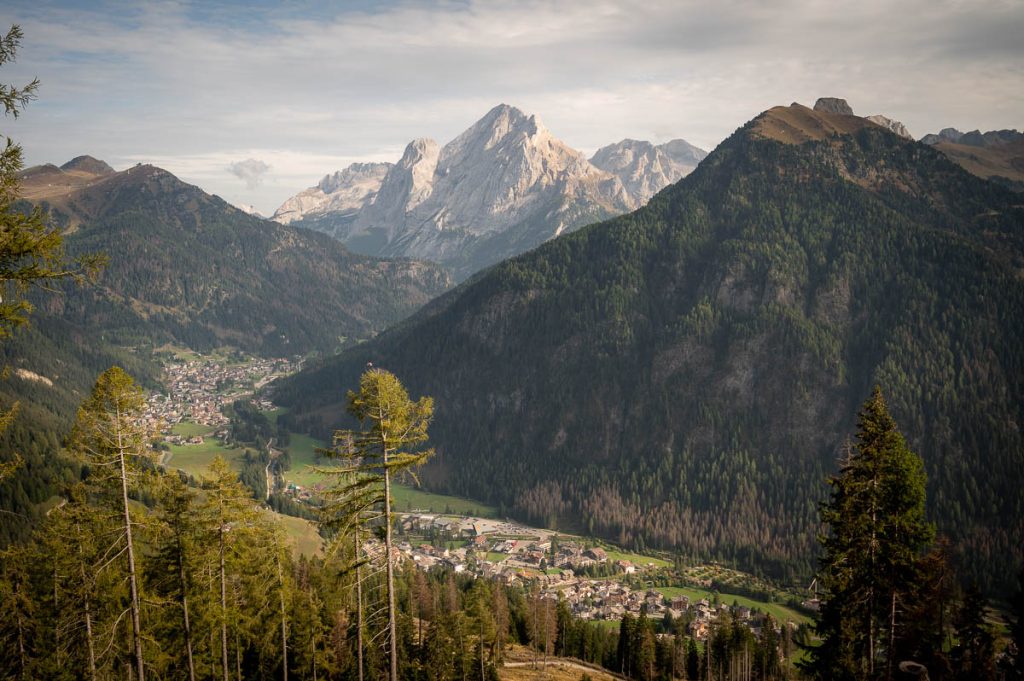
Fassa Valley stretches for approximately 20 kilometres and is dotted with little towns. Where one ends, another one begins. Below are my recommendations for the best towns to stay in when visiting Val Di Fassa. They offer the best access to chairlifts and gondolas that will transport you into high alpine areas with many hiking and via ferrata options.
- Canazei (located at the end of Fassa Valey with great views of Marmolada)
- Campitello Di Fassa (Slightly less touristy than Canazei. It has great access to Col Rodella Cable Car)
- Vigo Di Fassa (It has the quickest access to the Rosengarten group)
- Moena (a cool town with more local flair – my favourite in the Fassa Valley)
TIP: There are hundreds of hotels and apartments in Val Di Fassa. You can find one that suits your requirements on Booking.com.
How to reach Val Di Fassa
You can reach the Fassa Valley by car or public transport. Below are the distances and driving times from the nearest airports to Vigo di Fassa.
By car:
- Venice Marco Polo: 172 km / 107 mi / 2h 30 min
- Venice Treviso: 161 km / 100 mi / 2h 20 min
- Milan Malpensa: 270 km / 168 mi / 3 h 15 min
- Milan Bergamo: 353 km / 219 mi / 4 hours
- Innsbruck, Austria: 152 km / 94 mi / 2 h 20 min
- Munich, Germany: 346 km / 215 mi / 4 hours
By public transport
You can catch a train to Bolzano and then a local bus. There are direct buses from Bolzano to any of the towns in Val Di Fassa. I always use the Sued Tirol Mobil website to find the local bus connections.
Top Hikes Around Fassa Valley & Rosengarten Nature Park
I hiked extensively around Val Di Fassa and the Rosengarten group, yet I still feel like I only scratched the surface. I realized that it is not possible to cover them all. Here are some of my favourite routes.
TIP: click on the trail on the map, and a window will pop up with its name. You can find the corresponding descriptions below:
1. Ciampede to Rifugio Re Alberto
- Distance: 5.3 km / 3.29 mi
- Elevation gain: 837 m / 2746 ft
- Hiking time: 2-3 hours
- Colour on the map: red
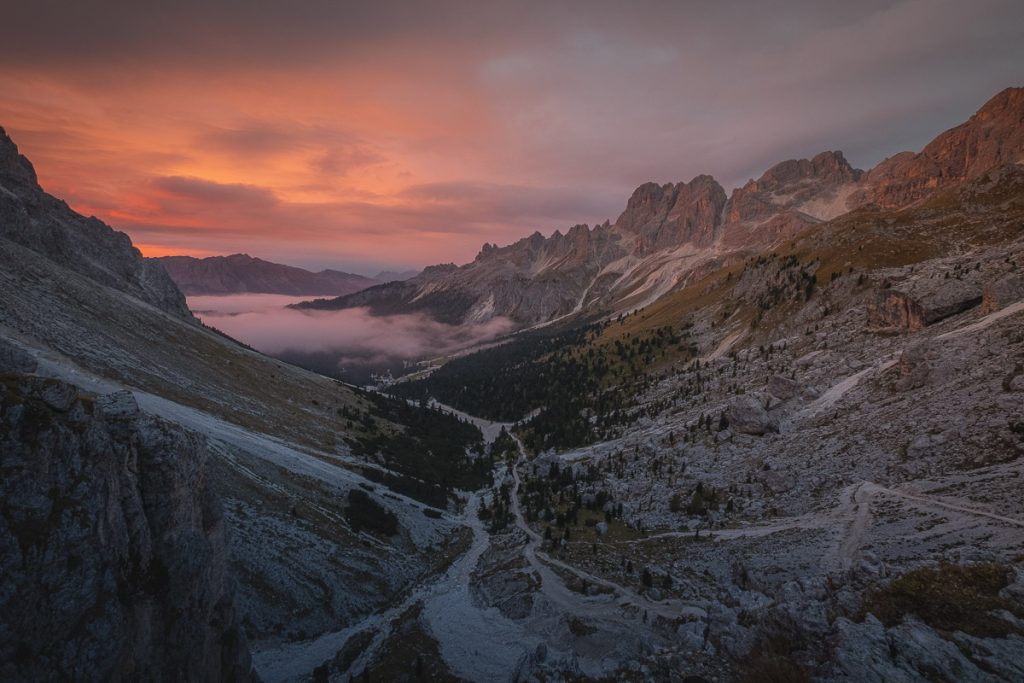
This is the most straightforward way to reach the Vajolet Towers, the iconic peaks of Rosengarten Nature Peak. The hike follows a wide gravel road for most of the way.
From the town of Vigo Di Fassa (bus stop name Vigo di Fassa, Funivia Catinaccio), take the Vajolet gondola up to Ciampede. Then, follow the signs first for Rifugio Gardeccia, then for Rifugio Vajolet, and last but not least, to Rifugio Re Alberto.
There is a short scrambling section between Rifugio Vajolet and Re Alberto (path no. 542) with some cables installed; skip it if you are not comfortable with heights and turn back after you reach the Vajolet hut.
2. Rifugio Fronza – Passo delle Coronelle – Rifugio Re Alberto
- Distance: 5.3 km / 3.3 mi
- Elevation gain: 775 m / 2542 ft
- Elevation loss: 446 m / 1463 ft
- Hiking time: 2.5-3.5 h
- Color on the map: pink
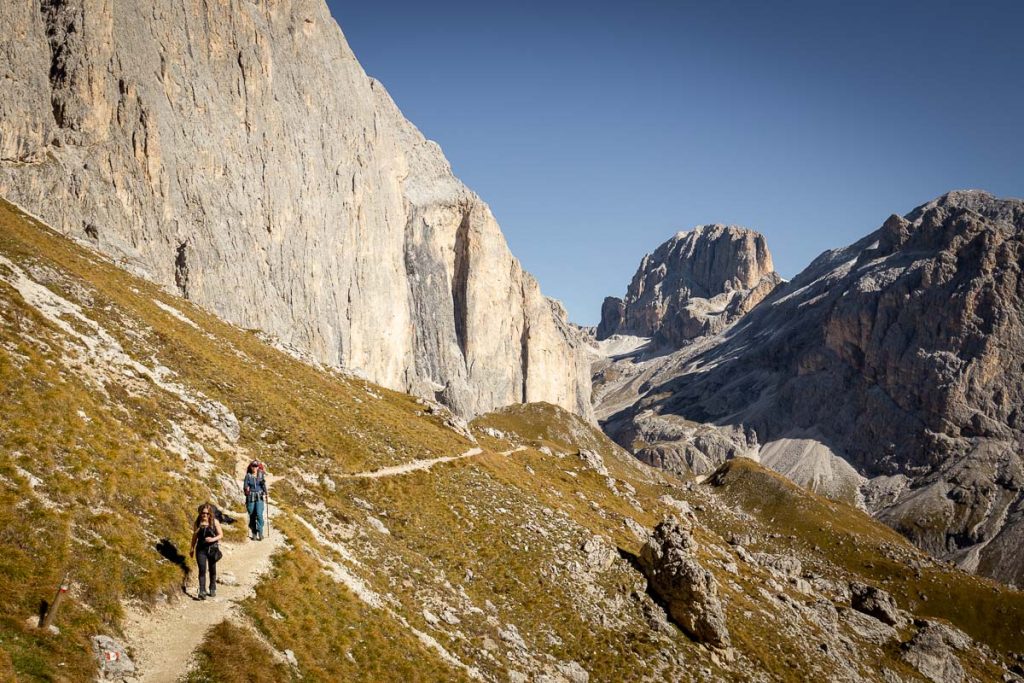
The hike over Colonelle Pass starts at the same hut as via ferrata Passo Santner, which I will get to soon. The hut has 3 names: Rosengarten, Kölner and Fronza.
Park your car near Albergo Frommeralm, then take the gondola to the hut. From here, start your hike on path no. 550 towards Passo D. Colonelle. It takes approximately 50 minutes to reach the pass.
Once you reach the saddle, you will start your descent toward Rifugio Vajolet. From the hut, the path follows a steep gully to Rifugio Re Alberto Primero.
The gully continues steeply along path no. 542. Cables are provided to help you with the most challenging sections. It’s a gruelling ascent but not very technical.
3. Col Rodella – Rifugio Alpe Di Tires – Val Duron – Campitello Di Fassa
- Distance: 22.5 km / 14 mi
- Elevation gain: 486 m / 1596 ft
- Elevation loss: 1338 m / 4390 ft
- Hiking time: 7-8 hours
- Colour on the map: yellow
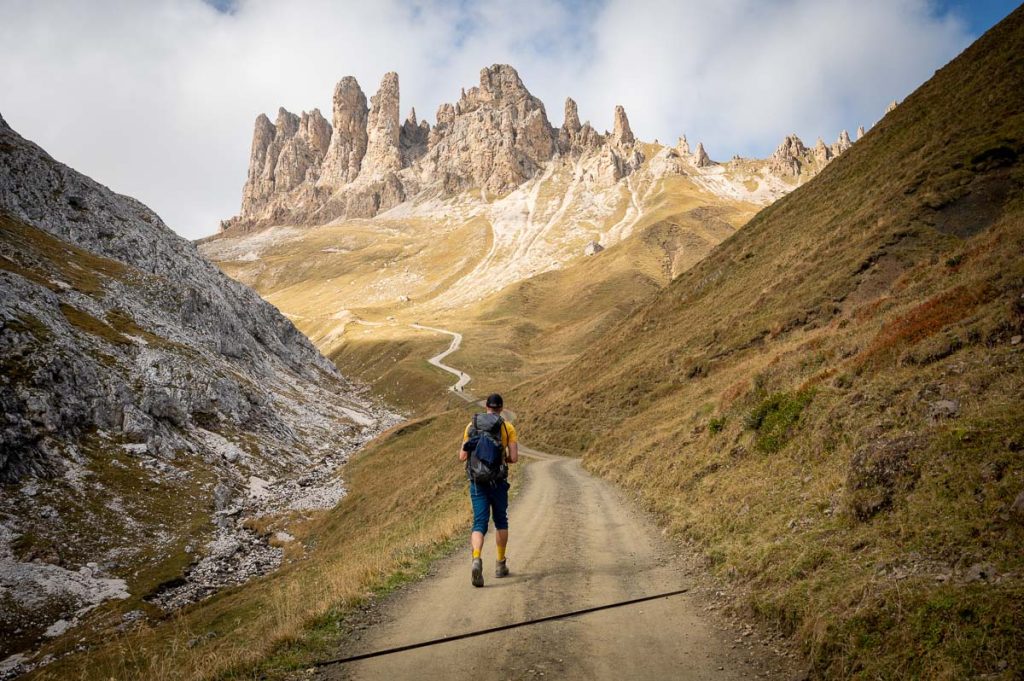
This hike is a full-day excursion. The trail starts with the gondola ride from Campitelo di Fassa to the top of Col Rodella and follows the Friedrich-August hiking route.
Along this hike, you will cross three great alpine huts: Sassopiatto, Alpe Di Tires, and Micheluzzi. There is no need to carry too much food or water with you. You can dine in their restaurants or even stay for a night.
4. Sassolungo Circuit
- Distance: 16.7 km / 10.4 miles
- Elevation gain: 787 m / 2720 ft
- Hiking time: 5-6 h
- Colour on the map: green
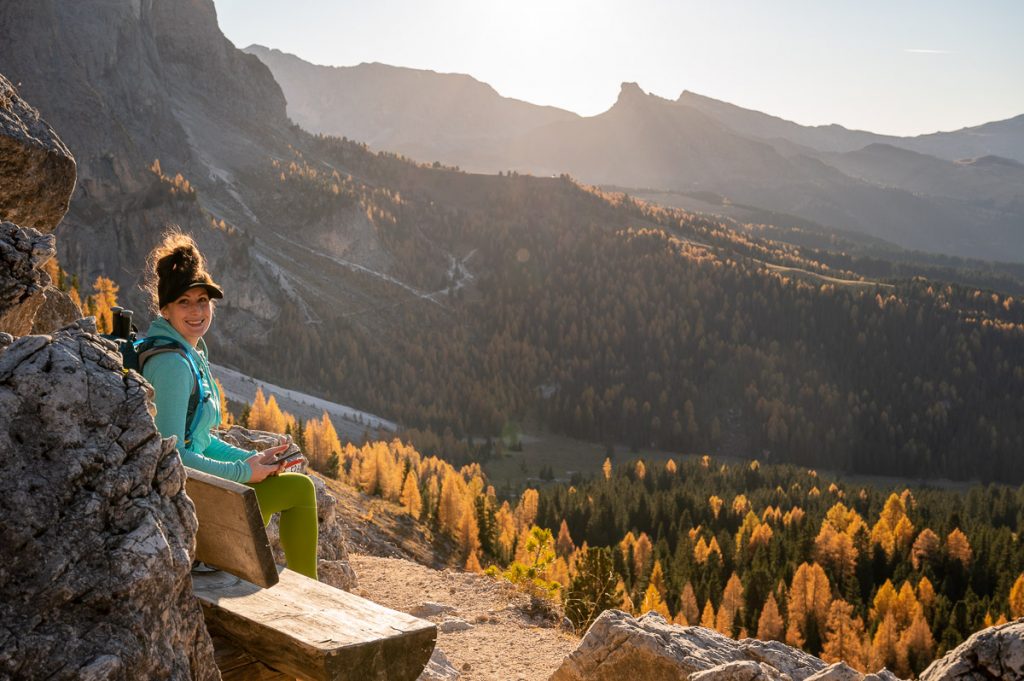
Sassolungo Circuit is one of my favourite hikes in the Dolomites. It is accessible from either the Fassa Valley or Gardena Valley. A part of it overlaps with the previously mentioned Friedrich August route.
The hike starts at Sella Pass and loops around the Sassolungo mountain group. It’s a full-day excursion in the high alpine environment. Almost the entire trail stays above the tree line. My favourite time to hike the Sassolungo Circuit is during Autumn when the larch trees turn yellow.
Read More: Guide to the Sassolungo Circuit hike.
5. Piz Boè Summit
- Distance: 6.4 km / 4 mi
- Elevation gain: 422 m / 1384 ft
- Hiking time: 2-3 hours
- Color on the map: purple
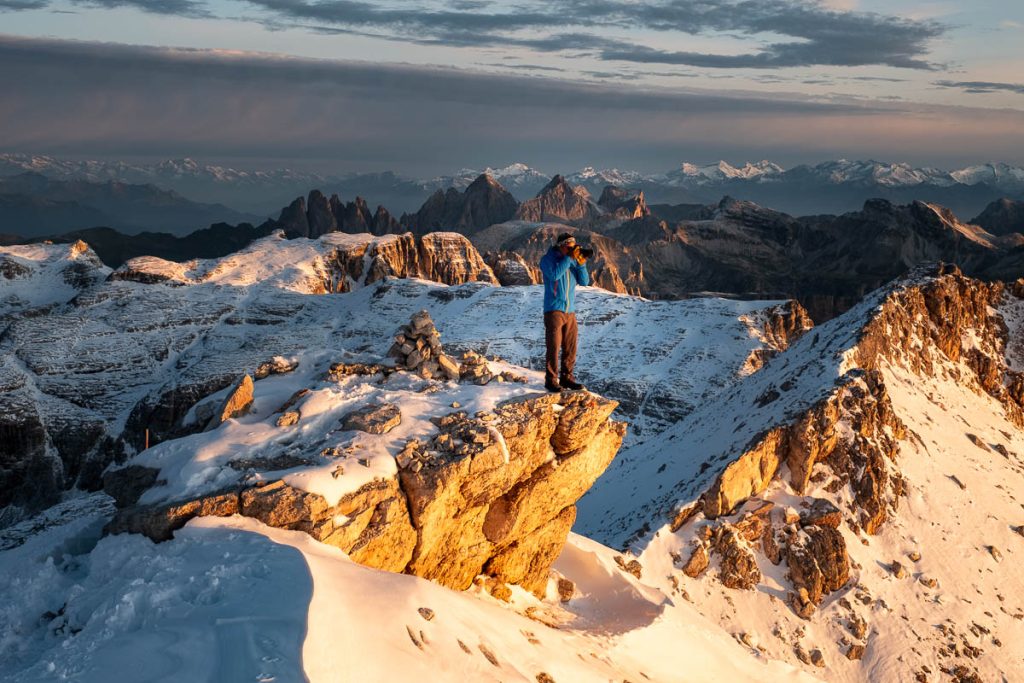
Piz Boè is the highest summit of the Sella group. You might have heard of Sellaronda, a famous ski route that circles it. It is the easiest to scale and the most accessible 3000-meter peak in the Dolomites. The hike starts with a cable car ride from Pordoi mountain pass to Sass Pordoi.
You only need to battle circa 400 meters of elevation from here to reach the peak. My favourite part about the Piz Boè summit hike was staying overnight in the Capana Fassa alpine hut. The refuge was built right on the summit. Talk about a hotel with a view.
Read more: Guide to the Piz Boè summit hike.
6. Passo Pordoi to Passo Fedaia Traverse
- Distance: 7.2 km / 4.5 mi
- Elevation gain: 291 m / 956 ft
- Elevation loss: 475 m / 1557 ft
- Hiking time: 3-4 hours
- Colour on the map: black
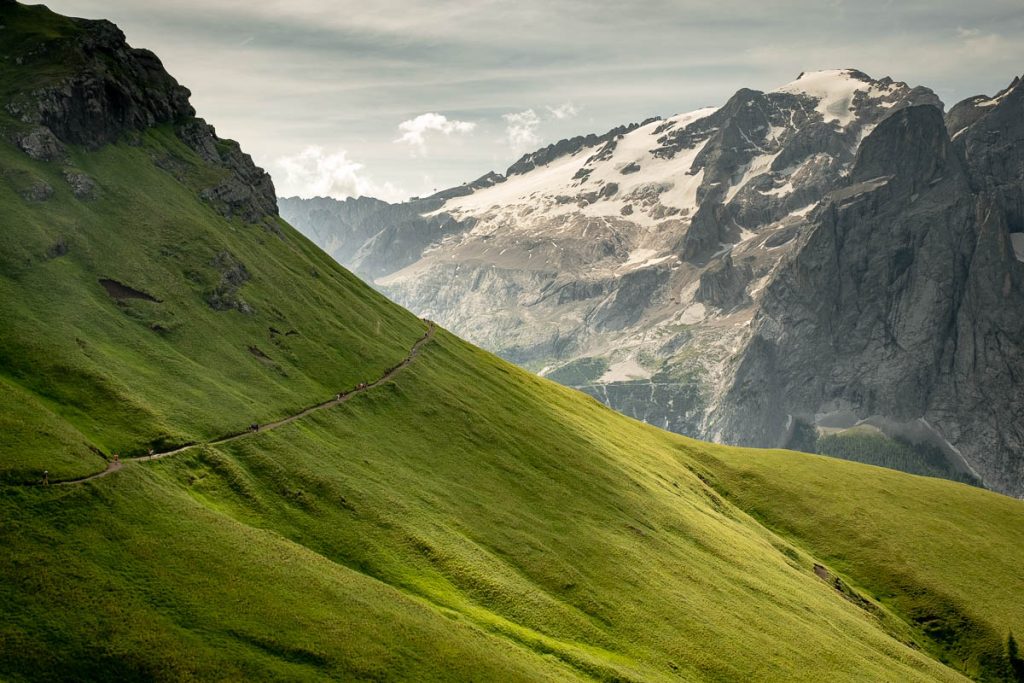
This hike traverses between two mountain passes: Sella and Fedaia. Both can be reached by car, and you can start at either end. However, since Passo Pordoi is higher than Fedaia, starting here will make the hike easier because you will gain less elevation.
This route overlaps with the Alta Via 2 multiday traverse but can be done as a day hike. Public transport reaches both passes, so leave your car in the valley.
The entire route stays in the high alpine environment above the treeline. You know what that means? Uninterrupted views along the whole hike. Speaking of the views, you can see Marmolada, Dolomite’s highest peak, from any point on this hike. Don’t miss a lunch stop at Rifugio Viel Dal Pan, which is around halfway on this hike and has fantastic terrace views.
TIP: If you plan to hike in Val Di Fassa purchase the Tabacco map no. 06
Top Via Ferratas Around Val Di Fassa & Rosengarten Nature Park
1. Passo Santner (Santnerpass)
- Difficulty level: beginner
- Time required: 2-3 hours (+ 2-3 hours exit route)
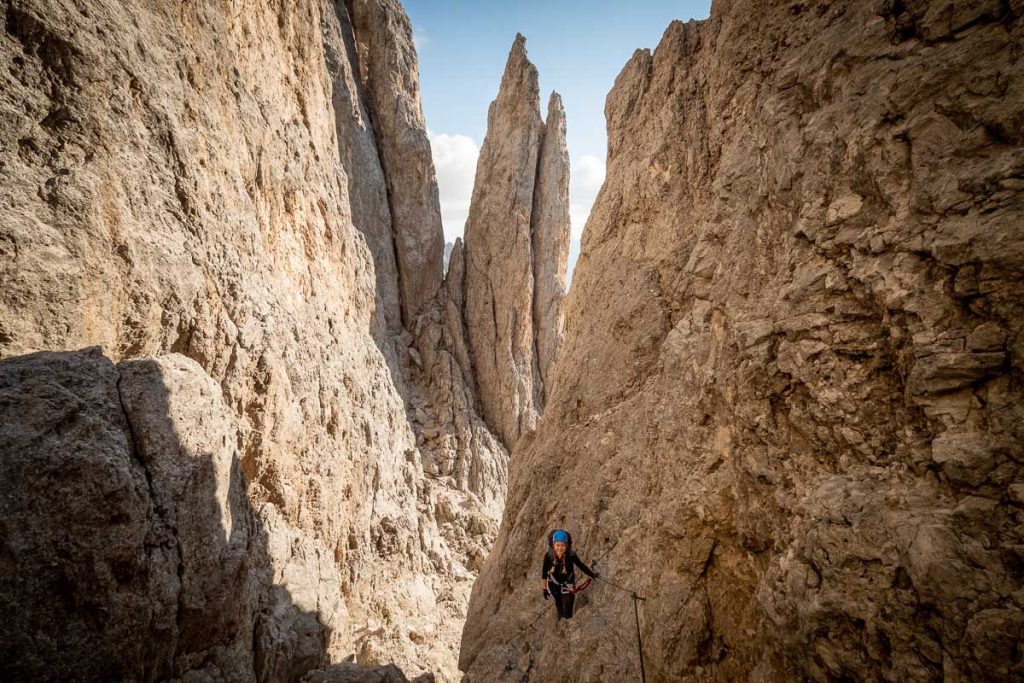
There are six via ferratas in the Rosengarten group, and I can proudly say I did them all. I will kick off the list of the best via ferratas around Val Di Fassa with the Passo Santner route.
This great and short via ferrata takes its name from where it culminates – the Santner Pass. Here, you will be rewarded with fantastic views of the Vajolet Towers. The newly built Santner Pass refuge, where you can stay overnight, makes this route even more exciting.
Read more: Guide to Via Ferrata Passo Santner
2. Via Ferratas Masaré & Roda de Vaél
- Difficulty level: intermediate
- Time required: 5-6 hours (including hut approach)
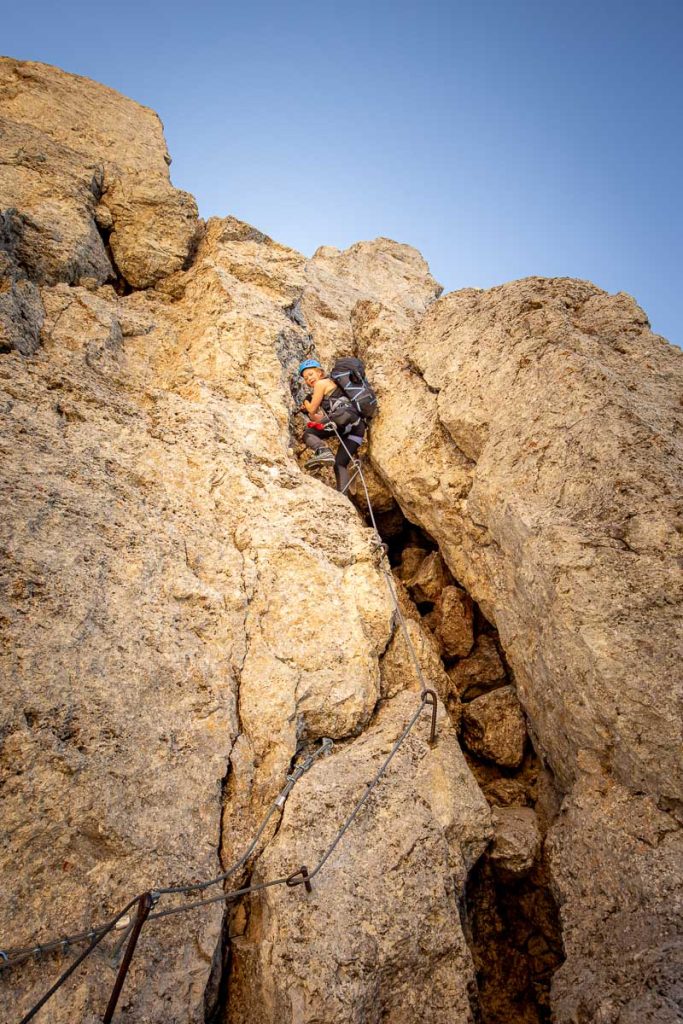
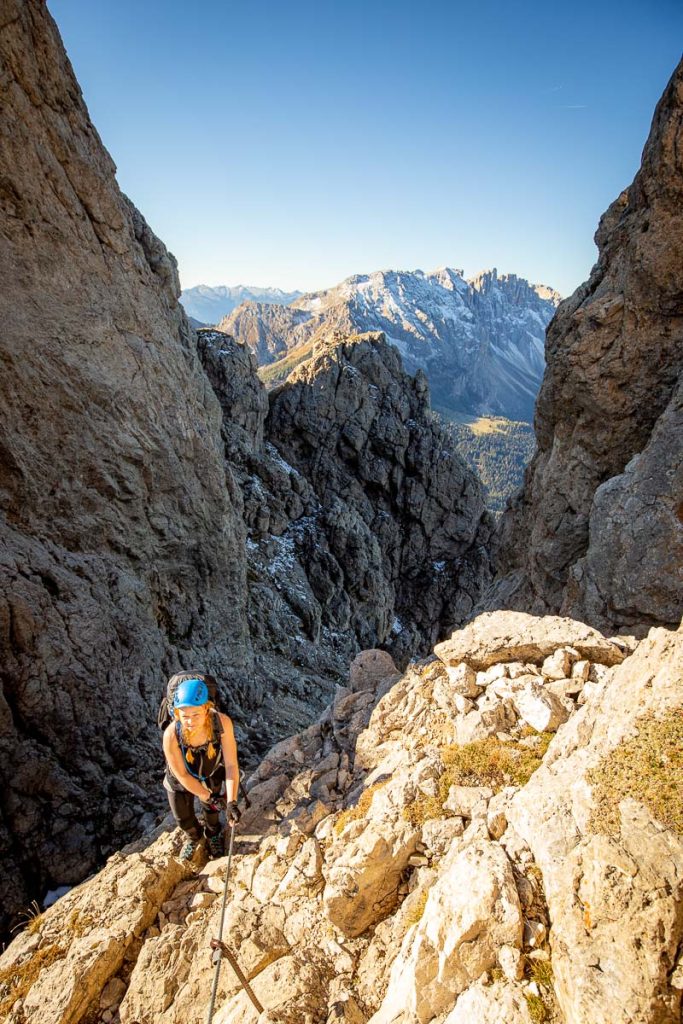
This via ferrata combo consists of two separate routes, which are best if done together. You can find Via Ferratas Masarè and Roda De Vaèl in the Southern part of the Rosengarten group.
The route takes you to the summit of Roda De Vaèl and delivers plenty of exciting traverses, as shown in the photos above.
Read more: Guide to Via Ferratas Masaré & Roda de Vaél
3. Catinnacio D’Antermoia (Kesselkogel)
- Difficulty level: beginner
- Time required: 3-4 hours (+ 4-5 hours roundtrip to the hut)
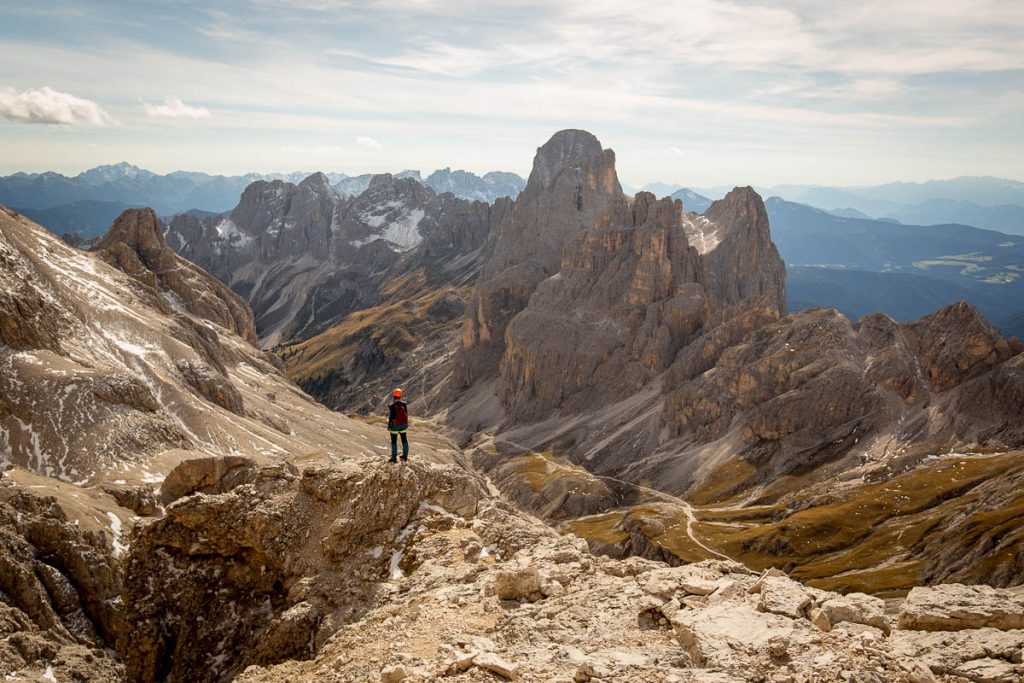
Catinaccio is the highest summit in the Rosengarten group. It delivers excellent 360 panoramic views of the Rosengarten and many other prominent peaks of the Dolomites.
It’s an easy beginner route with excellent protection. Via ferrata Catinaccio starts at the cute Alpine Hut called Passo Principe. It’s a tiny hut with a vast mountain spirit. I have very fond memories of my stay here.
Read more: Guide to Via Ferrata Catinaccio.
4. Sentiero Massimiliano (Maximiliansteig)
- Difficulty level: intermediate
- Time required: 3-4 hours (+3-4 hours roundtrip to the hut)
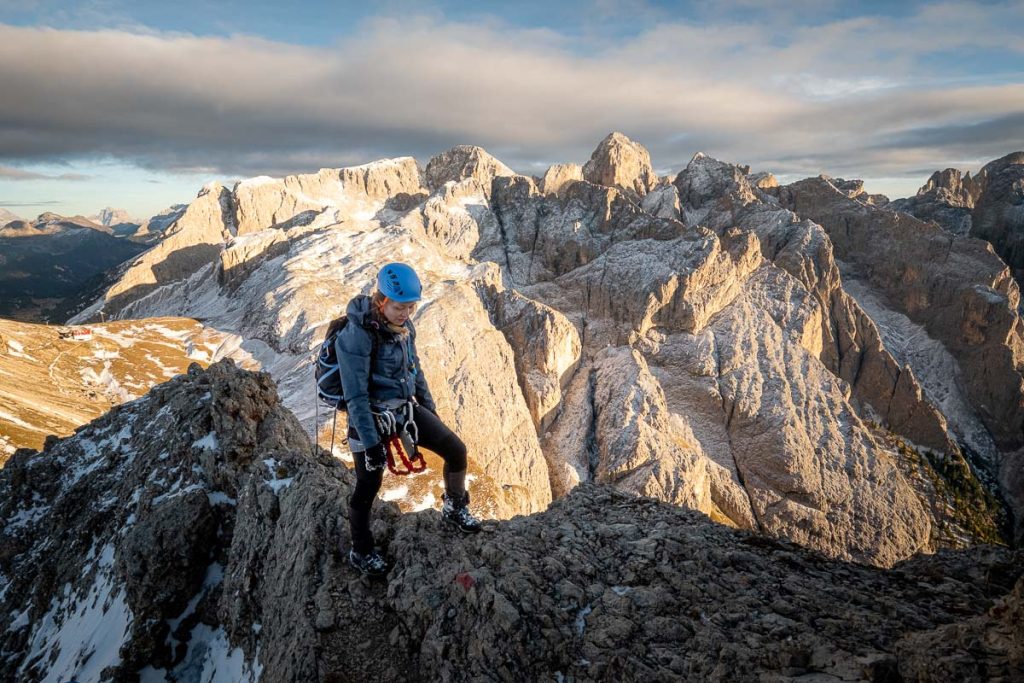
Maximiliansteig starts at the luxurious Alpe Di Tires hut and traverses the Terrarosa ridgeline. The path stretches between two summits and has constant panoramic views of the Rosengarten group and the Alpe Di Siusi Altopiano.
You will receive a lot in return for the small amount of effort that one has to put into traversing the ridgeline.
Read more: Guide to Via Ferrata Sentiero Massimiliano
5. Laurenzi (Laurenzisteig)
- Difficulty level: advanced
- Time required (Excluding hut approach): 4-5 hours
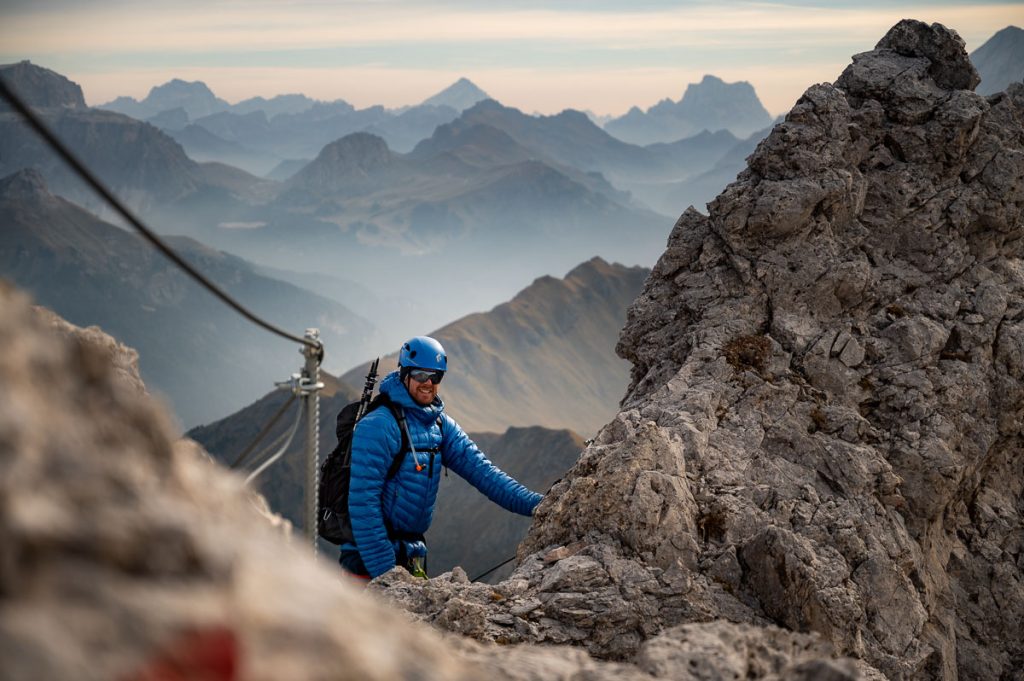
Via ferrata Laurenzi is the most complex iron path in the Rosengarten group. If you are a total beginner, look elsewhere. Those who already have some via ferrata experience and are looking for a challenge will find via ferrata Laurenzi exiting.
The route stretches between Alpe Di Tires and Antermoia huts and traverses the Molignon ridgeline. It has fantastic views of the Sassolungo mountain group and Marmolada.
Read more: Guide to Via Ferrata Laurenzi
6. Mesules (Pössnecker)
- Difficulty level: advanced
- Time required: 6-8 hours
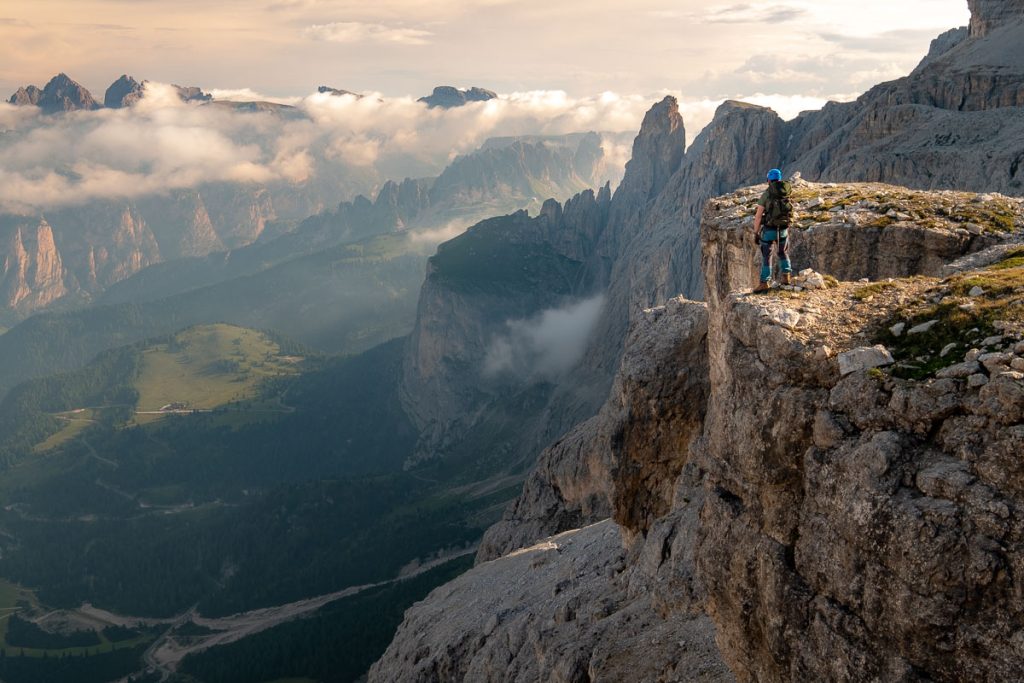
Via Ferrata Mesules is one of the oldest iron paths in the Dolomites. It climbs along the southern face of the Sella group. This challenging but fun via ferrata should only be tackled by those with some previous experience. It delivers excellent views of the Sassolungo and Odle Geisler groups.
Read more: Guide to via ferrata Mesules (Pössnecker)
7. Oskar Schuster
- Difficulty level: intermediate
- Time required: 6-8 hours
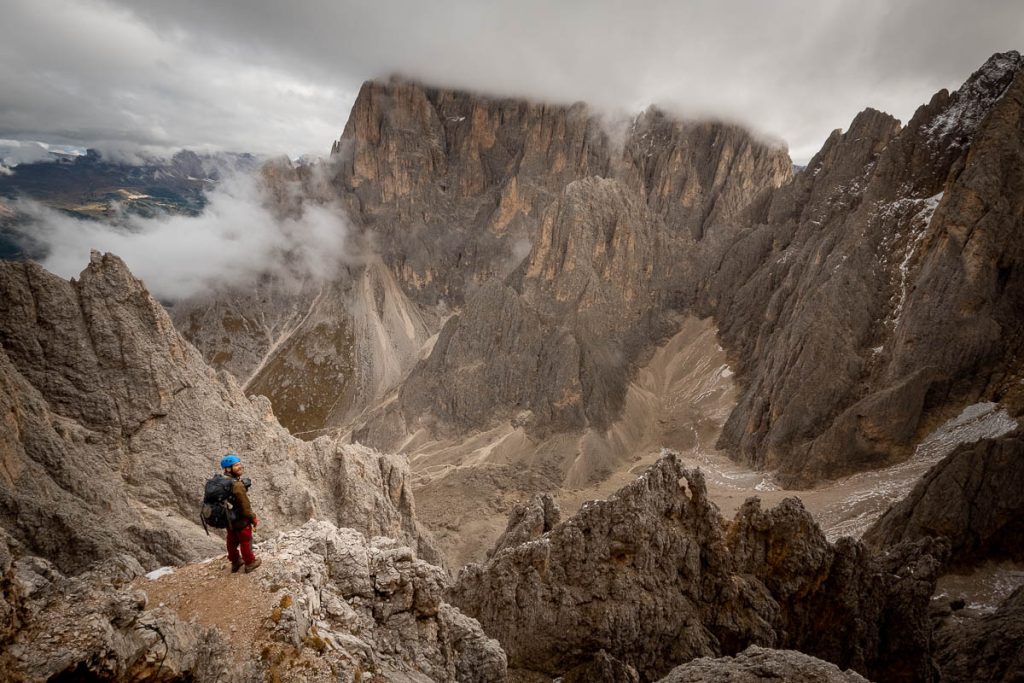
Another great via ferrata route that starts near Passo Sella. The Oskar Schuster iron path scales the walls of Sassopiatto in the Sassolungo mountain group, eventually ending at its summit. The return takes you across Rifugio Sassopiatto, which serves some of the best Kiaserschmarrn I’ve had. I bet you are now googling Kaiserschmarrn (as you should).
Read more: Guide to via ferrata Oskar Schuster
Top Photography Spots Near Fassa Valley
1. Passo Sella
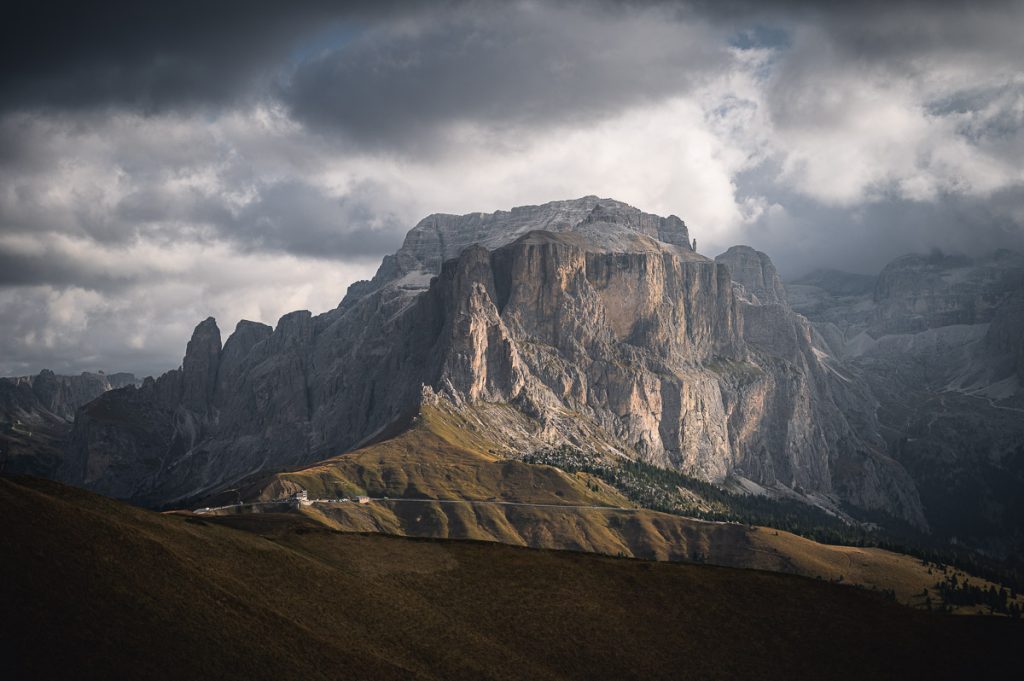
The Sella Pass connects the Fassa Valley with the Gardena Valley. It is part of the famous Sellaronda route, which can be done on skis in the Winter or on a bike in the summer. There are many photo opportunities directly on the Pass., including a few accommodation options if you want to be close to all the action.
2. Passo Fedaia
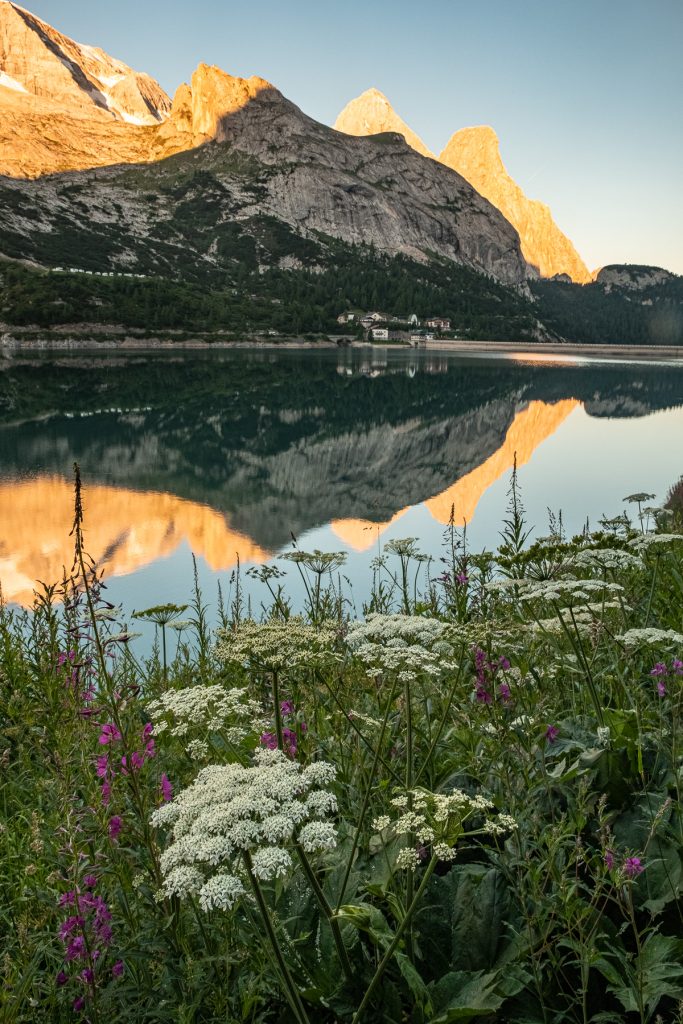
Passo Fedaia is one of the mountain passes surrounding Val Di Fassa. It is accessible by car, and a few hotels are built on the pass.
Passo Fedaia is located at the foot of Marmolada and is known for its Dam and the hydroelectric power plant attached to it, which provides clean energy to the nearby towns.
3. Vajolet Towers
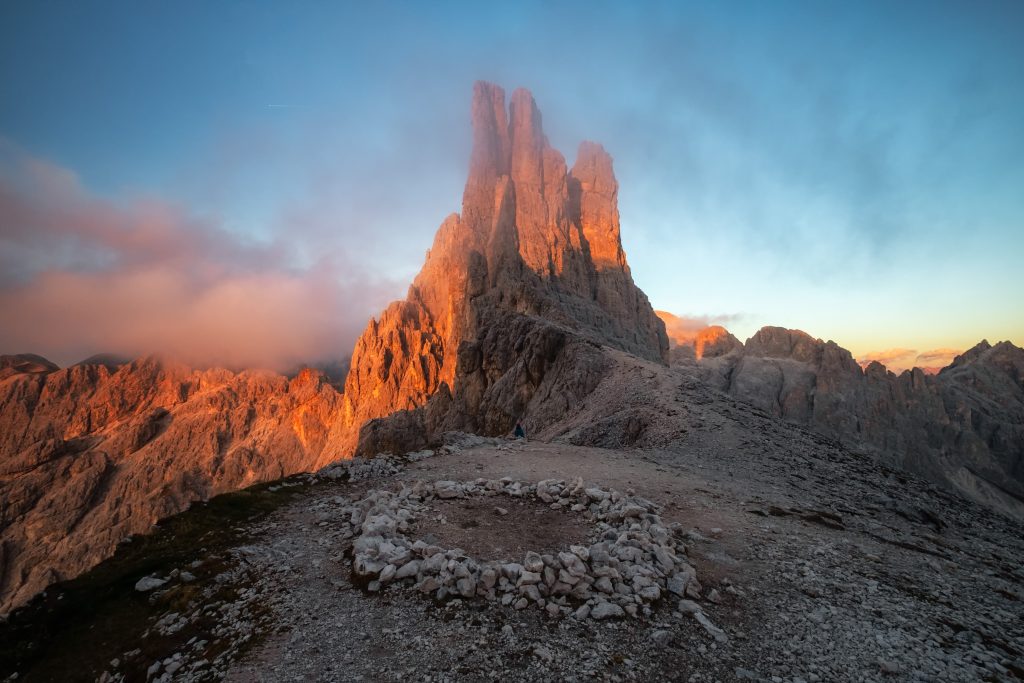
Vajolet towers are the icon of the Rosengarten mountain group and the most unique rock formation I have ever seen. There are several routes to reach the towers and a couple of mountain huts within small proximity for all those who want to photograph the towers at sunset or sunrise.
Read more: How to see the Vajolet Towers
4. Marmolada Summit
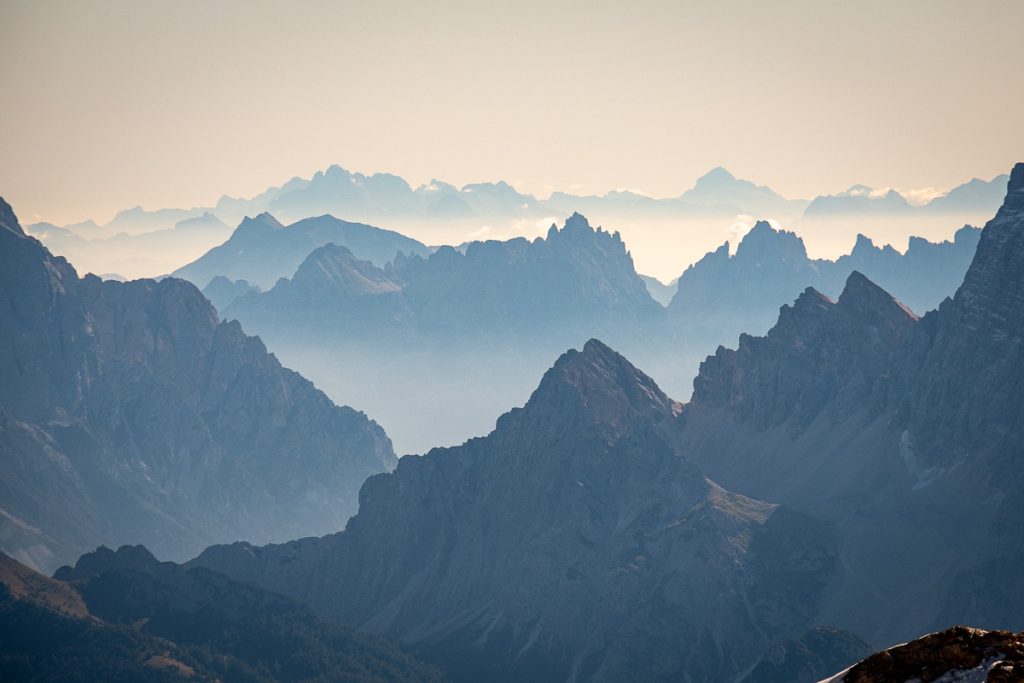
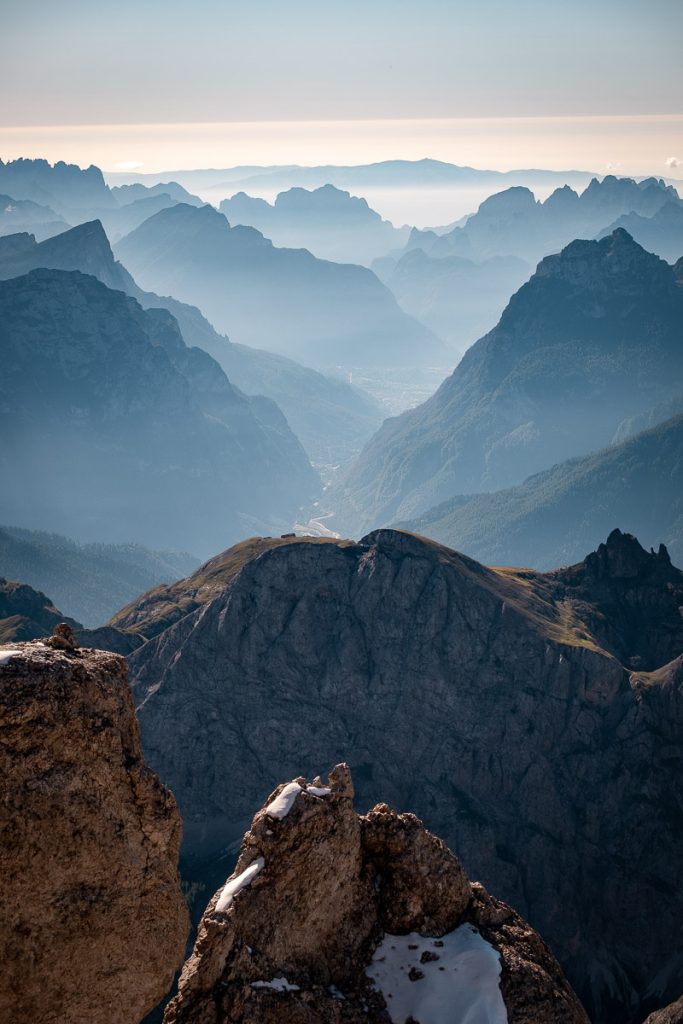
A short drive from Val Di Fassa over Fedaia Pass will take you to a little mountain settlement called Malga Ciapella. Here, you will find the cable car station for the two-tier gondola that takes tourists to one of the summits of Marmolada – Dolomite’s highest peak. The peak is called Punta Rocca.
This spot is a paradise for taking panoramic photos of the Dolomites. On a clear day, you can see most of the 3000-meter peaks that form beautiful mountain layers.
5. Lake Carezza
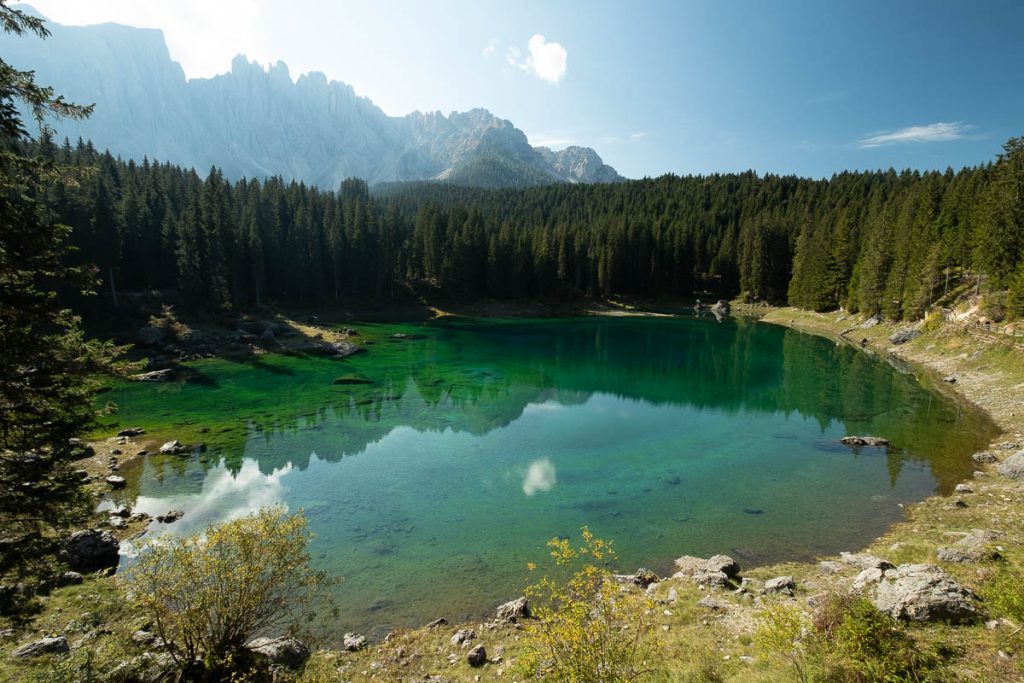
This turquoise jewel is one of the most famous lakes of the Dolomites. Small effort is needed to reach the lake. There is a parking lot right next to it. The easy access contributes to many tourists, so if you want to have the place all to yourself, plan your visit for early morning. There is a lovely, easy hiking path that circles the lake. The mountain group that reflects in its waters is called Latemar.
Other Regions of the Dolomites Worth Visiting
- Puster Valley (Val Pusteria)
- Gardena Valley (Val Gardena)
- Funes Valley (Val Di Funes)
- Primero Valley (Val Primero)
- Badia Valley (Val Badia / Alta Badia)
- Cortina D’Ampezzo & Central Dolomites
- Tre Cime Nature Park
Support my website!
Hi Reader! If you found any of my articles about the Dolomites useful please consider using the affiliate links below (at no extra cost) when booking your holiday. Thank you
- Reserve your hotel with Booking.com
- Book your rental car with Discover Cars
- Buy your outdoor gear with Backcountry.com (US readers)
If you have any questions, leave them in the comments below!
Hello Marta
Very interesting website! Can’t stop reading your adventure.
I was wondering if you had any suggestion for our family trip in the dolomites in august 2025.
We have 4 kids (9,10,11,12)
I was thinking take the cable/funicular to compaccio and then hike to alpi di tires directly ( or stop first bolzano) .?
Then we would sleep at alpi tires refugio.
After that I dont know where to go with the kids. Rifugio Bergamo or Sasso piato. I would stay 2 others nights in refugio (total 3 nights) and then go back to compaccio to get the car.
Any advice?
Thank you so much
Hi Emilie. Thanks for stopping by. If you don’t want to do any via ferratas then refer to my section about how to do the Rosengarten traverse without them. This is exactly 3 night option: Night 1: Rifugio Re Alberto or Passo Santner, Night 2 Rifugio Alpe Di Tires. Night 3 Rifugio Sassopiatto. If day 1 is too long for you, instead of starting at Paolina chairlift you could take the Vajolet gondola in Vigo Di Fassa and start your hike from there. It will be shorter and take ca. 3-4 hours. On last day you could exit to Campitello Di Fassa via Col Rodella Cable car.
I do offer consulting calls so if you are interested please schedule one. Click on the Trip Plannin Advice tab. Thanks! Marta
Hi Marta
I am so jealous of your wonderful life in the mountains and so thankful for your posting. I am trying to find an alternative to the Alta Via 1 as the huts are already booked. I came across a route on Hut to Hut trekking that seems to criss-cross many of you day hikes and I’m wondering if I can put it together myself, rather than paying a lot of money for them to do it.
This is what it looks like so far
Day 1: Bolzano arrive
Day 2: Bus to Kastelruth and cable car to Compatsch, then walk from Seiser Alm to Rifugio Bolzano
Day 3: walk to Rifugio Sasso Piatto
Day 4: No accomm mention but talks about the Sella Pass and passing Citta Dei Sassi which seems to be inthe vicinity of Rifugios Carlo Valentin and Salei on your map
Day 5: says Rifugio Antermoia but on the map it says temporarily closed so would Passo Principe be an alternative?
Day 6: Finish in Val di Fassa
What map would you suggest for this area. I know All Trails is an option but I like to have a hard copy back up too?
We would be traveling from and back to Venice on public transport, so hopefully that is possible. Do you think the Rifugios will be booked already? I will send queires now.
Thanks so much
Jez
Hi Jez. Yes, it is a bit madness that Alta Via 1 books out so far in advance now. You can definitely design your own hut-to-hut hiking route. Now some thoughts. Rifugio Sassopiatto lies only 1.5 hour from Sella Pass. If you want to extend that day you should walk around Sassolungo (sassolungo Circuit). or you can take a bus from Sella Pass to Pordoi Pass then hike to the summit of piz Boe. from piz boe you could follow Alta Via 2 (day 5) to passo Fedaia. From Passo Fedaia, you could exit to Val Di Fassa. I hope that helps!
Hi Marta, thank you for all this useful information. I am planning to visit this part of the Dolomites mid October (hope the weather will be on my side), is it possible to do the hikes using public transport or it is best to rent a car?
Hi Milena. Public transport becomes very limited in the shoulder season so you might be better off renting a car.
Marta Hi!
Does this first 7 hikes around Fassa Valley & Rosengarten Nature Park are just regular hikes can be done without Ferrata cable kits? (asking because found some where else on internet photos from Ciampede to Rifugio Re Alberto using them).
And can these google map roots be used on the phone for hiking, or are they just for informational purposes? I have dowloaded wikiloc to use on a hikes but can’t convert your maps to upload it there.
And distance of a hikes mentioned is point to point (one way) or it is from the trailhead and back?
Hi Igors. There is a short cable protected section between rif. Vajolet and Rif Re Alberto which should be attempted only if you are sure footed. It is not classed as a via ferrata, but if you are uncomfortable with steep trails and cables then you can bring the via ferrata kit with you. \
The google maps are only for info purposes to show where the trail runs, but should not be used for navigation. You can outline the hikes on garmin connect or use all trails if you need the GPX data.
As for the other hikes I enlisted in the Fassa Valley, there are some cable protected sections on the Piz Boe summit hike. The rest is cable free. I hope that helps!
Hello. Is it possible to hike from pera di fassa, to santnerhutt, and back down in one day?
Thank you
Hi Anna, Yes it is for a very fit hiker, but whether it is possible for you, that I cannot answer, I am afraid 🙂 You should know your own limits.
Thanks for your very informative website!
Is it possible to hike from Santnerpasshutte to Principe Pass hut without via ferrata? I’m visiting the Dolomites in late September and am thinking about staying two nights at Santnerpasshutte. (Planning on hiking up from Val di Fassa.) Would there be day hikes to do around Santnerpasshutte without retracing too many steps?
Thank you!
Hi Krystal. There are two ways to reach Santner Pass Hut. One is via the via ferrata Santner, the other is by hiking up the steep gully from Vajolet hut. I have the exact map for the routes in my post about How to See the Vajolet Towers.
There are no day hikes around Santner Pass hut. Its location doesn’t allow for much movement. If you want to stay a couple of nights in a hut and do day hikes from there then Alpe Di Tires hut (which belongs to the same family) is a much better option. From Alpe Di Tires you can reach the Santner Pass hut too.