
Via Ferrata Laurenzi was the only iron path in the Rosengarten group I hadn’t done yet. I’ve been putting it off for quite some time, thinking it is too advanced. Last October, five years after my first visit to the Rosengarten group, I finally ticked it off my list. Today, I know that my concerns were unfounded. It wasn’t as hard as I thought it was going to be.
About Via Ferrata Laurenzi
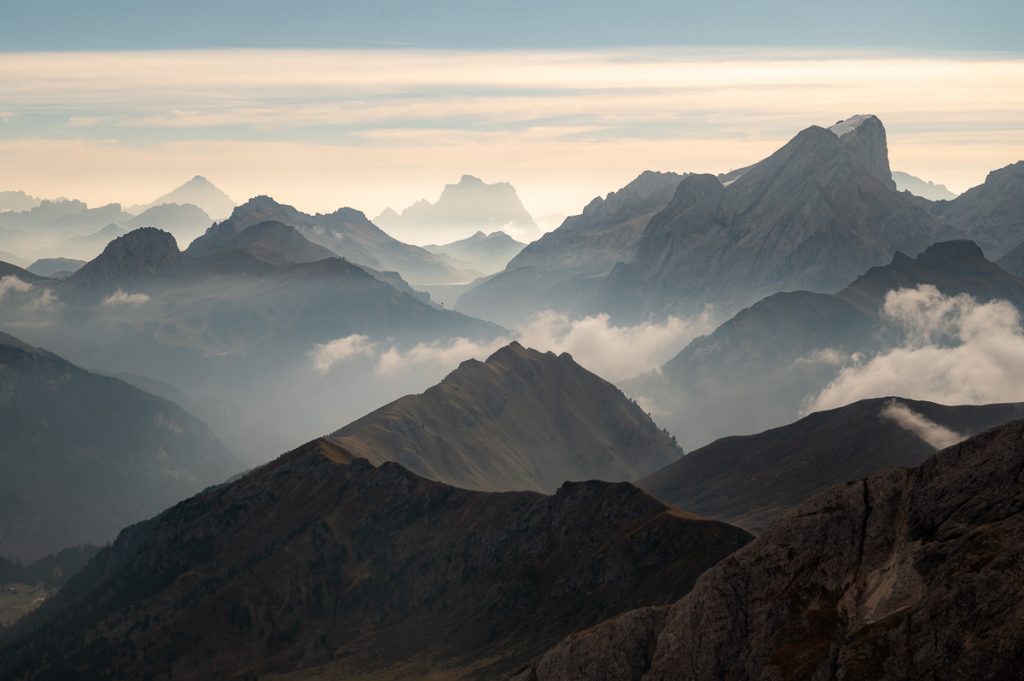
Via Ferrata Laurenzi (in German: Laurenzisteig) is a high-alpine iron route that traverses the Molignon ridgeline. The path runs between two alpine huts: Rifugio Alpe Di Tires and Rifugio Antermoia. Both huts are in the Rosengarten Mountain Group in the Italian Dolomites.
The two nearest towns where you can start the approach to reach the Via Ferrata Laurenzi are Siusi and Campitello di Fassa.
The stats for Laurenzisteig
- Start: Rifugio Alpe Di Tires
- End: Rifugio Antermoia
- Distance: 5 km / 3.1 mi
- Elevation gain: 532 m / 1746 feet
- Elevation loss: 497 m / 1630 feet
- Time required: 5-6 hours
- Route difficulty: advanced
- When to go: Mid-June – October
- Map required: Tabacco map no. 029 (Rosengarten) or Tabacco map no. 06 (Val Di Fassa)
Map of the trail
- Yellow – Via Ferrata Laurenzi
- Purple – Approach to Alpe Di Tires hut – Option 1 starting at the top of Alpe Di Siusi gondola in Compatsch
- Blue – Approach to Alpe Di Tires hut – Option 2 starting at the top of Col Rodella Cable car
- Red – Return hiking path from Rifugio Antermoia to Rifugio Alpe Di Tires
- Black – Exit route from Rifugio Antermoia to Campitello Di Fassa
TIP: Click on each trail, and a window will pop up where you will see the name and the stats for each trail
How to reach Rifugio Alpe Di Tires
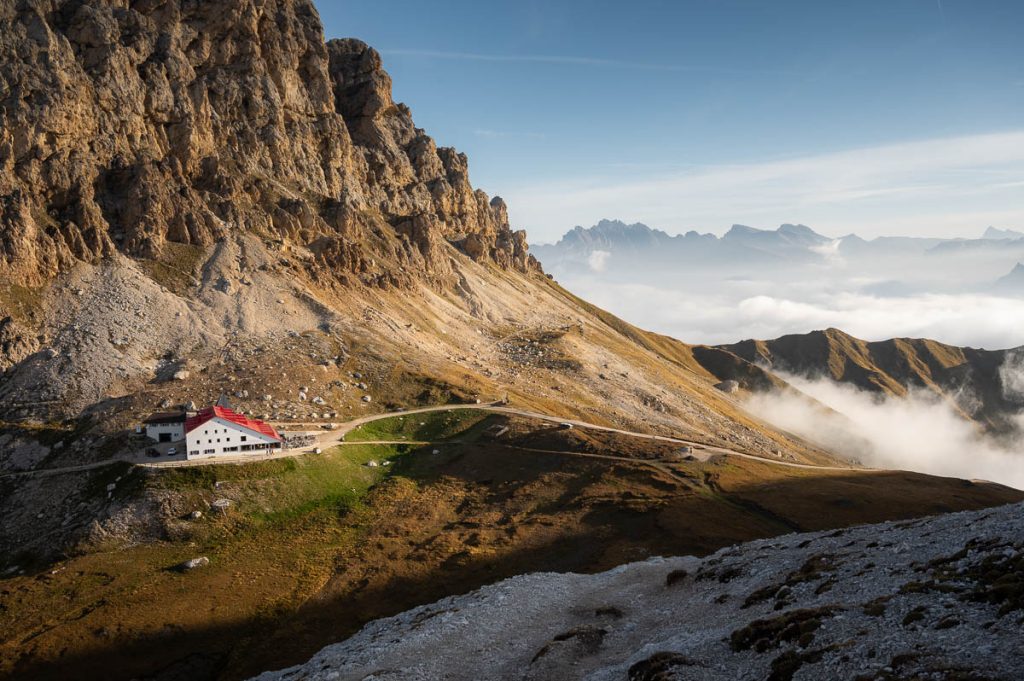
Many trails lead to the Alpe Di Tires hut. Below are two recommendations.
Option 1: Top of the Alpe Di Siusi gondola to Rifugio Alpe Di Tires across Denti Di Terrarosa saddle
- Distance: 7.8 km / 4.8 miles
- Elevation gain: 657 m / 2154 feet
- Elevation loss: 63 m / 208 feet
- Colour on the map: purple
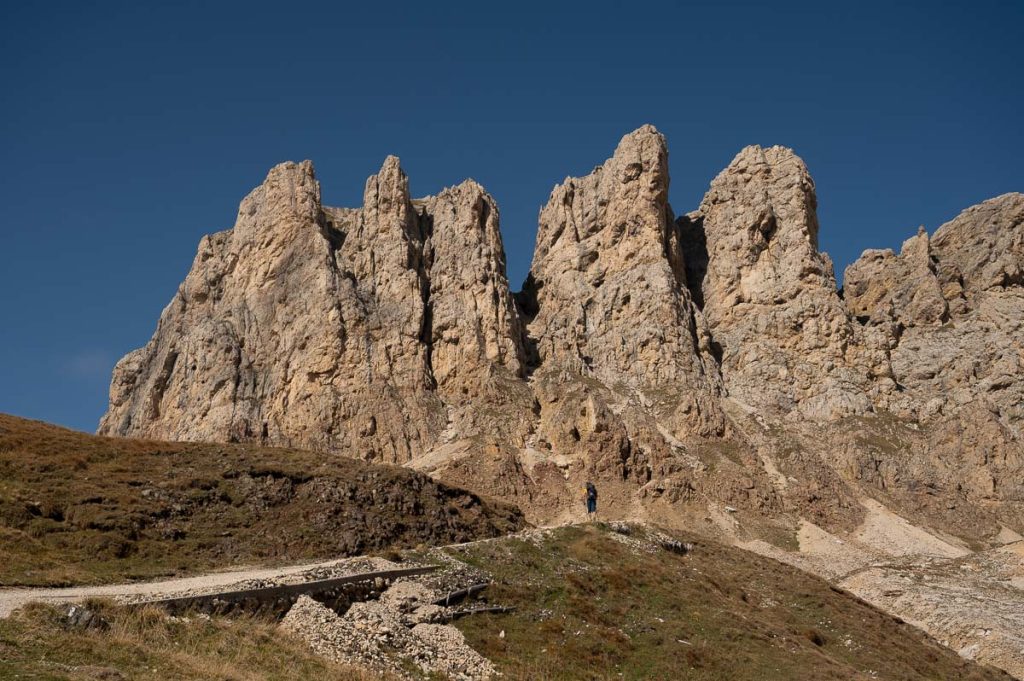
This is the shortest and fastest way to reach the Alpe Di Tires hut. The hike begins at the top of the Alpe Di Siusi gondola in Compatsch, which starts in Siusi. This is a good route if you plan to stay a few nights in Alpe Di Tires hut and tick off the nearby Via Ferrata Sentiero Massimiliano. The Alpe Di Siusi gondola runs from the third week of May until early November.
Option 2: Top of the Col Rodella cable car to Rifugio Alpe Di Tires
- Distance: 11.8 km / 7.3 miles
- Elevation gain: 430 m / 1413 feet
- Elevation loss: 443 m / 1454 feet
- Colour on the map: blue
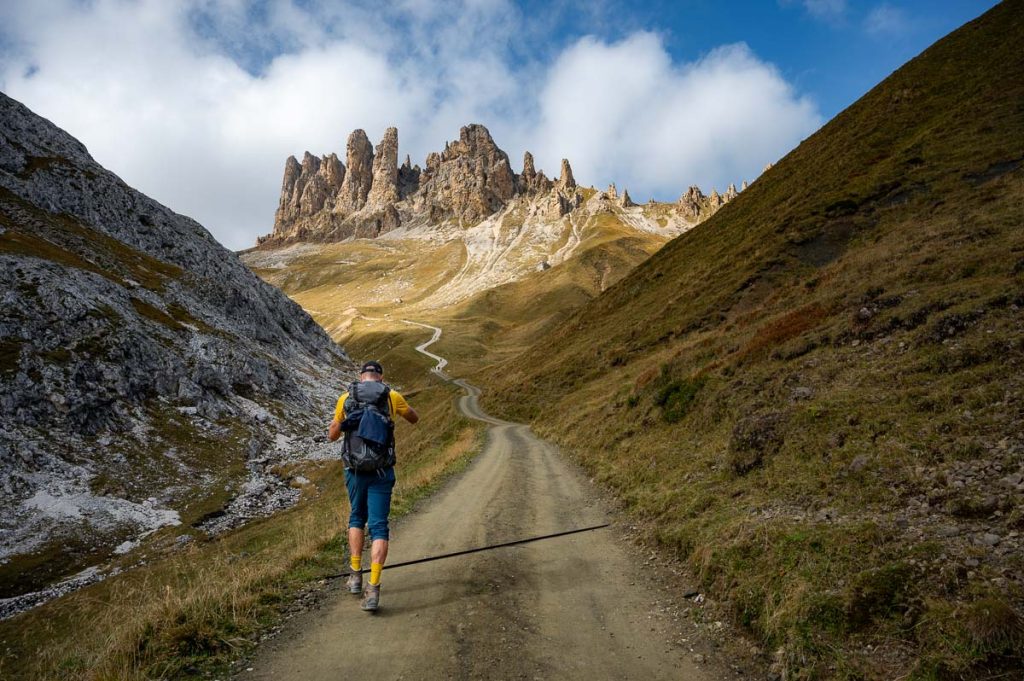
A slightly longer but more scenic route leads from the top of the Col Rodella gondola to Campitello di Fassa in the Fassa Valley. This is a good route if you want to start and end in the same town without repeating any of the trails.
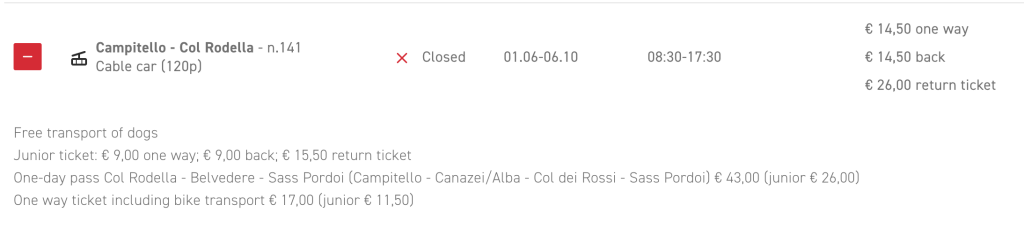
A part of this approach intersects with the Sassolungo Circuit hike. Below are the summer 2024 opening times and prices for the Col Rodella gondola. You will only need a one-way ticket for this trip.
The stages of Via Ferrata Laurenzi
Stage 1: Alpe Di Tires to the start of cables
- Time required: 45-60 mins
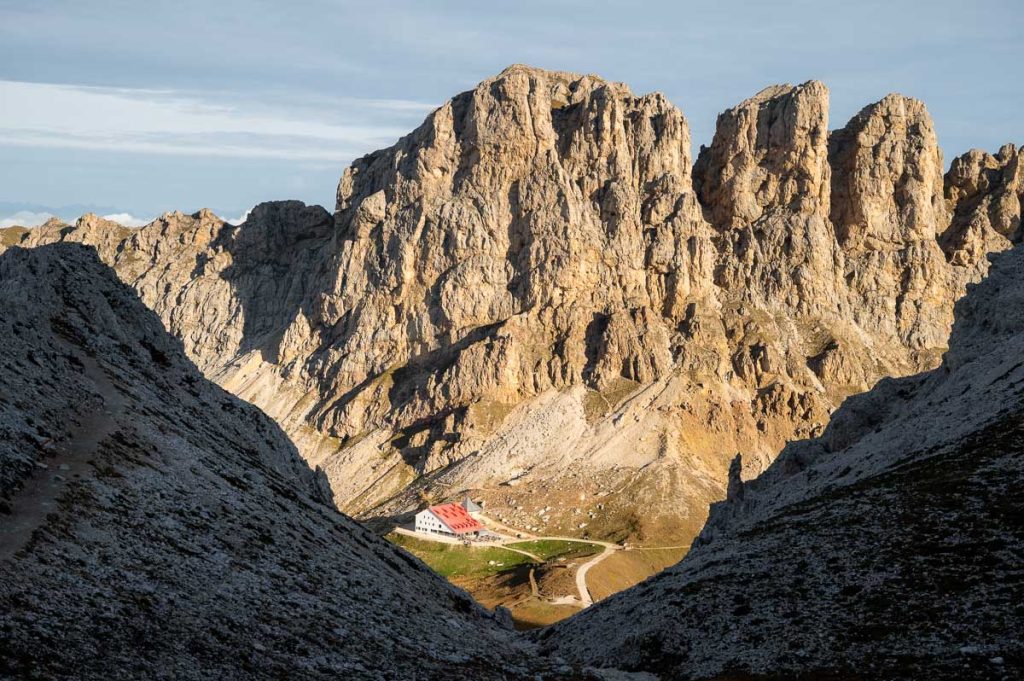
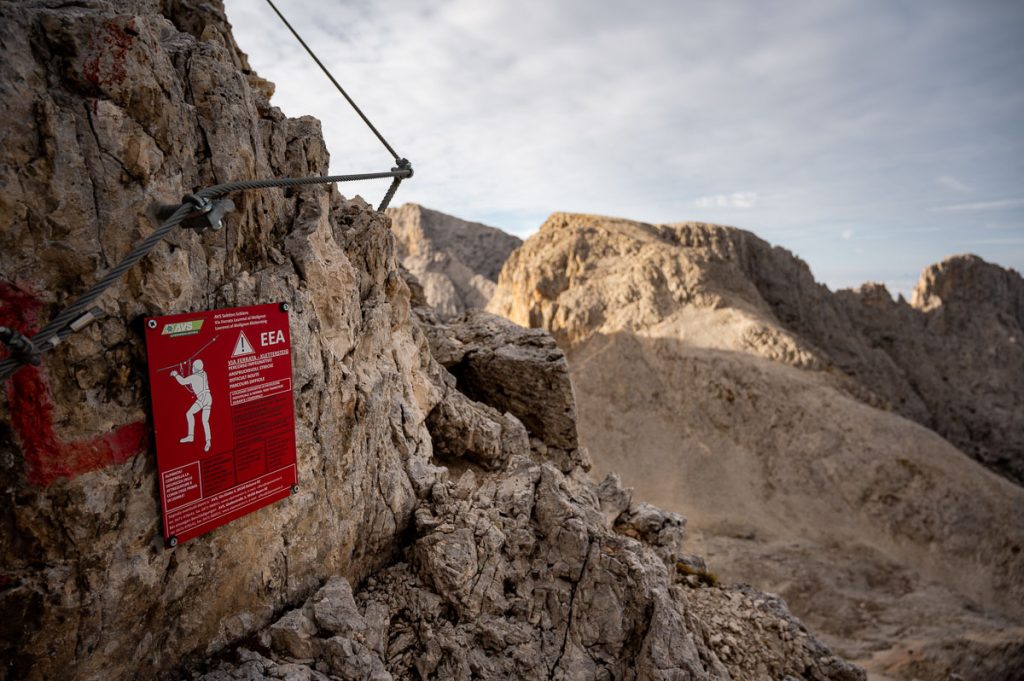
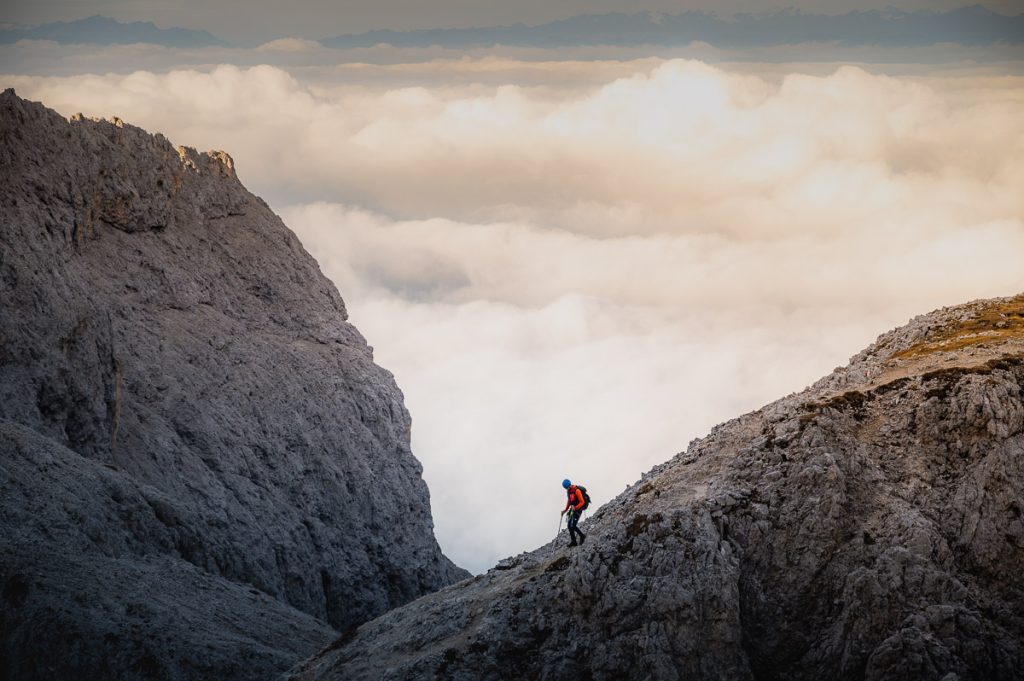
Leaving Alpe Di Tires hut, head South on path no. 3A in the direction of Forcella Molignon & Passo Principe Hut. The path starts with a steep ascent, where cables are placed to assist the hikers.
Follow the path until you reach a fork. A left turn will take you onto a zigzag path. About 45 minutes after leaving the hut, you will reach the first cables of via ferrata Laurenzi. It’s time to put on your gear.
Stage 2: Molignon rigdeline traverse
- Time required: 2.5-3 hours
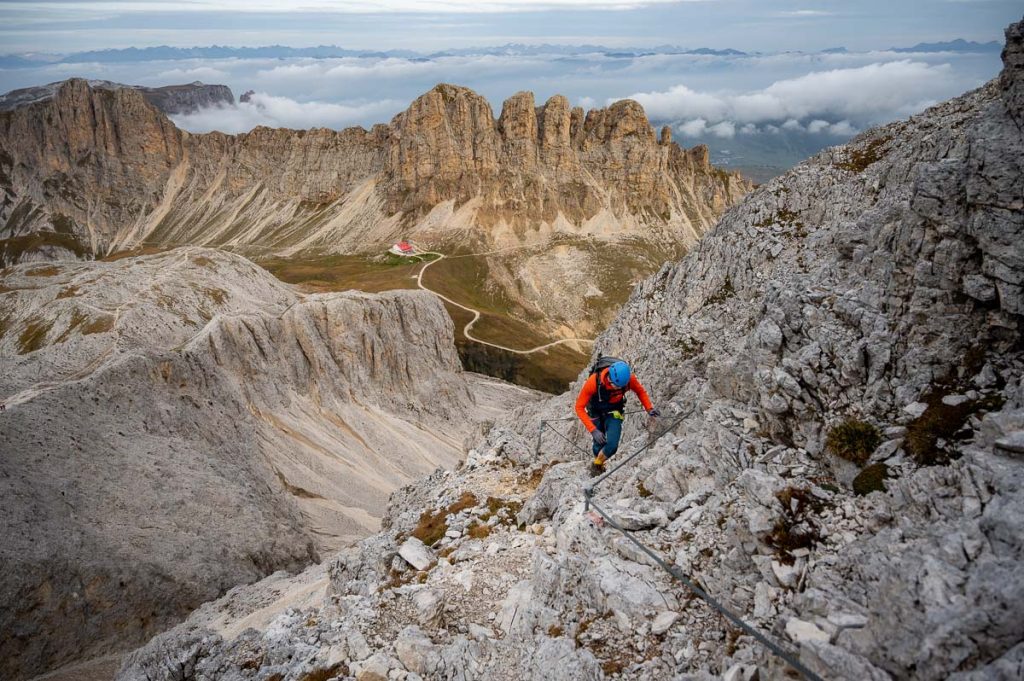
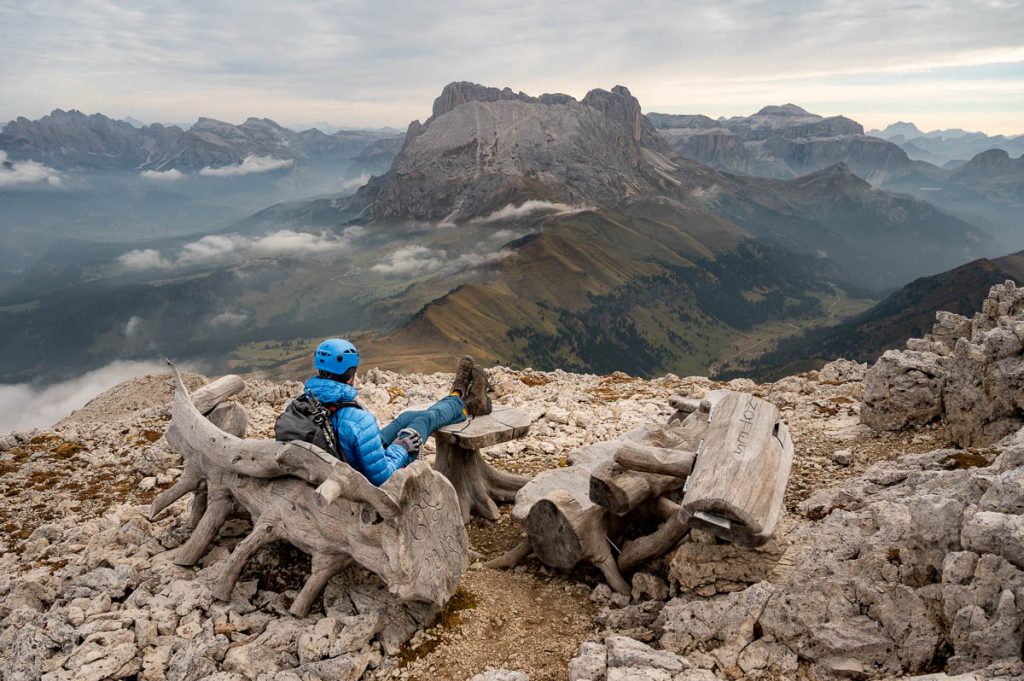
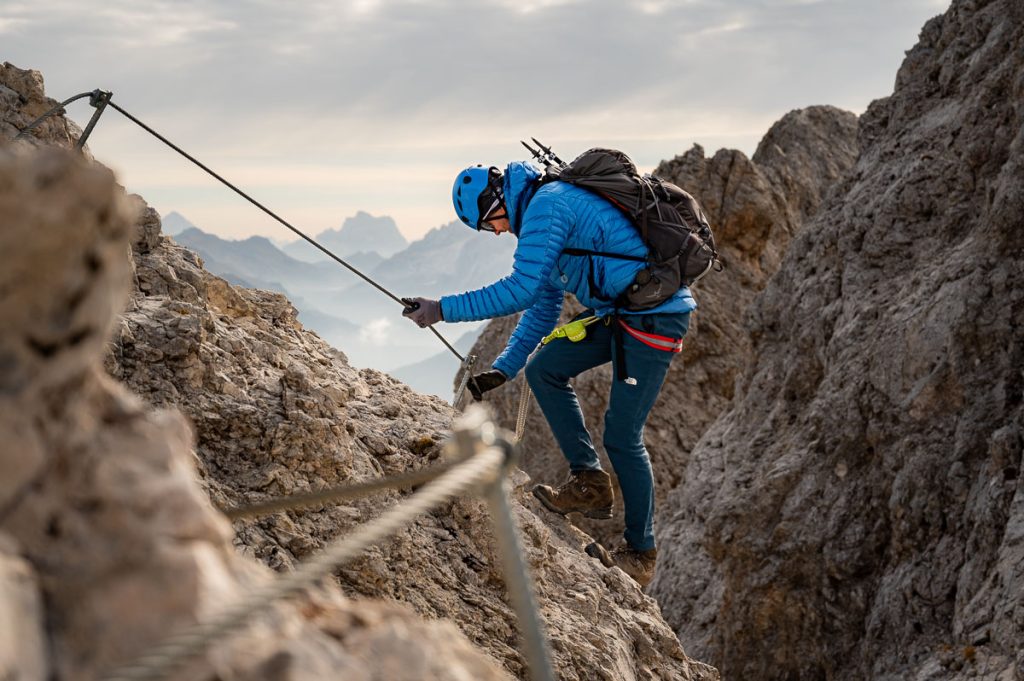
The first section of the via ferrata is straightforward and follows a well-protected path to the ridgeline. Once you reach it, the trail follows a broad plateau, and no climbing is involved.
There is a great rest area on the plateau with benches carved out of tree trunks and a wooden book where you can carve your name.
Sit down for a few minutes and enjoy the great views of Sassolungo, Mount Antealo, Mount Pelmo, and Dolomite’s highest peak, Marmolada. Before the trip, download the Peak Finder app on your phone. It’s my favourite tool for checking out all the peak names.
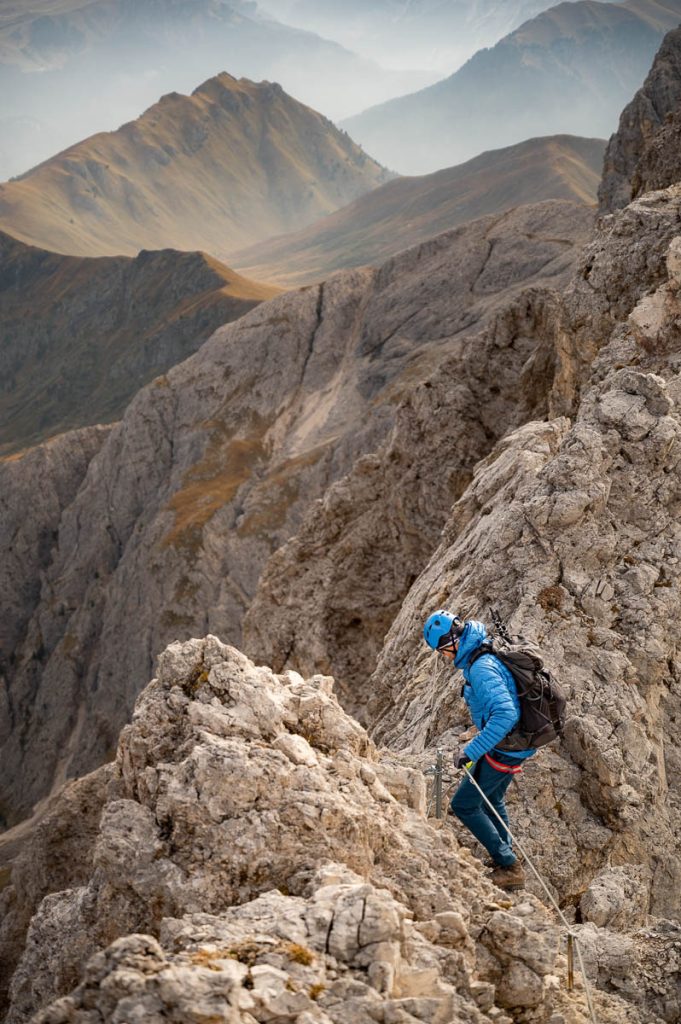
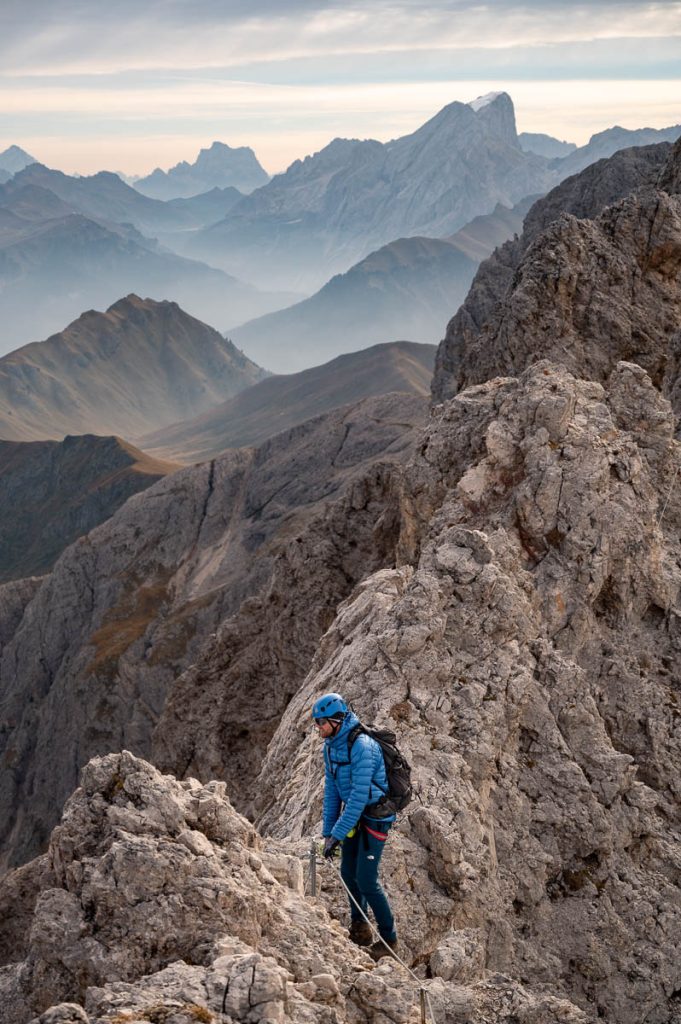
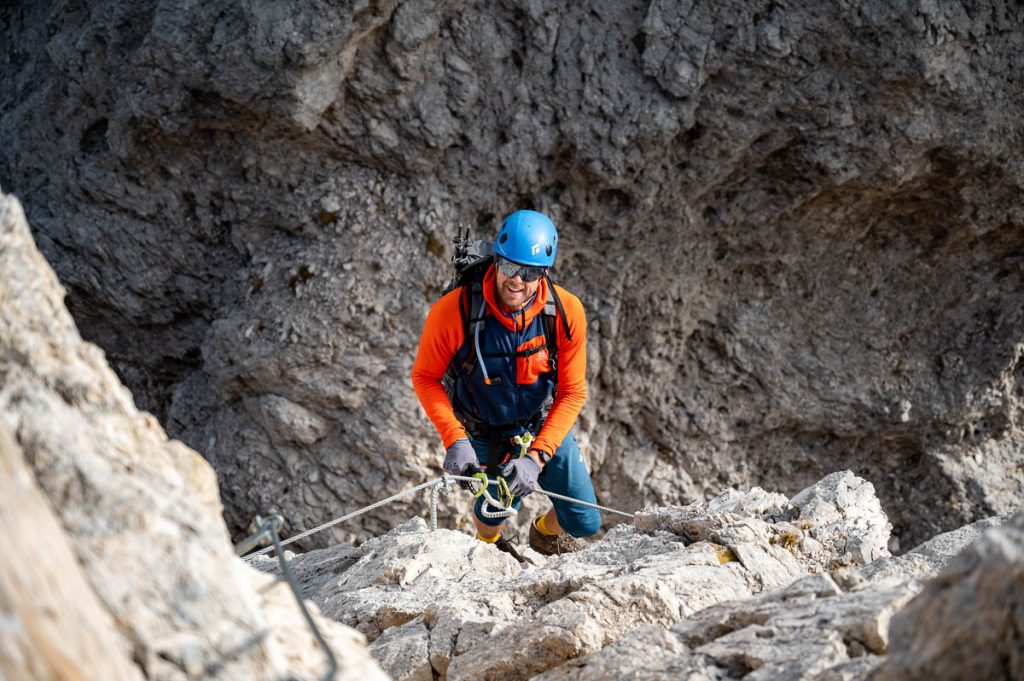
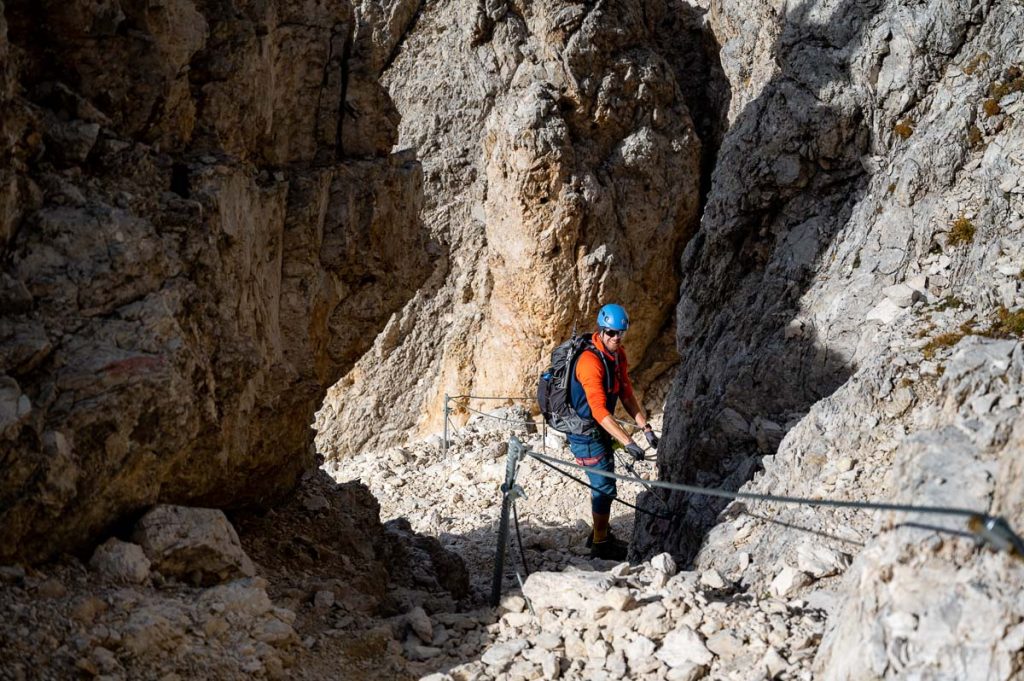
Gradually, the ridgeline becomes narrower, and the challenge begins. The rest of the ridgeline traverse will involve plenty of climbing up and down. As daunting as it may sound, the footholds and cable protection are excellent, and we didn’t have any troubles en route. After about 2.5 hours of following the ridgeline, you will reach its highest point—Molignon Di Dentro.
Stage 3: Descent to Lake Antermoia
- Time required: 1.5 – 2 hours
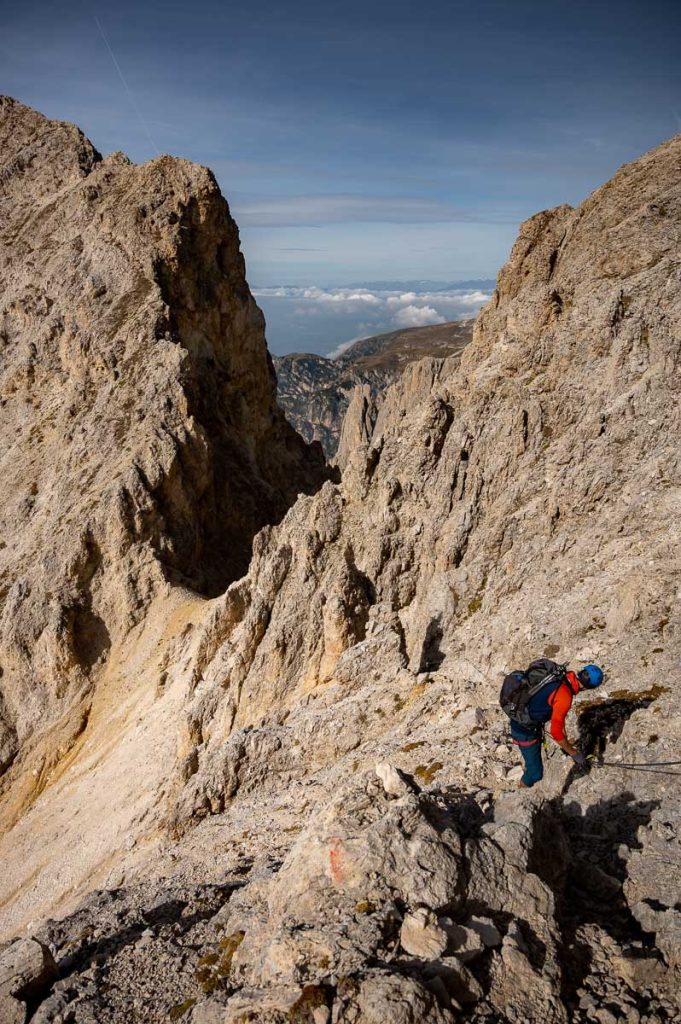
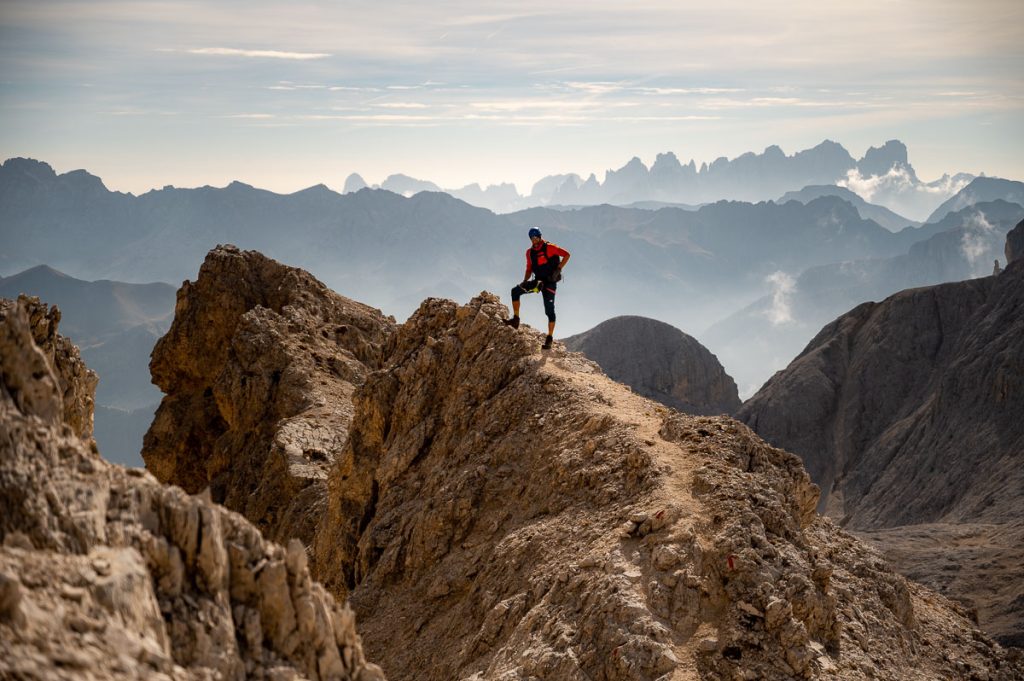
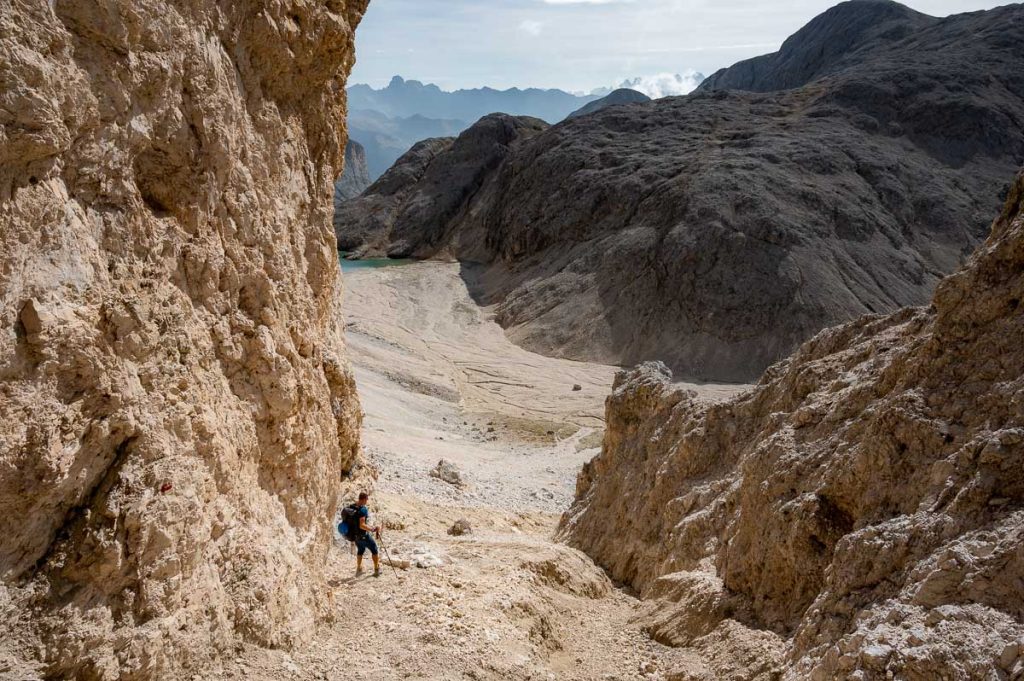
The last part of Via Ferrata Laurenzi involves a downclimb to Antermoia Valley. Right towards the end, the most challenging part was a sharp descent through a loose scree gulley. That’s where you will get the first glimpse of the turquoise Antermoia lake. Once you reach the valley bottom, it is a 15-minute hike to the Antermoia hut.
Exit route from Rifugio Antermoia
Grab a lunch at the Antermoia hut to regain strength for your return. If you are doing the Rosengarten traverse, this is where you will stay your last night. Otherwise, choose from the return routes below.
Option 1: Return to Rifugio Alpe Di Tires
- Distance: 6.5 km / 4 miles
- Elevation gain: 490 m / 1610 feet
- Elevation loss: 538 m / 1766 feet
- Colour on the map: red
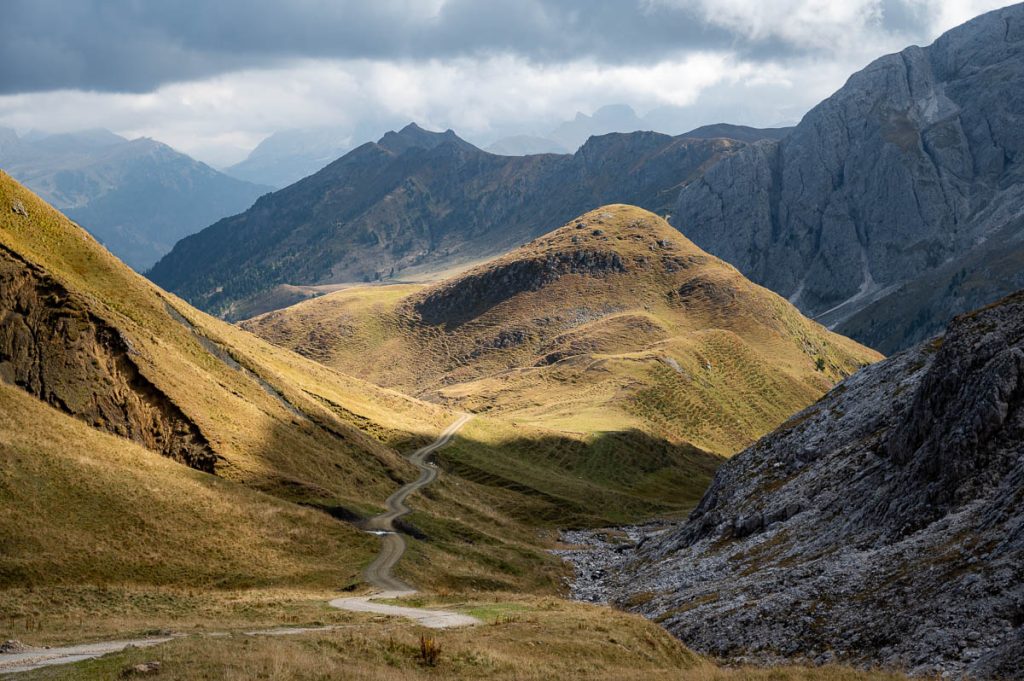
If you stay in the Alpe di Tires hut the night before, you can ask the staff to leave some of your things in the hut so you can do Via Ferrata Laurenzi with only the essentials in your backpack. This will make your trip a lot more enjoyable.
After completing the via ferrata, you can return to the Alpe Di Tires hut on a hiking path that runs parallel to the Laurenzisteig. Once back at the hut, you can either return to Compatsch and take the return gondola down to Siusi or stay another night in Rifugio Alpe Di Tires.
TIP: Stay two nights in Alpe Di Tires and tackle Via Ferrata Sentiero Massimiliano the next day.
Option 2: Return to Campitello di Fassa via Dona Valley
- Distance: 11.5 km / 7.1 miles
- Elevation gain: 151 m / 496 feet
- Elevation loss: 1181 m / 3876 feet
- Colour on the map: black
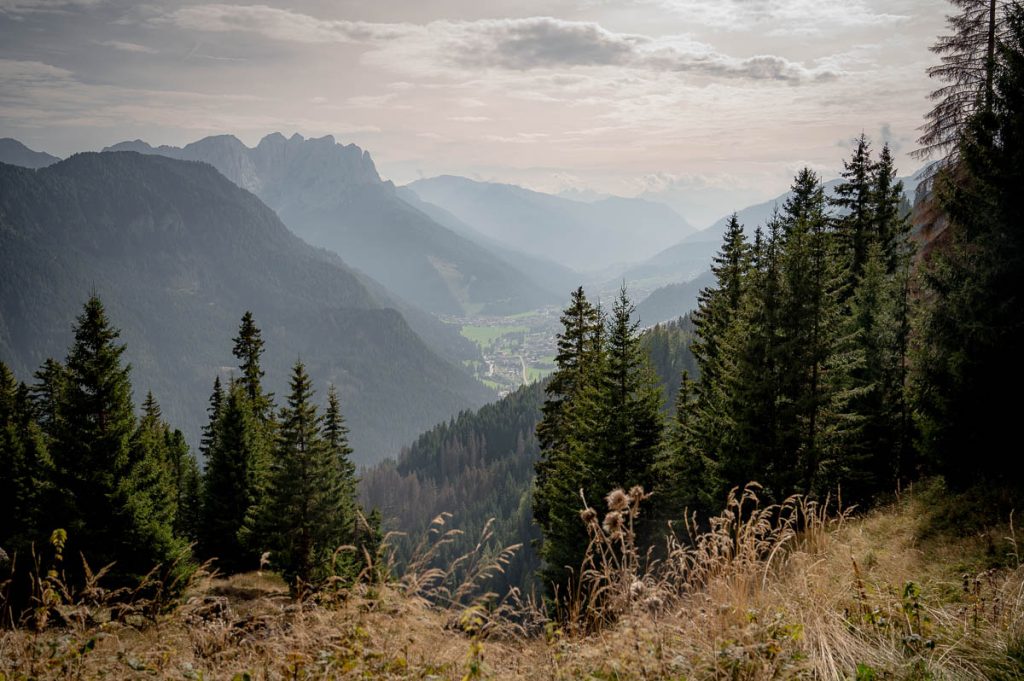
Take this route if you hiked to Alpe Di Tires Hut from the top of the Col Rodella gondola and want to return to Campitello Di Fassa. After completing Via Ferrata Laurenzi, follow the trail across Dona Valley, first to Rifugio Dona and then down to Campitello Di Fassa.
Via Ferrata Laurenzi as part of a multiday hut-to-hut traverse across the Rosengarten Group
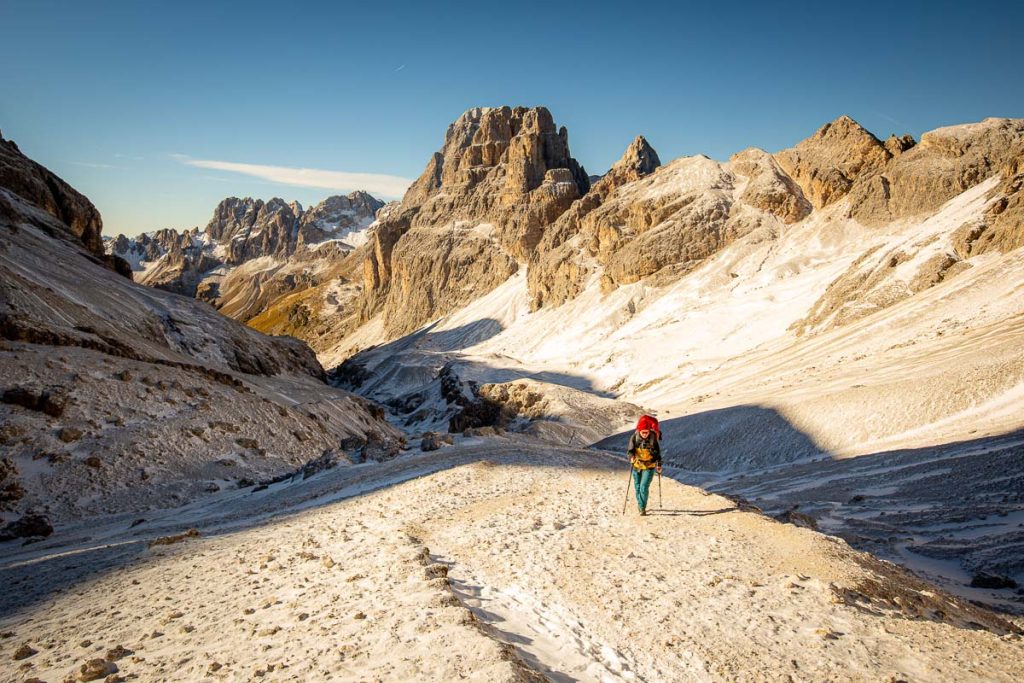
Via Ferrata Laurenzi can be greatly incorporated into a multiday hut-to-hut traverse across Rosengarten Nature Park. This traverse includes all via ferratas in the Park. Since Laurenzi is the hardest one, I left it for the last day. By then, you should be comfortable using your via ferrata gear and will know whether you are up for something slightly more challenging.
Shop my via ferrata gear essentials
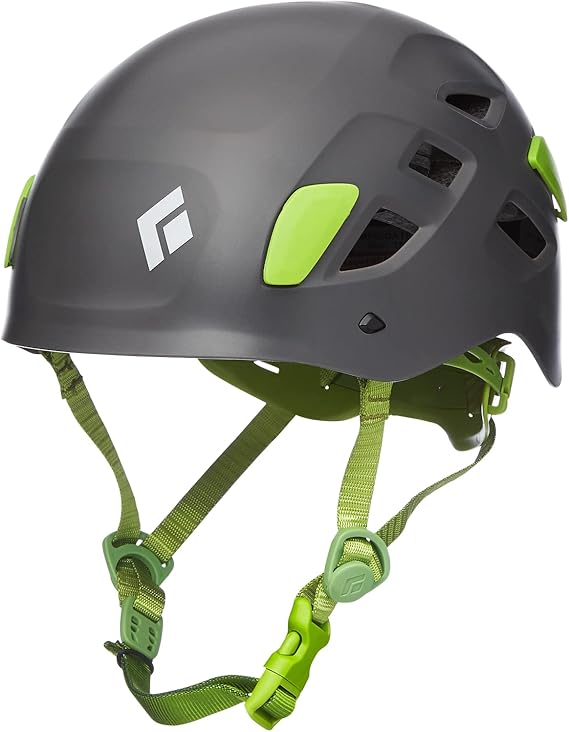
Black Diamond Helmet
Rockfall is a significant concern on via ferrata routes. Unbeknownst to you, other climbing groups above you may accidentally dislodge a small rock and send it down the mountain. If it hits you on the head, it could have serious consequences. A helmet on your head (not inside your backpack) is necessary.
Shop on: Amazon (Worldwide) / Backcountry (US)
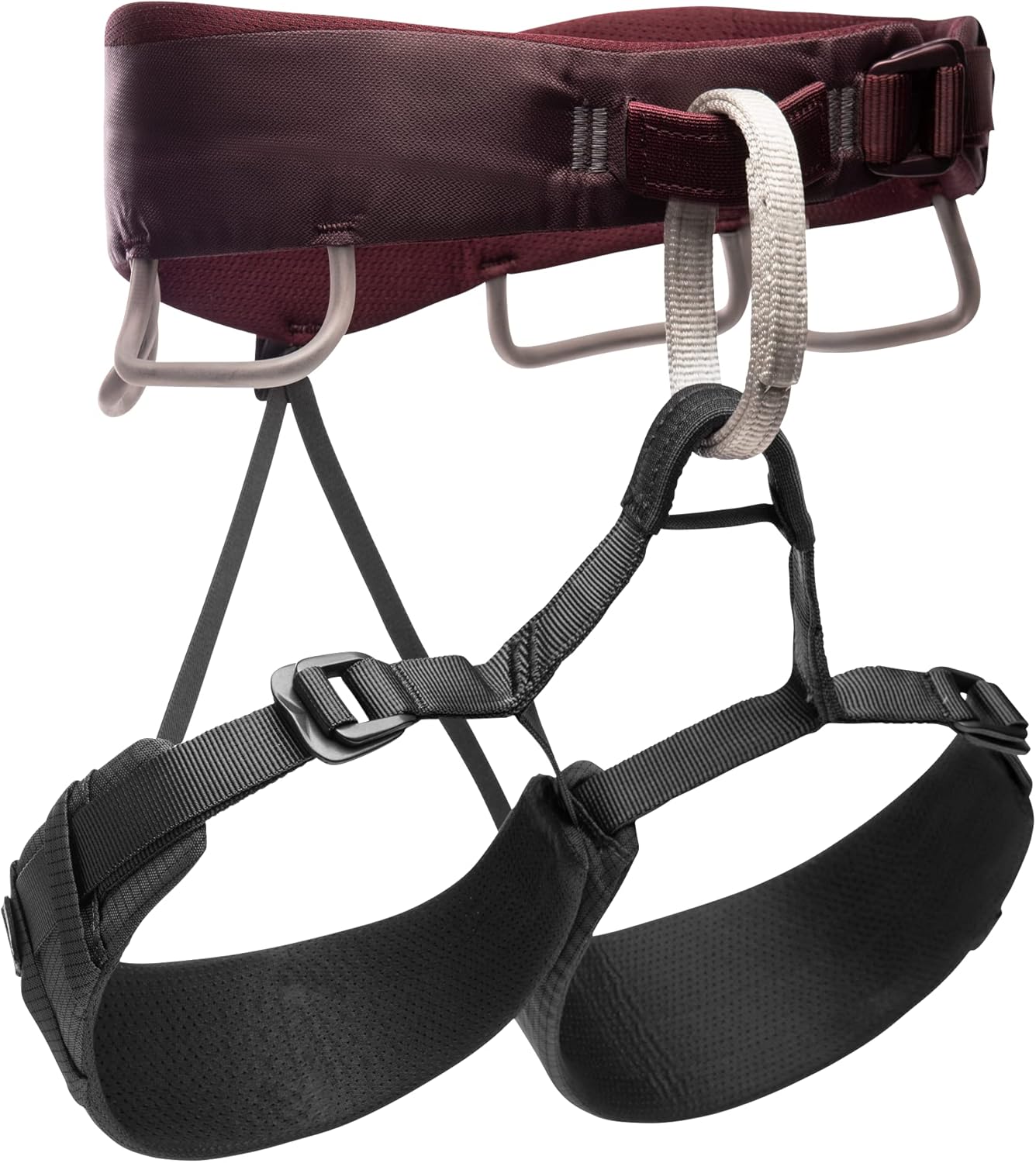
Black Diamond Momentum Harness
Another must-have on a via ferrata route is a climbing harness. A harness works as an anchor point for your via ferrata lanyard. Try it before your trip to ensure it fits snugly without limiting your movements. Aim for a lightweight harness that will be comfortable to wear between the cable-protected sections when hiking.
- Shop Women’s on Amazon (Worldwide) / Backcountry (US)
- Shop Men’s on Amazon (Worldwide) / Backcountry (US)
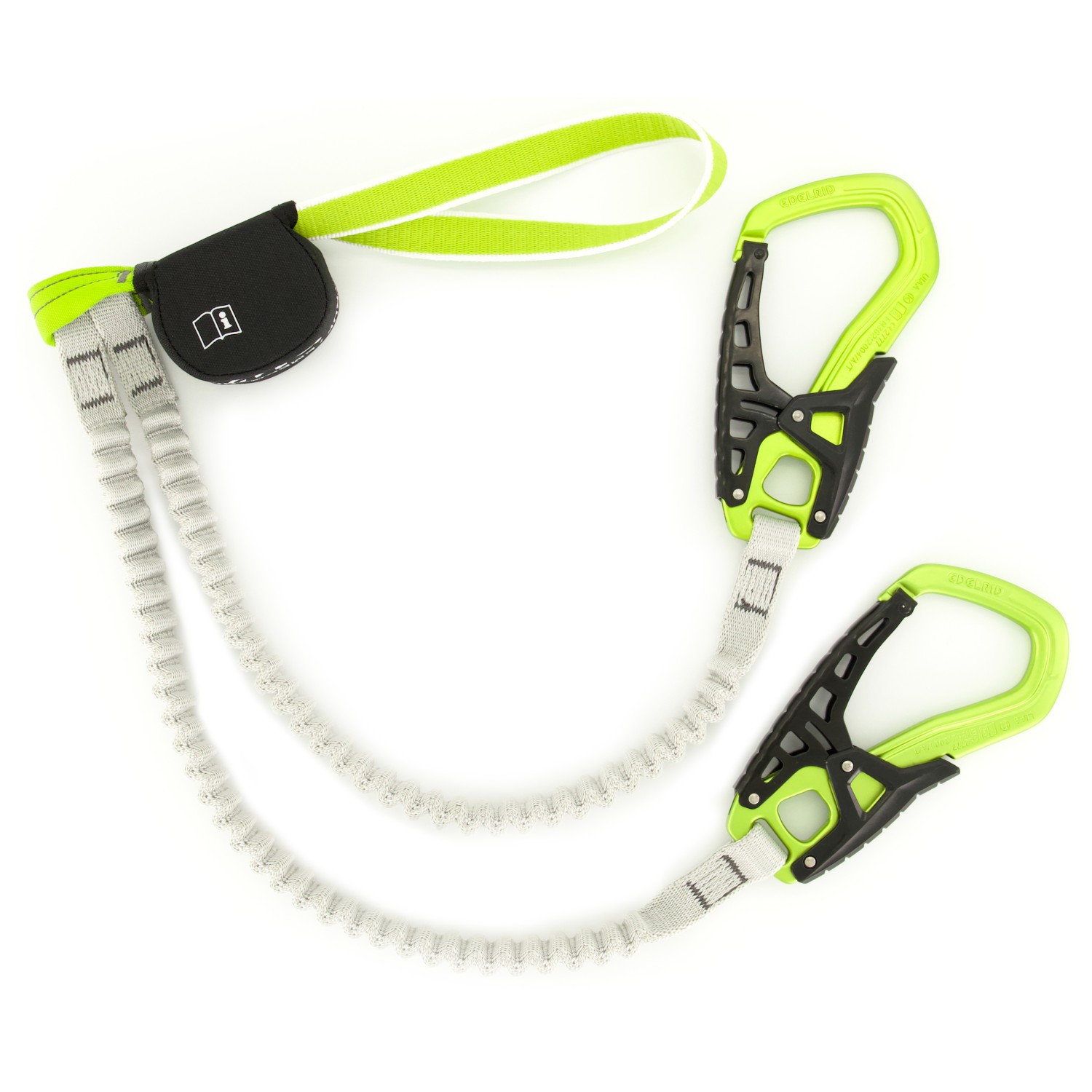
Edelrid, Camp or Black Diamond Via Ferrata Lanyard
A via ferrata lanyard connects the climber and their harness to the cables along the route. Its two arms and a hidden extra coil work as an energy absorption system in case of a fall. The two carabiners at the end of the lanyard clip into the cable. Make sure the carabiners are equipped with the palm squeeze mechanism. It’s the safest and most comfortable.
Shop on Amazon (Worldwide) / Backcountry (US)
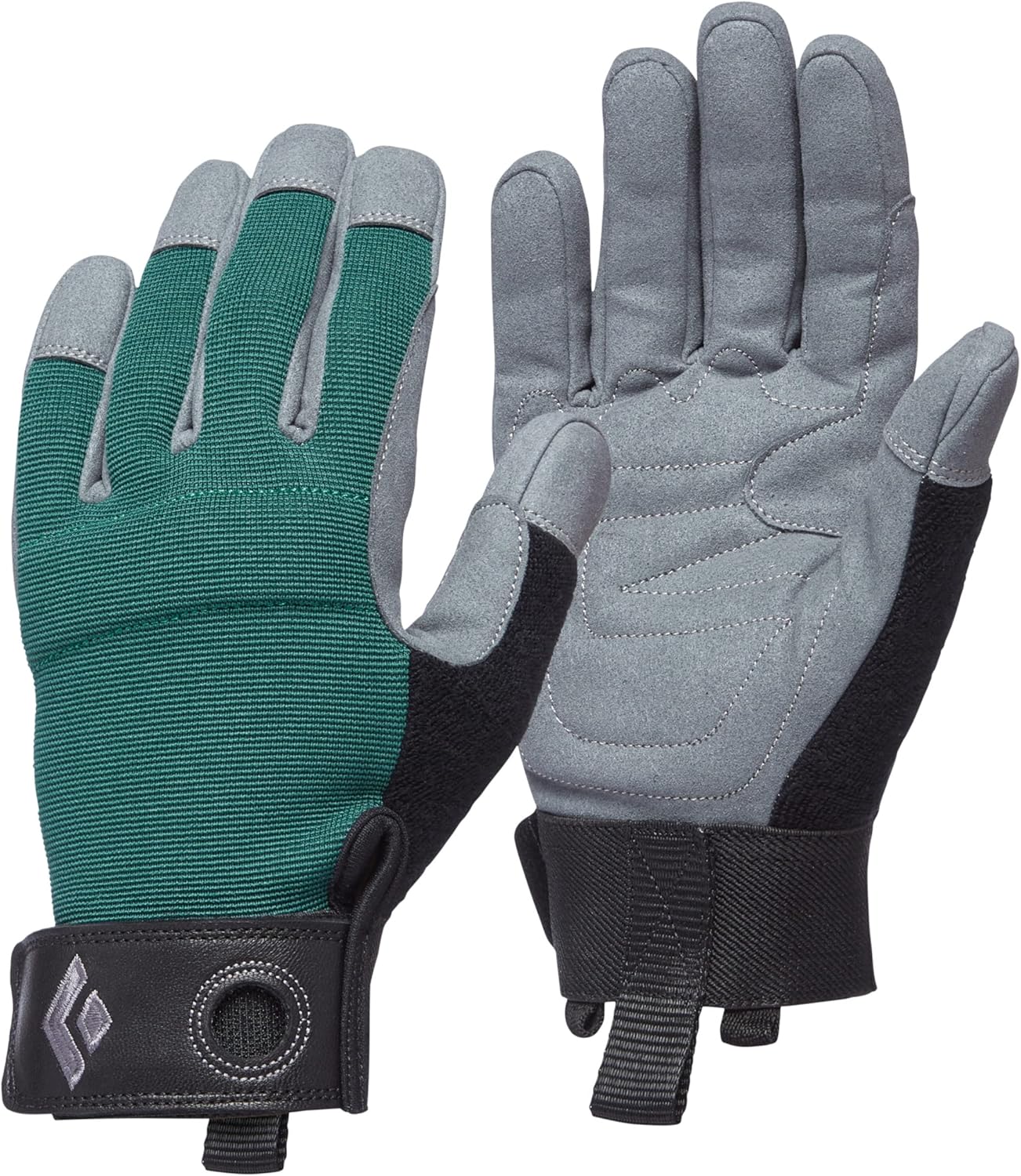
Black Diamond Crag Gloves
The gloves protect your hands from cuts and scratches you may otherwise get if you haul yourself on the cable without them. I prefer full-finger gloves for extra protection against blisters. If your hands sweat quickly, go for the fingerless version.
Shop on: Amazon (Worldwide) / Backcountry (US)
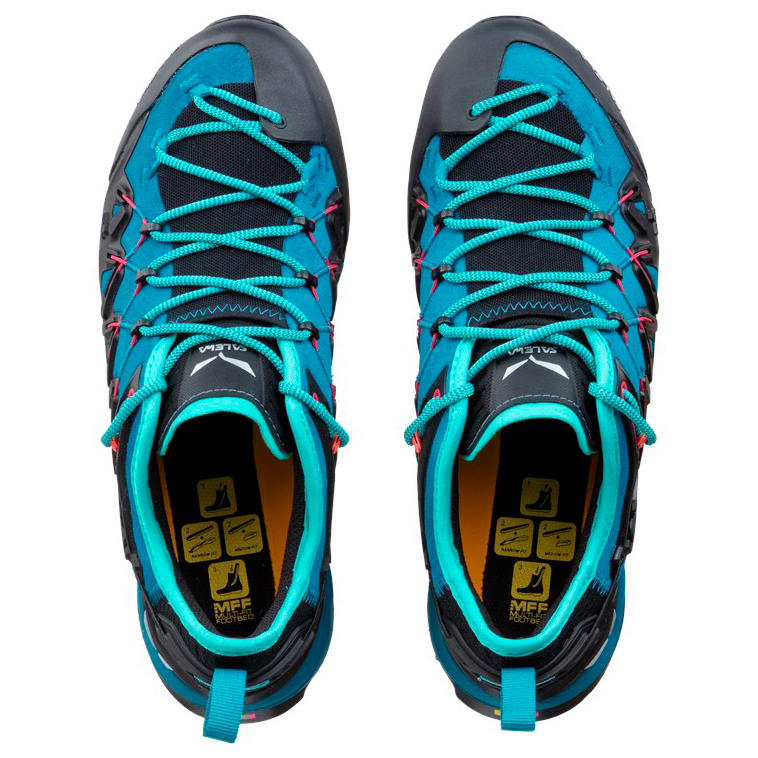
Salewa Wildfire Edge Approach Shoes
This is my go-to pair of hiking shoes for more accessible trails or via ferrata, where I don’t need extra ankle support. They provide excellent grip on the rock and are very durable.
Shop on: Amazon (Worldwide) / Backcountry (US)
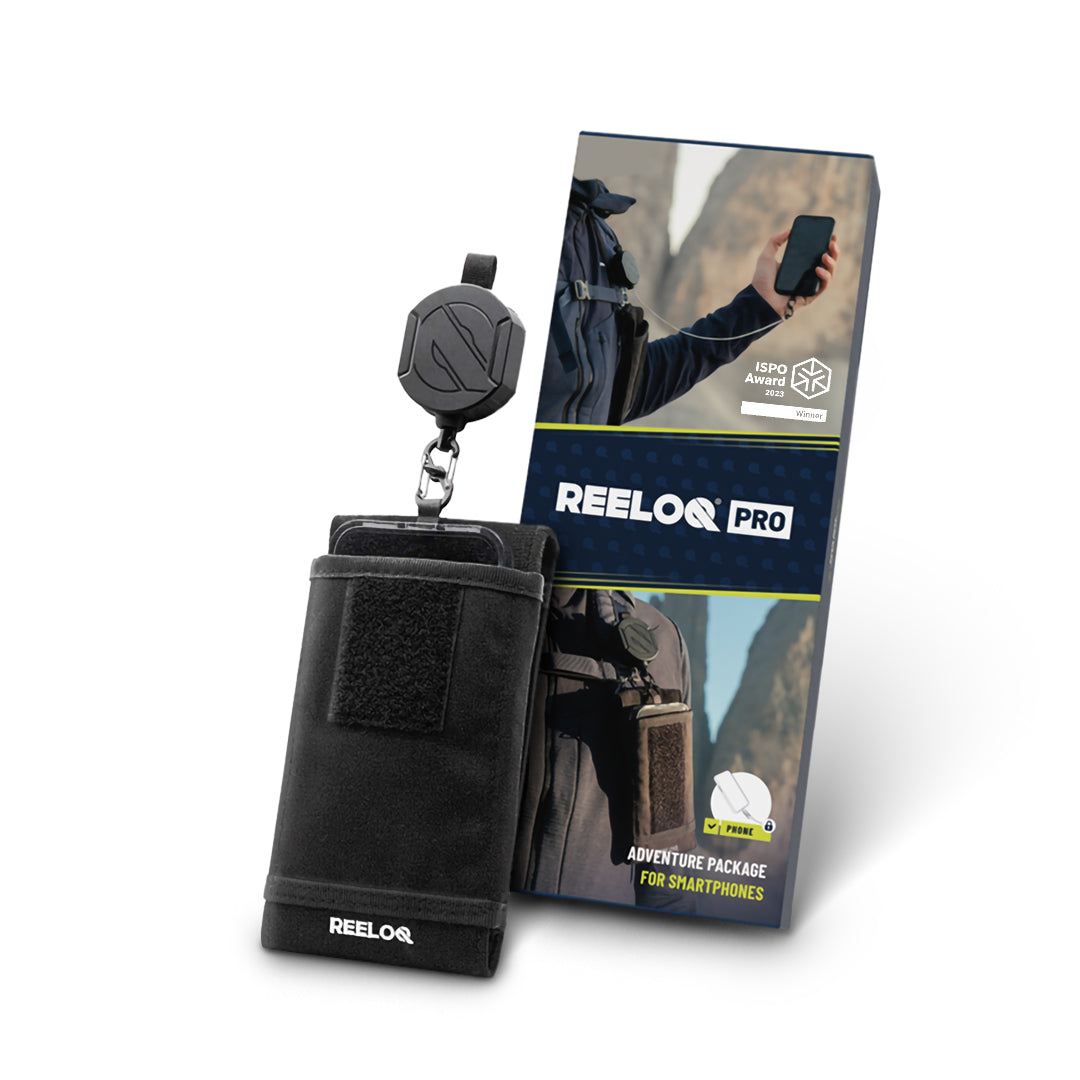
Reeloq Smartphone Securing System
If you want to take great photos on a via ferrata without worrying about losing your phone, Reeloq is the best tool for it. It’s a smartphone-securing system that allows you to use your phone on any adventure. This has been a great addition to my tool arsenal.
Shop on: REELOQ
Other via ferratas in the Rosengarten Mountain Group
- Via Ferrata Passo Santner
- Via Ferrata Catinaccio D’Antermoia (Kesselkogel)
- Via Ferrata Sentiero Massimiliano (Maximiliansteig)
- Via Ferrata Masare and Roda De Vael
More travel and hiking resources in the Dolomites
- Photography spots in the Italian Dolomites
- Regions in the Italian Dolomites
- Itineraries for the Italian Dolomites
- Via ferratas in the Italian Dolomites
- Day hikes in the Italian Dolomites
- Hut-to-hut treks in the Italian Dolomites
Support my website!
Hi Reader! If you found any of my articles about the Dolomites useful please consider using the affiliate links below (at no extra cost) when booking your holiday. Thank you
- Reserve your hotel with Booking.com
- Book your rental car with Discover Cars
- Buy your outdoor gear with Backcountry.com (US readers)
If you have any questions, leave them in the comments below!
Hi Marta,
Your website is truly a godsend for me – planning a Rosengarten circuit with my two boys this summer. I have a question – we are doing a mixture of regular hikes and via Ferrata’s over the 5 days 4 nights. We are currently staying in the following Rifugio
Nite 1) Rifugio Fronza Alle Coronelle Nite 2) Rifugio Re Alberto Nite 3) Rifugio Antermoia
Nite 4) ???? – my question is where would you stay the last night before going back down to Bolzano or Siusi? I tried to get a bed in Rifugio Alpe di Tires but they are fully booked. Thank you, Gavin
Hi Gavin. Thanks for the great feedback. You could either stay extra night in Rifugio Antermoia and on day 3 do Via ferrata Laurenzi in reverse. This VF can be done in both directions. This would be a nice option as you would be going lightweight with the essentials. Option two (if Laurenzi sounds too hard) would be to hike from Antermoia to Alpe Di Tires (ca. 2 h), do via ferrata Sentiero Massimiliano (with all your gear) and on decent instead of returning to Alpe Di Tires you continue to Schlernhaus. I hope that helps!
Thanks for the review! 2 questions:
1. I see this is rated 4c, and you mention it is advanced. My partner and I are new to Via Ferrata but are experienced lead climbing (trad and sport) in the USA. I see 4c is equivalent to 5.6/5.7 YDS, would you say that is accurate?
2. Could you do Laurenzi in the other direction (Antermoia to Alpe di Tires), or strongly recommend against it?
Hi Benjamin. Via ferratas are scrambling routes, not climbing. The hardest via ferrata should be easier than the easiest climbing route (maybe some really extreme ones rated E/F will compare to climbing routes, but I have never done those). I have zero climbing experience and I tackle the advanced routes without a problem so that should give you a good idea. Now for the direction, yes they can be done in both directions (both ways you have to climb up on down on a few sections). Have fun!