
One of my favourite things about planning a Dolomite trip is studying maps and analyzing how to connect via ferrata routes with overnight stays in mountain huts. The Sextener Dolomites are a paradise for iron paths, and this Monte Popera Circuit delivers six exciting via ferratas over four days.
Comprehensive Guide To Monte Popera Circuit
This guide is based on my experience gained in the Monte Popera Circuit. I hiked it together with my partner in September 2023.
The stats of the Monte Popera Circuit
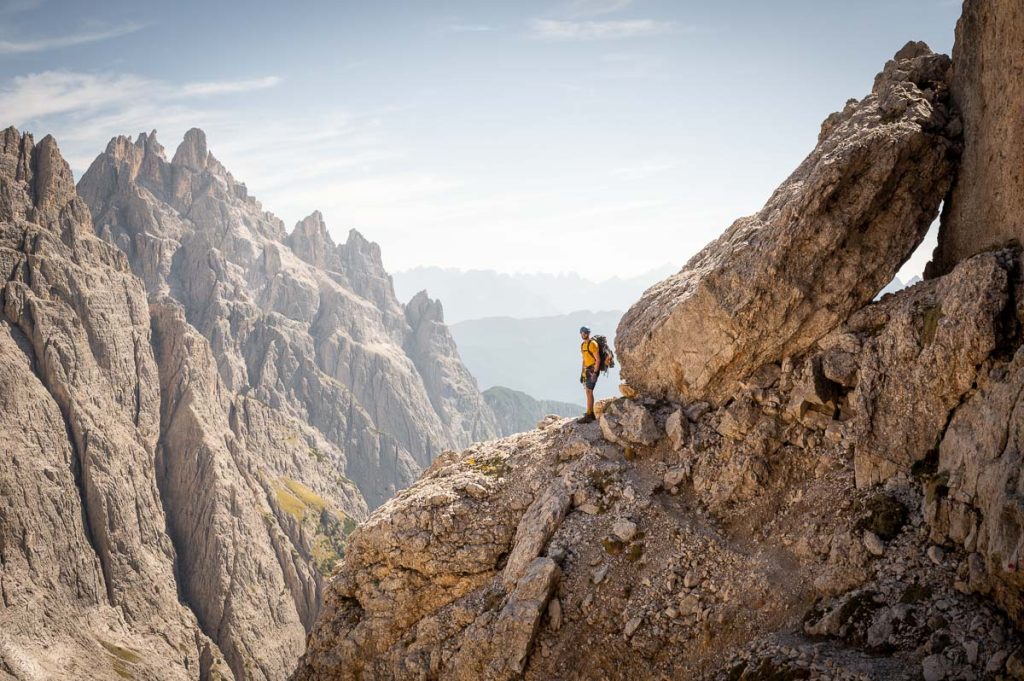
- Total Distance: 43.9 km / 27.3 mi
- Total Elevation Gain: 3565 m / 11700 ft
- Total Elevation Loss: 3540 m / 11650 ft
- Number of via ferratas along the route: 6
- Via ferrata difficulty level along the route: beginner to advance
- Days required: 3-4
- Map required: Tabacco no. 10 Dolomiti Di Sesto
When is it possible to do the Monte Popera Circuit?
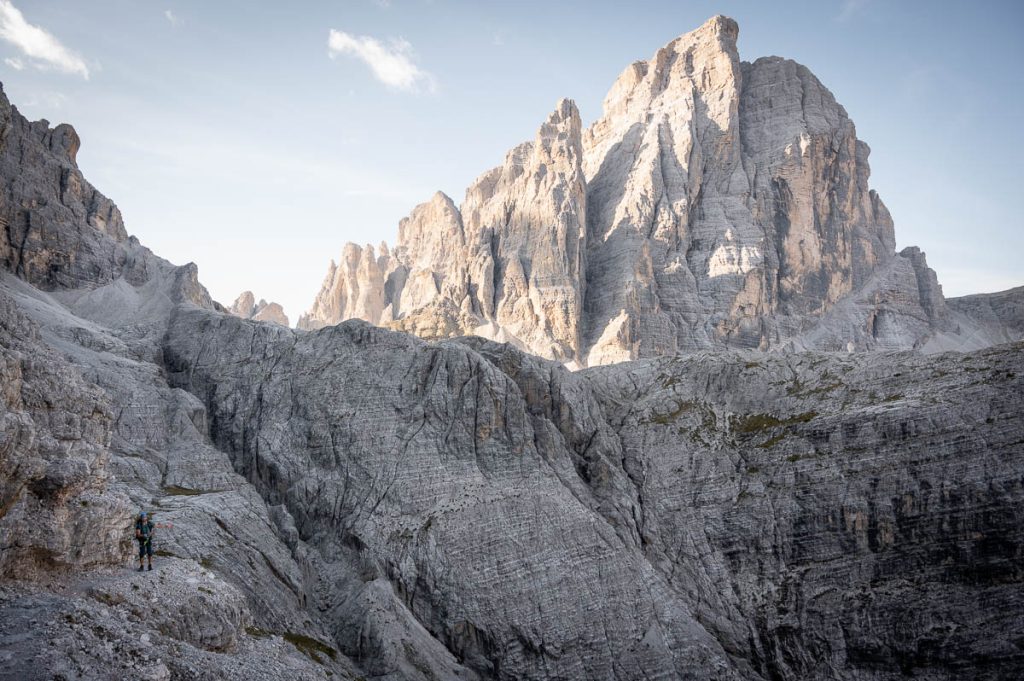
The timeframe for hiking and climbing the Monte Popera Circuit corresponds with the opening times of the huts. They vary slightly from year to year. The rifugios are usually open between the middle of June and the end of September.
I did this route at the end of September, right at the very end of the season, and I was graced with four straight days of perfect weather, with bluebird skies and unseasonably warm temperatures. The busiest times usually fall between July and August, so if you are going then, make sure to book the huts well in advance.
How challenging is the Monte Popera Circuit?
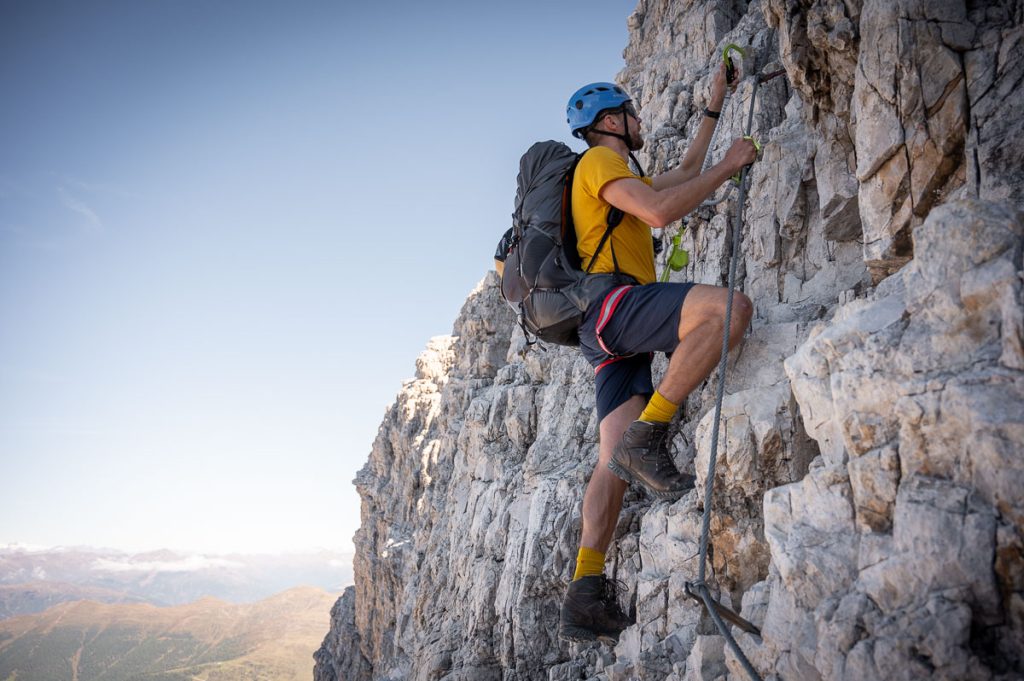
Monte Popera circuit is one of many hut-to-hut treks I completed in the Dolomites, and I must say it was also one of the toughest. That said, if you come well prepared, have done some via ferratas before, and have enough stamina to be on the move for 8-9 hours per day, then you will love this circuit.
Via ferrata routes along the Monte Popera circuit are mostly either beginner or intermediate level, apart from day two, when you cross two advanced via ferratas. This is undoubtedly the most demanding day on this traverse.
How to get to the trailhead
The trailhead for the Monte Popera Circuit is in the Fiscalina Valley. The two nearest towns are Sesto and Moos, both of which can be reached via public transport.
By car
You can drive your car to the bottom of the gondola station and leave it parked there for the hike. There are overnight parking restrictions in place, but we asked a person working at the ticket office, and she confirmed that it was okay for us to leave the car parked there overnight as long as we were not camping in it. In her words, the restrictions applied to campervans, particularly during the busy summer season.
IMPORTANT: Reaching Val Fiscalina with a private car during the peak summer season is restricted. For more info, visit the official tourism board website.
TIP: If you need to rent a car for the trip, check out Discover Cars. It’s the best rental car search engine that compares prices, so you don’t have to check providers individually.
By bus
Fiscalina Valley has excellent public transport connections during the summer season. Bus no. 440 or 446 runs at regular intervals, starting in Dobiacco and passing through Sesto and Moos. The bus stop where you have to get off is called Kabinenbahn Rotwand. The stop takes its name after the gondola station next to it.
TIP: Use the local Sued Tirol Mobil website to search for bus connections.
Croda Rossa Gondola (Kabinenbahn Rotwand)
Taking the gondola up to the Rotwandwiesen high alpine plateau is the last step that separates you from standing at the trailhead of the Monte Popera Circuit. The gondola runs from approximately mid-June until the first week of October. You can find its exact operating times here.
TIP: Buy the roundtrip ticket right away to save money. The ticket is valid for 10 days from the purchase date. You will be taking the same gondola down at the end of the trip.
Where to stay the night before
Best Value
Very modern hotel with extensive wellness facilities, phenomenal food, and beautiful interiors.
Top Rated
A cozy small B&B nestled in the mountains with a restaurant serving local produce
For Luxury Fans
Each room at the Leitlhof Hotel has a typical mountain feeling created by wooden furniture and wooden floors.
Monte Popera Circuit: Day-by-day breakdown
Above, you can see the map of the Monte Popera Circuit. I measured the distances, elevation gain, and walking time with my Garmin GPS watch. I decided to mark each day with a separate colour as follows:
- BLUE: Day 1
- YELLOW: Day 2
- PURPLE: Day 3
- RED: Day 4
Day 1: Rotwandwiesen to Rifugio Berti along Via Ferratas Croda Rossa and Zandonella
- Distance: 9.8 km / 6.1 mi
- Elevation Gain: 1080 m / 3530 ft
- Elevation Loss: 1040 m / 3420 ft
- Time Required: 7-8 hours
- Path Numbers: 100, 101
Stage 1: Rotwandwiesen to Croda Rossa Summit
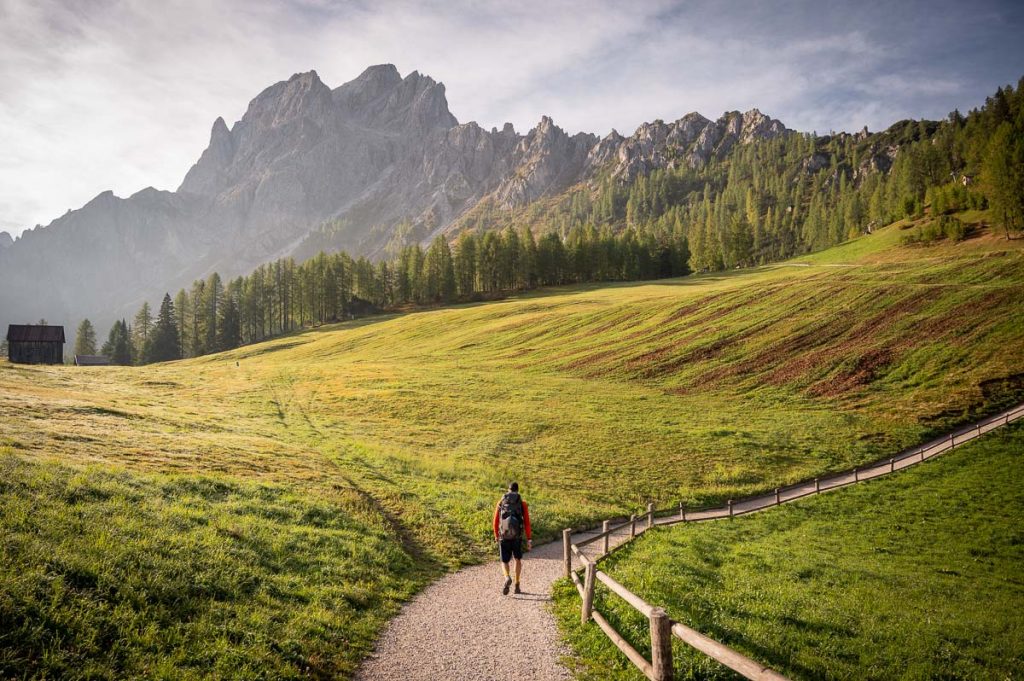
At the top of the Rotwand gondola station, you will first notice a big wall with maps of the area. The first signs pointing to Via Ferrata Croda Rossa are on its left side.
At first, you will follow a wide gravel path across high alpine pastures (see photo above). Monte Croda Rossa (Rotwandspitze), today’s summit objective, rises ahead of you.
After about 20 minutes, the path veers right and starts climbing into the thick larch forest. You will come across a lovely viewing platform from where you can look down into the Fiscalina Valley. 1.7 kilometres and 400 meters of elevation gain into the hike, the path veers off again, this time to the left.
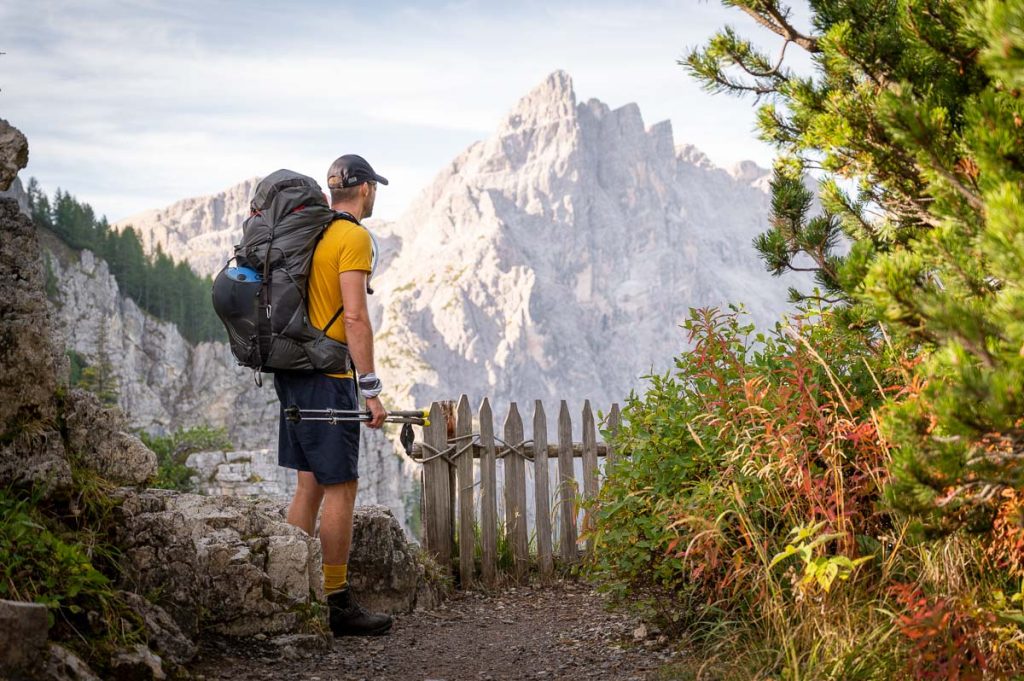
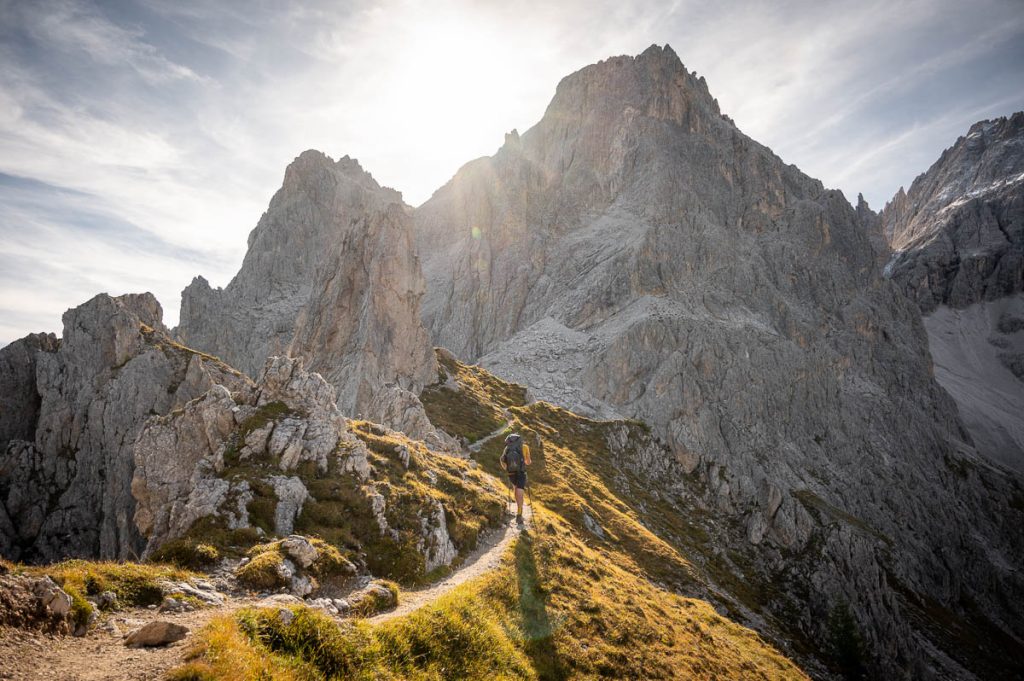
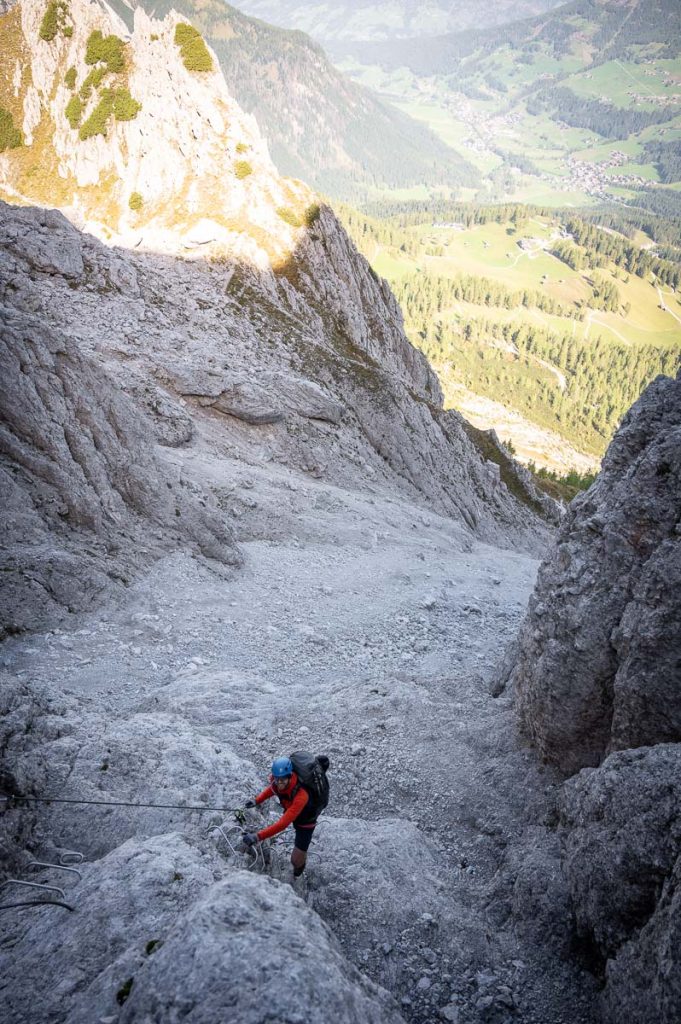
The first cable-protected section begins after 1.5 hours, 2.7 km into the hike, and 596 meters of elevation gain. The climbing remains at a beginner level, and the passages with cables are pretty short. The route to the summit is mostly along scree slopes, interspersed with three short via ferrata sections.
Via Ferrata Croda Rossa is full of remnants from World War I. Sometimes, you will come across old barbed wires or wooden beams decayed from over 100 years of brutal mountain weather. The higher you climb, the more caves dug by soldiers during the war you will be able to see.
The summit of Croda Rossa is relatively small, with little space for seating or taking photos. There is a little logbook in the box on the summit cross, where you can enter your name and a comment about the views.
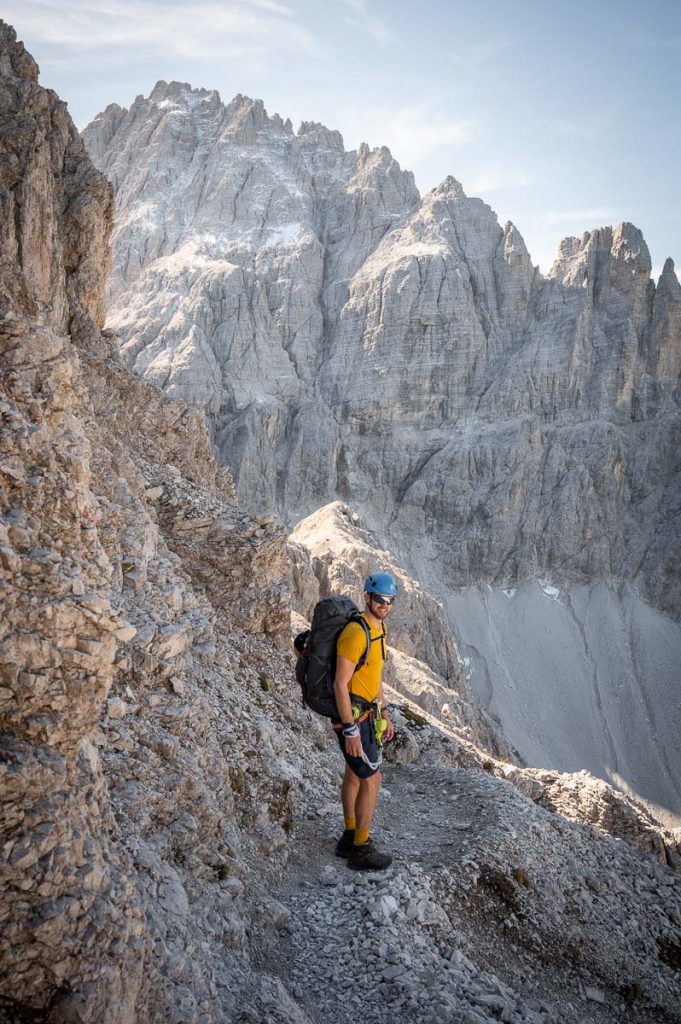
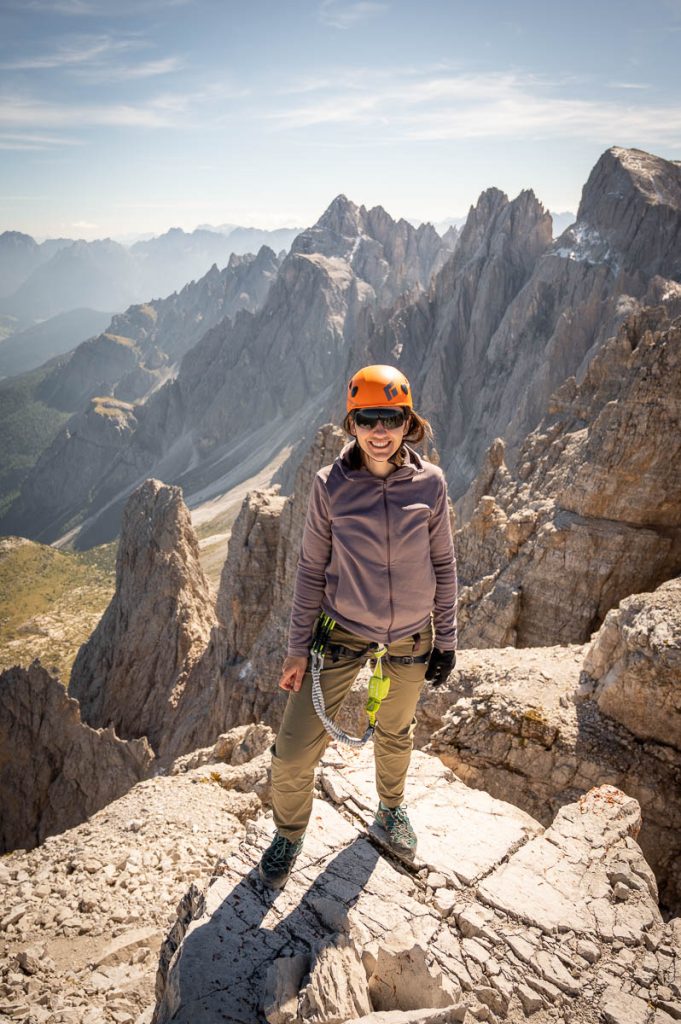
Once we made it to the summit, we used the Peak Finder app to recognize some of the peaks we were looking at. To our great surprise, Triglav, the highest peak in Slovenia, was visible at a far distance. Other peaks we could also spot included Olperer, Großvenediger, and Großglockner, the highest mountain in Austria.
Stage 2: Croda Rossa Summit to Rifugio Berti along Via Ferrata Zandonella
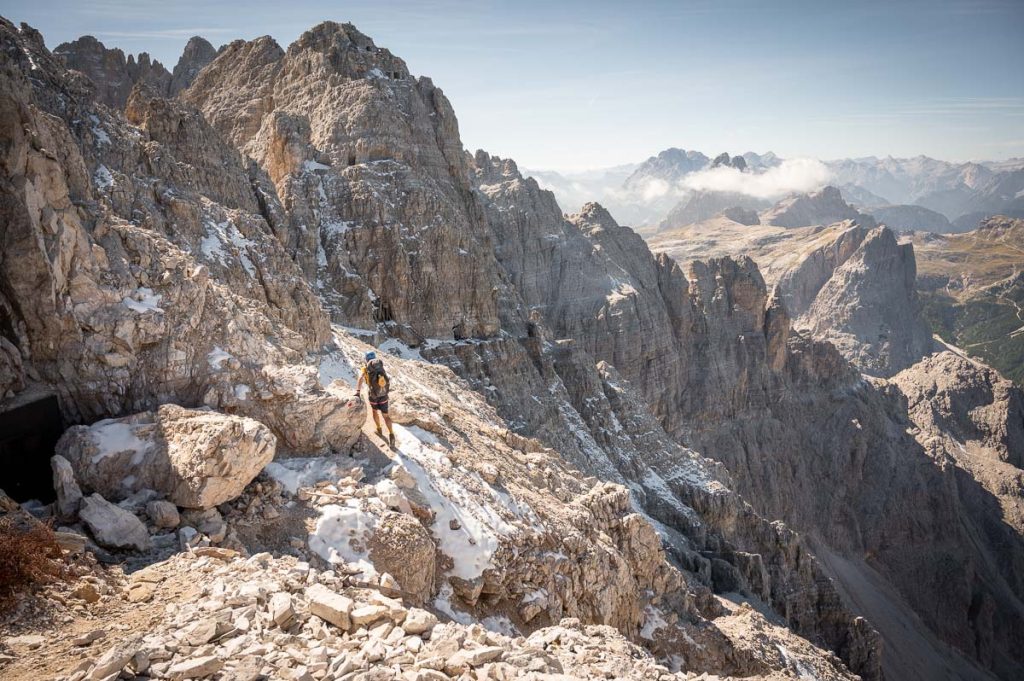
Keep your via ferrata gear on, you will need it very soon for the second stage of the first day of Monte Popera Circuit. Retrace your steps from the Croda Rossa summit until you see a sign pointing to Via Ferrata Zandonella.
This is the more challenging part of the day as it involves downclimbing along the cables. Take extra care, and if you are travelling in a group, keep enough distance between one another as there are plenty of loose rocks along the path.
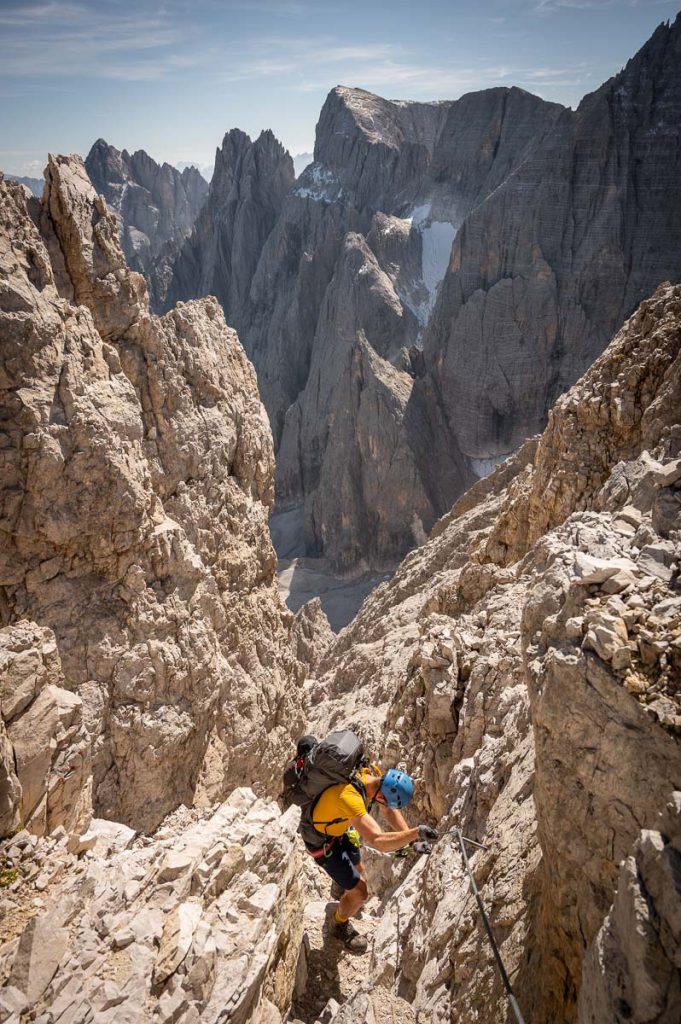
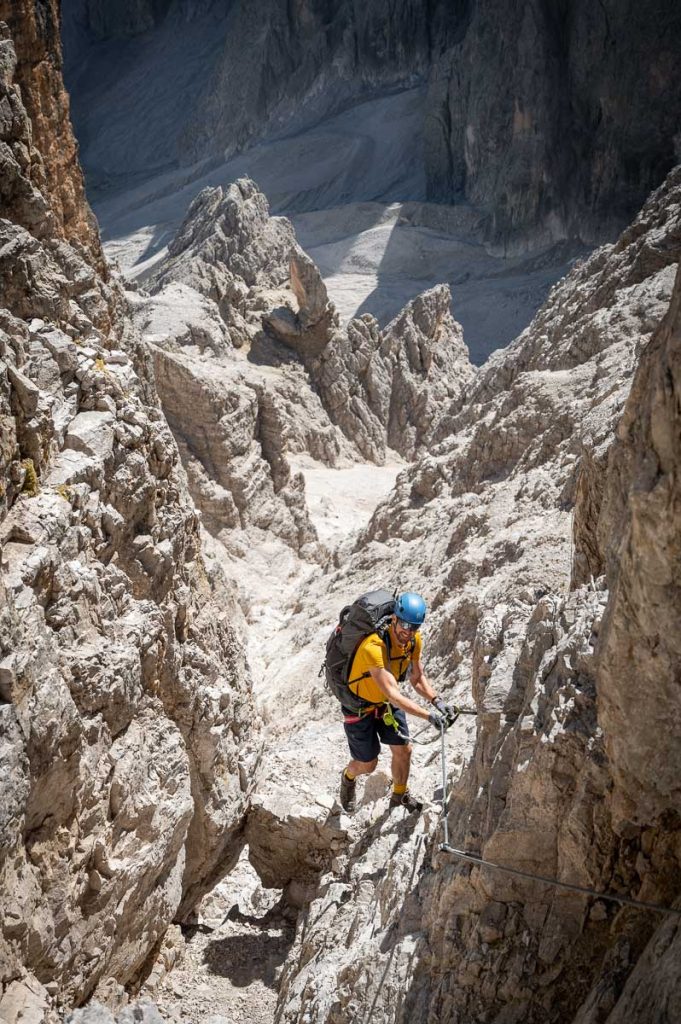
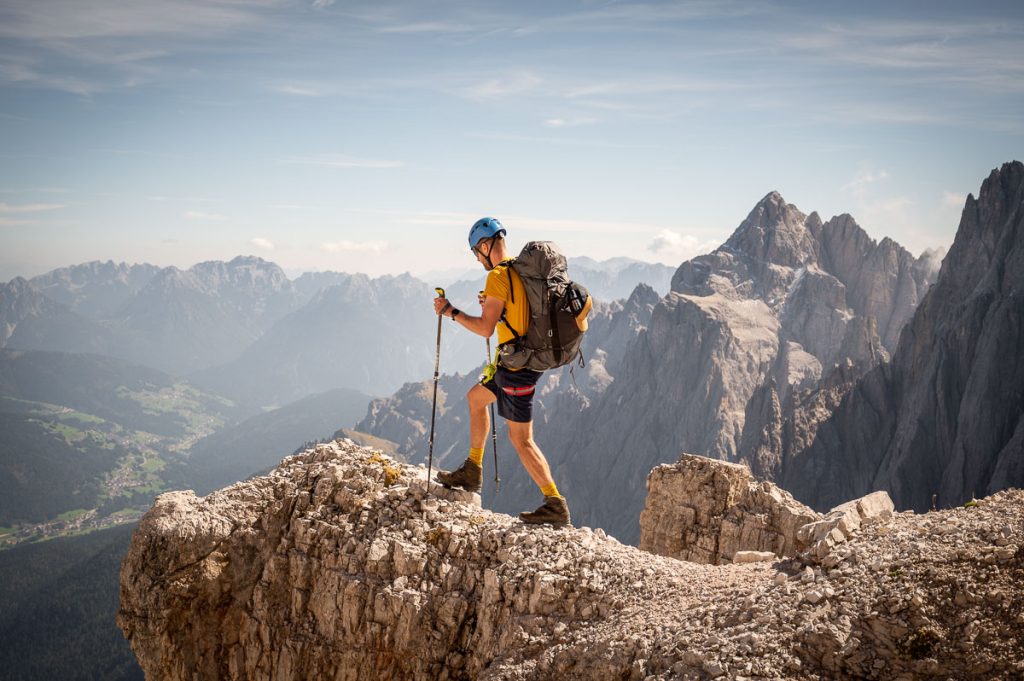
Once you descend from the via ferrata you will find yourself in a narrow gully. The Berti hut is visible from a far distance. Continue hiking down in the direction of the small alpine lake visible below. Pay special attention to the red markings along the path. It is easy to lose them from sight.
After the lake, the path flattens a bit and becomes much more enjoyable. The scenery is mind-blowing, with jagged peaks all around you.
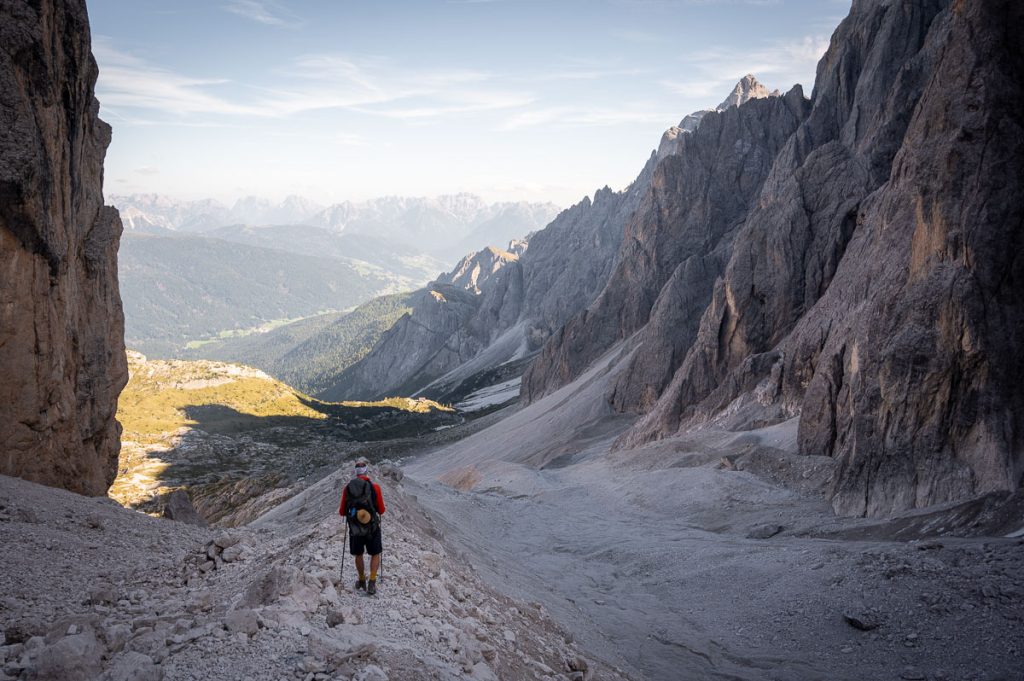
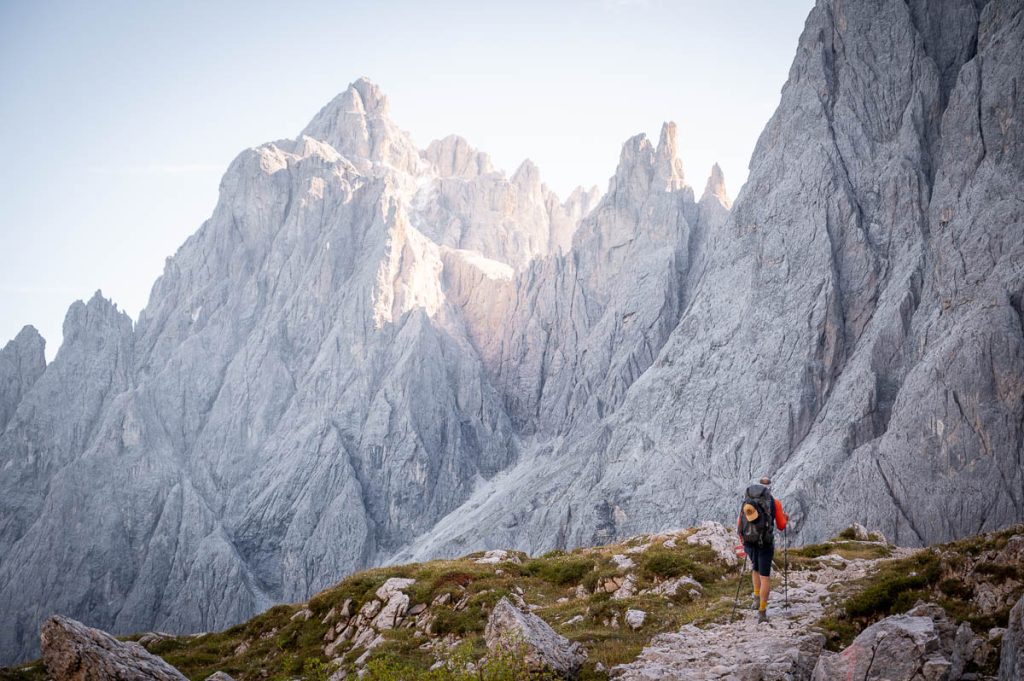
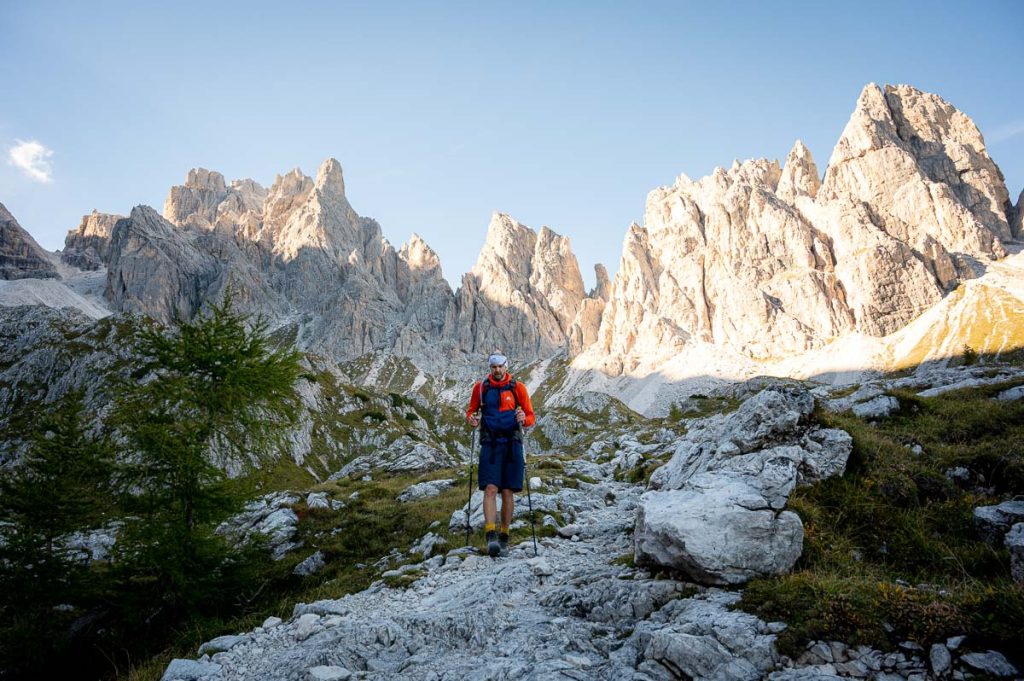
This was probably my favourite part of the day, not counting the summit views. Another great thing about it was that, once we left the summit of Croda Rossa, we didn’t meet another person on the trail until we arrived at the Berti Hut.
Night 1: Rifugio Berti
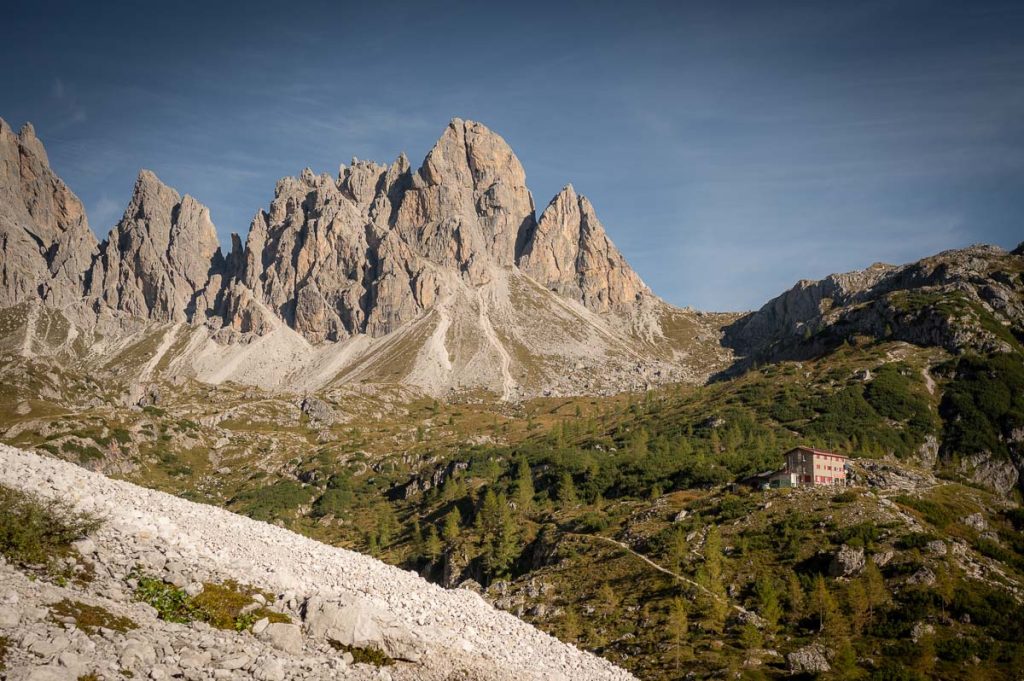
Built underneath the jagged Popera group peaks, Rifugio Berti is a sight to behold. Bookings for the summer season open in February. You can reserve a spot via a booking system directly on their website.
| Club Alpino Italiano member (CAI) | Price/night (half board) | Price/night for non-members | Summer season 2025 opening times |
| YES | 62 Euros | 78 Euros | June 14 – September 28 |
Day 2: Rifugio Berti to Rifugio Carducci along Via Ferratas Roghel and Cengia Gabriella
- Distance: 13.5 km / 8.4 mi
- Elevation Gain: 1170 m / 3850 ft
- Elevation Loss: 820 m / 2690 ft
- Time Required: 8-9 hours
- Path Numbers: 110, 103
Stage 1: Via Ferrata Roghel
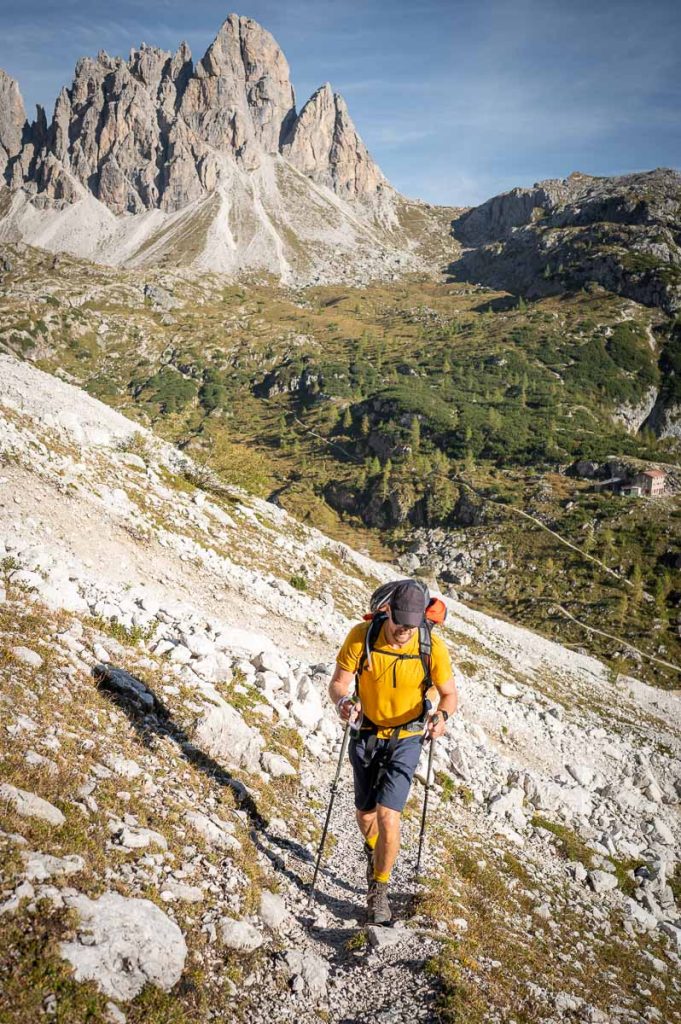
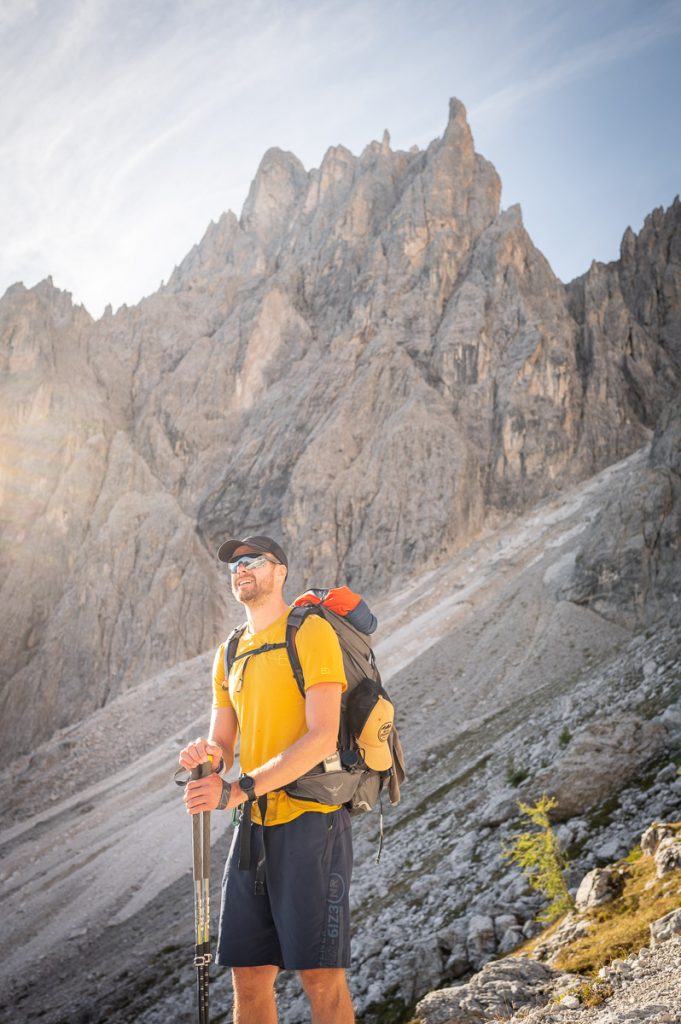
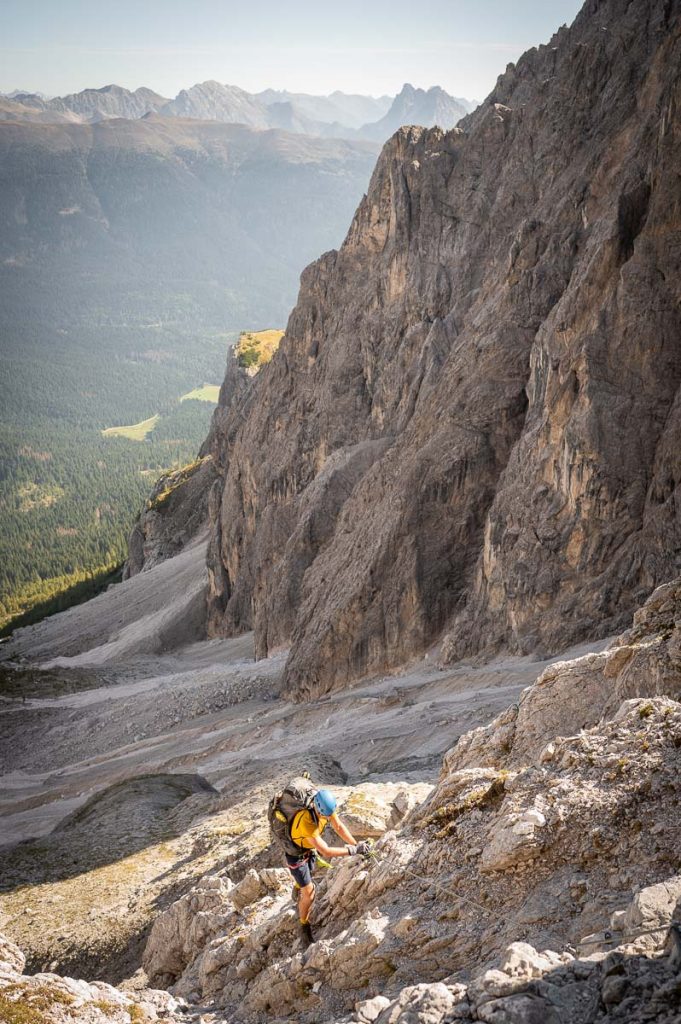
Don’t let the mere 13.5 kilometres fool you. Day 2 of the Monte Popera Circuit is the toughest of them all. Today, you will be circling Monte Popera along two advanced via ferratas: Roghel and Cengia Gabriella.
From Rifugio Berti, follow the path downhill, then cross the stream and climb the steep scree slope. Sometimes, the route is hard to follow, so pay attention to the red marks painted on the rocks. After about 1.5 hours, 430 meters of altitude, and 1.7 kilometres, you will reach the start of the cable-protected section.
Via Ferrata Roghel is challenging. It mostly leads through a gorge. At one point, there was a slight overhang that we had to tackle. The route leads to a narrow saddle before descending on the other side. It took us approximately 1 hour (1.33 km, 185 meters in altitude) to reach the saddle.
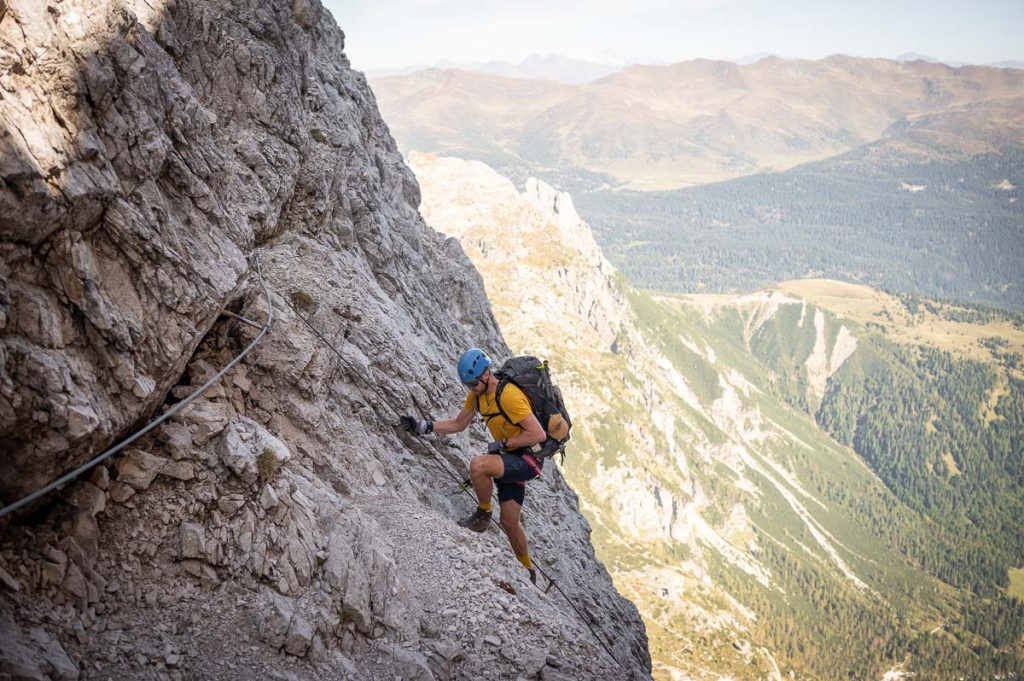
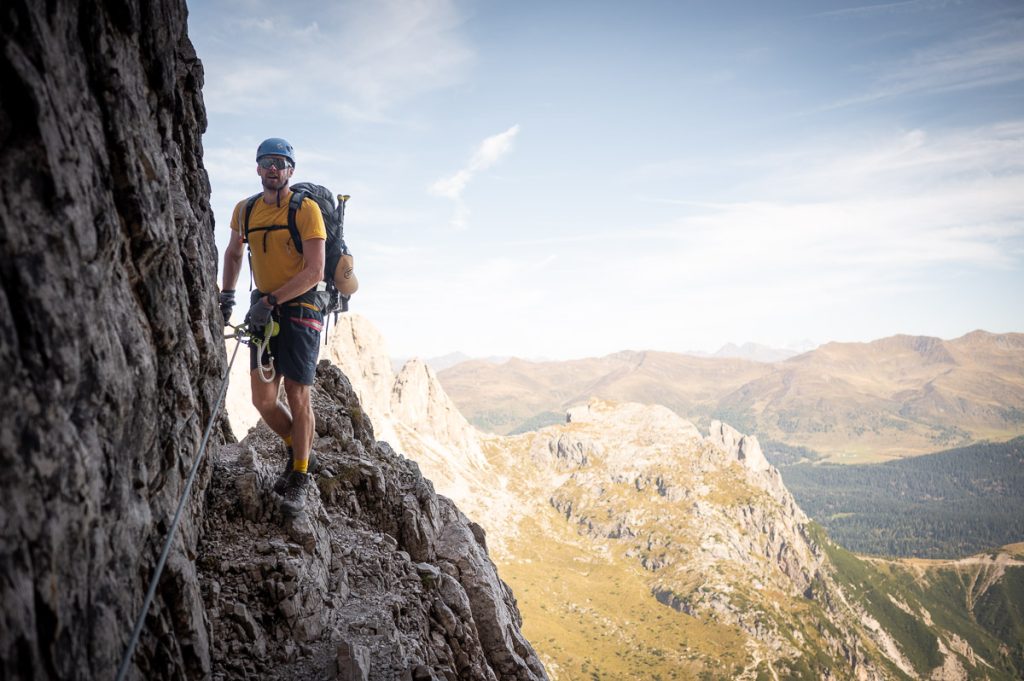
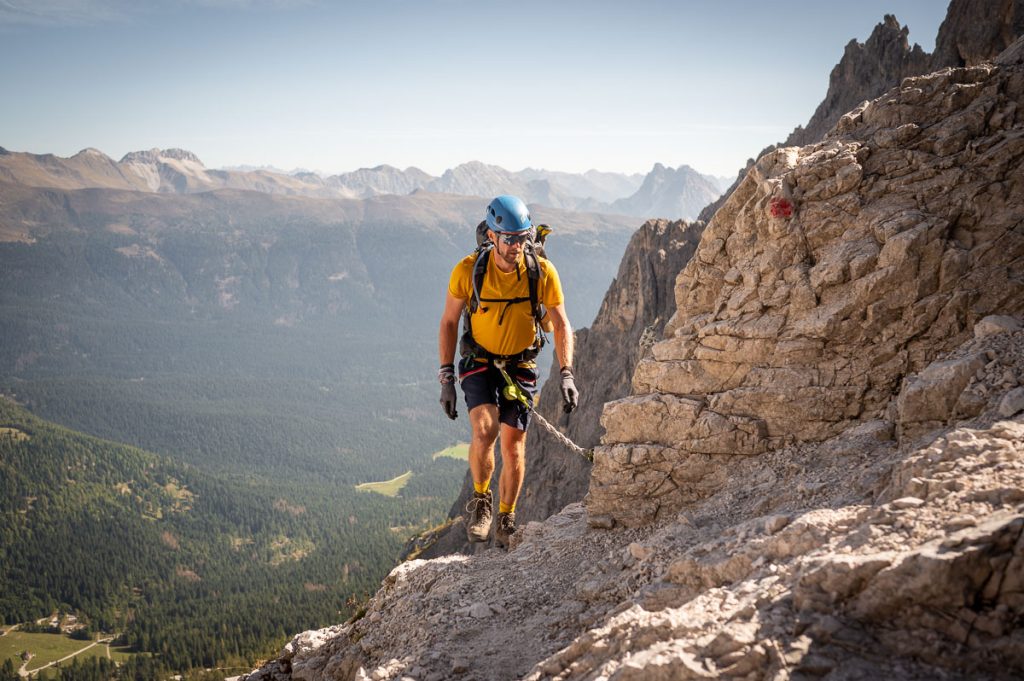
The downhill climb on the other side of the saddle was also quite steep and required long steps. The blazing heat and sun exposure made it even harder. After 50 minutes and 232 meters down, we reached the lowest point.
Another short ascent along the cables takes you to a scree gully. In the distance, to your left, you can spot a small alpine red Bivouac called Battaglioni Cadore. This can be used as an emergency shelter should the weather turn nasty.
Stage 2: Via Ferrata Cengia Gabriella
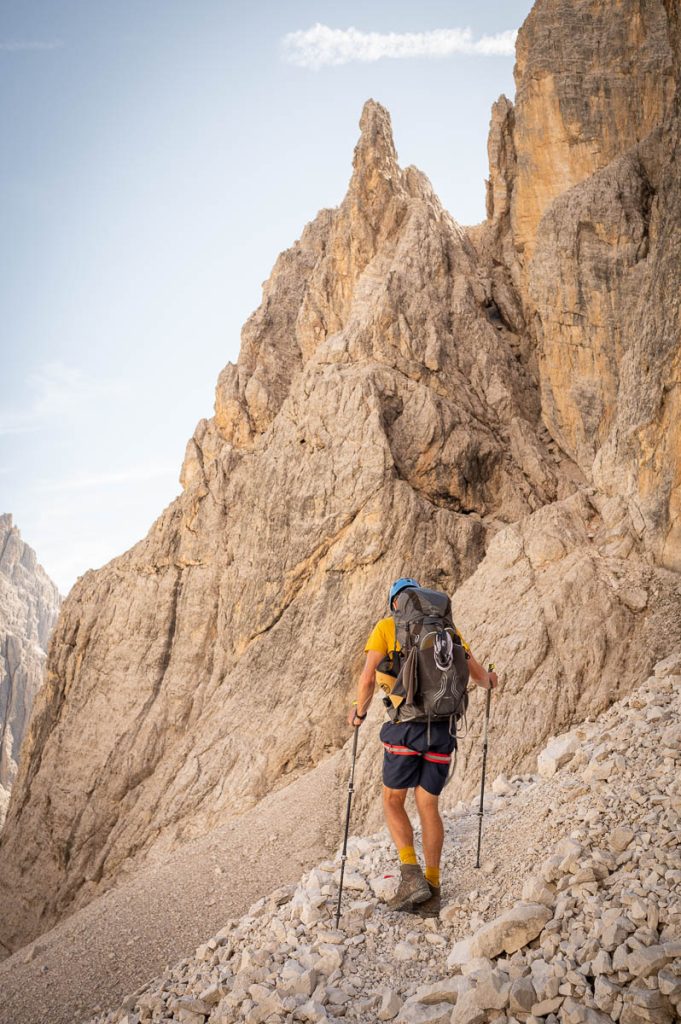
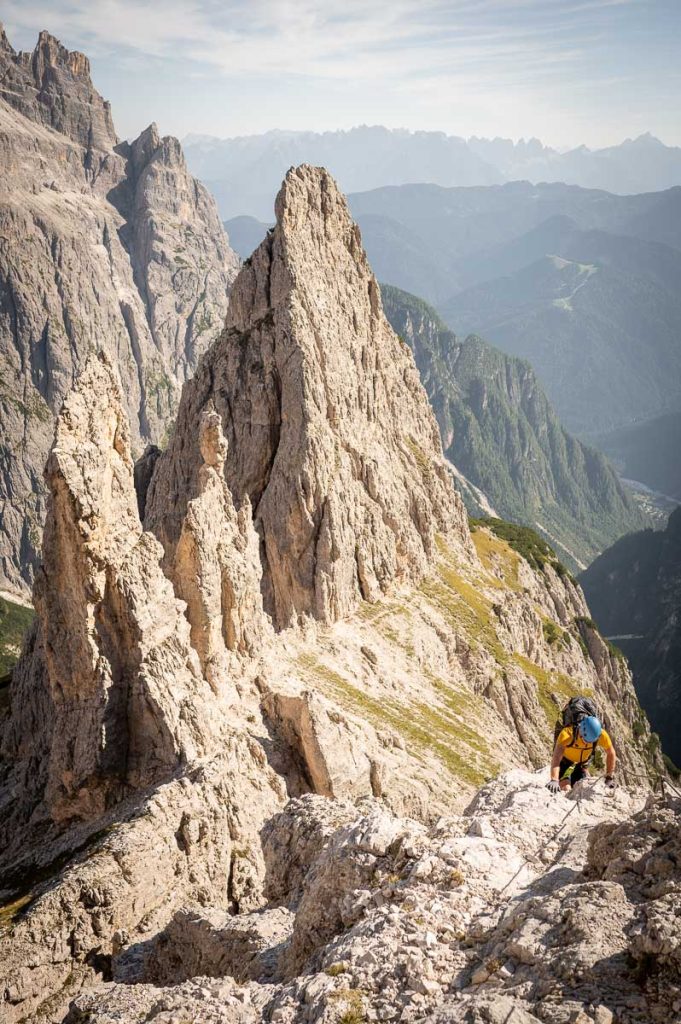
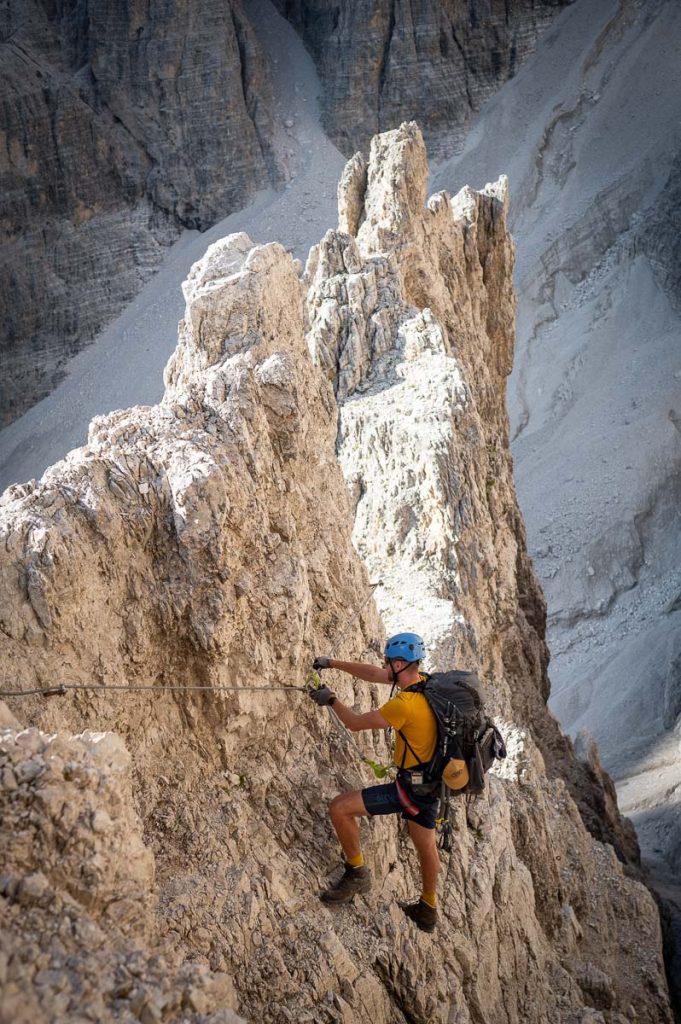
Continue across the scree gully following the signs for Rifugio Carducci. Once you reach the other side of the gully, you will start climbing again and traversing along many narrow ledges.
Though technically via ferrata Cengia Gabriella was easier than Roghel, many unprotected passages, with a few hundred meter drop to the side, made me uneasy. Mainly because I was becoming tired, and we still had quite a long way to go. Staying focused was becoming more challenging.
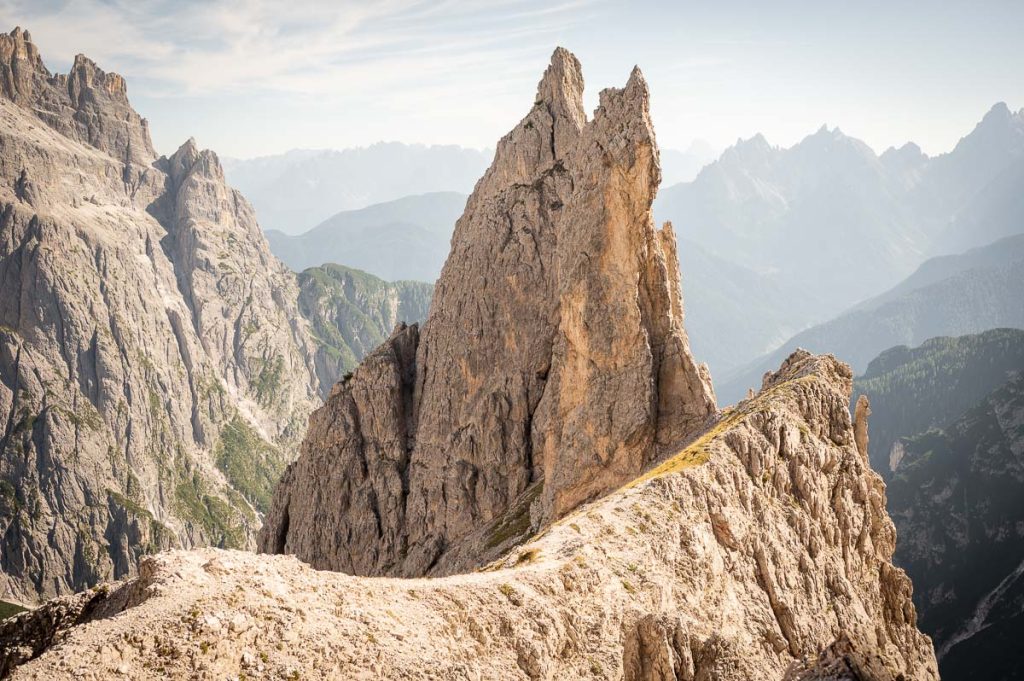
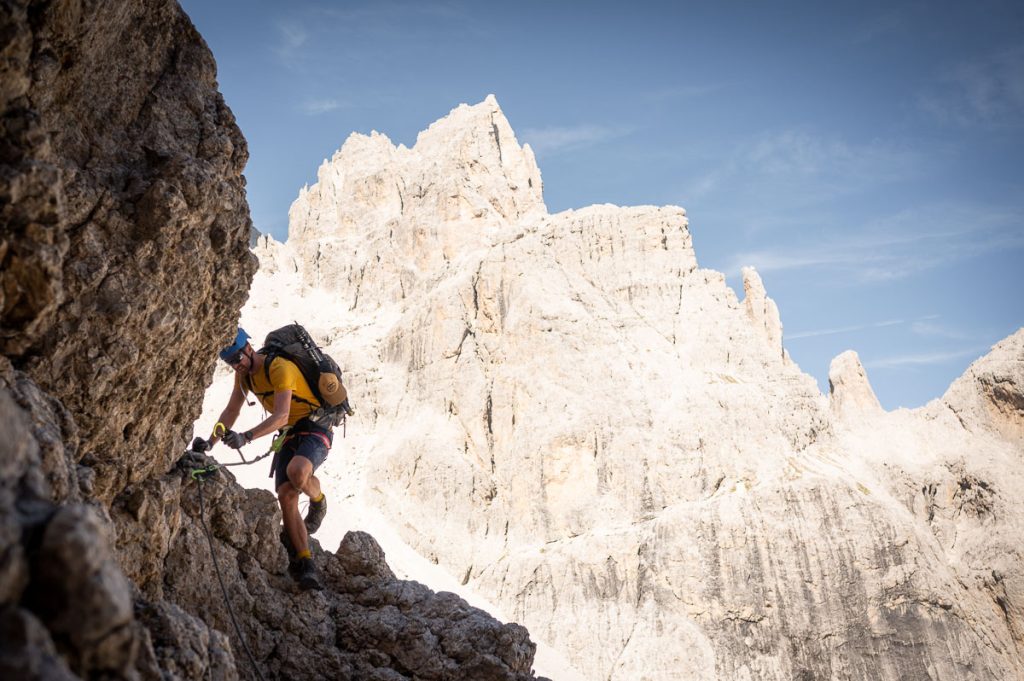
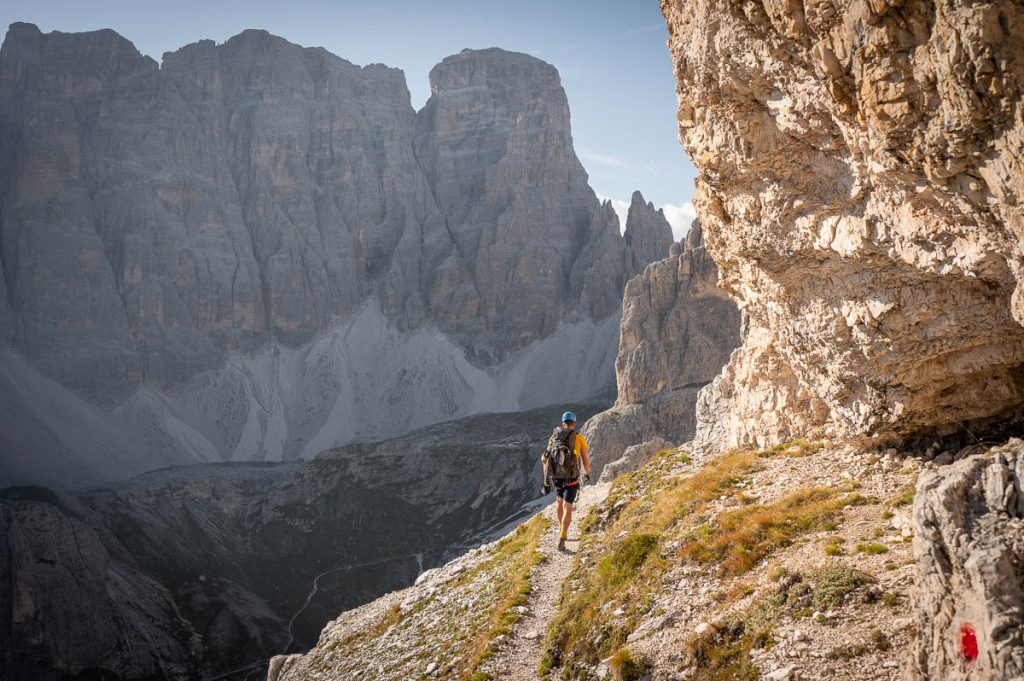
Eventually, Rifugio Carducci and the towering Croda Dei Toni (Zwölferkofel) will appear far away (see photo above). Though it seemed deceptively close, we still had quite a way to go before we reached it.
The last section of the Via Ferrata was very steep and required downclimbing to another scree gully. The path then crosses the gully and joins path no 103. The last few hundred meters of the trail ascend through the Giralba Alta Valley up to Rifugio Carducci.
Night 2: Rifugio Carducci
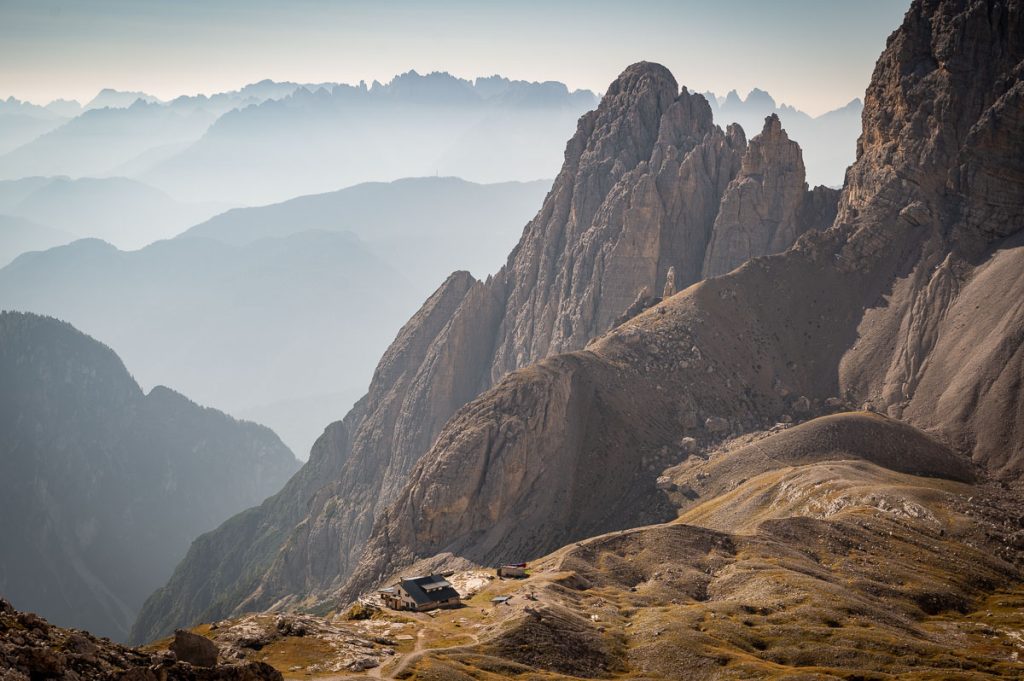
Rifugio Carducci was a welcomed sight after 9 hours of hiking and scrambling. Built on the edge of a small plateau, it has beautiful views of the Giralba Alta valley. You can reserve the hut by completing the request form on their website.
| Club Alpino Italiano member (CAI) | Price/night for Alpine Club members (half board) | Price/night for non-members | Summer season 2025 opening times |
| YES | 52 Euro | 62 Euro | June 20 – the start of October |
Day 3: Rifugio Carducci to Rifugio Zsigmondy Comici along Via Ferrata Severino Casara
- Distance: 9.8 km / 6.1 mi
- Elevation Gain: 615 m / 2020 ft
- Elevation Loss: 680 m / 2250 ft
- Time Required: 5-6 hours
- Path Numbers: 107, 103
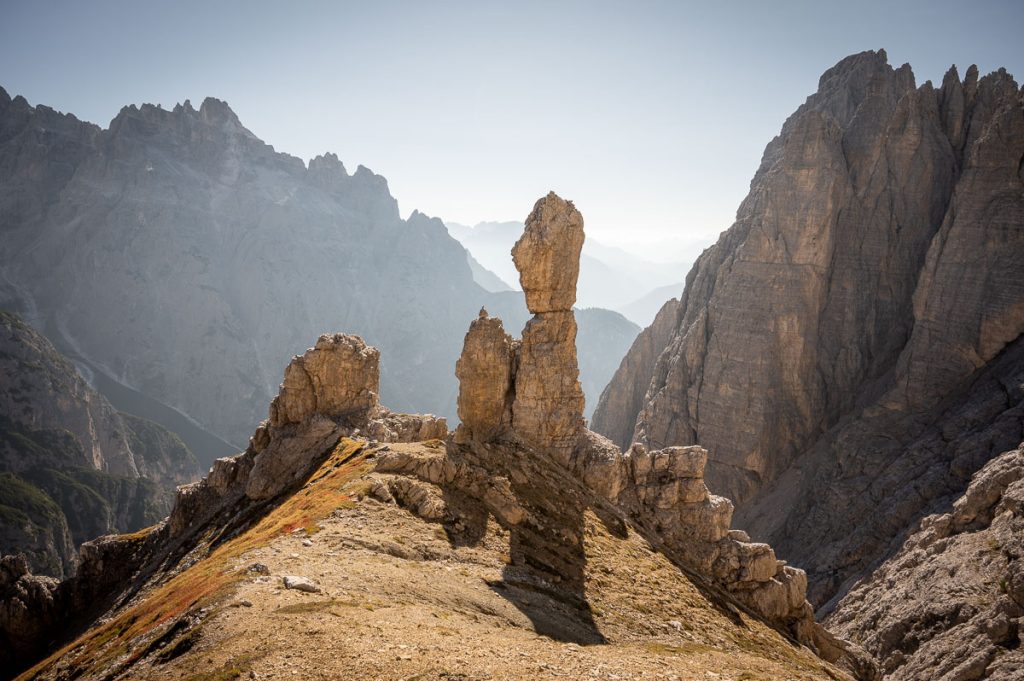
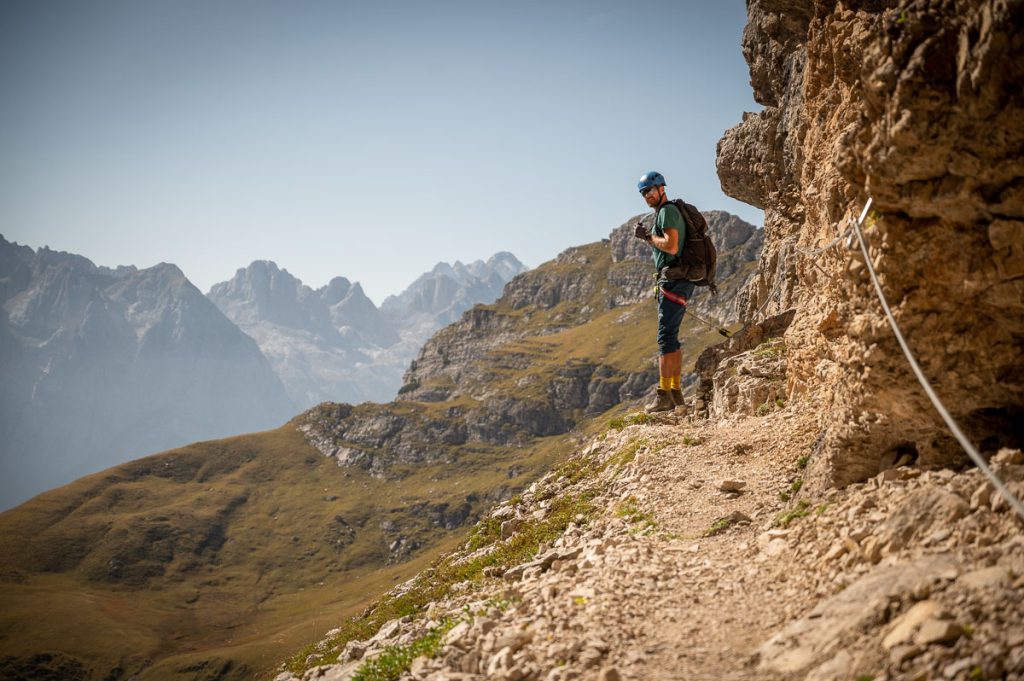
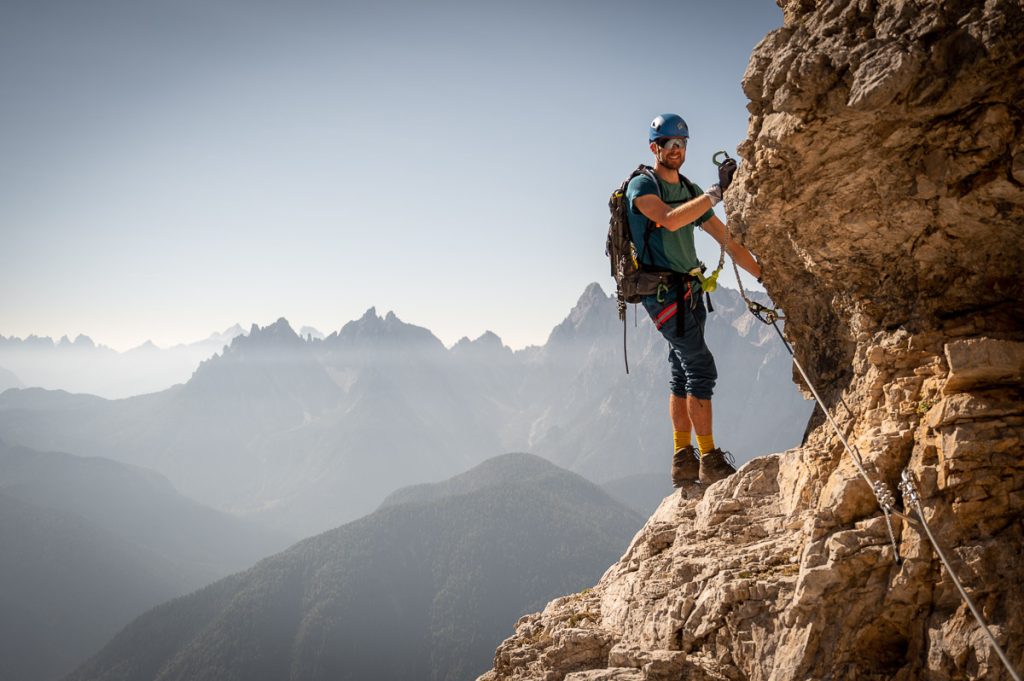
After two intensive days on the Monte Popera Circuit, it is time for something slightly more manageable. Today, you will tackle yet another via ferrata circling a famous summit in the Sexten Dolomites – Croda Dei Toni.
The official name of today’s via ferrata is Severino Casara, but it is often called Zwölferkofel, which is the German name of Monte Croda Dei Toni.
The route circles the mountain, crossing a few saddles. The via ferrata stages are mostly beginner with a few more advanced passages. You will also cross a couple of small suspension bridges.
From Rifugio Carducci head onto path no. 107 following signs for Bivacco dei Toni. The cable-protected section starts 30 minutes and 1.14 km into the hike. The first suspension bridge appears shortly after. The via ferrata sections intertwine with the hiking sections. Hopefully, you will not be tired of walking on a scree after the previous day because today will be no different.
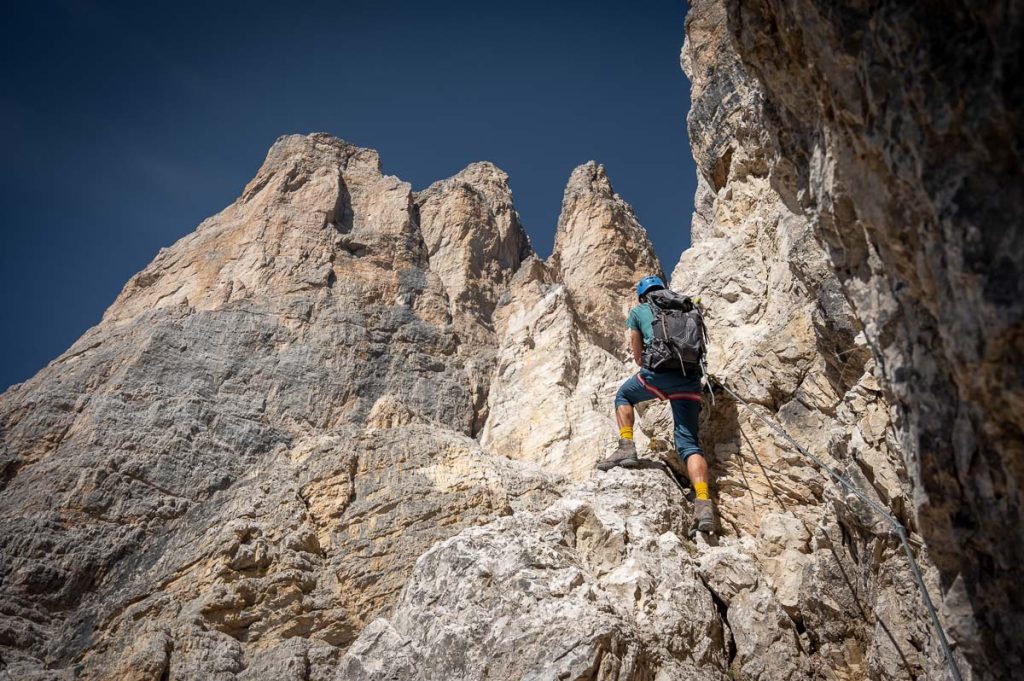
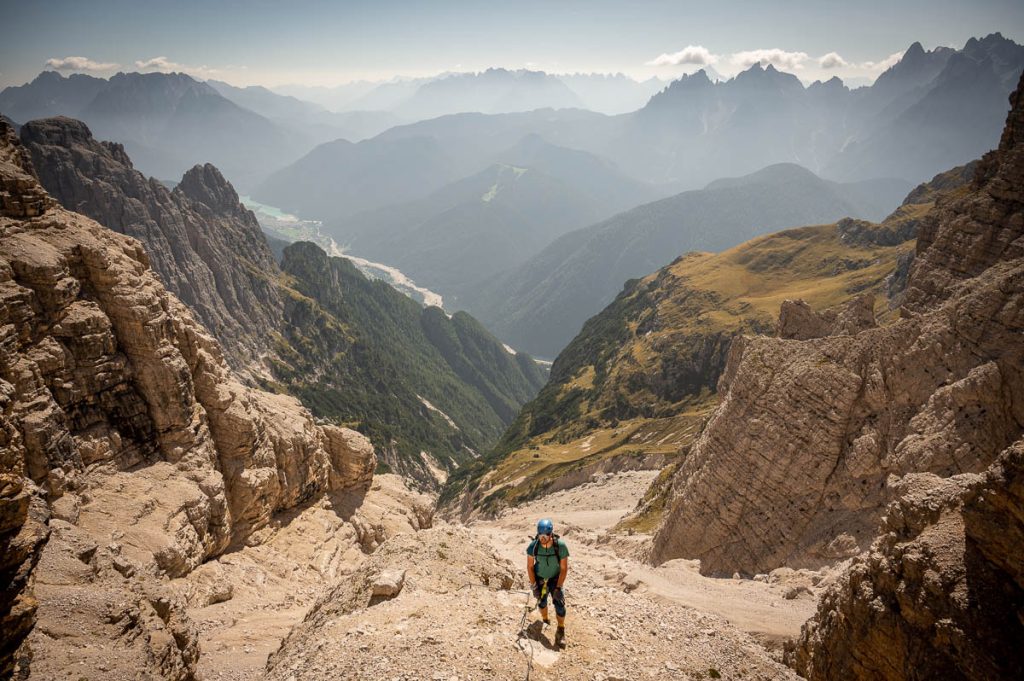
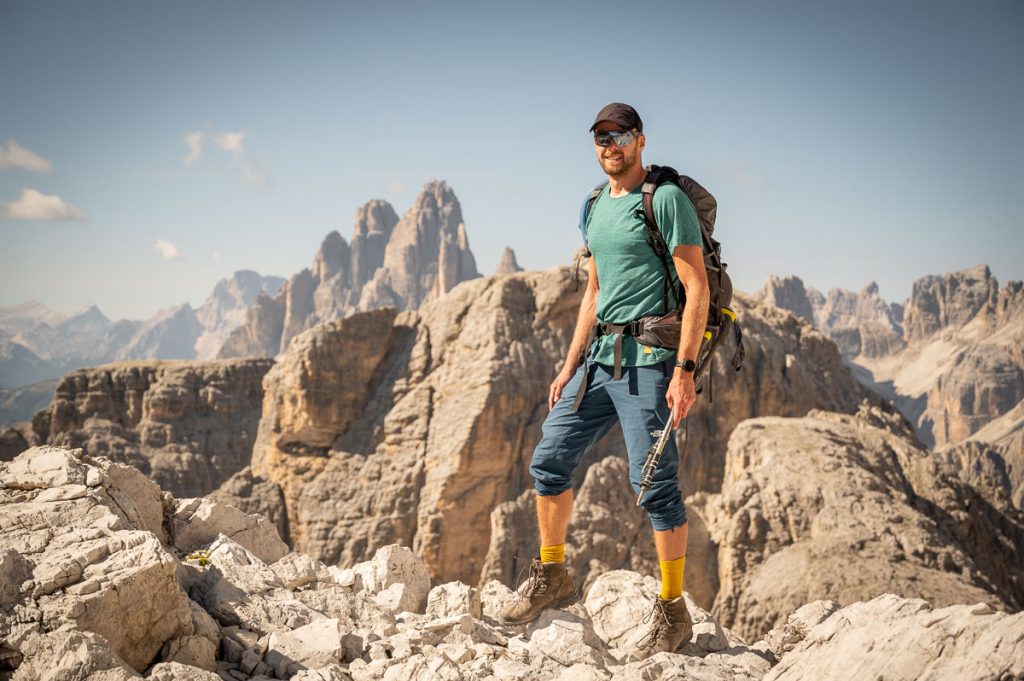
As the route progresses, the via ferrata sections become more demanding, including some low passages you must crawl through. Remember warnings about falling rocks; don’t stop in those places for too long.
The Forcella de L’Agnel saddle, where Bivacco dei Toni was built, is the perfect location for a break. To the southeast, you can spot the turquoise lake Auronzo. Looking northeast, you will see that the unique view of the Tre Cime formation will stretch ahead of you.
Unfortunately, the Bivouac was out of order when we arrived. The whole construction was crooked and looked like it was shifted from its original location.
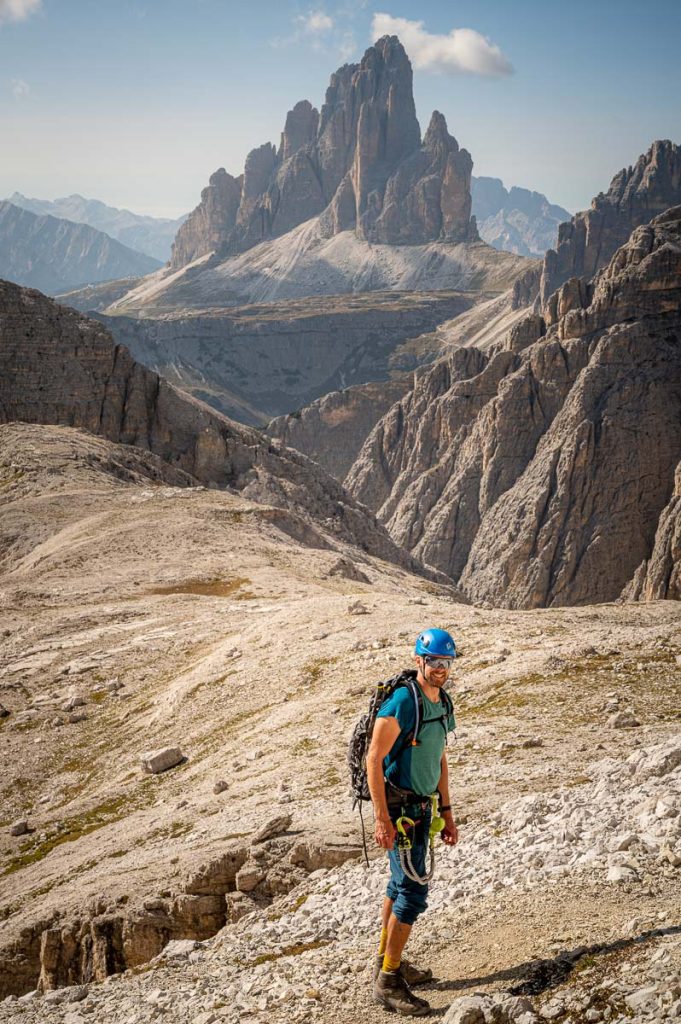
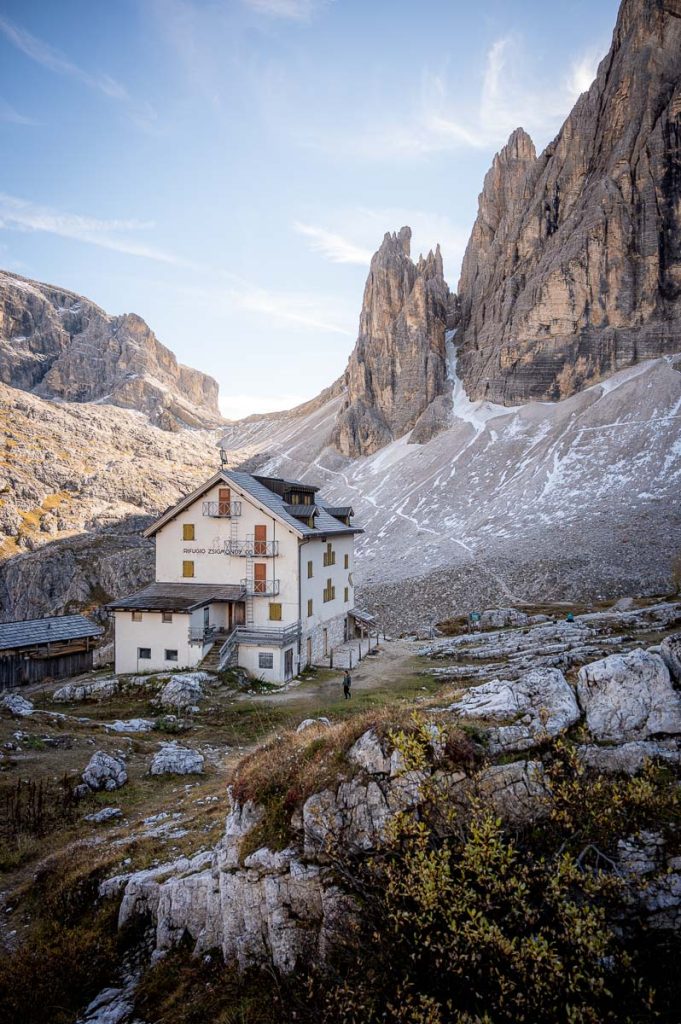
From the saddle, continue down on a very unpleasant scree slope, then along the Western face of the Zwölferkofel towards Forcella Croda Dei Toni. Keep your via ferrata gear on. There is another short iron path section coming up. Once you reach the last saddle, you can take it off.
Rifugio Comici comes into the first view once you reach Croda dei Toni saddle (Zwölferscharte). Steep zig-zags along another scree slope will take you down toward the refuge. Forty-five minutes later, you will arrive at the Zsigmondy hut. Make sure to glimpse back at the view of the Croda Dei Toni. It looks imposing from the Comici hut.
Night 3: Rifugio Zsigmondy Comici
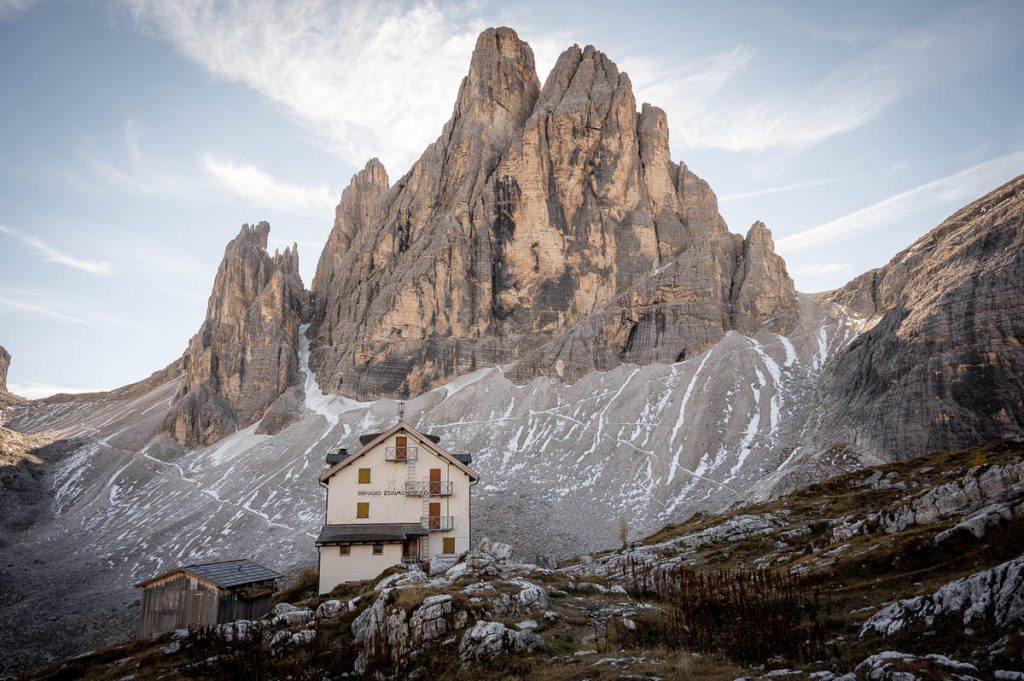
This is the busiest and most modern hut along the circuit, with hot showers and a glassed terrace at your disposal. Not to mention the incredible view of the towering Croda dei Toni (Zwölferkofel). You can book the hut directly through their booking system.
| Club Alpino Italiano member (CAI) | Starting price/night (half board) | Summer season 2025 opening times |
| NO | 80 for a dorm | June 13 – October 4 |
Day 4: Rifugio Zsigmondy Comici to Rotwandwiesen along Via Ferrata Strada Degli Alpini (Alpinisteig)
- Distance: 10.8 km / 6.7 mi
- Elevation Gain: 700 m / 2300 ft
- Elevation Loss: 1000 m / 3290 ft
- Time Required: 5-6 hours
- Path Numbers: 103, 101
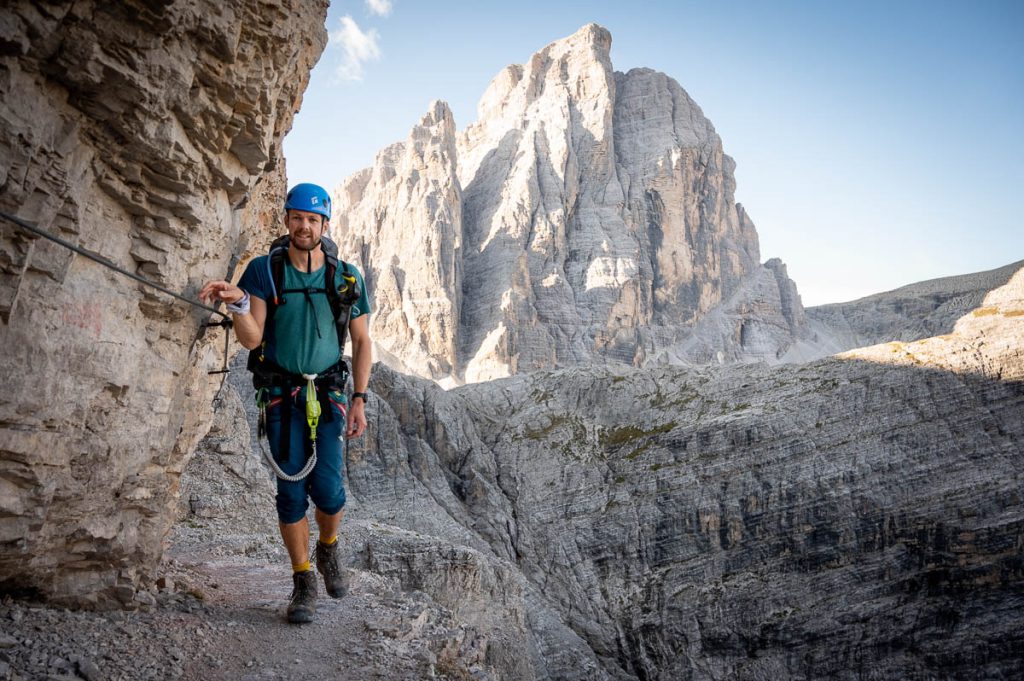
There are places and routes in the Dolomites that I can return to with pleasure. Via Ferrata Strada Degli Alpini (German: Alpinisteig) is one of them. I did it once five years ago on another overnight trip, so I knew what to expect, but the views were just as impressive the second time around.
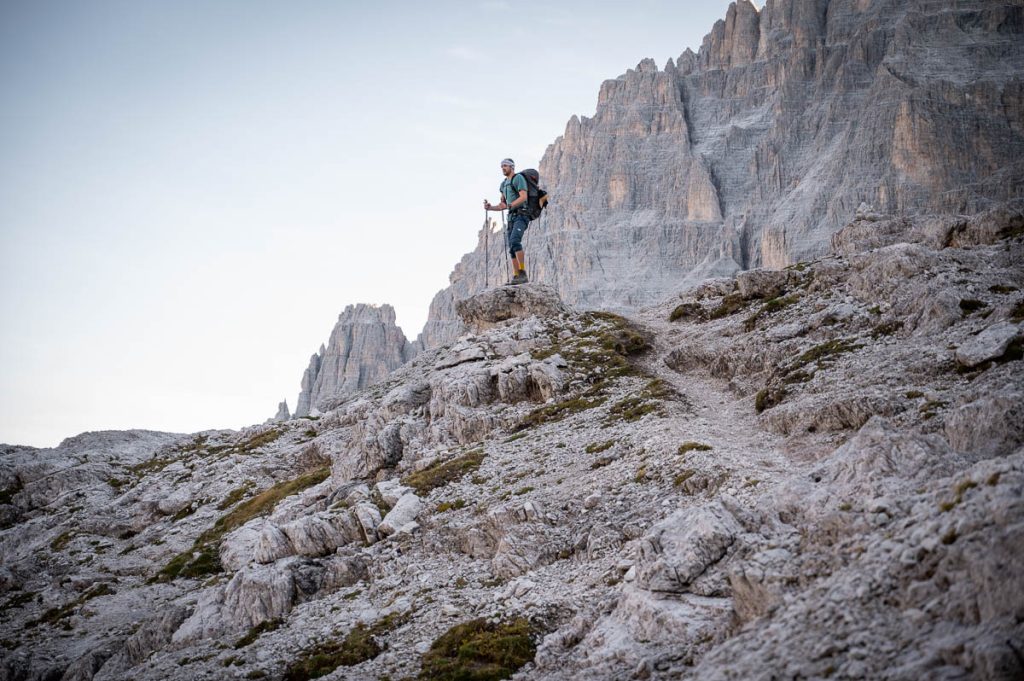
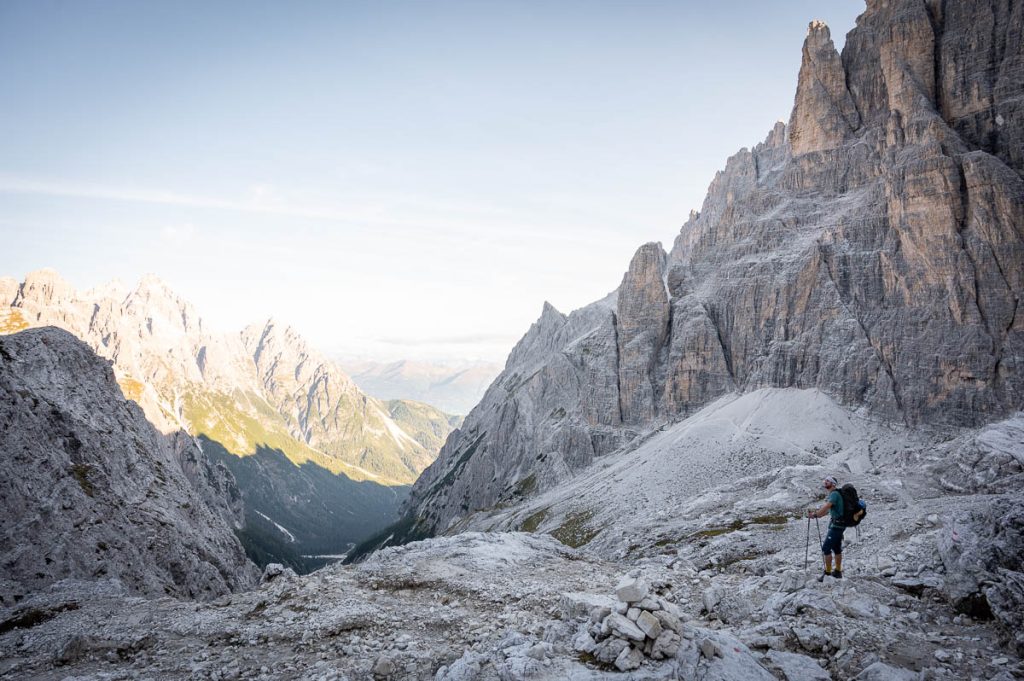
From Rifugio Comici head onto path no. 101 in the direction of Rifugio Carducci (the same one where you stayed on the second night). After around 30 minutes, the path breaks to the left and circles around a small glacial lake.
The cable-protected sections start approximately one hour into the Alpinisteig. The via ferrata Strada Degli Alpini follows narrow ledges for the most part. The route is well-equipped.
Even though using your lanyard might seem unnecessary, especially when comparing the difficulty level with via ferratas Roghel and Cengia Gabriella, you should still make full use of your via ferrata set. It’s always better to stay humble in the mountains. One wrong step might send you tumbling down a few hundred meters.
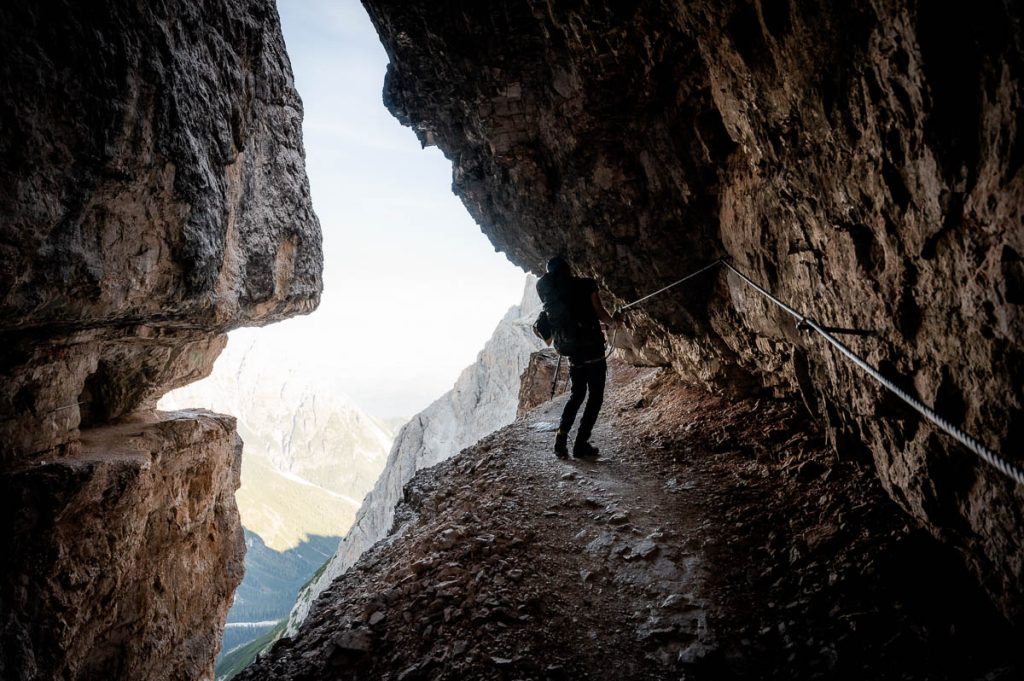
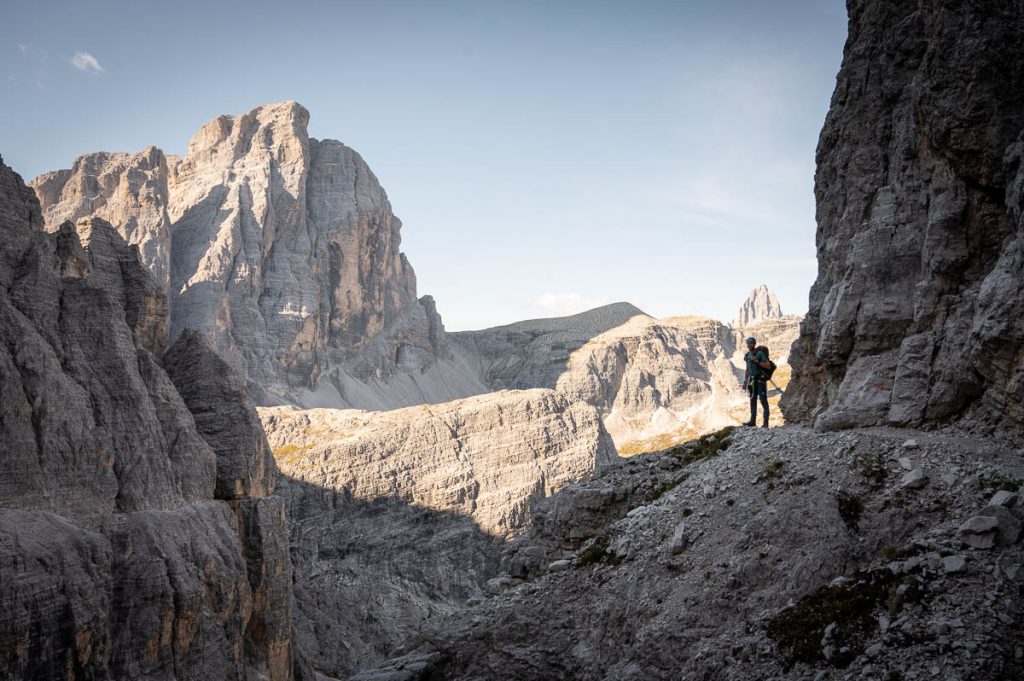
Eventually, the route starts climbing up to the Undici Saddle, followed by a sharp drop into Vallon Sentinella on the other side of the saddle. Keep your via ferrata gear on. You will need it on the climb down from the saddle, followed by seemingly endless zigzags on a loose scree path.
After you reach a fork, follow the sign for Rotwandwiesen. After another hour, you will be standing in the same spot where you started the Monte Popera Circuit just four days ago.
How to shorten the Monte Popera Circuit to 3 days?
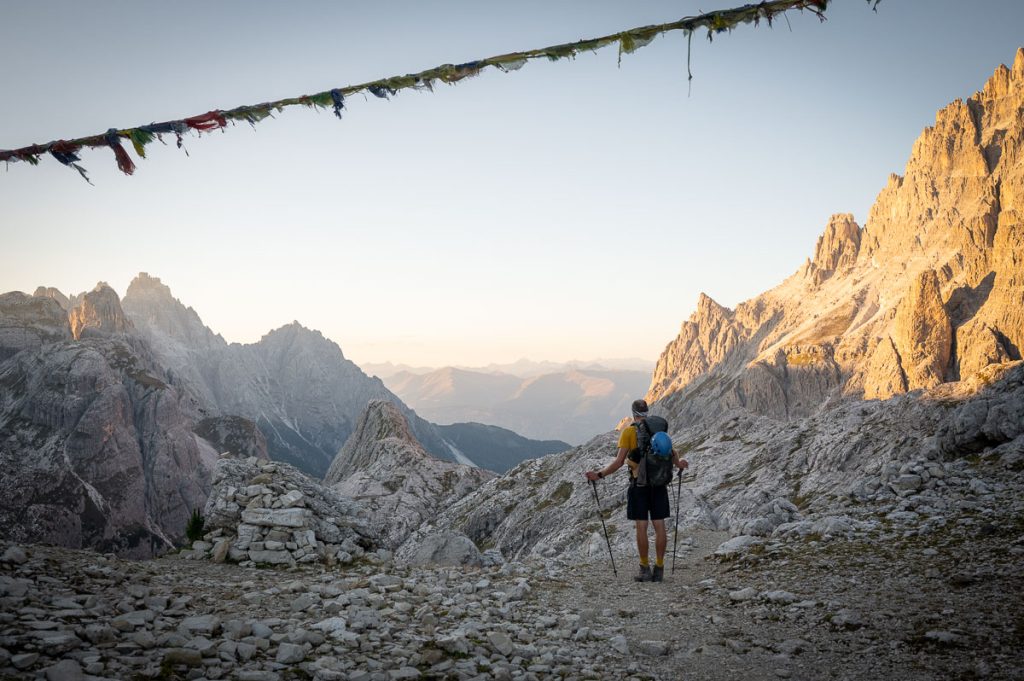
If you only have three days, you can easily shorten this itinerary. Here is how. On 3rd day, instead of tackling Via Ferrata Severino Casara, head onto path no 103 from Rifugio Carducci toward Forcella (saddle) Giralba. From the saddle, follow the signs for via ferrata Strada Degli Alpini (Alpinisteig).
This way, you will skip the night at Rifugio Zsigmondy and return to the gondola station on the third day. It takes approximately 6 hours to hike from Rifugio Carducci to the top of the Croda Rossa gondola.
Frequently Asked Questions About The Monte Popera Circuit
How soon should I reserve huts for the Monte Popera Circuit?
If you are going in the peak season (July-August), book the huts a few months before, mainly Zsigmondy Comici hut. It is the busiest hut along this traverse.
The refuge was at full capacity when I stayed there—it was the last day of the operating season. I did this route at the end of September and booked the huts only a few weeks before, at the start of August.
What kind of facilities can I expect in the huts?
The huts in the Dolomites are pretty luxurious. You can expect bedsheets, duvets, and a proper mattress. Some even offer hot showers. Food is provided at the hut restaurant, so carrying too much is unnecessary.
TIP: If you have never stayed in a mountain hut before, then jump to my article about everything there is to know about staying in a rifugio in the Italian Dolomites.
How should I pack for the Monte Popera Circuit?
The best thing is to pack it as light as possible. I always say you are overpacked if you have a 38-litre backpack and fill it to the brim. Overnight stays in the huts eliminate the need to carry sleeping bags or food, so you only need the essentials.
You will need a change of clothes, warm layers, snacks, and, most importantly, a water ration for the day. You will also need via ferrata gear along the Monte Popera Circuit. I have a comprehensive hut-to-hut packing list that should help you pack your backpack properly.
Shop my hut-to-hut backpacking gear
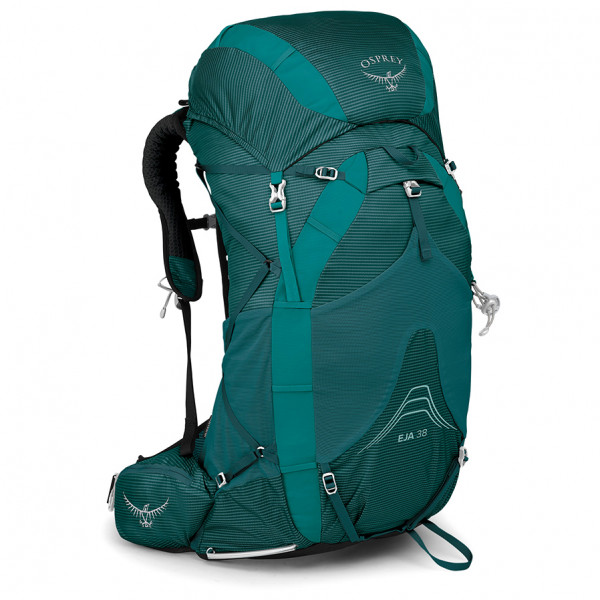
Osprey 30+ Litre Backpack
30-40 litre backpack should be more than enough to pack everything you need for a hut-to-hut trip in the Dolomites with plenty of room for water and snacks. If you can’t fit in, it means you are overpacking. I am a huge fan of Osprey backpacks and currently own the Eja 38-litre. Osprey has plenty of options in this storage volume range to choose from.
Shop on Osprey Amazon Store (Worldwide) / Backcountry (US)
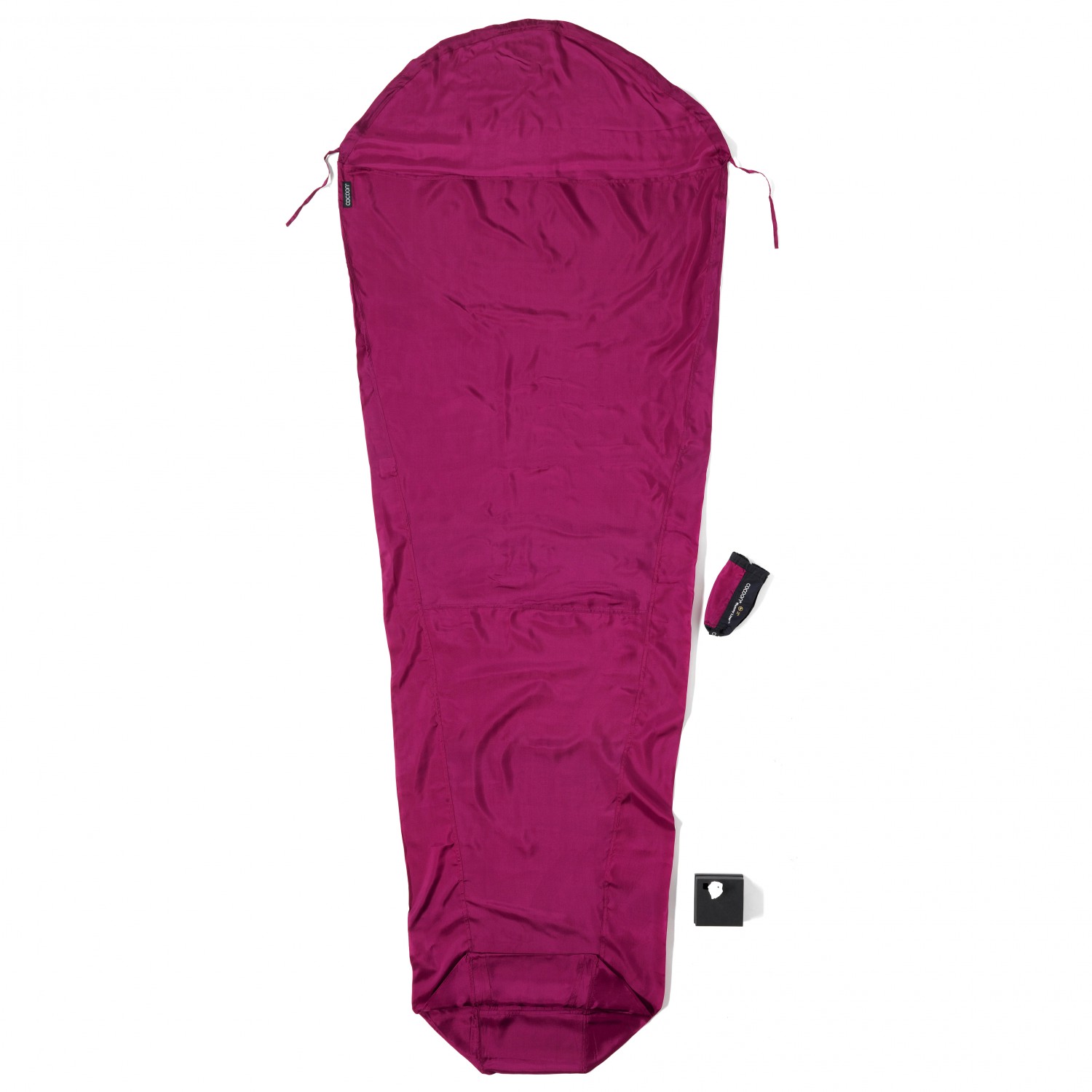
Sleeping Bag Liner
Sleeping bag liners are required for hut stays. Duvets and blankets aren’t washed after each guest who stays at the hut. Liners ensure that you don’t come in direct contact with the sheets and subsequently, it is more hygienic. Some huts rent or sell them, but it’s better to bring your own.
Shop on Amazon (Worldwide) / Backcountry (US)
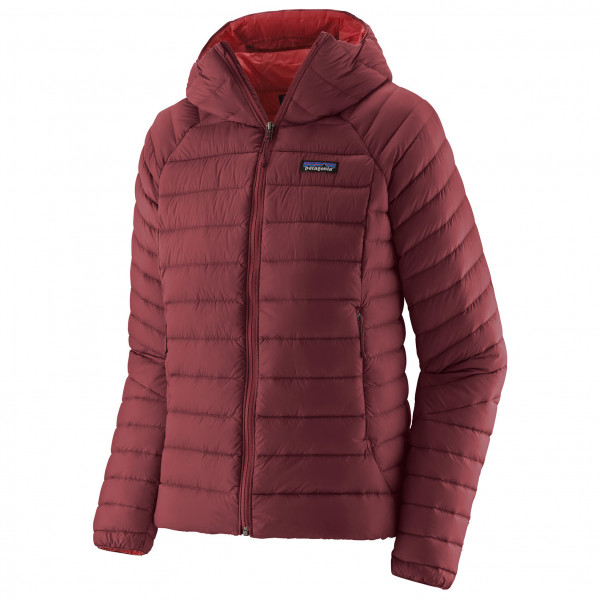
Patagonia Insulated Jacket
Even in the middle of the summer season evenings can be quite cold. If you don’t plan on venturing out of the hut in the evenings, you can skip this layer. I personally always bring one with me as I like to take sunset photos outside.
Shop on Backcountry (US)
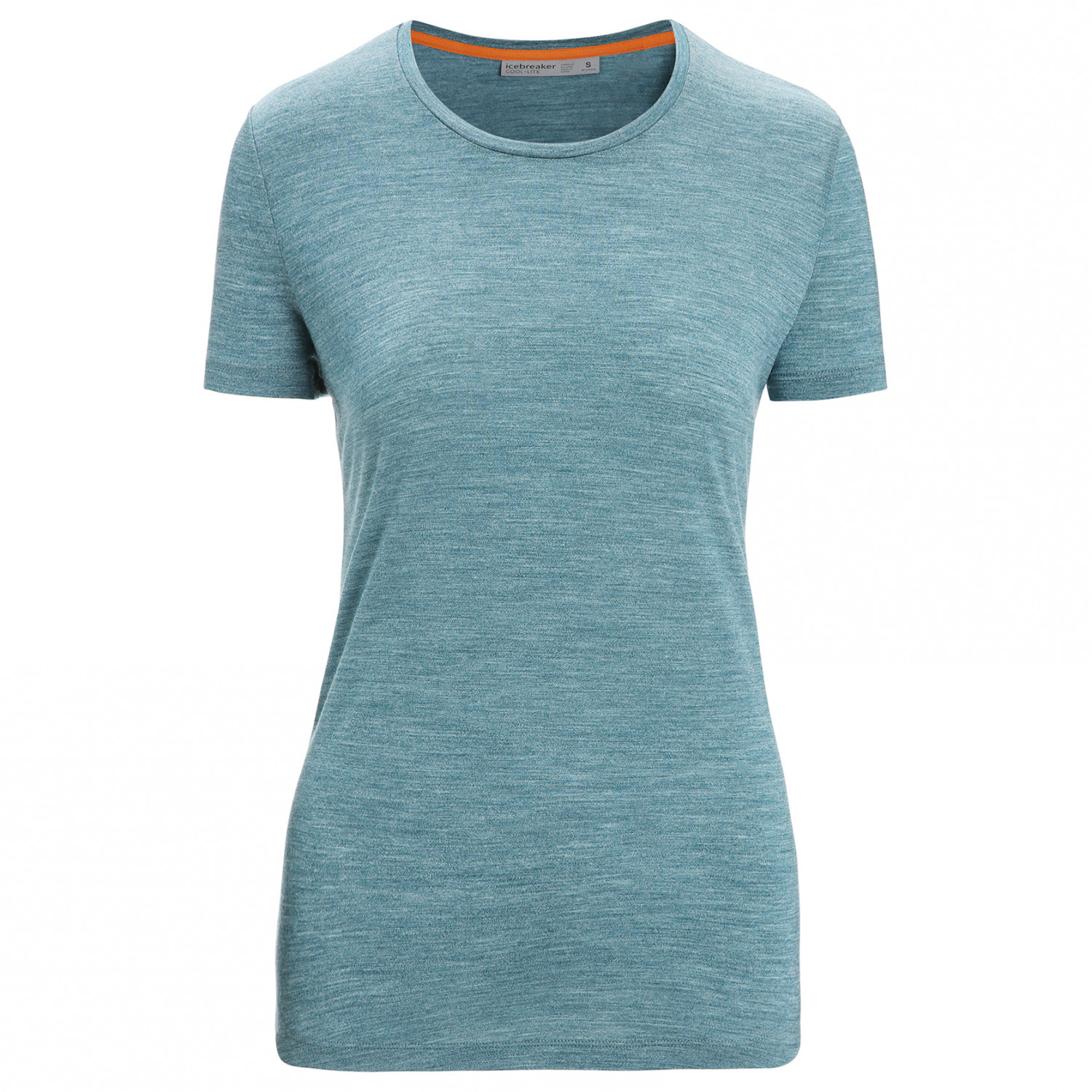
Merino Wool T-Shirts
Having a couple of Merino Wool T-shirts which you can alternate and then wash at the hut each day will be more than enough to keep body odors at bay. I am personally a big fan of the Icebreaker brand, however these days plenty of other brands have Merino products in their inventory.
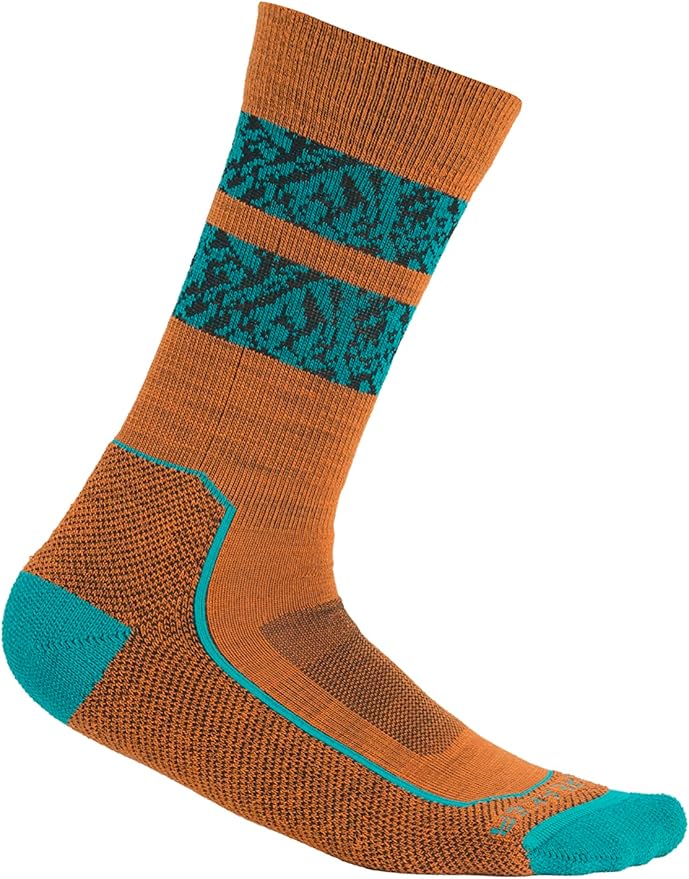
Merino Wool Socks
I always carry 2 pairs of socks in my backpack and one on me during multiday backpacking trails. Merino wool fibers and their unique properties are resistant to odors. Merino wool socks also prevent getting blisters as opposed to cotton socks.
Shop on Amazon (Worldwide) / Backcountry (US)
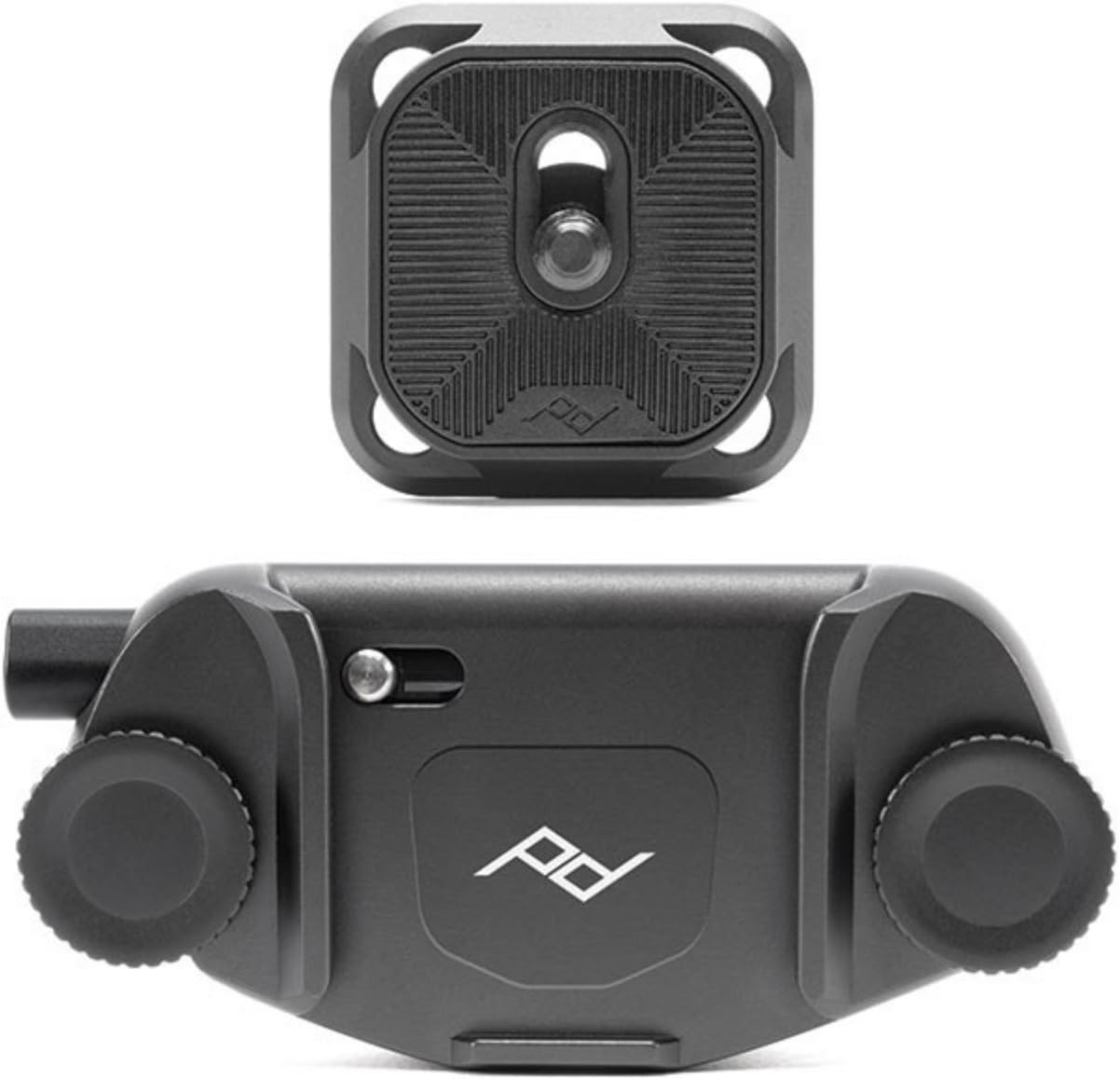
Peak Design Camera Clip
A must-have for any mountain photography enthusiast who is tired of carrying a camera around their neck. The peak design capture clip allows you to attach your camera to a backpack strap. That way you don’t have to take your backpack off and take your camera out every time you want to take a photo. You will always have it handy.
Shop on Amazon (Worldwide)
Where to rent via ferrata gear?
You can always rent one if you don’t own a via ferrata set. Sports equipment rental places are in Sesto and San Candido, the two biggest towns near the trailhead. Look for places called Noleggio on Google Maps. Noleggio, in Italian, stands for rental.
Is it possible to do the Monte Popera Circuit counter-clockwise?
Yes, however, I wouldn’t recommend it. There were stages along via ferrata Roghel on the second day where I was pleased that we were climbing them up and not down. If you choose to go counter-clockwise, ensure you are incredibly sure-footed.
Is there a place to store my excess luggage for the trip?
I usually leave my excess luggage in the car booth. I never encountered any problems. You can also leave your luggage at a hotel where you stayed the night before and pick it up once you finish the Monte Popera Circuit. Make sure to contact the hotel before to make sure they offer such services.
Other fantastic backpacking trip ideas in the Italian Dolomites
- Dolomiti Brenta Circuit (3-5 days)
- Rosengarten Traverse (3-5 days)
- Tre Cime Traverse (3-5 days)
- Pale Di San Martino Traverse (2-4 days)
- Alta Via 1: Part 1 & Part 2 (11 days)
- Alta Via 2: Part 1 & Part 2 (14 days)
- Alta Via 4 (6 days)
More travel and hiking resources in the Dolomites
- Photography spots in the Italian Dolomites
- Regions in the Italian Dolomites
- Itineraries for the Italian Dolomites
- Via ferratas in the Italian Dolomites
- Day hikes in the Italian Dolomites
- Hut-to-hut treks in the Italian Dolomites
Support my website!
Hi Reader! If you found any of my articles about the Dolomites useful please consider using the affiliate links below (at no extra cost) when booking your holiday. Thank you
- Reserve your hotel with Booking.com
- Book your rental car with Discover Cars
- Buy your outdoor gear with Backcountry.com (US readers)
If you have any questions, leave them in the comments below!
Hi Marta,
After day 3 at Zsigmondy Comici, we plan to go to Locatelli to see Tre Crime. How does it work getting to Locatelli and how do we get back on track to the original trek you share here? Thanks so much this is massively helpful
Best,
John
Hi John. You can follow the Croda Fiscalina Circuit trail. I hope that helps!
Hi Marta,
My partner and I have been pouring over all your valuable information. Thank you!
We are thinking of tackling Monte Pompera Circuit. The first night at Refugio Berti mentions the need for bringing your own sleeping bag! I was surprised as I thought it was unnecessary. They do provide a blanket. And I always have a down vest or coat. What do you think? Bring a bag too?
Also, can you recommend another VF prior to this that would be off the beaten path so we can still get reservations for fall.
We are traveling using public transport and most likely coming from Cortina.
Many thanks!
Michelle
Hi Michelle. By Sleeping bag the buts always mean sleeping bag liner. It’s just lost in translation (it often happens in Italy).
Another great via ferrata near Cortina which is very quiet is Giro Del Sorapiss. Or you can also try Marino Bianchi. You can find both using the search loop on my site.
Hi Marta! I’ve been using your guides to plan a trip for this fall and they’ve been so helpful. I was wondering if there are any ways to extend this route by a day or two? Thank you for your help!
Hi Christian. Thanks for following! Yes you could connect this route with the Tre Cime traverse. After completing Day 3 (Severino Casara) and staying at Zsigmondy you could then hike to Locatelli and do VF Innerkofler and Torre Di Toblin, then the next day hike to Fonda Savio and do VF Merlone. I hope that helps!
Thank you so much, that’s super helpful. Is there a way to extend only for more night as well?
Hi Christian. sorry I didn’t get your question. you wrote ” Is there a way to extend only for more night as well?”
Hi Marta, sorry for the confusion. I was wondering if there was a hut that you would recommend for a one day/night extension instead of two
Yes You can hike to Locatelli, do VF Torre Di Toblin and Innerkofler and then from Locatelli exit to Val Fiscalina (val means) Valley through Val Sassovecchio or take the exit through Val Campo Di Dentro
Hi Marta, I want to thank you for your amazing blogs! They are super helpful and inspirational!
We are planning to do a trip to the dolomites and of June and we’re thinking about this track or the Brenta Traverse. However after reading into your blog and the comments I’m a bit worried about the snow levels. Do you think the Monte Popera would be better with less snow end of June? Or would you recommend another tour with via Feratas for this time of the year?
We are experienced climbers, have done via Ferratas and multi day hikes in the mountains before. But we are definitely not mountaineers! I have done a course before and some experience with walking on glaciers.
Hope you can help us out!
Kind regards,
Aafke
Hi Aafke. Thanks for visiting. Both will have snow in the gullies, only short sections, so carrying crampons might be a good idea. Truth is, noone will know what the snow situation is until 1-2 weeks ahead. It really varies from year to year.
Hi Marta,
I’ve been exploring your website and have found your articles incredibly informative—thank you for sharing such valuable insights.
As I plan my trip, I’m finding it challenging to choose between the 4-Day Monte Popera Circuit and the 5-Day Trek Across the Adamello Brenta Nature Park. My preference leans toward a more demanding trek with remote landscapes and fewer people.
Given your expertise, which route would you recommend based on these preferences?
I truly appreciate your guidance.
Warm regards,
Marcus Gyles
Hi Marcus. Thanks for visiting. Dolomiti Brenta Circuit is definitely quieter than the Monte Popera. The latter was very quiet on the second day on the Via ferrata Roghel and Cengia Gabriella, but the area around Rifugio Zsigmondy is quite busy. Brenta is also more demanding. I hope this will help you with the decision.
Hi Marta, great website which inspired us to do Rosengarten hut to hut and multi pitch climbing last year. This year we’re planning to do the Popero Circuit but were concerned about the length of Day 2, not technically, but pace and stamina to get to the hut in time for supper. Our thoughts were to start from Rif Fondovalle and head to Rif Carducci, and then complete Day 3 and Day 4 of your circuit, i.e. a three day trip overall. Do you think this would work and how long is the hike from Fondovalle to Carducci?
Thank you!
Hi Derek. Thanks for stopping by. I am glad to hear you are returning to my site to complete another tour. Dolimiti Brenta traverse might also be something for you. As for your question, yes, that’s one way to do it. You could also start with Via Ferrata Strada Degli Alpini on day 1, then do Severino Casara on day two from Carducci to Zsigmondy. On day 3 you could hike from Zsigmondy to Locatelli, do via ferrata Torre Di Toblin and walk out through Sassovecchio valley back to the start.
Hi Marta, is there a chance to avoid via ferrata with advanced level of difficulty? I’d like to try this route with kids next summer and would like to avoid nasty surprises. Thanks.
Hi Anastasia. Good call, Cengia Gabriella and Roghel are definitely not suitable for kids. You could rearange the hike and do Strada Degli Alpini first to rif. Carducci, the next day you can do Severino Casara and stay in either rif. Zsigmondy or Pian Di Cengia. On day 3 you can move onto Rif. Locatelli and do Via Ferrata Innerkofler or Torre do Toblin as extension then on day 4 walk back out to the start through Sassovecchio valley. I hope that helps!
Hi Marta. Many thanks for all your guides and very useful tips! We are planning to do the ferrata Severino Casara this autumn (on our way from Rifugio Carducci to Rifugio Auronzo). Some descriptions of this route mention that at the end of the scree field, right before Forcella Croda dei Toni, there is a fixed rope one has to climb for over 3-4 meters. Is it true? Is it difficult to pass?
Overall, is Severino Casara suitable for beginners? We have some mountain experience, but not on via ferratas (apart from Strada degli Alpini, which we will be doing only one day before). We have an option of going to Rifugio Auronzo either via Severino Casara or via Sentiero delle Forcelle, and were not quite sure which one to take. Any of your tips or advice would be helpful. Thank you!
Hi Mirek. Thanks for stopping by! I am glad to hear you are thinking about doing the Severino Casara. It is slightly more difficult than Strada Degli Alpini but not by much. If you find the first one scary then you shouldn’t tackle the next one. If however you find it just the opposite then you will have no trouble on the Severino Casara.
As for the fixed ropes, no I don’t remember to be any. There are just fixed steel cables. I think the weather in the end will decide for you, which path to choose from. ANother option if you skip Severino Casara is doing the Innerkofler via ferrata between Rif. Pian Di Cengia and Locatelli which you will be passing enroute when skipping Severino Casara.
I hope that helps!
Thank you Marta!!! This is exactly what we intend to do 🙂
Best wishes, Mirek
Have lots of fun!
Hi Marta,
Thank you so much for all of your guides, they have been so so helpful in planning our trip!! We had planned to do this route next week but the forecast says rain every day. I saw elsewhere that you mentioned not to cancel your trip if this happened. Do you think these routes would be unsafe and have you done any other hiking in the area you would recommend?
Thank you!!
Hi Stephanie. Thanks for visiting. Generally the rain and thunderstorms come in the afternoon. I would say for day 2 you definitely need dry weather for the whole day. The forecast changes from day to day so it is hard to tell at this point. I would recommend that you monitor it. As for hikes in the area I have a whole post dedicated to hikes and via ferratas in the Tre Cime Nature Park
Hi, what maps do you need for this route?
Hi Jasmine. I Updated the stats section and added what map is required. I hope that helps!
Hi Marta! I’m working on booking reservations at Rifugio Comici. Do you possibly know how many beds are in their “Shared rooms (Mehrbettzimmer)”? We have party of 5 and I want to make sure we all have a bed!
Your website has been a HUGE help as I’ve been researching Tre Cime. Thank you for all your hard work in documenting your travels!!
Hi Claire. The rooms differ. I don’t know their exact room layout. What I can tell your is that when I stayed there our room had 6 beds. If you book together then they usually accommodate the groups together. I hope that helps!
Good to know! Thanks Marta!