
Follow me on a 4-day / 3-night traverse across the Pale Di San Martino Group in the Southern Dolomites, filled with dramatic views of spires and monoliths, lunar-like high alpine plateaus, and cosy evenings spent in some of the best Italian mountain huts.
About Pale di San Martino Group
International tourists often overlook the Pale di San Martino Range. While it certainly isn’t deathly quiet, it sees a fraction of the traffic compared to Tre Cime National Park or Lago di Braies.
The Pala group is the most extensive massif in the Dolomites and lies in the eastern Trentino region. The group’s highest peak is Cima Vezzana, which is 3192 meters (ca. 10500 feet) above sea level. The two nearest Dolomiti towns built at the foot of the Pala group are San Martino Di Castrozza and Fiera di Pimero.
Where to stay nearby
Depending on where you are coming from, you have three locations to choose from for your overnight stay before and after completing the Pale Di San Martino Traverse: Passo Rolle (a mountain pass), San Martino Di Castrozza, or Fiera Di Primero.
About Pale Di San Martino Traverse
- Total Distance (not including extensions): 37 km (23 mi)
- Time required: 2-4 days
- When to go: the 3rd week of June until the 3rd week of September
- Total elevation gain (not including extensions): 2700 m / 8860 ft
- Total elevation loss (not including extensions): 2780 m / 9120 ft
- Starting point: 46.297999, 11.789191
- Ending point: 46.217590, 11.877617
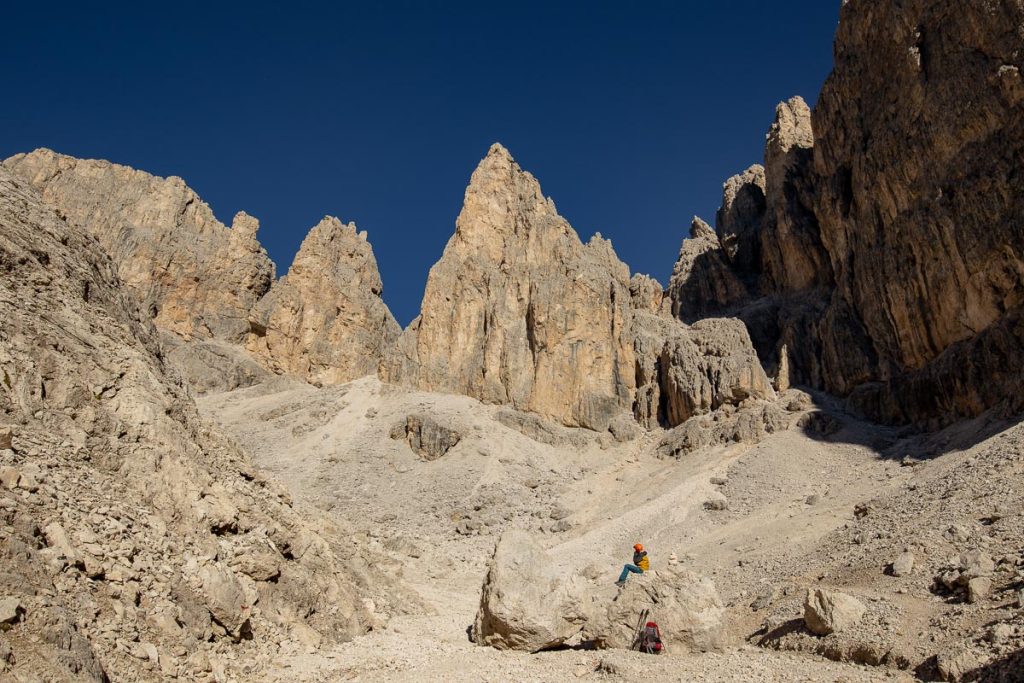
The traverse takes you from the northern end of the Pale Di San Martino Nature Park all the way South. The total distance (not including extensions) is 37 kilometres (23 miles).
Whilst the distance might not sound like a lot, it will be challenging enough to keep you on your feet for a few hours each day, especially if you undertake the extensions to the nearby summits, which, by the way, I really think you should.
This traverse is my favourite part of the much longer Alta Via 2, a 200-kilometre, 14-day trek across the Dolomites.
I modified it to fit the needs of adventurers who don’t have two weeks to complete the whole route but still want to experience a multiday backpacking trip in the Dolomites.
An interactive map of the Pale Di San Martino traverse
Whilst this map is pretty accurate and will be a valuable tool whilst planning this excursion, it should not be used to navigate whilst in the mountains. The correct map for this hike is Tabacco No. 022. You can purchase it online or pick it up in any sports or souvenir shop in the Dolomites.
Getting to the trailhead
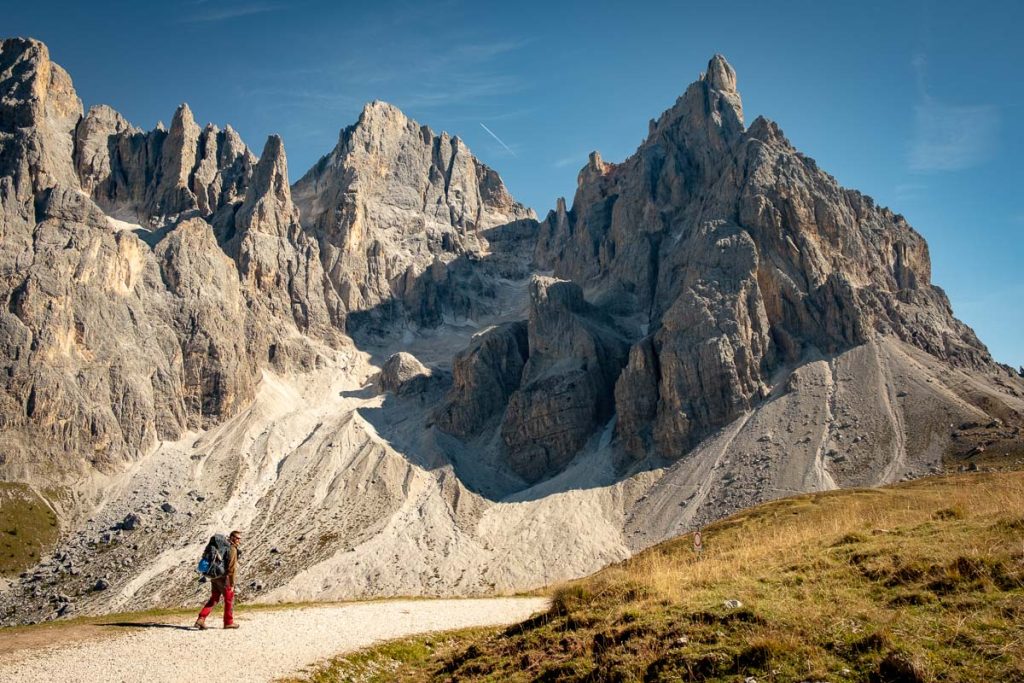
The Pale Di San Martino traverse starts at Passo Rolle (zoom on the map), a mountain pass about a 20-minute drive from San Martino di Castrozza or a 35-minute drive from Fiera di Primiero. Both towns are located in the Trentino region of Italy.
You can reach the pass either by car or public bus no. B122, going in the direction of Predazzo. The bus stop, right near the trailhead, is called Passo Rolle-Segg. Segantini. To check bus connections, use Google Maps or download the official transport app of the Trentino region, Muoversi.
There is a parking lot near the trailhead (Parcheggio per Malga Juribello) where you can leave your car free of charge for a few days.
Pale Di San Martino Traverse: day-by-day breakdown
Day 1: Passo Rolle to Rifugio Volpi al Mulaz
- Distance: 9km / 5.6 mi
- Walking time: 3-4 h
- Elevation gain: 900 m / 2950 ft
- Elevation loss: 250 m / 820 ft
- Path numbers: 710A, 710
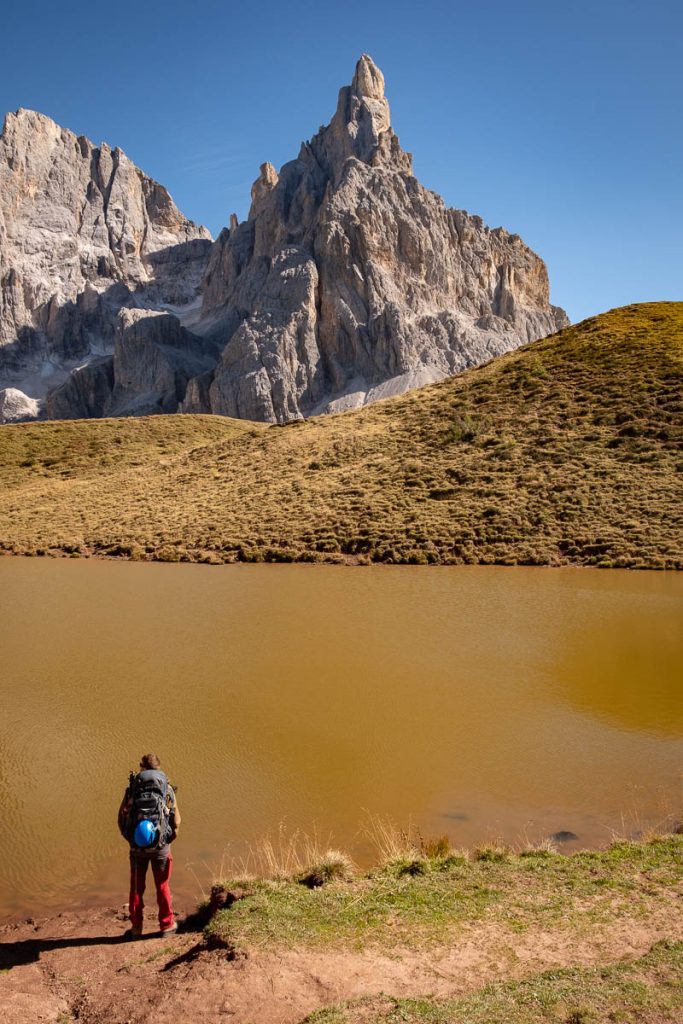
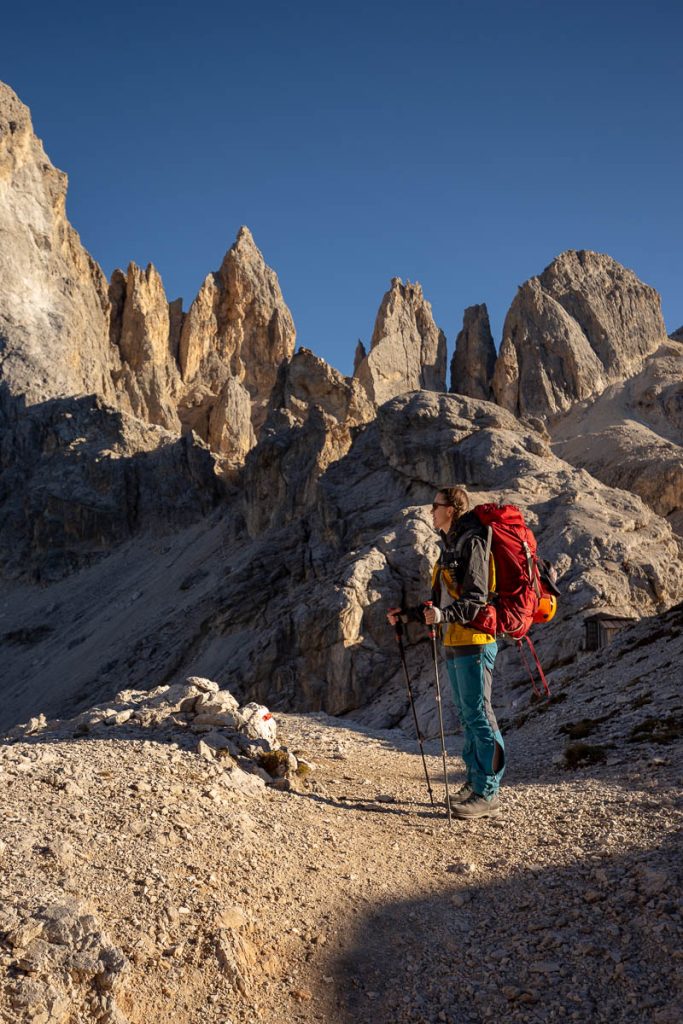
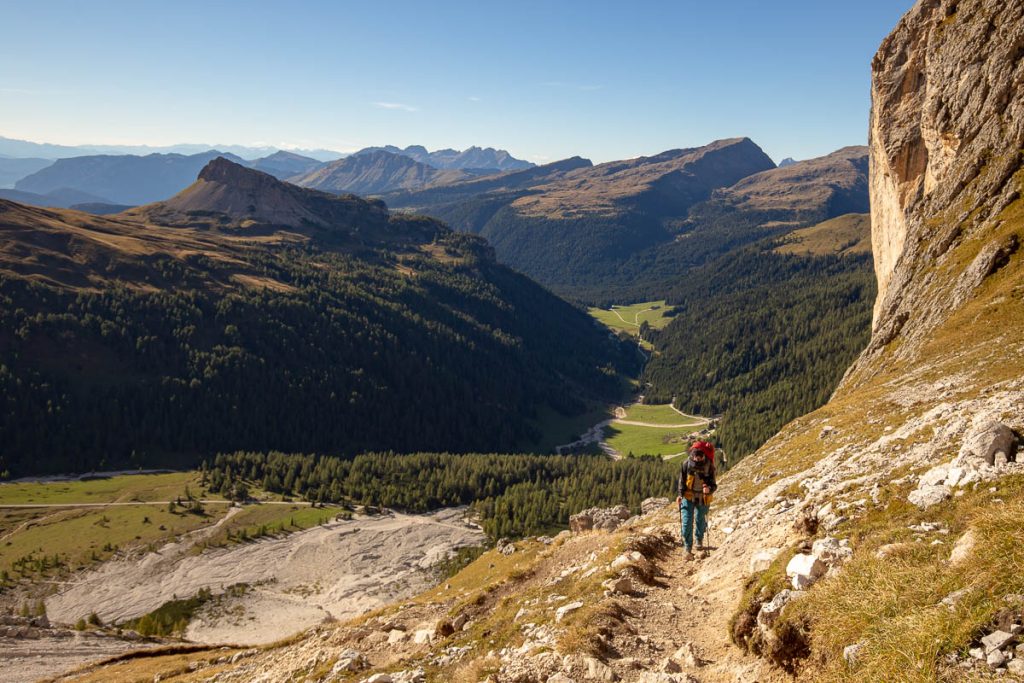
It’s a tough first day, but it isn’t long, so take your time to admire the views. In a separate article, I’ve written about the route up to Passo Mulaz (and Rifugio Mulaz), so I won’t go into too much detail here.
From Passo Rolle, the access road and the path that runs near it lead you first up to Baita G Segantini—an iconic photo spot in the Dolomites. It’s a great place to admire the sawback range you’re about to hike through.
The route then passes the Baita (small restaurant) and begins to head down into the Val Venegia before a higher elevation path (710A) takes you toward Passo Mulaz. From there, it is a stone’s throw away from Rifugio Volpi Al Mulaz, visible from the pass.
Extension day 1: Summit of Monte Mulaz
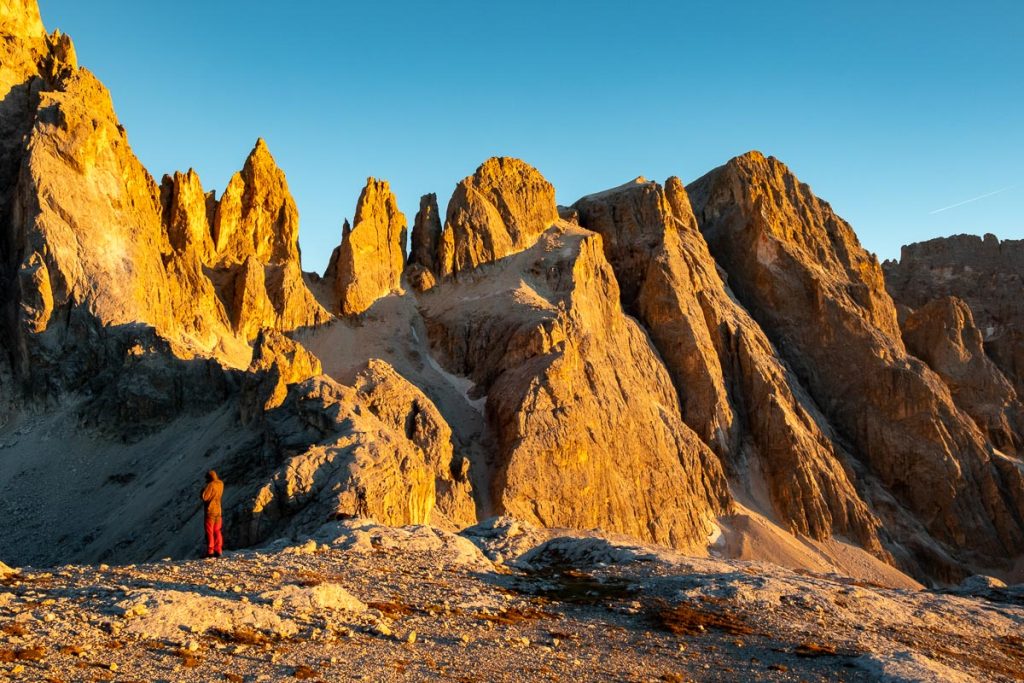
If you set off early from Passo Rolle and are full of adrenaline and excitement on your first day, consider extending to the summit of Monte Mulaz.
You can reach it from Passo Mulaz or check in at the hut first, unload your backpack, and then hike back up with a much lighter load.
It will take another 2 hours and add an extra 300m (980 feet) of elevation gain to your day, but the summit’s views will be well worth it.
Night 1: Rifugio Volpi al Mulaz
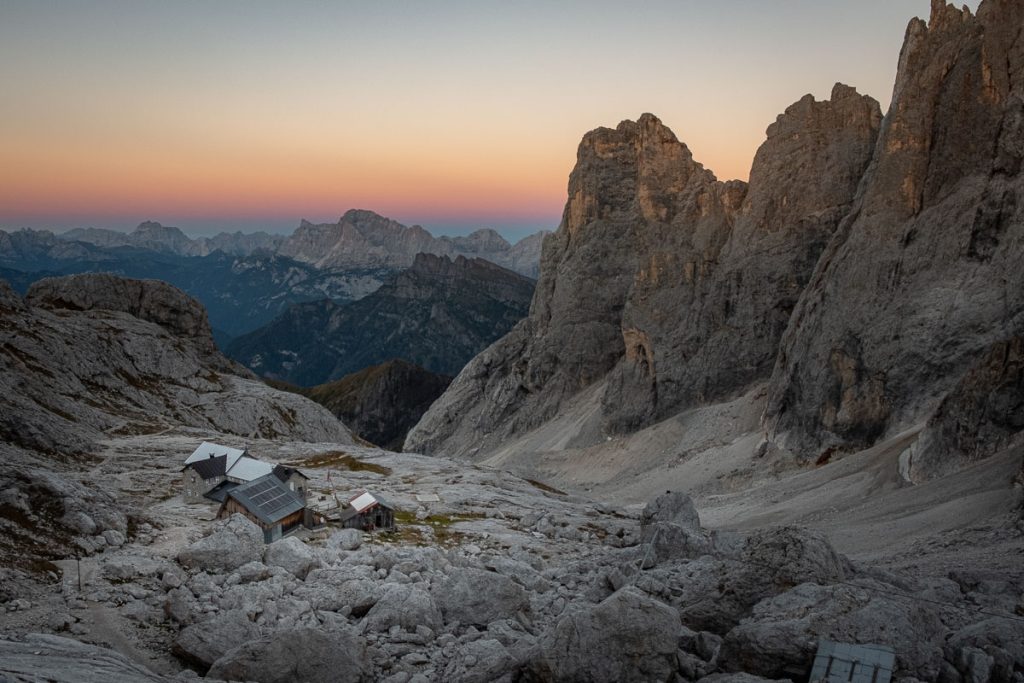
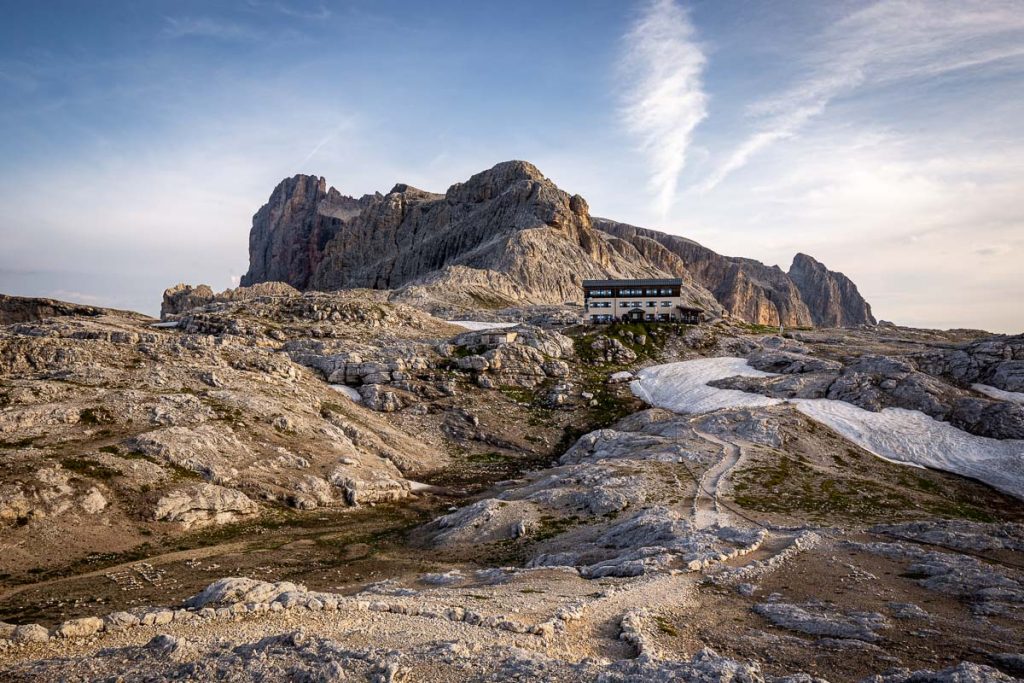
Rifugio Volpi Al Mulaz usually opens in mid-June and closes in the 3rd week of September. It’s a well-situated hut offering views northeastward into the Val di Focobon (see the picture above).
It’s also Club Alpino Italiano affiliated, so if you have a CAI membership or an Alpine Club membership in your home country, you’re entitled to accommodation discounts.
I first stayed in Rifugio Mulaz at the end of September 2018. I expected the hut to be closed (following the dates on their website), so I packed enough food and a warm sleeping bag to either stay in the ‘winter room’ or just bivouac outside on the pass, depending on the weather.
When we arrived, the hut was still open, and the staff was preparing for seasonal closure, but they graciously agreed to host us. We paid for a night but didn’t want to waste the effort of prepping and carrying our food, pots, pans, cutlery, stove, and gas, so we cooked and ate our dinner while watching the sunset from Passo Mulaz.
When we got back to the hut, another group of hikers was being served flaming creme brûlées for dessert! I couldn’t have been more jealous after eating my thousandth meal of pasta and pesto during that hiking season. What an incredible luxury in such a remote location!
Day 2: Rifugio Mulaz to Rifugio Rosetta
- Distance: 8.8 km / 5.5 mi
- Walking time: 4 h 30 min
- Elevation gain: 930 m / 3060 ft
- Elevation loss: 918 m / 3010 ft
- Path number: 703
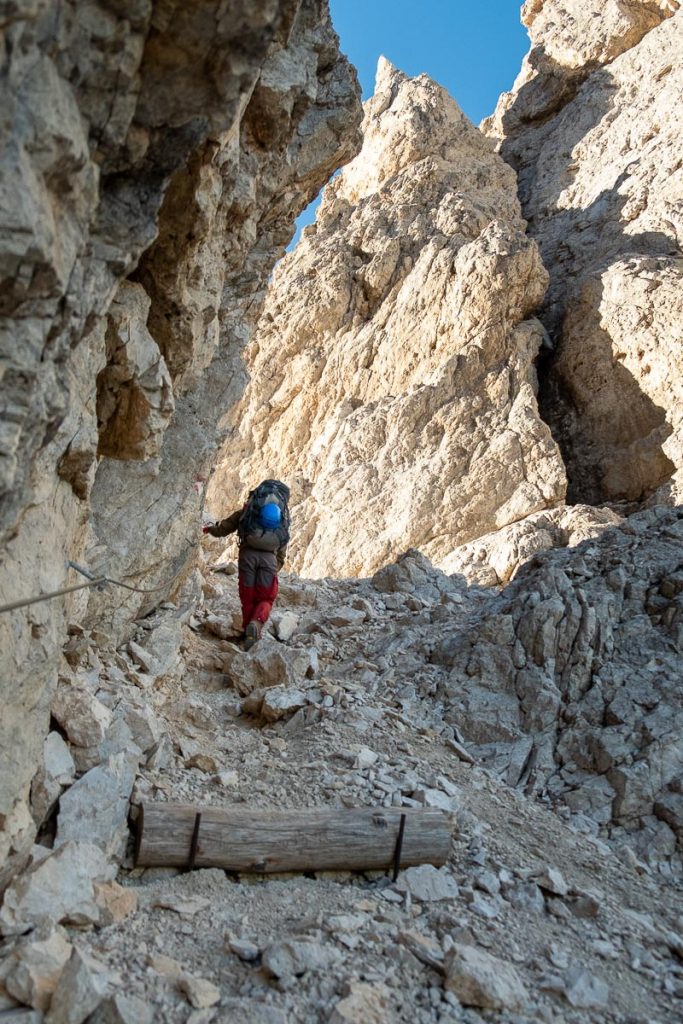
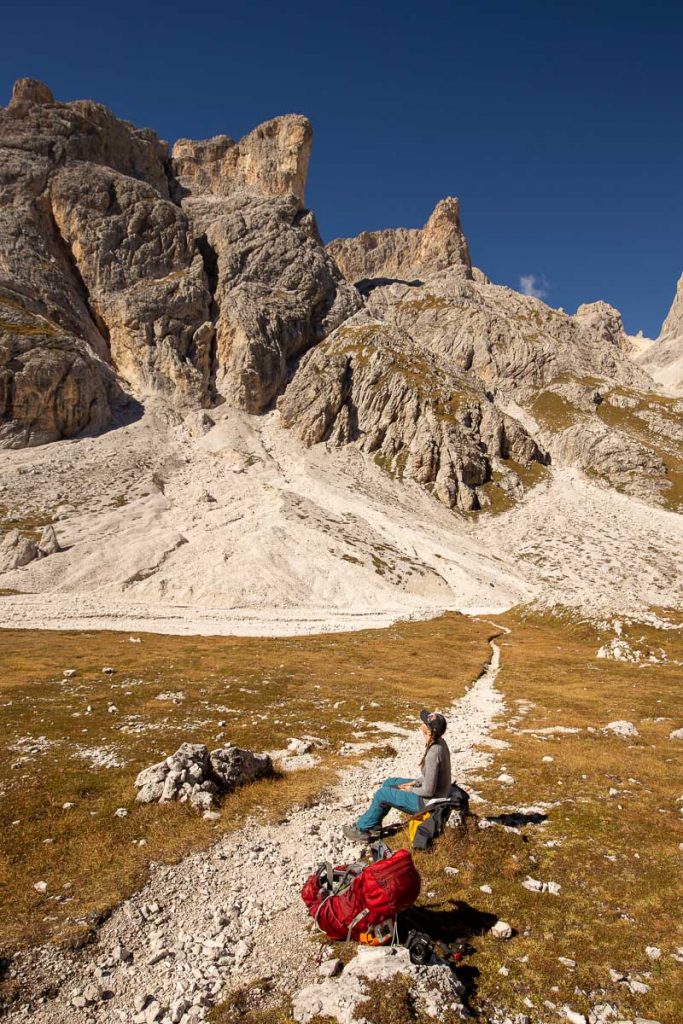
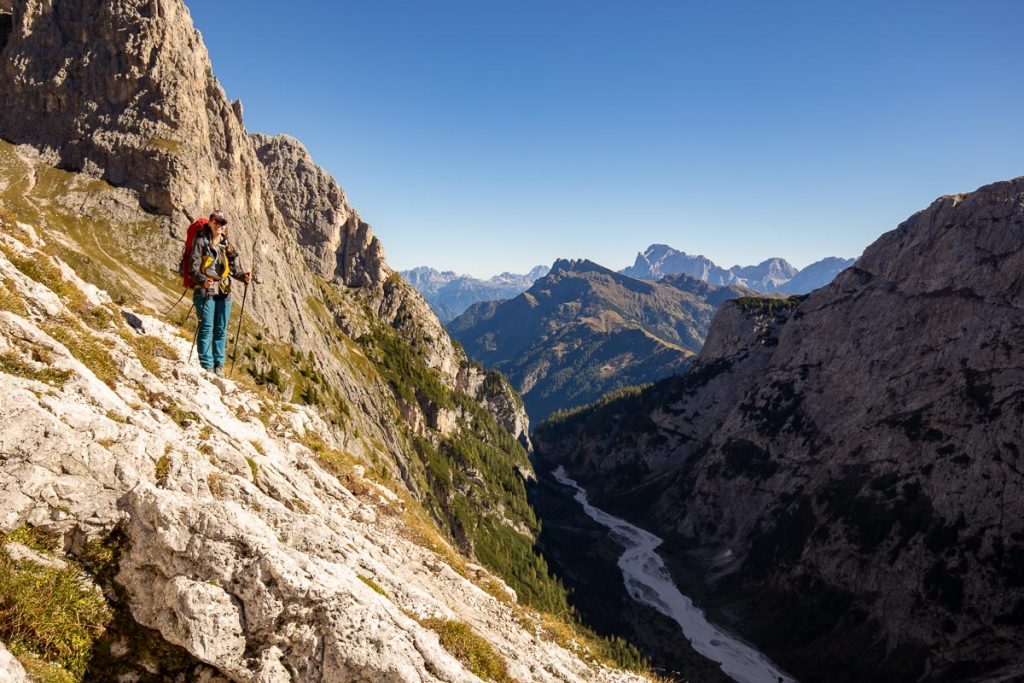
After a comfortable night’s sleep and a decent breakfast at Rifugio Mulaz, head back toward the ridgeline to the south (path 703).
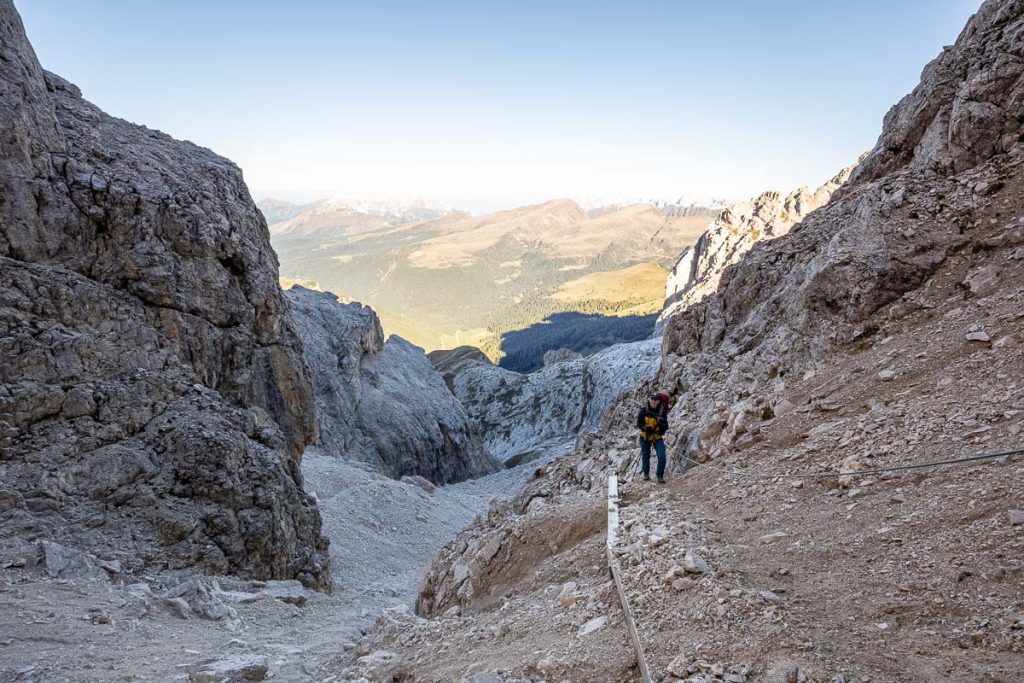
A scree traverse and an uphill push will lead you to Passo Farangole. The last section leading up to the pass is cable-protected; on the other side, you will find some ladders to help you get back down. Being around the spires of this ridgeline is one of the most exciting parts of the hike.
Kitting up is optional if you are sure-footed. However, I always prefer to follow the rule ‘better to be safe than sorry’. The mountains can be really unforgiving. At the very least, put on your helmet to protect your head from any loose rocks.
The route then drops 500 meters (1640 feet) into the Val delle Comelle, with a few more short, simple cabled sections, before rising again onto a moon-like landscape where Rifugio Rosetta will become apparent. The whole day is spent on path no. 703.
TIP: If you only have two days to hike, you can finish the traverse at Rifugio Rosetta, which is a 15-minute walk from the top of the Col Verde gondola. It will take you down to San Martino Di Castrozza.
Extension Day 2: Summit of Monte Rosetta
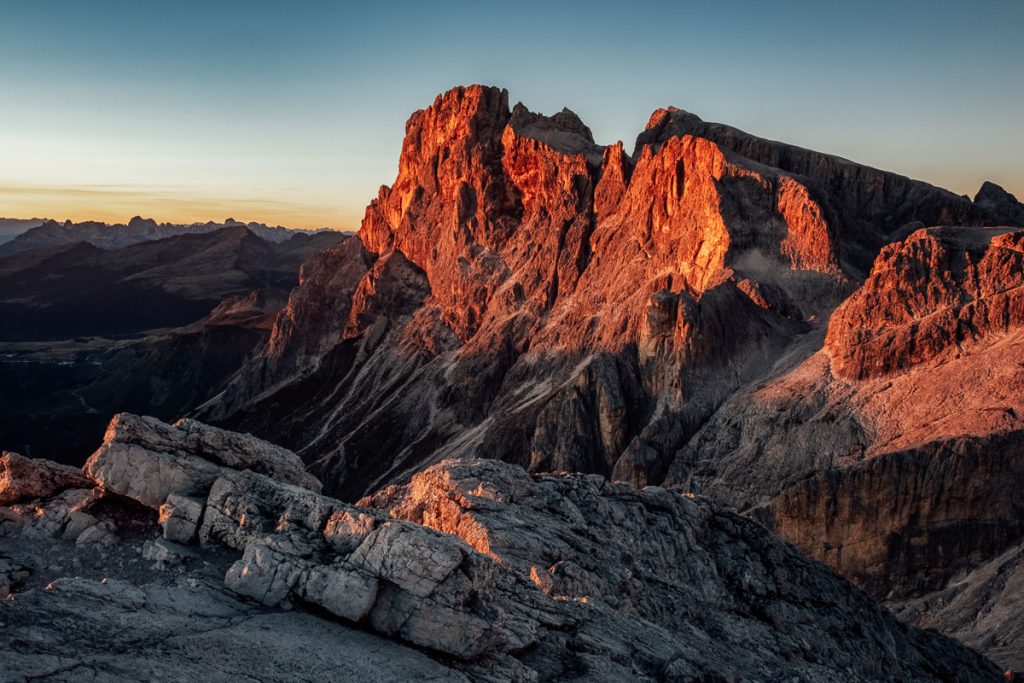
This easy-to-reach summit is clearly visible from the hut, and it only takes 45 minutes (160 meters or 525 feet in elevation) to reach the top. If you are looking for a great spot to watch the sunset, this is it! It’s a good way to burn off those calories from the three-course dinners you will be served at the huts.
From the summit of Monte Rosetta, you can look down into Cismon Valley, home to the towns of San Martino di Castrozza and Fiera di Primiero.
You will also be able to spot Passo di Ball – your objective for tomorrow, creating the perfect heart shape with the mountains in the background.
Night 2: Rifugio Rosetta G. Pedrotti
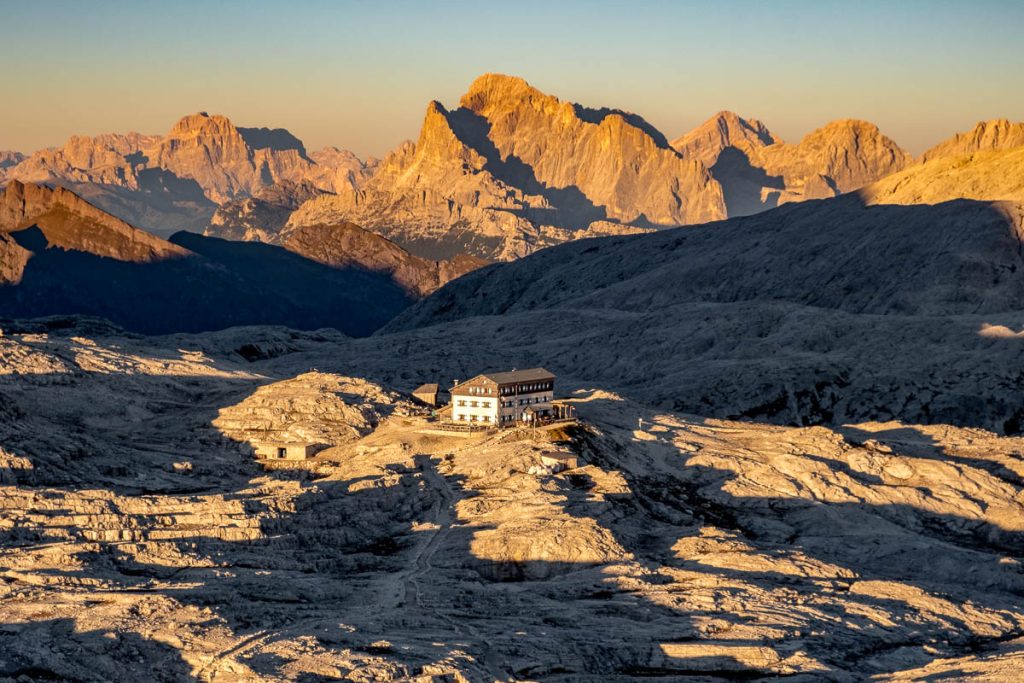
The website of Rifugio Rosetta G. Pedrotti has all the information you need to make a reservation, from contact details to the lunch menu. It’s also available in English, which isn’t always true for Dolomites’ huts. They are affiliated with Club Alpino Italiano.
Day 3: Rifugio Rosetta to Rifugio Pradidali
- Distance: 6.5 km / 4 mi
- Walking time: 2 h
- Elevation gain: 217 m / 710 ft
- Elevation loss: 362 m / 1190 ft
- Path numbers: 702, 715
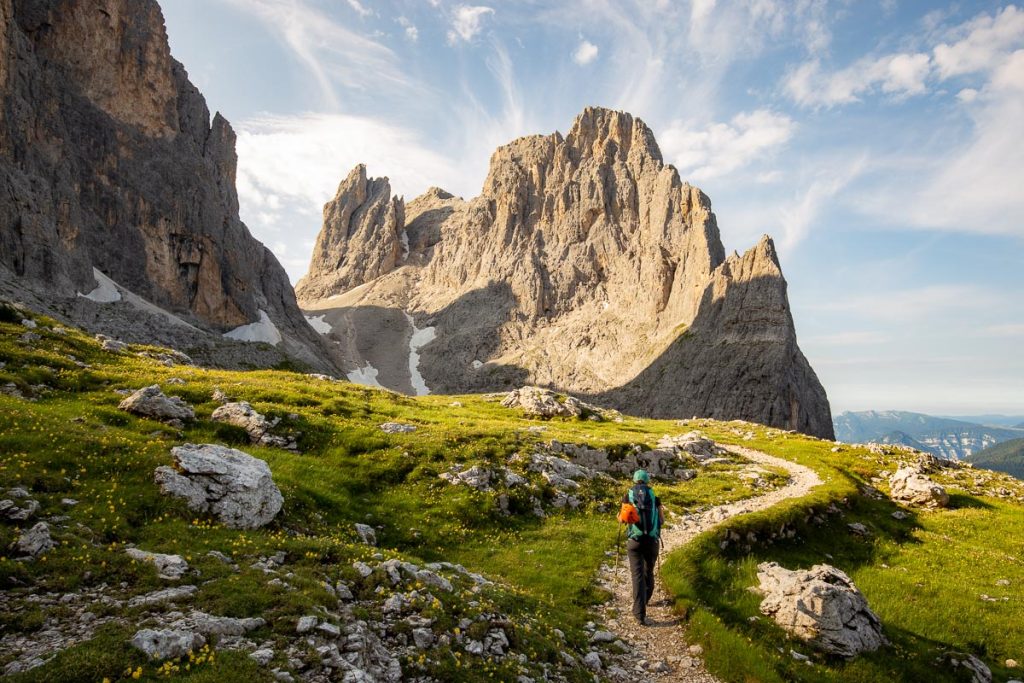
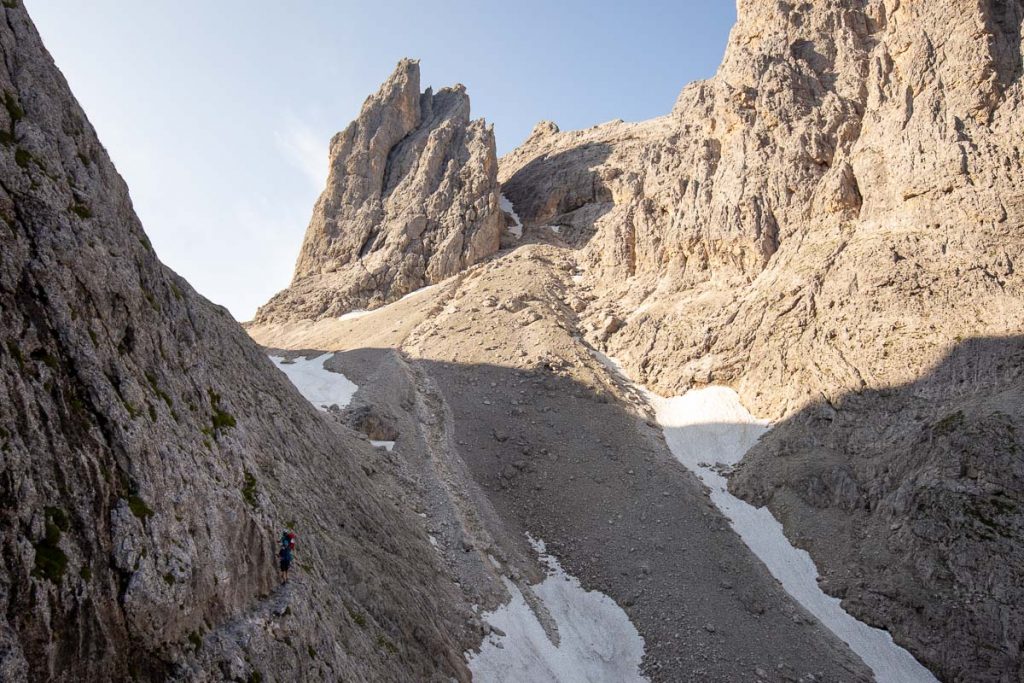
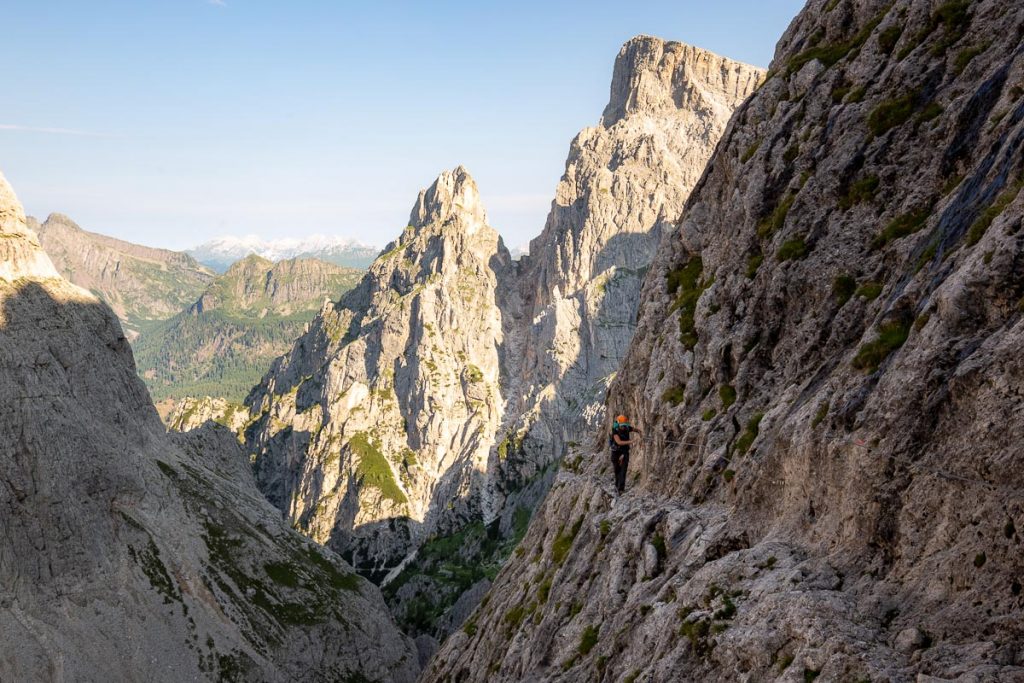
This part of the day is accessible, but that doesn’t mean you won’t get many beautiful views. For most of the hike between Rifugio Rosetta and Pradidali, you can keep your head high and admire the mountains.
After leaving Rifugio Rosetta, the route switches back southward on path no. 702. If you are wondering how you will ever know which path number to follow, don’t worry! Everything is well signposted in the Dolomites, and as long as you pay attention to the route, you won’t get lost.
Shortly after, the route plateaus and traverses along the western slopes between Croda di Roda and Cima Pradidali peaks. Cable sections are prevalent here but are very easy. The route then heads slowly uphill to Passo di Ball, where you’ll get your first glimpse of Rifugio Pradidali. It’s only another 20 minutes away.
Extension: Via Ferratas Porton and Sentiero Nico Gusela
- Distance: 10 km / 6.2 mi
- Walking time: 4 h
- Elevation gain: 670 m / 2200 ft
- Elevation loss: 670 m / 2200 ft
- Via Ferrata level: Intermediate
- Path numbers: 739A, 714, 715
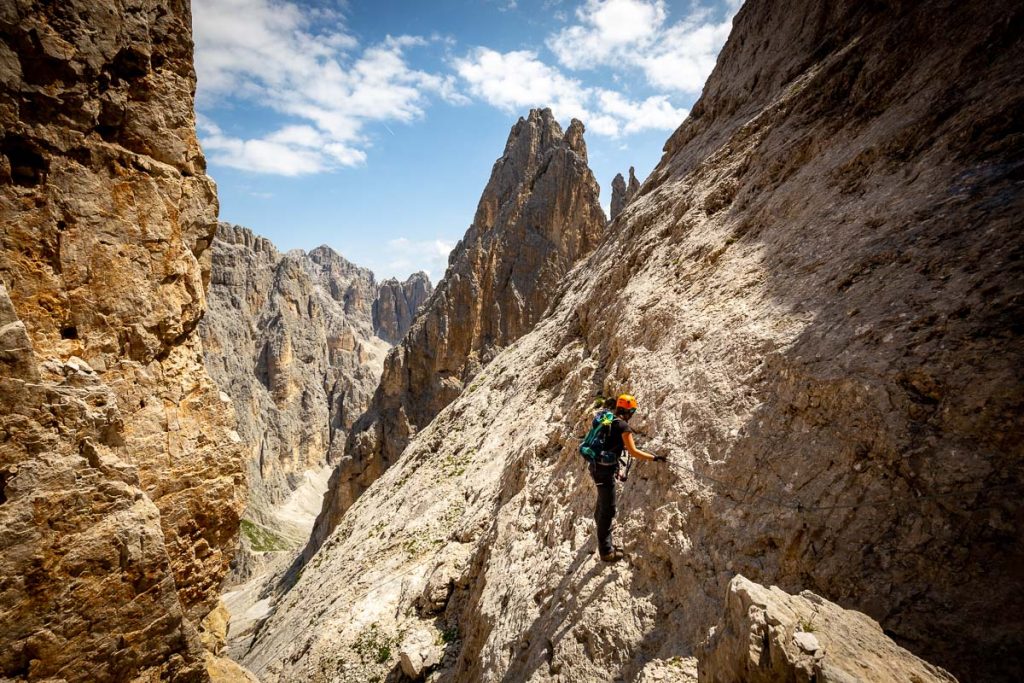
Via Ferratas Porton and Sentiero Nico Gusela, make excellent afternoon activities on your third day. They form a loop that runs clockwise from Rifugio Pradidali via the Cima di Val Roda and Passo di Ball, where you were earlier in the day.
Logistically, you can do these two ferratas anticlockwise when you get to Passo di Ball from Rifugio Rosetta and end up at the refuge. Still, I’d advise against this for two reasons.
Going to the hut first allows you to drop heavier items off, making the climbing more enjoyable. Moreover, via ferrata Porton is much better done clockwise. It involves a steep, ladder-assisted climb, which is safer and more accessible to tackle in the clockwise direction.
The first ferrata (Porton) starts around 15 minutes away from Pradidali hut on path 739A, then by a series of ladders and stemples in a narrow gully it gains over 350m of elevation and culminates at Forcella Porton.
The route then moves around Cima di Ball on path 714, where more cable-protected sections are found.
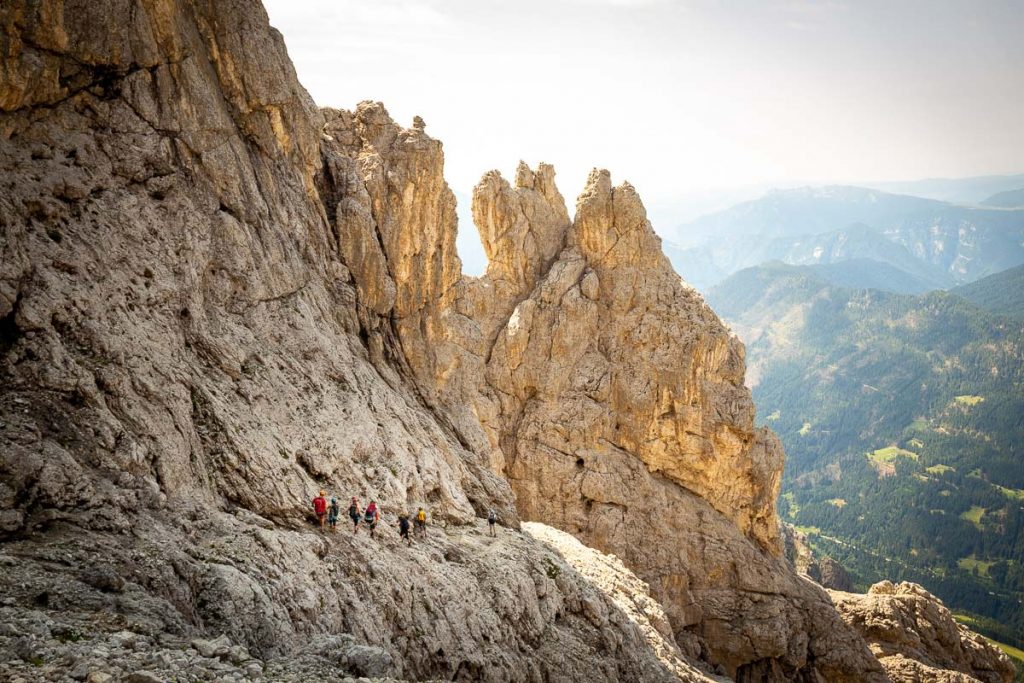
The route traverses the slopes up to Forcella di Stephen, where the path becomes ambiguous. However, as long as you’re heading uphill toward the pass, you are going in the right direction. Now, you have the chance to do the summit extension to Cima Di Val Roda. The view over San Martino di Castrozza to the north is well worth it.
The path then down-climbs along the via ferrata Sentiero Attrezzato Nico Gusella, the easier of the two ferratas. Using a few more ladders and pegs, the route loses elevation quickly before traversing to Passo di Ball, where you were earlier in the day. You can now return to the refuge knowing you’ve earned tonight’s dinner.
Night 3: Rifugio Pradidali
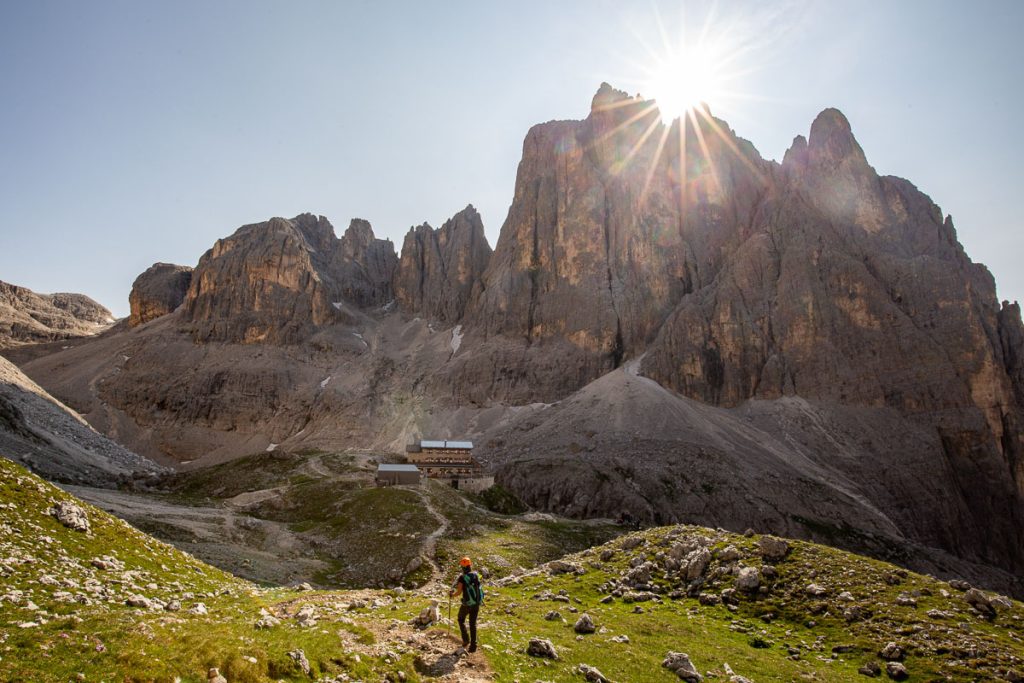
The hut’s website is full of helpful information about the area’s history and the ‘traverses’ available. This hut’s opening times are similar to Mulaz (from mid-June to the end of September). Rifugio Rosetta opens longer due to the proximity of the lift.
Try to avoid booking a room in the attic. It’s dark, damp, and has no ventilation. The rooms on the floors, however, are charming and cosy. Rifugio Pradidali, like the previous two huts, is also Club Alpino Italiano affiliated, so make sure to bring your Alpine Club membership.
Day 4: Rifugio Pradidali to Val Canali
- Distance: 12.5 km / 7.8 mi
- Walking time: 5 h
- Elevation gain: 650 m / 2132 ft
- Elevation loss: 1515 m / 4970 ft
- Path numbers: 709, 711, 707
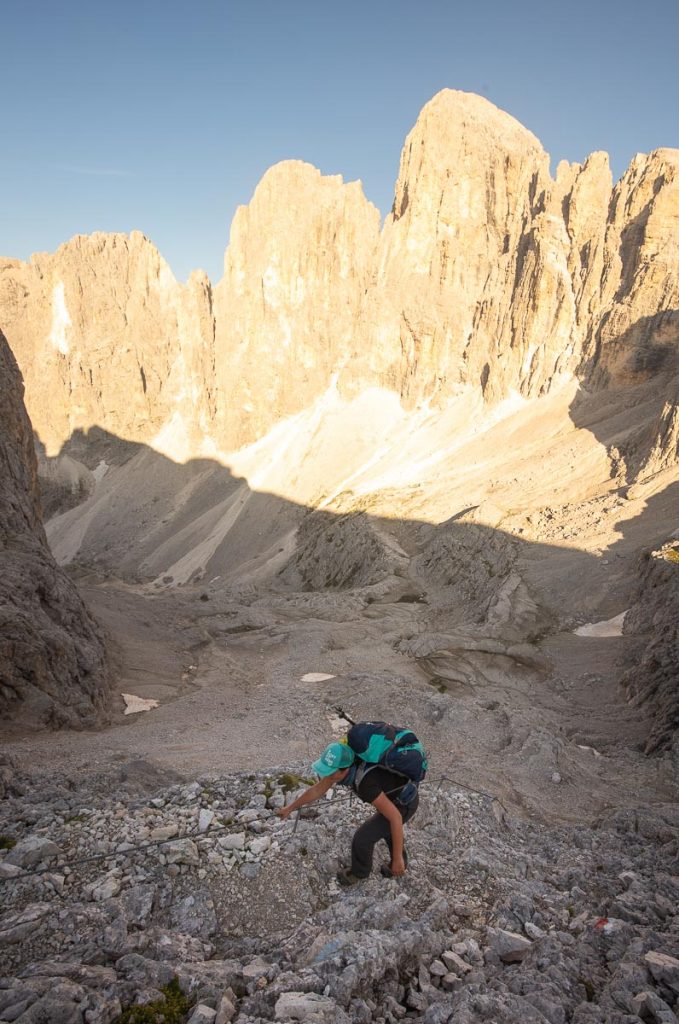
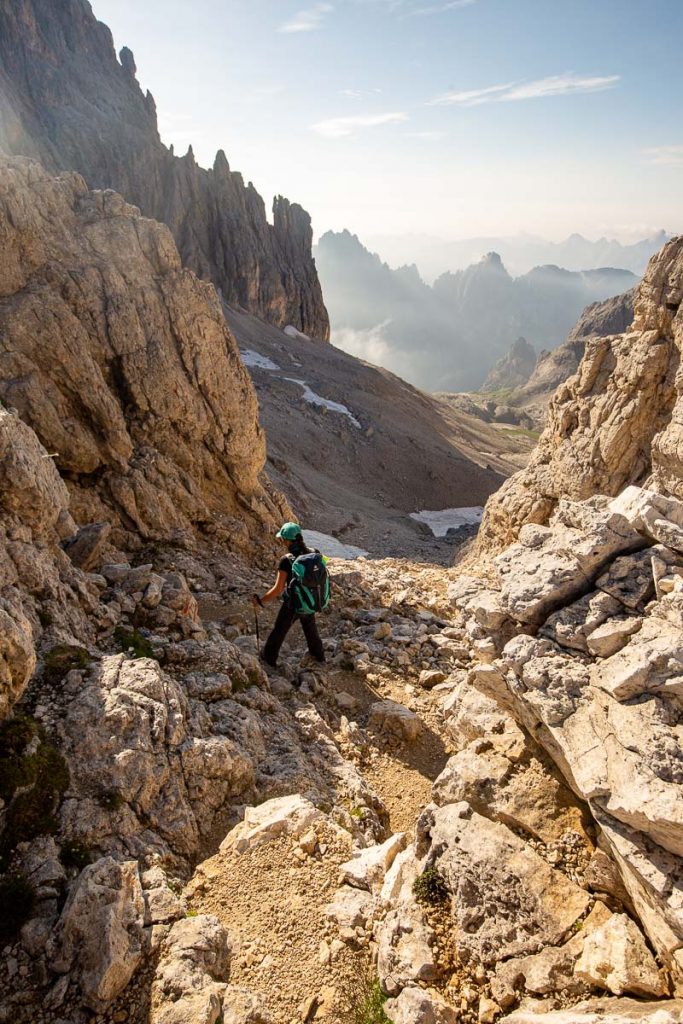
When I did this part of the route, I saw only two other hikers the entire time. It’s undoubtedly the quietest but also the hardest section of this traverse, so make sure to get an early start.
The traverse meanders northward, passing Lago Pradidali following the Alta Via 2 route. It switchbacks up some decent scree slopes before branching right onto path 711, where a simple, protected section leads you over a hump and up toward Passo delle Lede. The views from there are epic.
The pass is rugged to reach; if you don’t get an early start, the midday sun could make your life sweaty. The route then enters a widening gulley and starts your 1500-meter elevation loss.
The descent is a real knee-buster, but the views are still grand, especially as you get close to the Bivouac C Minazio. It makes an excellent spot for lunch.
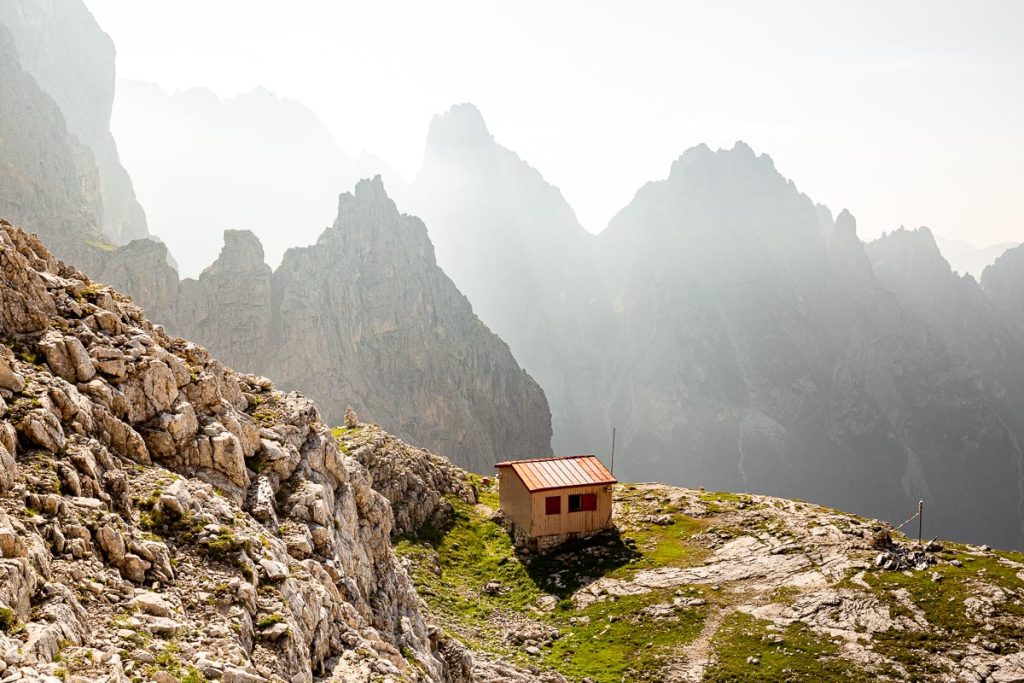
Shortly after the bivouac, the route enters the tree line, and although the mountain vistas are temporarily gone, the change is very much appreciated. At the end of this route, stay on path 711 until you reach the river, then follow path no. 707 to the final point of this traverse.
TIP: If the previous day’s excursions have left you worse for wear, there’s an easier alternative route down from Rifugio Pradidali into the aptly named Val Pradidali, following path no. 709.
Onward Travel
At the finish point, you can relax and have a beer at the Cant del Gal Hotel. I’d advise checking the bus timetable at the Val Canali bus stop on the opposite side of the road first so you can time it well with your departure.
Bus no. B503 from Val Canali to Fiera Di Primero runs at 1-hour intervals most of the day. The journey takes 16 minutes. In Fiera di Primiero, you can change and travel onward to San Martino di Castrozza (30 minutes) or to Feltre (60 minutes).
Feltre is a bigger town with train and bus connections to Trento, Verona, and Venice.
How can the Pale Di San Martino Traverse be shortened?
If you want to follow this itinerary but don’t have four days, here are some possibilities to shorten it.
TIP: If you would like to adjust this itinerary to your personal needs then use my trip planning services. We can schedule an online meeting and talk about personalizing the trip.
2-day option: Stay the first night in Rifugio Pradidali
You can skip the first two days, take the Col Verde – Rosetta gondola from San Martino di Castrozza, and then start your hike from Rifugio Rosetta. This way, the third day of my itinerary will become the first day.
2-day option 2: Exit to San Martino Di Castrozza
After completing day two of hiking from Rifugio Mulaz to Rifugio Rosetta, you can take the Col Verde-Rosetta gondola down to San Martino Di Castrozza.
3-day option: Alternative start with Via Ferrata Bolver Lugli
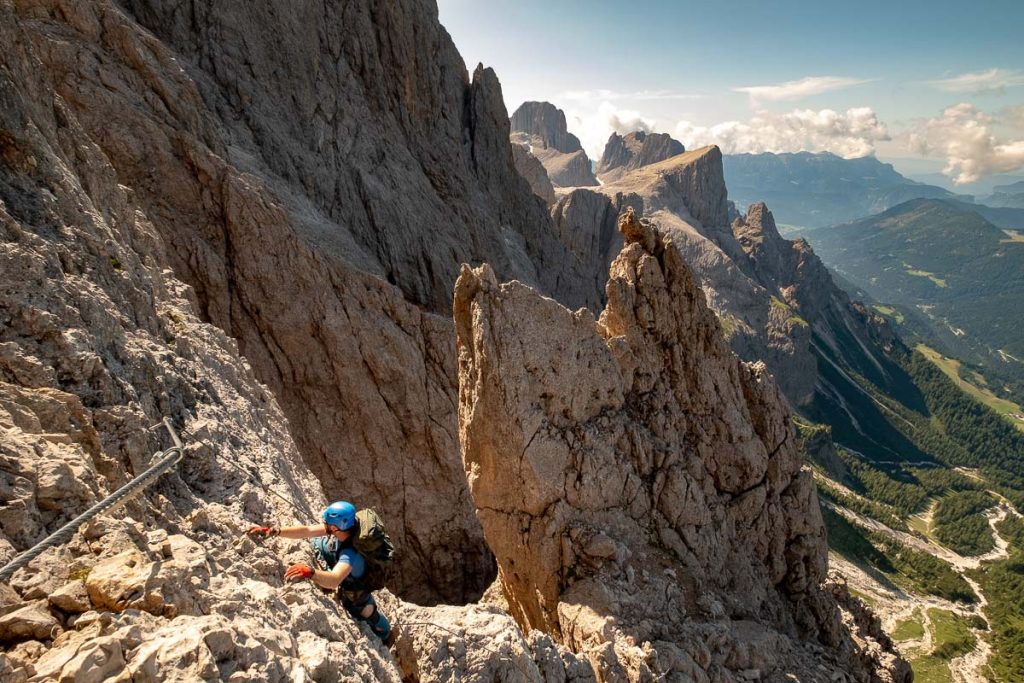
To make this traverse even more exciting and challenging, you can start it with the advanced Via Ferrata Bolver Lugli.
The Ferrata takes you along the western slopes of the Pale Di San Martino range to its highest point – Bivouac Fiamme Gialle. It then heads down the Valle Dei Cantoni, over Passo Bettega to Rifugio Rosetta, where you can spend the first night. After the alternative day 1, continue as per the itinerary.
3-day option 2: return to Passo Rolle
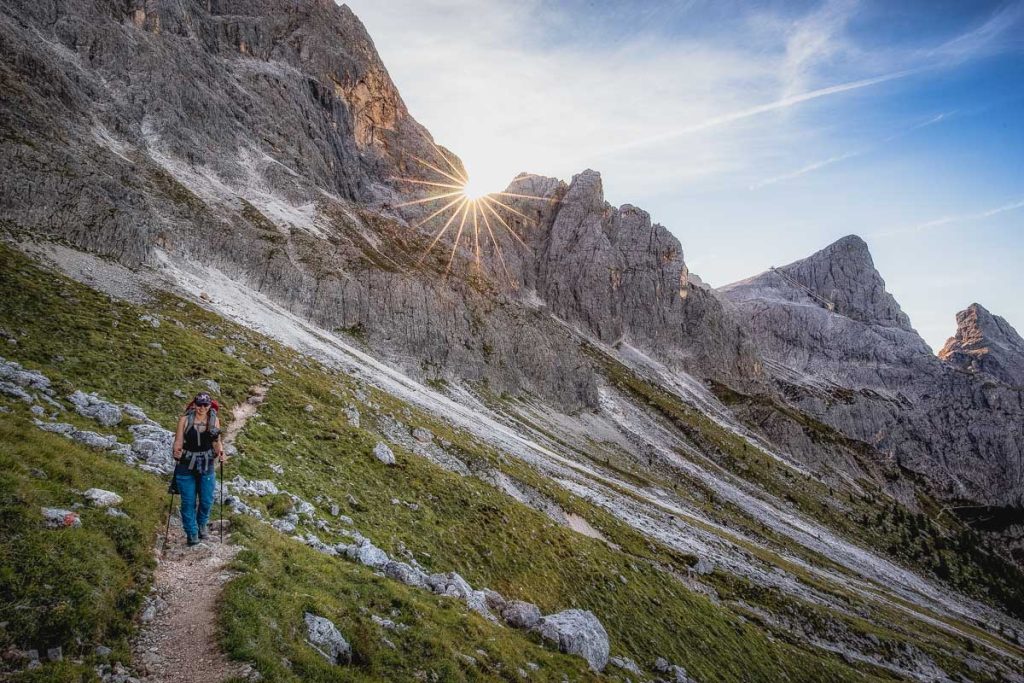
Follow the first and second days of this itinerary, then return to Passo Rolle on the third day, following paths 716, 712A, and 712, forming a loop through the Pale di San Martino group.
Refer to the Tabacco map no 022 to better understand the paths.
9 Frequently asked questions about the Pale di San Martino Traverse
1. Do I need via ferrata gear to complete this traverse?
Yes, a short via ferrata section on day 2 leads across Passo Farangole and a cable-protected section that leads to Passo di Ball on day 3.
Whilst those are beginner routes, and I have seen lots of people doing them without the gear, I think being well-equipped should always be a priority for those heading out into the mountains. Check out my beginner’s guide to via ferrata climbing in the Dolomites to see what gear you will need.
2. Where can I rent the via ferrata gear?
Look for sports shops and rental places (Noleggio in Italian) in San Martino Di Castrozza and Fiera di Primero. The via ferrata set costs around 30 Euro to rent for the day. Gloves are often not included, so you should bring your own pair.
3. Is there a way to omit via ferrata sections on this traverse?
Unfortunately, there isn’t. If you are looking for a backpacking trip in the Dolomites that doesn’t include any via ferrata crossings, try the Alta Via 1. Even though it’s a 10-day traverse, you can plan on doing just a part of it.
4. Is there a way to turn this traverse into a loop?
Yes, please refer to the previous section, where I discuss how to shorten this traverse, particularly 3-day option 2.
5. How to pack for this traverse?
My advice is always to pack as lightly as possible. I created a packing list for hut-to-hut hikes, which lists all the essentials you must bring along on a backpacking trip to the Dolomites.
6. Do I need to bring cash?
Whilst many huts started accepting card payments in recent years, I would still recommend bringing cash. 80-100 Euro per person per night should be enough. There are ATMs in San Martino di Castrozza and Fiera di Primero.
7. What can I expect when staying in the huts?
The Italian Alpine Huts are very well equipped and provide everything you might need for a comfortable night’s stay, from running water to flushable toilets through on-site restaurants and duvets. However, a few things you will need to bring, most notably a sleeping bag liner, are also recommended. Here is everything you need to know about staying in mountain huts in the Dolomites.
8. Is it possible to do this route in reverse?
Yes, however, going North to South is more recommendable, particularly if you are hiking between June and August. The northern slopes stay in shade much longer, providing cooler temperatures during the hot Italian summer.
It will also be easier to do the Pale Di San Martino Traverse from North to South, particularly the last section between Rifugio Pradidali and Val Canali.
9. Is there a place to store my excess luggage for the trip?
Your best bet is to leave your excess luggage in the trunk of your car. If you travel by public transport, leave your luggage at the hotel where you stayed the night before. Contact the hotel first and ask if they provide such services.
Shop my hut-to-hut backpacking gear
Osprey 30+ Litre Backpack
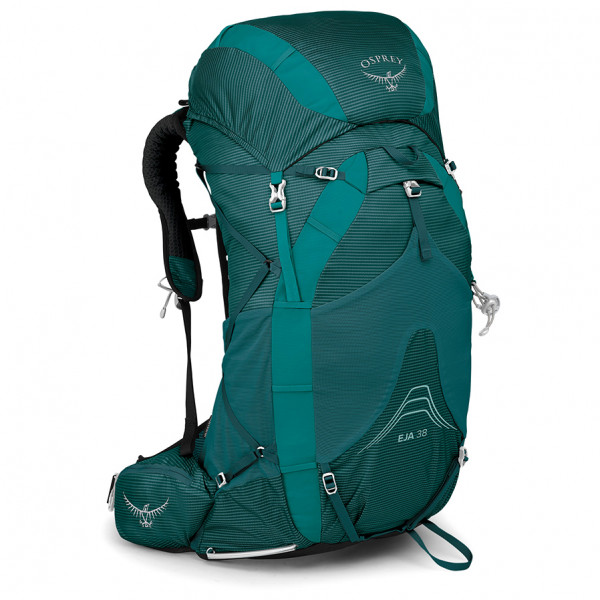
30-40 litre backpack should be more than enough to pack everything you need for a hut-to-hut trip in the Dolomites with plenty of room for water and snacks. If you can’t fit in, it means you are overpacking. I am a huge fan of Osprey backpacks and currently own the Eja 38-litre. Osprey has plenty of options in this storage volume range to choose from.
Shop on Osprey Amazon Store (Worldwide) / Backcountry (US)
Sleeping Bag Liner
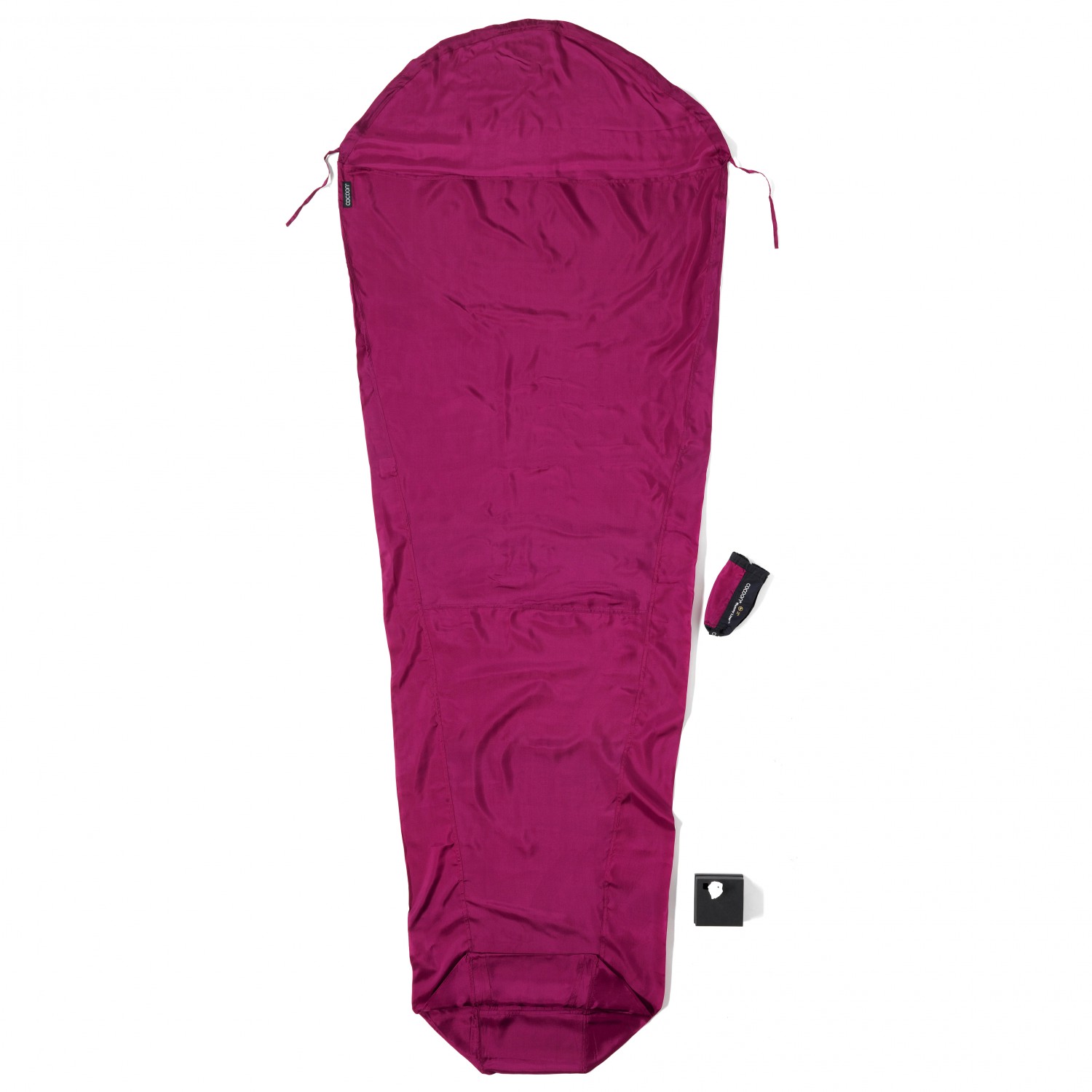
Sleeping bag liners are required for hut stays. Duvets and blankets aren’t washed after each guest who stays at the hut. Liners ensure that you don’t come in direct contact with the sheets and subsequently, it is more hygienic. Some huts rent or sell them, but it’s better to bring your own.
Shop on Amazon (Worldwide) / Backcountry (US)
Patagonia Insulated Jacket
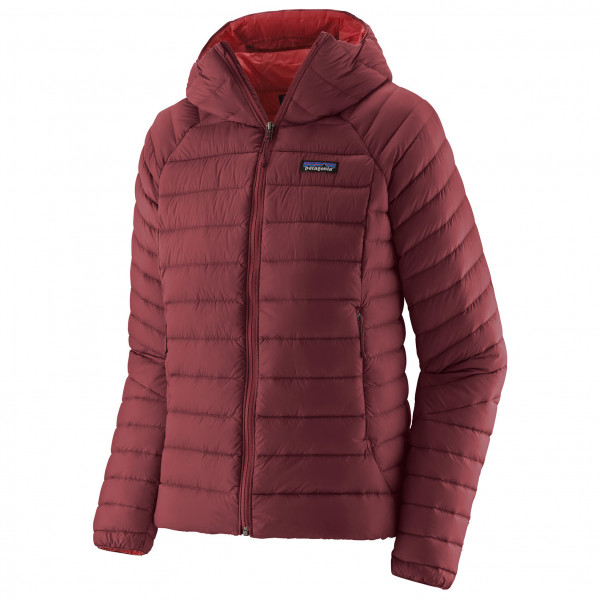
Even in the middle of the summer season evenings can be quite cold. If you don’t plan on venturing out of the hut in the evenings, you can skip this layer. I personally always bring one with me as I like to take sunset photos outside.
Shop on Backcountry (US)
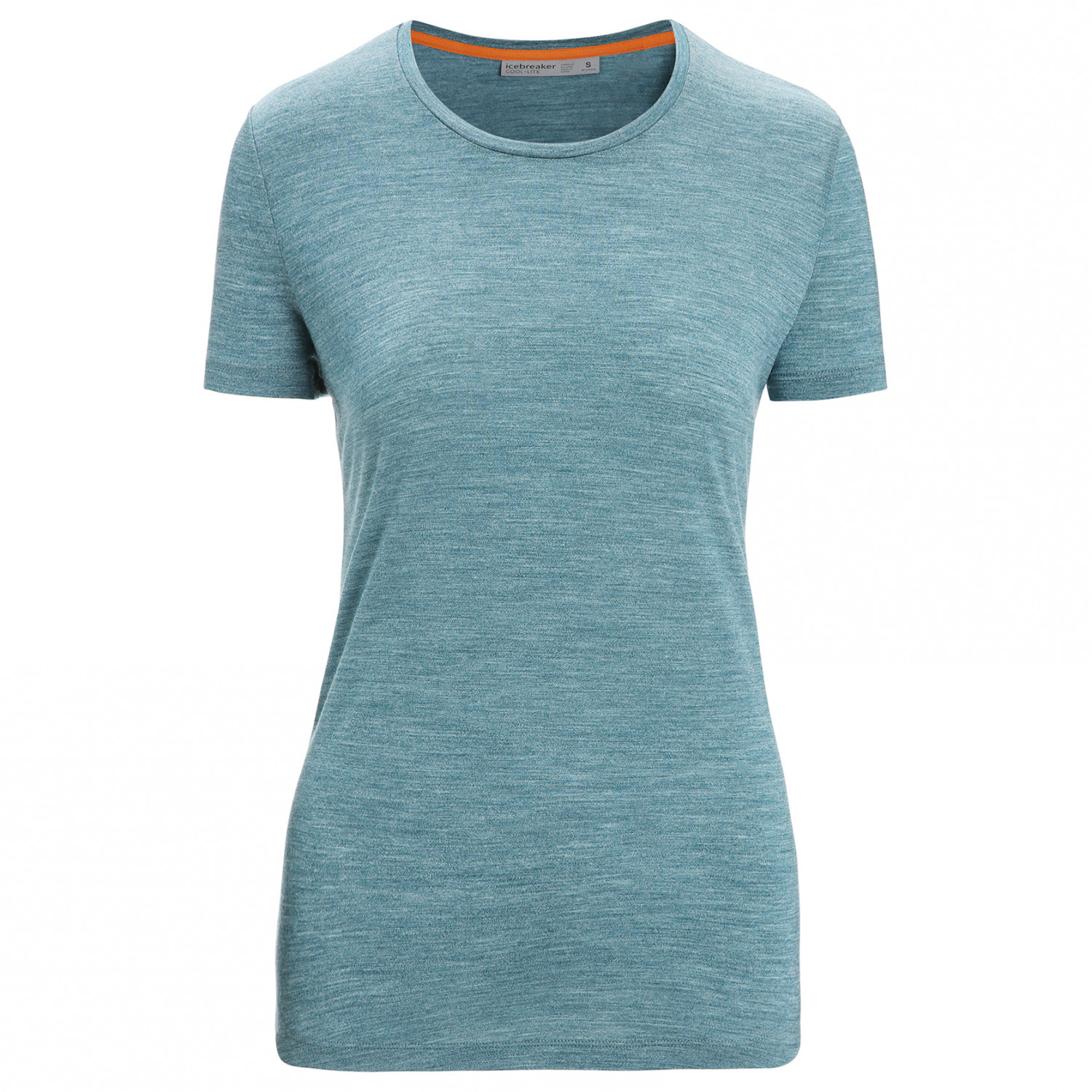
Merino Wool T-Shirts
Having a couple of Merino Wool T-shirts which you can alternate and then wash at the hut each day will be more than enough to keep body odors at bay. I am personally a big fan of the Icebreaker brand, however these days plenty of other brands have Merino products in their inventory.
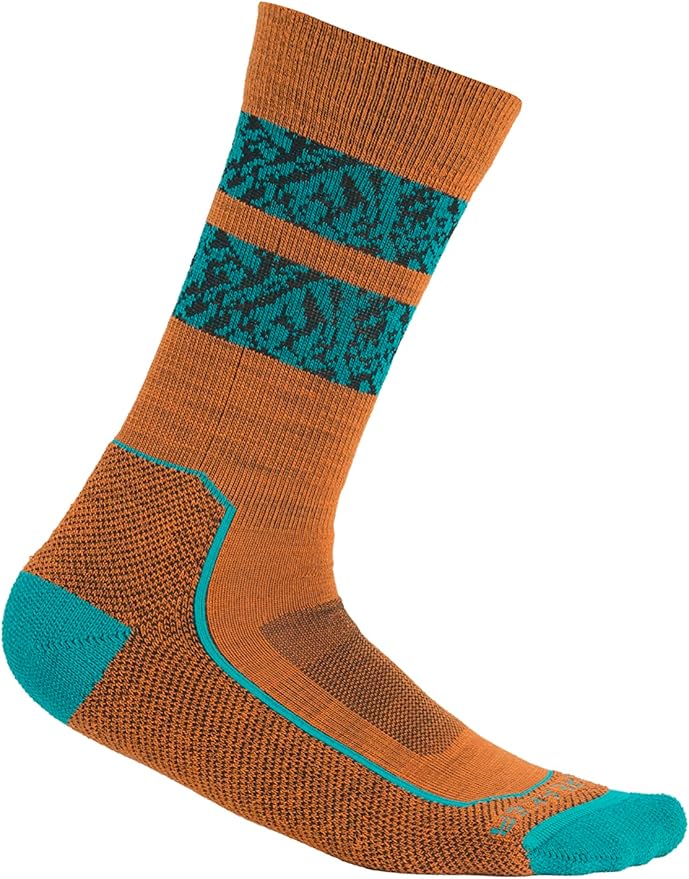
Merino Wool Socks
I always carry 2 pairs of socks in my backpack and one on me during multiday backpacking trails. Merino wool fibers and their unique properties are resistant to odors. Merino wool socks also prevent getting blisters as opposed to cotton socks.
Shop on Amazon (Worldwide) / Backcountry (US)
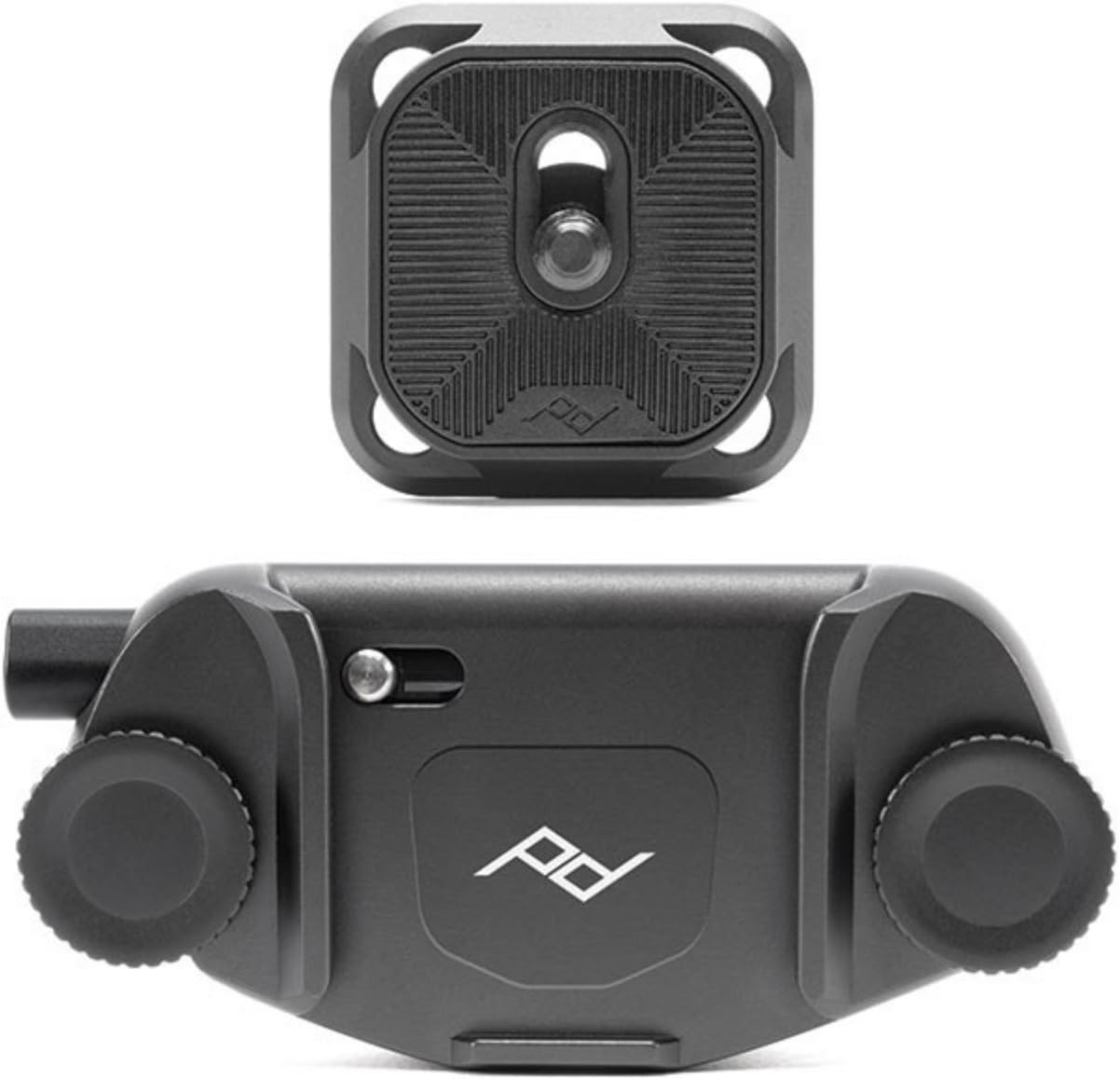
Peak Design Camera Clip
A must-have for any mountain photography enthusiast who is tired of carrying a camera around their neck. The peak design capture clip allows you to attach your camera to a backpack strap. That way you don’t have to take your backpack off and take your camera out every time you want to take a photo. You will always have it handy.
Shop on Amazon (Worldwide)
Other backpacking trip ideas in the Italian Dolomites
- 3-5-day Rosengarten Traverse
- 3-4-day Tre Cime National Park Traverse
- 3-5-day Dolomiti Brenta Traverse
- 3-4-day Monte Popera Circuit
- Alta Via 1 (11 days)
- Alta Via 2 (14 days)
- Alta Via 4 (7 days)
More travel and hiking resources in the Dolomites
- Photography spots in the Italian Dolomites
- Via ferratas in the Italian Dolomites
- Day hikes in the Italian Dolomites
- Hut-to-hut treks in the Italian Dolomites
Support my website!
Hi Reader! If you found any of my articles about the Dolomites useful please consider using the affiliate links below (at no extra cost) when booking your holiday. Thank you
- Reserve your hotel with Booking.com
- Book your rental car with Discover Cars
- Buy your outdoor gear with Backcountry.com (US readers)
If you have any questions, leave them in the comments below!
Hi Marta, my 16 year old son and I have just completed this tour. This is a challenging trek with epic scenery and we had an amazing 4 days. Your guide was really helpful. Just some observations which may be helpful to others:
– coming from the UK the quickest way to reach the route is flying to Venice and then picking up the daily bus service from Venice (which stops at Mestre bus station) to San Martino
– the service is run by https://www.brusutti.com/en/public-transport.html; they speak good English although the timetables and fares are on the website, and you can buy your tickets in advance online; from Mestre to San Martino is 12 Euros one way.
– as the bus does the return route and goes round the mountain villages you can pick it up in Fiera di Primiero to return to Venice
– a word on the via ferrata on this route (the compulsory ones). If you are inexperienced on via ferrata I would absolutely recommend taking helmets and harnesses for added peace of mind. There are rental shops in San Martino and the one we used (https://noleggiskisport.it/) will let you drop the equipment back in Fiera by prior arrangement.
– Don’t make the mistake we made of looking too far ahead on Day 2 to the chasm that needs crossing – once you get there it’s pretty straightforward but from a distance looks daunting! Day 2 is a longish day with a climb to Rosetta in warm conditions to finish the day.
– You can skirt round the Day 3 and Day 4 via ferrata if you prefer on the alternative paths shown on the map
– Showers were available only at Mulaz and Rosetta due to the water supply.
– The huts much prefer cash.
– As Marta says, the drop from Passo delle Lede on the last day is very tiring but the scenery is incredible and you will have had the exhilaration of the via ferrata to get to the pass (as well as a long cold drink at the end!)
Hi Robert. Thanks so much for your feedback and for including the links to the places you used, I am sure it will help other travellers. Do happy to hear you had a great time!
Hi Marta,
We will be doing the route in reverse, due to the refugio availability. You mentioned it may be harder, do you mean just more physically demanding ? Or perhaps the via ferrata would be harder?
Thanks for a great resource.
Hi Jack. You will do more elevation gain doing it in reverse. When it comes down to via ferrata sections they are short and involve both down and upclimbing, so that won’t make much difference. Another thing is the sun exposure. You will be hiking a lot more in the sun because of going South to North direction. that means you will be exposed to the sun a lot more. It might make things a lot harder on hot days. I hope that helps!
Hi marta,
This is incredibly helpful! We are just a little confused on where to stay the night before we start. We have a car rented and the parking lot you mentioned at the trailhead shows as closed on google maps… do you have any other recommendations on where we can start/leave the car?
Hi Delfina. I was just there last month and yes, the Malga Juribella parking lot is undergoing construction, but there are still places on the other side of the road to park.
Hi Marta! Wow, thank you for this incredible resource! We were able to book the first and third refuges but unfortunately Refugio Rosetta is fully booked. Do you have any recommendations for how to get around this? Are there any other refugios in the area we should consider detouring to, or is the best option to combine days 2 and 3 and skip Refugio Rosetta altogether?
Hi Katy. Once you reach Rosetta you can hike 15 mins to the gondola station and get down by gondola to San MArtino Di Castrozza and stay in a hotel. The next day you just take the gondola back up and continue with the journey. Otherwise if you are strong hikers you can hike from Mulaz to Pradidali in one day. I hope that helps.
What an incredible guide! Thank you so much for this! We are particularly interested in the “3-day option 2: return to Passo Rolle.” But we are having a hard time finding a map showing paths 716, 712A, and 712 that you need to follow to make a loop back to Passo Rolle. Any chance you have some pointers?
Hi Dinis. Thanks for stopping by. I link to the appropriate map in the post (in the text right above the map). I hope that helps!
Thank you so much, Marta! I will purchase the map. While I wait for it, would you mind please letting me know if paths 716, 712A, and 712 run on the other side of the mountain from the side than the Day 2 trail?
Hi Dinis. Yes, they run from Rifugio Rosetta to Malga Fosse. You can see this trail on google maps too (although not marked with numbers, just green lines). It forms a nice circle with previous days.
Thank you so much!
Sorry, one more question if you don’t mind. Do you think it is possible to do this route in reverse. Specifically to start on 716/712A/712, then stay at Rifugio Rosetta for the first night and then, second night, at Rifugio Volpi al Mulaz. I am only asking because of the availabilities of the rifugios. Thank you!
Yes It is. But you can just take the gondola up to Rifugio Rosetta from San Martino Di Castrozza. so you might want to just Hike from Rosetta to Rifugio Mulaz and make it a one night adventure instead.
Thank you for all your help! Do you know if you can do the via ferrata Bolver Lugli in the opposite direction from what you recommend, specifically: from Rifugio Rosetta to the Rosetta Gondola?
Hi Dinis. Doing it in the opposite direction would mean climbing down on the via ferrata, in the opposite direction of travel, which creates unnecessary risk for you and other people who are climbing up, because of the passing issues. I hope that explains it!
From Rosetta you can just take the Rosetta Cable Car down to the Col Verde station and start the via ferrata Bolver Lugli in the correct direction of travel from here. You will then end up back at rif. Rosetta.
Hello! This is incredible, thank you! My friends and I are trying to plan backpacking trip through the Dolomites and came across your blog. We liked this hike and “An Epic 3-5 Day Traverse Across The Rosengarten Nature Park In The Italian Dolomites.” We are trying to decide between the two. Do you have a personal favorite between the two or any other recommendations?
Hi Mary Lynne. Rosengarten is slightly easier with the logistics and what I like about it is that the via ferratas (apart from the one on day 2) are all done as extensions which means you can check into the hut and head out for the day with a lighter load to do the via ferratas. Pale Di San Martino is definitely quieter though, but it is more of a hiking excursion than a via ferrata. If you are looking for a challenge I can also highly recommend the Dolomiti Brenta Circuit. You just need to ask yourself what is more important for you.
Hi Marta,
Thank you for this trip plan. I am wondering if you think the Via Ferrata sections are doable for a couple people new to this. We are avid hikers but never done rock climbing or Ferratas. Would you consider the heights of the Ferratas “scary” for example walking along a small ledge of a cliff. Or something less intimidating? Do you think if we rented gear and watched a couple you tube videos we would be prepared for these sections of the route? We are hoping to hike the route self guided.
Thanks!
Jessie
Hi Jessie. That’s how I did my first via ferrata. I learnt off a friend how to use the gear and off we went. The gear is simple to use. With that said everyone is different and has different risk aversion. I cannot give you a straight answer whether you would be ok or not. If you suffer from vertigo, you definitely shouldn’t do any via ferratas. Yes, there are narrow ledge section where you often have a big drop to the side. With the Pale Di San Martino Traverse, the tricky (albeit short) part of crossing passo Farangole. There are some cables and ladders installed along the pass. You always stay clipped in though during that tricky passage. The first time I crossed it I met a group of 65+ year old from Ireland who did it without the gear, because they didn’t know they needed it. As I said, everyone has a different risk aversion 🙂 I hope that helps!
Hi again Marta! Thank you for your reply regarding the Via ferrata. We have booked our huts and plan to do this hike in September 2025. I have ordered the paper map you recommended. I am wondering if there is a trail app such as Trail Forks or All trails you would recommend that has these trails?
Thanks again!
Jessie
Hi Jessie. I am glad you are following my guide. I never use any trails apps, just paper maps. Navigating with those is super easy in the Dolomites and I find the paper maps give you a much better overview of the area than any online trails do. My advice is stick to one. Once you will start using different navigation systems you will start second guessing yourself. I hope that helps!
Hi Marta,
We just finished the 4-day hike based on your blog (we met like 3/4 couples from around the world that used your blog, so you’re getting popular 😉 haha), and we went with a small tent. Thanks a lot for putting this all together. I wanted to add some information for those who plan to go with a tent. The huts tolerate putting your tent next to it, provided that you leave no trace, set up at dusk and leave at dawn. At all the refugios there are at most 3 good spots to put down your tent, beyond that it becomes quite rocky or quite far from the hut. At pradidali, the wind got very strong and almost blew us of the mountain, so we packed up at 5 in the morning to make sure we didn’t end up in a storm (rain started only at 11, luckily). The people from the hut told us that this is the case every morning, so, take care of this weather condition. Though, because the mountain huts are not 5 star hotels with separate rooms and kingsize beds, we often had a better night outside than the people inside ;-). In terms of dinner, the huts always had room for the two of us to join a table. I totally back up the fact that you cannot do this trip with proper via ferrata gear, some of the parts are way to sketchy to do without. We rented it (without reservation, which was not a problem) in a small shop in San Martino for 33€ for 5 days (1 helmet,1 harness).
Thanks again for this amazing blog,
Best, Chris and Kaya
Hi Chris & Kaya. Thanks for following my itinerary and for your feedback. I am glad to hear you were able to rent the gear in San Martino. As for your tent consider yourself lucky. I have seen first hand people being ask to pack up their things and leave near huts. Camping in a tent within nature park is not allowed. Just because you were tolerated won’t be that others will be in the future, especially if more tent campers would start to show up. I am glad to hear you had a fantastic time and to hear that others also followed my itinerary. I hope you try another route in the future!
Hi there, I’m curious which shop you rented your gear at? We are visiting very soon and hoping to do the same!
Thanks
Dear Marta,
Really love your account and the amazing trips you have laid out! It’s very inspiring.
Me and my partner are very excited about this one.
The only thing is that it is not possible to book the Rosetta hut as it is fully booked.
This makes us wonder if we could skip night two and walk from the 1st hut to the 3d hut in one day. (From Volpi al Mulaz to Pradidali) We are planning to leave very early and not do any extensions that day.
Really hope to hear from you.
Thank you in advance
Best,
Julia
Hi Julia. Thanks for following along. Your comment was posted twice (need to be approved first before they appear here) so I deleted the first one. Yes, you can hike from Mulaz to Pradidali in one day stopping for lunch at Rosetta. I hope you have lots of fun! Let me know how it goes. Happy hiking!
Thank you!
Do you think that a particularly advanced pair of hikers would be able to take the Rosetta gondola and do the via ferrata extensions Porton and Sentiero Nico Gusela, hike back to the gondola, and return to town in a single day? We tend to enjoy really long day hikes and it’s far too late in the season to get any huts booked.
Hi Ecil. Yes this is doable in a day providing you take the first gondola up and keep a good pace.
Hi Marta,
My friend and I are planning on doing this 4 day hike. We are very excited and booked everything.
We also trained on a Via Ferrata parcour and did a B classification and a B/C, but never got to do it in a real environment.
Do you think the Extension on day 3 (Via Ferrata Del Porton) is do-able for us?
Kind Regards, Joey
Hi Joey. It’s a beginner via ferrata with B rating. If you have head for heights and know how to use the gear you should be fine, however in the end you are the only person who knows their own abilities.
Hi Marta,
I am SO excited to be using this guide this summer. I cannot wait to get onto the mountains.
I just had a question about getting to Rifugio Velo Della Madonna. I have booked a night there rather than at Rifugio Pradidali as they were full. Do you know how I would go about getting to that hut instead and still joining the same route the following day?
Thank you!
Lucy
Hi Lucy. There are a couple of different ways you can get to Velo Della Madonna. The next day after staying there the night you could also alter the route and exit via Val Pradidali. It would be best if you just got the Tabacco Map off Pale Di San Martino (no. 22).
Fab – Thank you so much!
Thank you for your guide! I’ve poured over it for hours and it has to be the best resource out there. I’m planning a last-minute trip (in peak season, unfortunately) so you have helped me narrow it down to do roughly this itinerary starting at Passo Valles instead. I was wondering if you’d care to share the mileage on the alternative route down to Val Pradidali, that last day seems brutal for someone who’s used to day hikes, and if the alternative is easy enough, I’d love to add back in the VF extension from day three before coming down instead.
Hi Cody. I am glad to hear you are following one of my guides. The descent through Val Pradidali has ca. 6 km, 200 meters of elevation gain and 1350 meters of elevation loss. Still pretty steep but shorter in time and not as much elevation loss. If you did the via ferratas on the same day it would definitely bed a long day. I hope that helps.
Hi Marta! Thank you so much for writing this blog, it is extremely useful! Is there any way to extend this hike by one night on either side (start or finish), ideally in an area that is quite green – to contrast with the rocky/lunar landscapes of the rest of the hike? We are keen to do a 4 night hike if possible!
Thank you so much!
Mikey
Hi Mikey. Thanks for your feedback. You could start on Passo Fedaia and just follow the Alta Via 2 (day 6) from there. It includes the Pale Di San Martino Traverse.
If you need more explanation or suggestions I am happy to schedule a call with you. Look into the Trip Planning advice tab.
Hi Marta! Thank you so much for this super detailed plan, it’s so nice to organise a plan having so much information, and makes us to relieved and excited about this trip, the pictures are also incredibly appealing. We are going to do this 4 day hiking trip with my best friend in July! I just have one tiny question, you say that it is better to rent those via ferrata equipment, does that mean that w need to rent them and transport them for the entire 4 days? and also, we rely on public transportation, what would be in your opinion the best shop to go to rent this equipment, as the path is not finishing where it started? thank you so much for your help!
Hi Cloe. Thanks for following my blog. I really depends where you are coming from on the first day. If your plan is to stay in Fiera Di Primero the night before the trek then you can rent the equipment there. You will have to look for sports shops there. The question is also what is your plan after the trek. I think this influences a lot where to rent the gear. And yes you will have to carry the equipment with you throughout the 4 days.
Hi Marta, my apologies for several questions. I am wondering if you know if it is ok to leave a car in the parking lot of the Col Verde – Rosetta gondola for a couple of days? We are thinking of staying at Rifugio Rosetta & doing the 2 day version of this trek (day 3 & 4), then getting the bus back to San Martino Di Castrozza to our car. Thanks!
Hi Paula. Normally it isn’t a problem to leave a car overnight at the bottom of the gondola station. There are also other parking lots in San Martino. You can also park it at Malga Juribello and then get back to it at the end of the trek. First night would be in rifugio Mulaz and the second in Rosetta then You can hike from Rosetta back to Passo Rolle. That way you won’t need any buses. I hope that helps!
Thanks so much! That is helpful. We had been debating that route as well. If you had to pick which half of the 4 day route you’d do based solely on nicest part/best views, would you do the section between Passo Rolle & Rosetta? Or Rosetta through Pradidali & exiting that side? We don’t mind getting a bus back if it’s worth doing that section!
Hi Paula. That’s a tough one. Both are very beautiful but I think I would go with the first one mainly because of the views of Passo Farangole and the views of the Cimon della Pala as you start hiking from Passo Rolle.
Hi Marta,
We are planning to do this trip in the summer of 2024, and I love that all the information is so clear! One question I had was how to get back to the free car parking lot you state in the beginning? On maps I saw it would take one hour to get there with transfers, but to you know if this is true?
Kind regards,
Gillian
Hi Gillian. Thanks for the great feedback. Yes you can get back to the start with public transport. What I actually recommend doing is either leaving the car in Fiera Di Primero before the trek, then catch a bus to Passo Rolle on first day. Then when you finish you will only have to get back to Fiera di Primero which is a direct bus trip away from the end of the trek. I hope that helps!
Hi Marta,
Just wanted to send you a big Thank You for putting all this info out there. Just returned from a trip to Italy where I included your Itinerary to take my family(myself, wife, son(12) and daughter(10)) on a incredible hiking trip. Also, wanted other people to see my comments, as I know others have asked about kids in the past and wanted to add my experience. We all used full via ferrata gear, but other groups did the 4 day section without it. But as parents it gave us and our kids peace of mind. First, looks like your 2nd day stats are off(doubled), mileage and elevation gain/loss), but your time may be understated. No group who we left Mulaz made it in under 5 hours 15 minutes and it took us 7.5 hours. We were slower with kids/equipping and unequipping via ferrata gear and stopped for lots of photos, but most made it in the 6 hour range. That skree traverse is also a skree uphill. That was really tough on everyone. Otherwise we were pretty close to your other time estimates. Second, just wanted you to know how far reaching your travel guide has gotten. On the 2nd night we happened to be seated with a brother and sister from New Zealand, we’re from Georgia(US), who were also using your travel guide. Lastly, Pradidali was already having water shortage issues and Rosetta less so, but the only available shower was the first night at Mulaz. Thanks again, and I’ll be sending some coffee your way soon.
Hi Daks. Wow thank you, you made my day with your comment. Also thank you for pointing out the mistake in the article. You were right the distance between Mulaz and Rosetta was wrong. This post used to be a little bit different and the second day used to call for a hike from Mulaz to Pradidali. I changed it to Rosetta but forgot to change the distance.I updated it. Also thanks for sharing your own experience. Many people ask me why the distances for day hikes are so short. 8.8 km in 6-7 hours is slow going but nothing out of ordinary because of the difficult sections and plenty of pauses that slow one day a lot. As far as I remember I walked this distance in ca. 5 hours. 4.5 hours only states walking time, never breaks. This is an absolute minimum a regular hiker would need on this section without taking any breaks. As you already said though hiking time are very subjective to many things. I am so glad you had an awesome experience and thank you for being responsible and bringing the via ferrata gear with you. From what I’ve noticed most of the accidents and memorial plaques in the Dolomites are on the beginner routes, because people just think they can wing it. All it takes though is one wrong step. The cables are there for a reason.I hope you return to the Dolomites one day to complete more routes. Happy trails!
Marta,
Thanks again for outlining all of this. I was able to reserve at all the recommended refugi for mid July and we are very excited. I guess only question to you would be, do you think it’s better to book a room and park a the end of the trail and then take the bus in the morning to the start of the trailhead(since day one is fairly easy), or just park and stay at the start and then bus back around at the end? Which town is better would you say and which would be easier to rent the Via Ferrata gear? Maybe that will play a factor. 🙂 Thanks again, I’ll try to book hotels through your links, if not I will make a donation to your site.
Hu Bill. Thanks for visiting. Fiera di Primero has more local feeling, San Martino di Castrozza is a ski resort town. Both will have rental opportunities. Personally I prefer to get the shuttle out of the way on the first day and have my car wait for me at the end of the trail. But what you could also do is to leave the car in either Fiera di Primero or San Martino and bus to Passo Rolle from there. Then once you finish take the bus to Fiera or San Martino. I hope that helps.
As for booking the hotels through my affiliate links, you don’t have to book exact places I recommend. As long as you book something through the link i receive a commission. Thanks for the support and let me know if you have more questions.
Thanks so much. Last question, we have a full day the 18th as our free day. We need to head back towards Bergamo airport(leaving the 19th afternoon) but we do not need to get all the way there. Are there any cool Mountain towns with good day hikes or recommendations of places to visit/stay for one night? Mountain Lake/River, swimming holes, hot springs, great day hikes or just a must see town? We are open to anything. Thanks again, we reserved hotels through your links and I will do the same for renting a car. Really appreciate all the information you laid out.
Hi Bill. I really like Trento and Rovereto. If you have a car I would recommend stopping by in Molveno right on the lake. I hope that helps!
Hello Marta, as the other have said yes the best website out there that I have found so far. So thank you very much.
A couple friends and I are interested in this route but we wanted to clarify that the via ferratas from Rifrugio Pradidali are optional ie there is no requirement to do a via ferrata on this route? ( the yellow via ferrata line overlaps the purple hiking line so I wanted to verify) One of our group has already done Alta Via 1 or we would do that.
A second question is that once we decide on a route I will create a track from gaia gps however I noticed your info is more detailed than what the gaia topo layers offer and there is no specific layer for the Dolomites that I can see for gaia gps app. Would I be better off using Koomot?
thanks very much
Hi Janet,
Thanks for visiting on your lovely feedback. Via ferrata Porton and Nico Gusela are additions. The overlapping segment is not a via ferrata, however you still should carry at least a helmet to cross Passo Farangole on day two.
As for the second questions I always use a paper map and for Pale di San MArtino you need Tabacco map 22. I Use my GPS watch to measure the distances and trails, but I don’t rely on its maps. The trails are very well marked and you should follow the signs for the next hut on the itinerary. I do not use Koomot so I can’t give an opinion on that.
Hi Marta, thanks for this elaborate guide! we want to go in july, but nowhere on the internet can I find information about the busses there (we are dependent on public transportation), do you think that on day 4 we can make it by bus and train all the way back to trento, or is it better to stay the night first in fiera di primiero?
thanks!
Sanne
Hi Sanne. I just typed in Fiera Di Primero to Trento in google directions and chose public transport and it tells me 2h 49 minutes with a couple of bus connections and trains. If you were only hiking from rifugio Treviso down to the valley and then took the local bus from there to Fiera di primero which takes around 20 minutes then I reckon you can make it Trento on the same day. Let me know if you have any more questions.
Hi Marta!
Your website is incredibly helpful. Thanks so much for all of the work you put into this.
My wife and I will be in Italy through mid/late June and are thinking about doing this exact trip itinerary. It looks like Rifugio Volpe al Mulaz opens on June 17th. Do you think this itinerary would work that early in the season? Will there be too much snow? We don’t mind some snow fields, but I am worried about dangerous via ferratas and areas that might require crampons. Let me know, thanks!
Hi Brian. Thanks for visiting. I can’t give you a straight answer because I simply don’t know. I personally did Alta Via 1 starting on June 17th a few years back after a very snowy winter and all trails were passable although there were spots where I waded in knee-deep snow. You might have probably heard though that the snow level this winter season in the Alps is laughable, which is very sad actually. This will work to your advantage though So my guess would be that it should be fine. I would still recommend calling or e-mailing the refuge a few days before to check what they say about the snow levels. The staff usually starts working on reopening the hut 1-2 weeks before.
Hi Marta! This adventure looks incredible. My partner and I are traveling to Germany and Italy this upcoming May for a couple weeks. Being from Colorado, I understand that many of the mountain ranges are covered in snow through mid-June. Do you think this backpacking trip would be possible the last week of May? Or do you have other suggestions if we would like to travel to the Italian Dolomites for some outdoor adventures during this time? Please let me know what you think! Thank you for sharing your expertise!
Hi Paige. Thanks for visiting. I am afraid the Pale di San Martino traverse won’t be possible until the third week of June, but you should look at the Sassopiatto hut and Alpe Di Tires hut. They connect nicely and both of them open at the end of May. Rifugio Bolzano usually opens at the start of June (last year it was June 4th) and Bolzano, in turn, connects nicely with rifugio Alpe Di Tires so maybe you will be able to workout an early season traverse then. Let me know if I can help any further.
Hi Marta, thank you for your quick response and suggestions! It looks like Sasso Piatto and Alpe Di Tires open May 26 and May 28 this year. This may be a great option given our limited wiggle room for timing. Could you please offer some insight on how to get to these huts and how far apart they are hiking wise? Additionally, what would be the best town to access these huts from? Thinking we could do a short 3-4 days exploring and do some day hikes between these two huts. Thank you again for your help! I certainly appreciate it.
Hi Paige. I am glad you might be able to experience the overnight stay in the hut. Fingers crossed for securing a reservation.
As for your question please check out my post about the Sassolungo Circuit. Rif Sassopiatto is one of the huts along the circuit and that will give you a lot of answers.
As for the distance between Sassopiatto and Alpe di Tires it is around 3 hours of walking time. Plenty of other trails around Alpe Di Tires to fill up your day including via ferrata Sentiero Massimiliano. Although I am not sure if it will already be clear of snow. Let me know if that helps! I would be very happy if you supported my site.
Wonderful Marta! Thank you for all your recommendations. Sounds like the adventure we are looking for. I will check out the Sassolungo Circuit more. Thank you again and take care!
Glad I could help!
Hi Marta! You are the most helpful person on the internet for this subject– so THANK YOU. I was wondering if you knew of any sections of the dolomites that would be feasible to hike hut to hut in the end of May/beginning June, or none of them are fully open until middle/end of June. If not, wondering if you had any other suggestions! Thanks so much 🙂
Hi Maggie, Thanks for visiting. Rifugio Alpe Di Tires open on 26/05/2023 and rifugio Sassopiatto was open last year from May 28th (this year’s dates are not announced yet). They are around 2 hour’s walking distance from one another so that could be an option for you. You could do a little traverse starting at Passo Sella (which can be reached from Ortisei) and going to rifugio Sassopiatto then the next day walking from Sassopiatto to Alpe Di Tires and then on the last day you could hike out across Alpe Di Suisi to Ortisei. Though the distance would be quite short once you make it to the rifugio you could do some small extensions around the huts. I hope that helps!
Marta, Thank you for this amazing resource, and your helpful responses to questions. You are so valuable to the hiking community! My family (with 2 teenage boys) is planning to do a modified version of this route this summer. We have only 3 days, and would like to minimize travel time at the end of the trip. We are thinking of doing Days 1-3 as you suggested, but instead of staying over, carry our gear on the VF Porton and Sentiero Nico Gusela portion, turning back toward Rifugio Rosetta at Passo di Ball and taking the gondola down to town from the Rifugio. Would this make sense and is the distance reasonable? If so, would it be safe to leave most of our gear at the Passo di Ball juncture to pick up after the VFs, or is that asking for trouble? We have your loop back to Passo Rolle as a back up route but I’d love the chance to do more via ferratas. Thank you!
Hi Rebecca. Thanks for stopping by. Going from Rosetta to Sentiero Nico Gusela and VF Porton then back is totally doable. As for leaving some of your stuff on Passo di Ball, I recommend something else. I suggest that you actually leave some of your things at rifugio Rosetta and only bring the essentials for the day, then pick them all up at the end of the day in rifugio Rosetta before taking the gondola down. I have done this plenty of times before. The staff at the huts is normally very accommodating. Let me know if you have more questions!
Hey Marta! Me and my boyfriend are going to do this during the first week of September but wondering if we need experience with via ferrata before going? We’ve never done it before and my boyfriend is afraid we might fall off a cliff or something!
Also, is this a loop? Or do we need to book a bus back to the start carpark?
Your blog is amazing by the way!!
Hi Rachel. Thanks for visiting my site. I recommend that you check out my post about the beginner’s guide to via ferrata climbing in the Italian Dolomites where you will find answer to your first question in detail. You will find it in the via ferrata section of my Italian Dolomite’s guide. Or by simply using the search loop.
As for the second question, no it’s a one way route, but there are buses at the end that will take you back to Passo Rolle. I also explain how to turn this route into a loop if preferred by shortening it by a day and from rifugio Rosetta hiking back to Passo Rolle on day 3. Let me know if that helps and if I can help any further!
Hi Marta! The hike was fantastic, albeit more challenging than expected due to snowfall and ice forming (of course we had left our crampons at home…). Especially the Gusela via ferrata was rather risky, but we didn’t want to go all the way back via Porton either (Porton was amazing!) so we took our time to carefully descent, using a lot of upper body strength. Eventually, we made it back to the hut 45 minutes before dinner 😅 and treated ourselves to some well-deserved mulled wines. It has been an amazing traverse, the Pale di San Martino range is gorgeous! Once again thank you for your wonderful blog! I had taken screenshots of each separate day and it has been a great guide during our hike!!
Hi Ruud! Thanks for the feedback. I am so glad to hear you had lots of fun. Yes, snow and ice can make the easiest of trails a lot more challenging. I am sure the dinner tasted all the more delicious after the big outing on that day! Make sure to come back and check out other areas. I highly recommend the Rosengarten traverse and the Dolomiti Brenta Circuit as next 😉
Hi Marta, what an amazing blog you have! We are leaving for Italy today and have decided to do this 4-day trek starting next week at the end of the season. Huts are booked (half board, so we can travel light), we have our Via Ferrata Gear and the weather forecast looks good next week. We are inexperienced when it comes to Via Ferrata. Do you think the extension from Rifugio Pradidali is possible for beginners? We are fit and have all the gear with us. Like other people said: your website is our Holy Book. 🙂
Hi Ruud! I am so happy to hear this. You will love Pale Di San Martino. You will have an occasion to practice clipping in and out of the cables when crossing Passo Farangole. There is a small via ferrata section along the saddle. The via ferratas next to rifugio Pradidali are totally manageable too and as an added bonus you will be going lightweight as you can already leave most of your stuff at the hut. Watch a video or two on youtube about how to clip in and out (it’s really not difficult) as well as some of my tips in my beginner’s guide to via ferrata climbing in the Dolomites. I hope that helps! have lots of fun and let me know how it goes!
Hi Marta,
The last question, I swear 🙂 So I’m getting ready for my hike and I bought the Tobacco map as recommended–it’s a bit overwhelming and large. I know you said the trails in the Dolomites are well marked, but I’m wondering if it’s enough to know the next hut I’m going to. For example, if I’m heading up Passo Rolle and will be spending the night at Rifugio Volpi al Mulaz, will the trail markers indicate the Rifugios, or do I need to know the specific numbered paths to get there? I plan on following the itinerary you have laid out here (4 days / 3 nights) to the T. I just want to know if knowing the next hut is enough to get me there, or if I have to know the specific numbered routes.
Hi there! In general, all you have to know is the refuge names so no worries. What I sometimes do is just take photos of the section of the maps which I know I will need and can refer to, then just use them on my smartphone. Most of the huts also have maps of the particular range, where the hut is located, hanging somewhere inside or outside of the hut. I hope that helps! Let me know if I can help any further.
Can this be done without Ferrata gear?
Hi Claire. Thanks for stopping by. I am afraid not.
Hi Marta,
I’d just like to say thank you so much for this blog! I have just come back from doing this 4 day hike in the dolomites with 3 of my girlfriends. We had the absolute best time, and without your amazingly helpful blog we would have been clueless!
We have never done Via Ferrata and didn’t really know where to start with choosing a route or planning the trip, so this blog was literally our bible. The 4 day hike was a perfect intro into the dolomites and has really lit a fire in us to come back and do more!
Whilst we were hiking we kept saying ‘we must thank Marta for all her help’ as we probably wouldn’t have been there without this blog, so thank you! 🙂
Looking forward to doing more of your routes in the future!
Hi Carolyn! You have no idea how much brighter you made my day yesterday! I am currently travelling through Norway, doing research for another guide, the weather yesterday was atrocious and I was getting frustrated with not being able to get the photographs that I wanted for my site. Then I fired up my laptop to check on the comments, read yours and instantly smiled. Thank you so much for taking the time to leave some feedback. I hope you do return to the Dolomites for more treks and via ferratas. I am returning again in September and I already have some routes planned. I am really looking forward to it!
Hi Marta!
Thank you so much for your website! I am hoping to do this route alone in mid July! I’m 25 and have done some hiking in the west coast of Canada but have never hiked alone. Would you say that hikers in the dolomites are friendly and open to making friends and hiking with others?
Thanks! Annie 🙂
Hi Annie. I have made friends along the way when hiking in the Dolomites. There are plenty of international people in those places. When crossing the Pale Di San Martino for the first time I met a group of Irish friends in their 60ties doing Alta Via 2 (pale di san martino traverse is a part of it). I also made great friends on AV4 and hiked with them along the way to the very last hut. If you are friendly and open-minded I am sure you will make friends. I hope you have a wonderful time! Let me know if I can help further!
Hi Marta,
Thank you for the effort in putting this info together. My girlfriend and I have two nights in the Dolomites and we would like to do part of this trek. However, Rifugio Rosetta is fully booked the day we will be there. Could we combine days 2 and 3, spend the night at Rifugio Pradidali, and the next day walk back to Rifugio Rosetta to catch the Col Verde – Rosetta gondola back to town?
Thank you!
Mike
Hi Mike. Thanks for stopping by. Yes, connecting day 2 with 3 is definitely possible and doable. Let me know if you have more questions!
Hi Marta! Your website is amazing and has helped us put together our trip. We still have a few bumpy spots. Our first section ends at Rifugio Contrin, the next day goes down to San Pellegrino. We then need to find our way San Martino di Castrozza to begin our trek in the San Palo. So…ideas where to stay in San Pellegrino (is Rifugio Passo Vales actually in Paso San Pellegrino or how do we get there…the website is confusing for us), how to get to San Martino di Castrozza from San Psiblellegrino (hostel says there is “sometimes” a bus!) and ideas for where to stay in San Martino di Castrozza. We will then be taking transport from there back to Venice…ideas. I would like to offer a contribution to your website if that is possible, SO helpful! THANKS a million! Judy
Hi Judy.Thanks for stopping by. Please have a look at my guide to Alta Via 2. Particularly the section from Passo San Pellegrino. It will show you have to reach the Pale Di San Martino Range from PAsso San Pellegrino. Basically you hike from Passo San Pellegrino to Rifugio Mulaz (over Passo Vales) then from Rifugio Mulaz to rifugio Rosetta and from rifugio Rosetta you can reach the gondola down to San Martino Di Castrozza. This will really help you. Let me know if something is unclear.
Hello! Thanks for this wonderful resource! I am wondering if you have a suggestion for making this into a 4- or 5-night trip, either by starting somewhere else, or by continuing on further. We won’t have 14 days to do the entire Alta Via 2, but we might like to add a few days to this hike. Thanks a lot!
Hi Colin! Thanks for stopping by. Yes you can extend it by one fay by continuing from Rifugio Treviso to Passo Cereda. And if You want to start a day earlier you can start at Passo Fedaia and Hike from there to Passo San Pellegrino then from Passo San Pellegrino to Rifugio Mulaz. Pale Di San Martino is a part of AV2 and you can check out the Passo Fedaia to Passo Cereda section in my Alta Via 2 guide, which is in the hut to hut section of my Italian Dolomites guide! I hope that helps!
Hallo, Marta! Your blog is invaluable! Use it myself and have recommended to others. Please, advise: do you thing it would be doable for active 12 years old?
Hi Kristine. Absolutely! I have seen plenty of families with kids on more difficult routes. Just bear in mind that there are a few sections where Via Ferrata equipment will be needed to stay clipped into the cables. Let me know if you have more questions and thanks for your kind words about my site!
Hi Marta,
Thank you for your reply to my comment a while ago. Just wondering, is it at all possible to do the Ferrata del Porton backwards? (Starting from Passo Di Ball). I’m really eager to do it but not willing to go all the way down to Pradidali hut just to go back the way I came :). If it’s really that bad going the opposite way I’ll probably just skip it.
Hi Cal. Yes, it is, however, Rifugio Pradidali is only 150 meters in elevation below Passo Di Ball, so you wouldn’t actually be losing that much elevation, in case you wanted to leave your stuff at rifugio Pradidali first.
Hi there,
What an amazing trip! You do know how to make your reader excited! My partner Justin and I will be going to the Dolomites 21-28 April in a few weeks and would like to do this route (or at least part of it in three days). However, we were unsure about the snow/accessibility in April, and we read that most rifugio’s are closed end of April. Do you know if this route is possible this time of year? Or do you have a similar recommendation? We are experienced hikers and are training for an expedition in Norway in the summer.
Thank you so much for your help/advice in advance!
Best regards,
Ilse and Justin
Hi Ilse! Thanks for stopping by and your amazing feedback. I am afraid this trip is an absolute no go at the end of April. It’s barely when the ski season ends. There will still be way too much snow up in the mountains and you read that right. Rifugios only open in the third week of June when most mountain passes are clear of snow. April is a good time to go ski touring so if you do that, then consider a few routes. Otherwise, stick to the valley walks, visiting towns or hikes on the southern slopes below 2000 meters as those should be clear of snow at this time of the year. Let me know if that helps! I wish you lots of fun on your trip!
Hi,
Do you have a gps map of the route you took for this? I would be interested in downloading it if you do.
Thanks,
Chris
Hi Chris. Yes, I do, but a part of it, not all of it. please email me directly and I will share it with you.
Hi there! First, thank you so much for this awesome blog. I’ve always wanted to visit the Dolomites, for almost 10 years now, and I just bought my tickets for September. I’m interested in the 4-day, Pale Di San Martino Traverse. I’ve done long distance hikes in the past, but I don’t have any mountaineering experience. What do you think? I see in some of the pictures that there are harnesses and some pretty gnarly passes. Just wondering what you think, if I’m in shape, and have done a lot of hiking, do you think I can do this without any mountaineering experience?
Thank you for your time!
Best,
Russ
Hi Russell. Thanks for stopping by and your lovely comment. You don’t need any mountaineering experience to do the Pale Di San Martino Traverse, but if you plan on doing the via ferrata extensions then I would highly recommend bringing the via ferrata gear with you (helmet, harness gloves and a lanyard). If you are not doing the extensions then at the very least bring a helmet, because there are a few sections (for example when crossing Passo Delle Farangole) where there is lots of loose rock and a bit of scrambling involved. I highly recommend looking into the Dolomiti Brenta Traverse if you need any future hut to hut trek inspirations! Let me know if you have more questions!
So great to hear from you. Thank you for your reply. This response leads me to two more questions. The first: is it possible to do this 4-day trek of the Pale Di San Martino without doing any of the ferrata extensions? And the second: do you know if there are places near the trailhead where you can rent this type of equipment? Also, if you have a tip jar for this page, please let me know. I truly appreciate your time and would be more than happy to donate towards any future endeavors of yours 🙂
Hi there! You can skip the extension, but there are a few cable protected sections along the main route, which are not possible to skip. The first one is around Passo Farangole, which includes some ladders and the second is around 1 hour late after you pass Passo Farangole, a short but quite precarious section with some cables. I would recommend bringing the gear. Look for noleggio shops in San Martino di Castrozza where you should be able to rent gear. Contact them directly prior to your trip! As for the tip jar, it’s on my to-do list, but anytime you book accommodation anywhere in the World through my affiliate links I do receive a commission at no cost to you, so if you would like to show some support, you are welcome to use the links! I hope that helps!
Thank you, again, so much. I’ve reached out to a couple of noleggio shops about renting gear. I noticed that you mentioned an easier alternative route down from Rifugio Pradidali. Is the alternative route shorter than the one in your itinerary?
I’ll be sure to check out those links. Really appreciate your time 🙂
Yes, it would be slightly shorter and quicker, but going over Passo Lede is definitely more scenic. Good luck with renting the gear!