
Today, I will transport you to one of my favourite corners of the Dolomites. I knew little about it until I spent a week skiing in the small town of Madonna di Campiglio at the foot of the Dolomiti Brenta Group. From then, I promised to return in the summer and cross this range on foot.
A few months after the ski trip, while attending a conference in Trento, a mere 70 kilometres from Madonna Di Campiglio, I picked up a map of the Brenta Group. I outlined a five-day Dolomiti Brenta Traverse with a Sharpie that included eight via ferratas. This article will help you follow in my footsteps.
Dolomiti Brenta Traverse – know before you go
When is it possible to do the Dolomiti Brenta Traverse?
Considering you will need the help of a cableway at the start and the end of this trip, the time window for tackling the Dolomiti Brenta Traverse is relatively short.
It stretches between the end of June, when the paths are mostly clear of snow, and mid-September, when the snow starts to fall at higher altitudes and mountain huts close to tourism traffic for the season.
What gear will I need to tackle the Dolomiti Brenta Traverse?
This traverse includes multiple via ferratas. You must pack full ferrata gear and know how to use it.
I wrote a complete packing guide for hut-to-hut treks and a beginner’s guide to via ferrata climbing in the Italian Dolomites. Be sure to review those articles before planning your Dolomiti Brenta Traverse.
TIP: You can rent the via ferrata gear in one of the sports equipment rental shops in Madonna di Campiglio.
Where does the Dolomiti Brenta Traverse start and end?
Madonna di Campiglio is a small ski resort in the heart of the Brenta Dolomites, surrounded by the Adamello Brenta Nature Park in the Trentino region of Italy. In the summer, the whole area transforms into a hikers’ paradise. Sounds idyllic.
To start this 5-day Dolomiti Brenta traverse, you must take the Groste Cableway at the northern end of the town in Campo Carlo Magno.
The gondola opening times are here. It will whisk you up to Passo Grostè, an altitude of 2435 m a.s.l. (7990 feet), where you will begin your trek. Buy a round-trip ticket on the first day. It is valid for seven days, but don’t lose the gondola ticket!
TIP: The trek starts and ends in the same location, so you don’t have to worry about relocating your car or finding public transport between trailheads.
Getting to the trailhead of the Dolomiti Brenta Traverse
Madonna di Campiglio is well-connected by public transport to the nearby cities of Trento and Verona. Shuttles also run from Venice and Milan (Bergamo) airports to Madonna Di Campiglio.
If you are travelling by car, there is a big paid parking lot next to the gondola station where you can leave your car overnight. I parked my campervan there for the entire trip, and I am pleased to report that everything was in the same condition as when I left it upon my return. Sometimes, it’s worth paying for peace of mind.
Accommodation in Madonna Di Campiglio
I highly recommend staying in Madonna di Campiglio the night before and after your trek. Since it’s a resort, there are plenty of accommodation options to suit any budget, and below, I have listed some of my suggestions.
If you follow my guide and find it helpful, I would appreciate it if you could use the links when booking your hotel (even if you don’t opt for the ones I recommend). I receive a small commission for each booking at no additional cost.
The Map Of The Dolomiti Brenta Traverse
I thought showing you a rough outline of the route might be a good idea. The map below is interactive, allowing you to click on it and view the hikes, via ferratas, and huts that are part of the itinerary.
Whilst fairly accurate, please note that this is not a topographic map and should not be used for navigating the mountains. For this, I highly recommend purchasing the Tabacco map no. 053 and familiarising yourself with the route.
Dolomiti Brenta Traverse: Day-By-Day Trip Breakdown
Day 1: Passo Grosté to Rifugio Tuckett along Via Ferrata Sentiero Alfredo Benini
- Distance: 7 km / 4.4 mi
- Walking time: 3-4 h
- Elevation gain: 700 m / 2300 ft
- Elevation loss: 900 m / 2950 ft
- Path numbers: 305, 315, 303
- Via Ferrata section: beginner
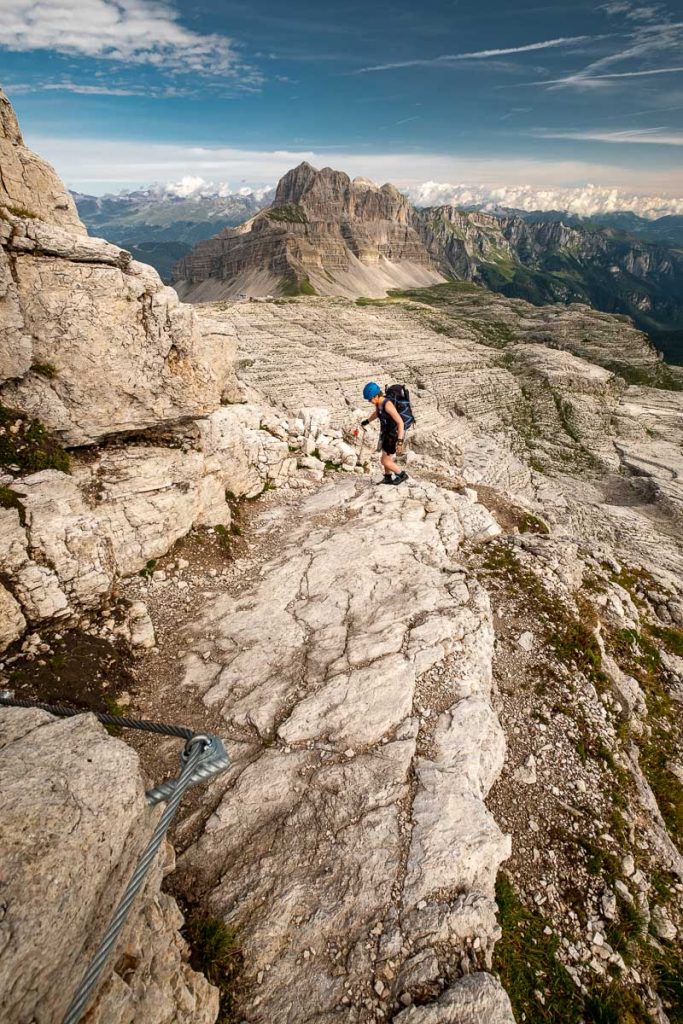
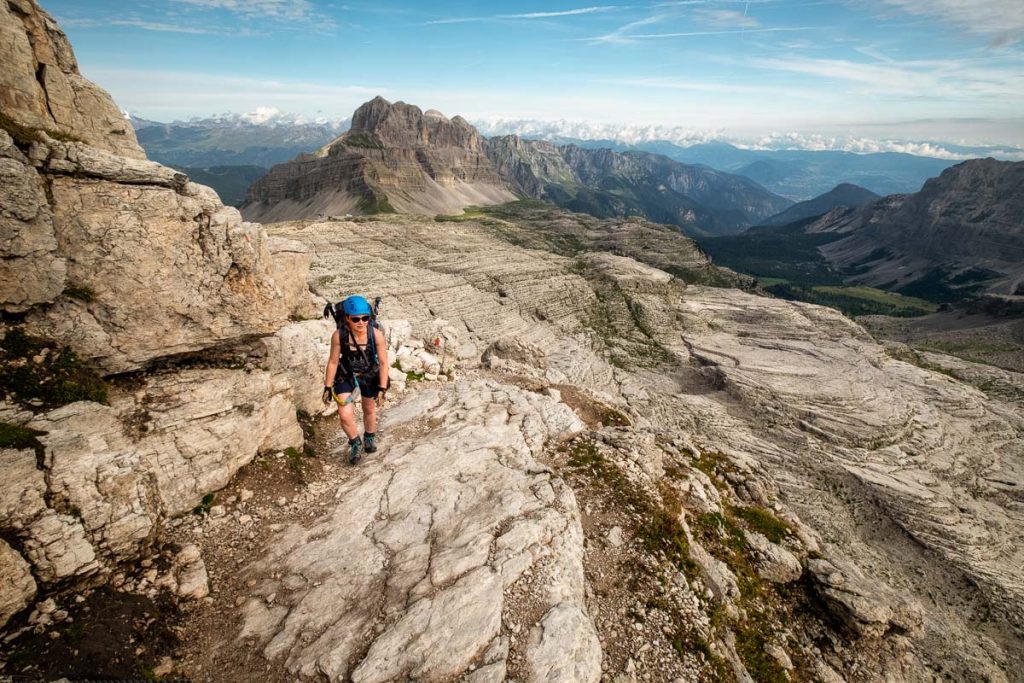
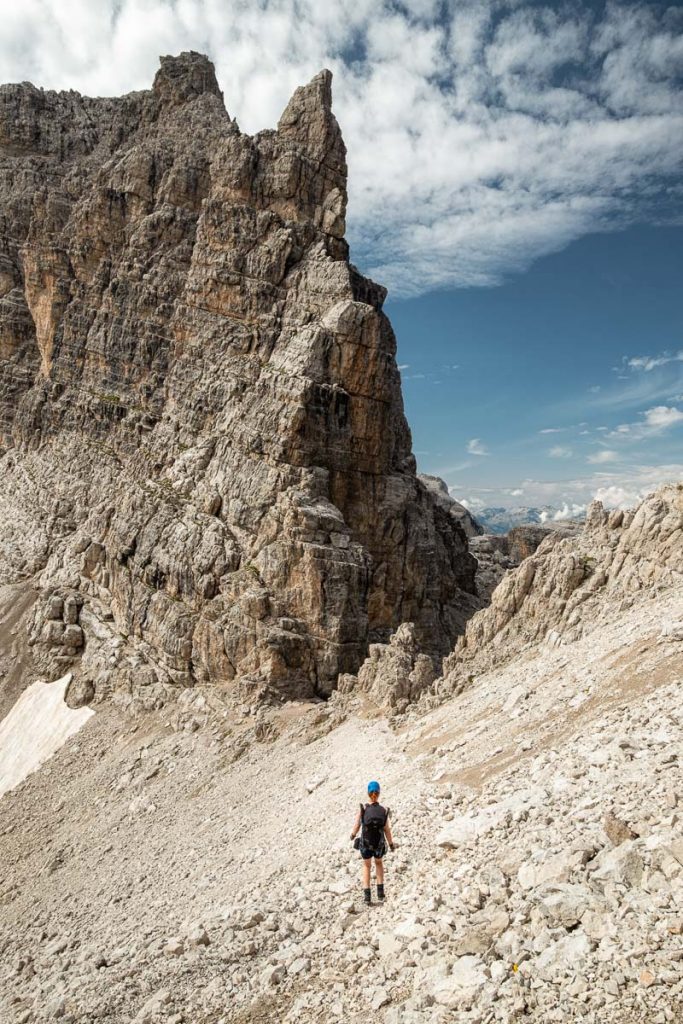
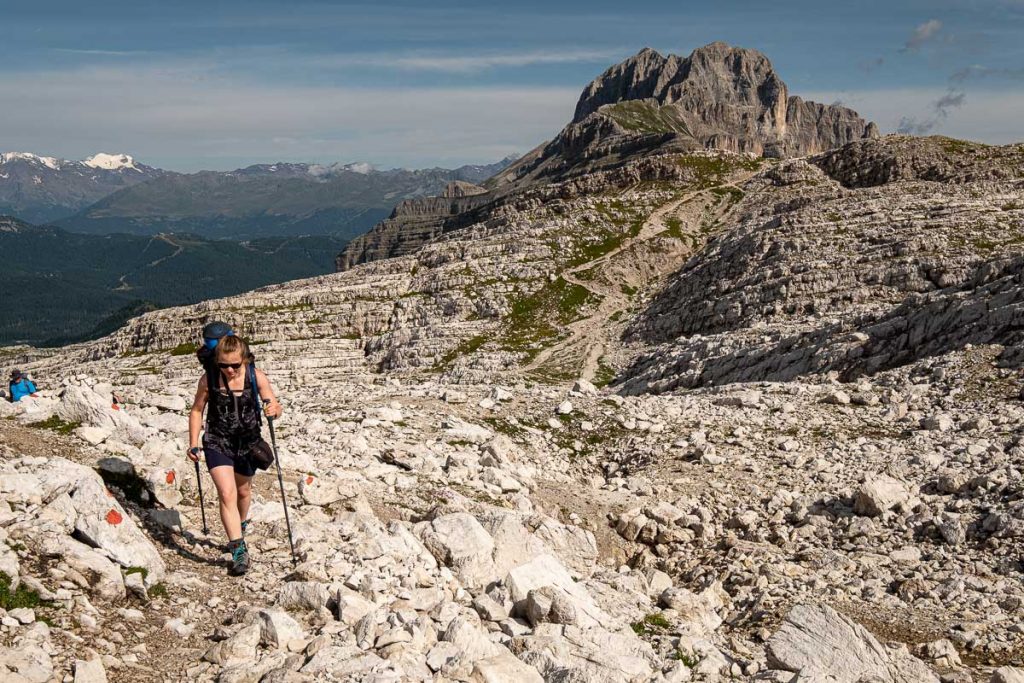
Via Ferrata Sentiero Alfredo Benini is the perfect warm-up day. If you’ve never done a via ferrata before, this is a great route to practice clipping in and navigating through the cables.
Once you reach Passo del Grosté, you must start heading south along path no. 305 following the waymarks painted on rocks.
For the first 30-40 minutes, the route has a gentle incline until you reach limestone slabs, followed by a memorial plaque 20 minutes later. Put on your via ferrata gear, and let the fun begin!
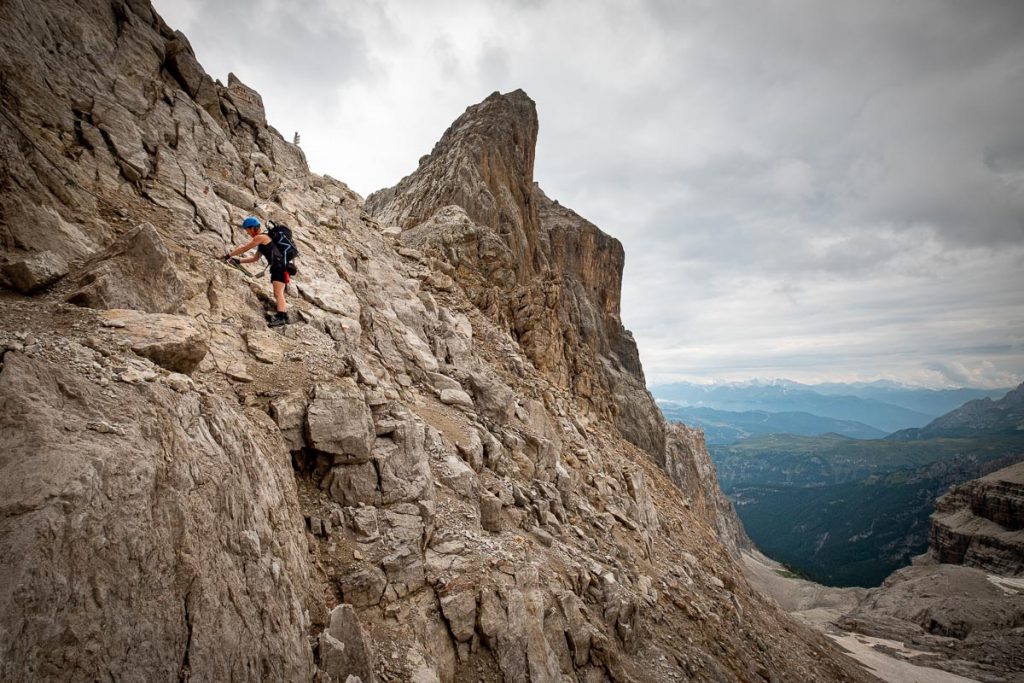
The ferrata runs along the east side of Cima Groste, then gently drops down to Bocchete dei Camiosci and continues up below Cima Falkner to its highest point, marked by a memorial plaque. From there, it’s an exposed but well-protected down-climb.
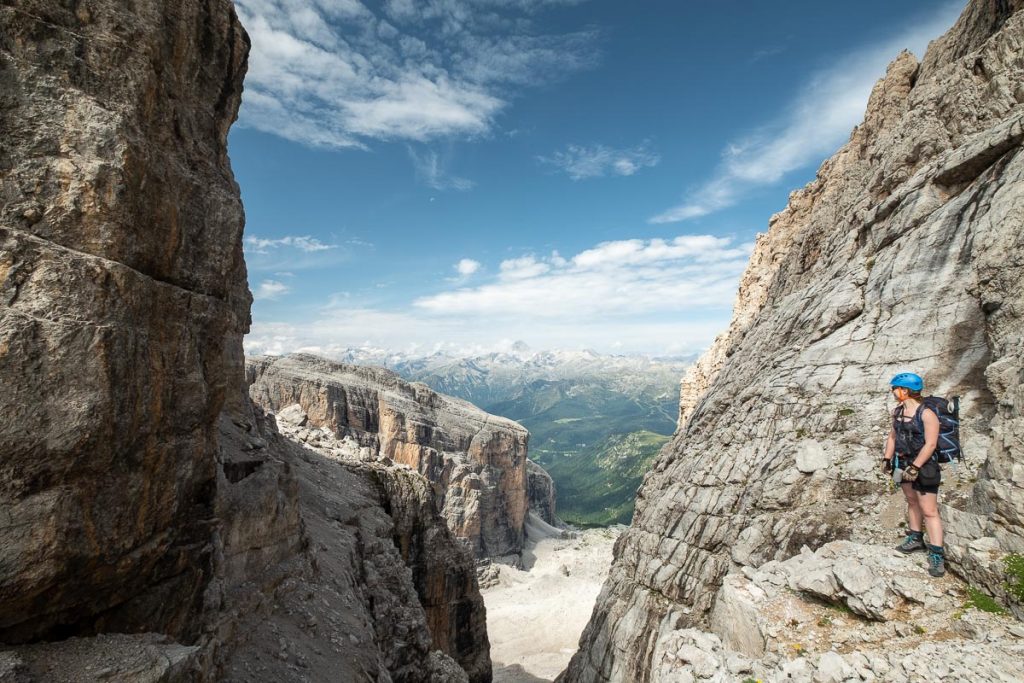
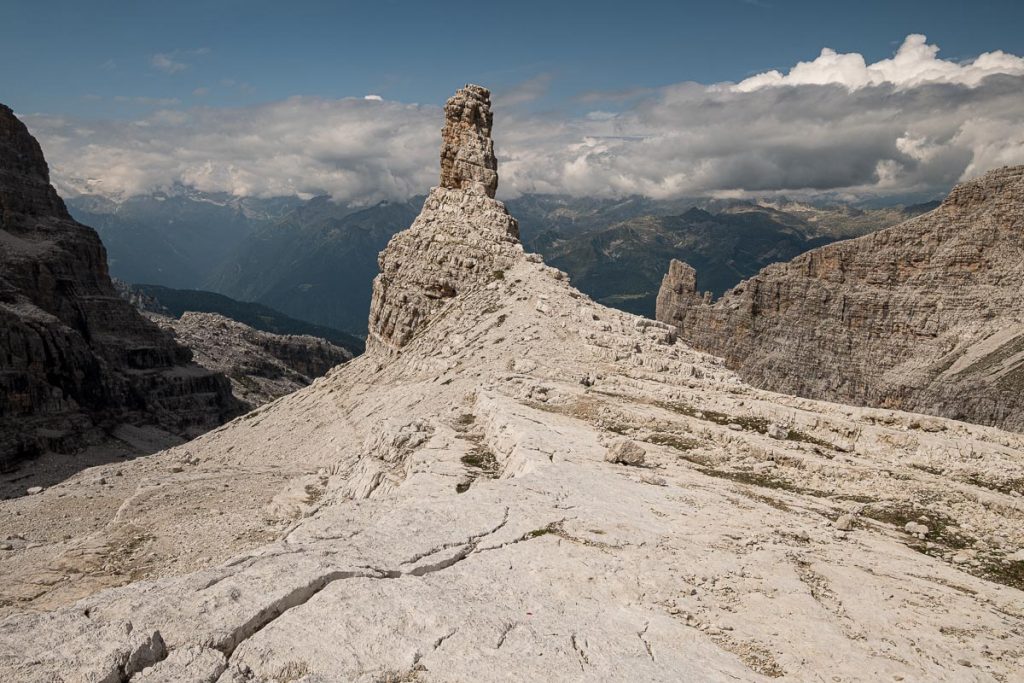
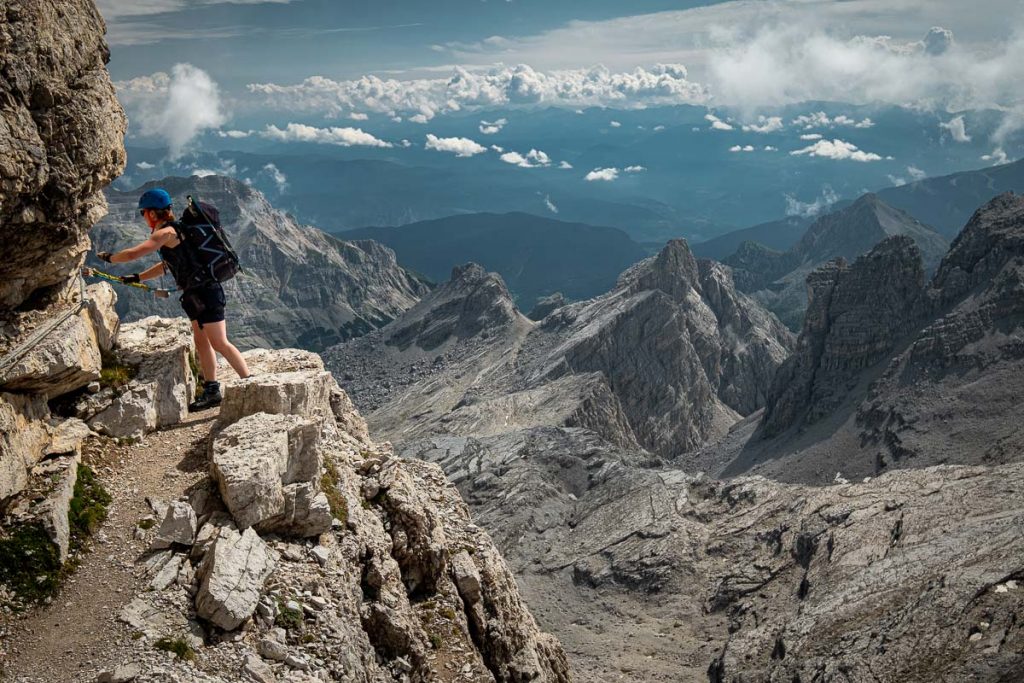
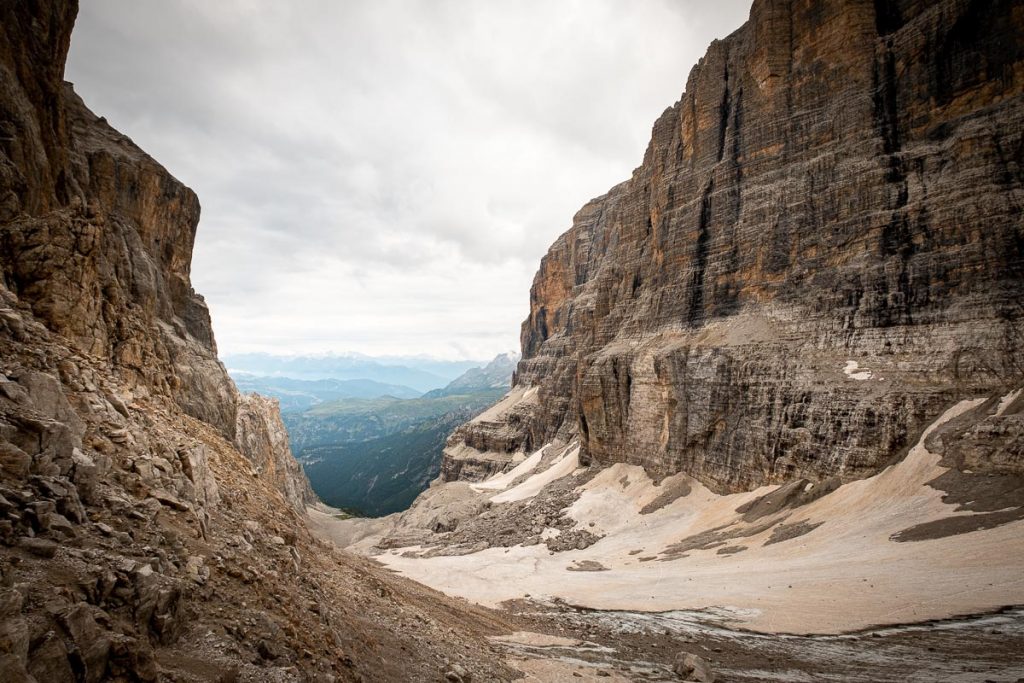
The path eventually turns West, traverses underneath Cima Sella, and descends to Vedretta di Vallesinella Superiore. Although I took this excursion at the end of August, we encountered a significant amount of remaining snow on this section.
Thankfully, the path is well-marked, and we had no trouble navigating it. However, a GPS will be useful in adverse conditions.
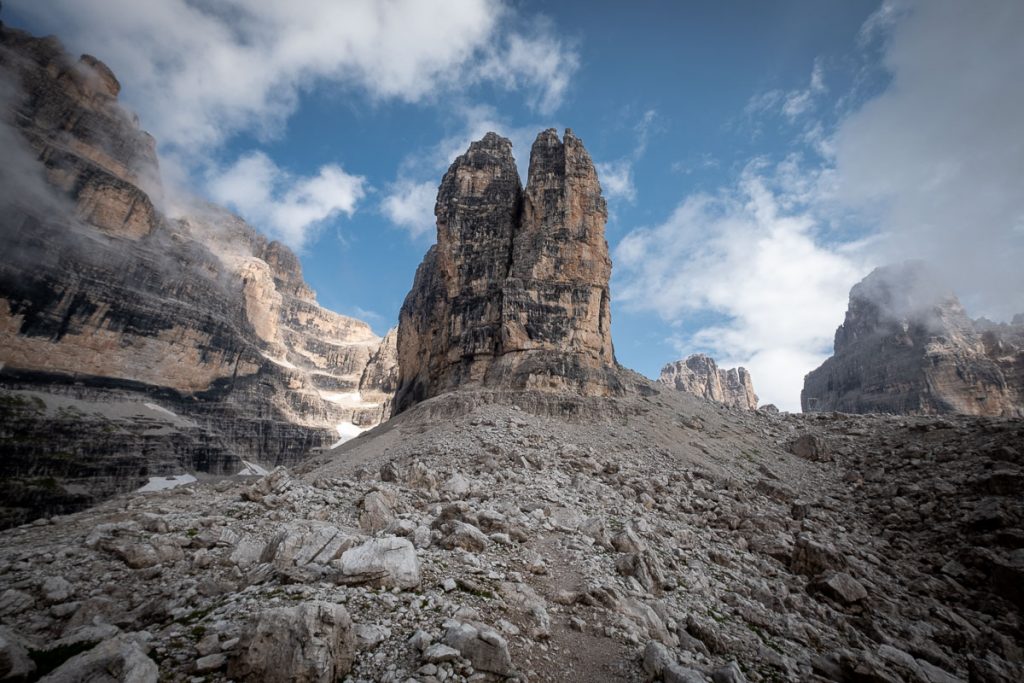
Right ahead, you will see a distinct pinnacle. It’s called Castelletto Superiore (see photos above). After you reach a fork and a sign for Rifugio Tuckett, where you will spend the first night, take path no. 315.
It descends to the hut, and for the most part, it’s a sharp descent with some cable-protected sections, so keep that ferrata gear on.
You will reach another fork about 10 minutes before reaching the hut. Path no. 303 will take you straight to the hut. You will be able to see the refuge from a distance.
Night 1: Rifugio Tuckett
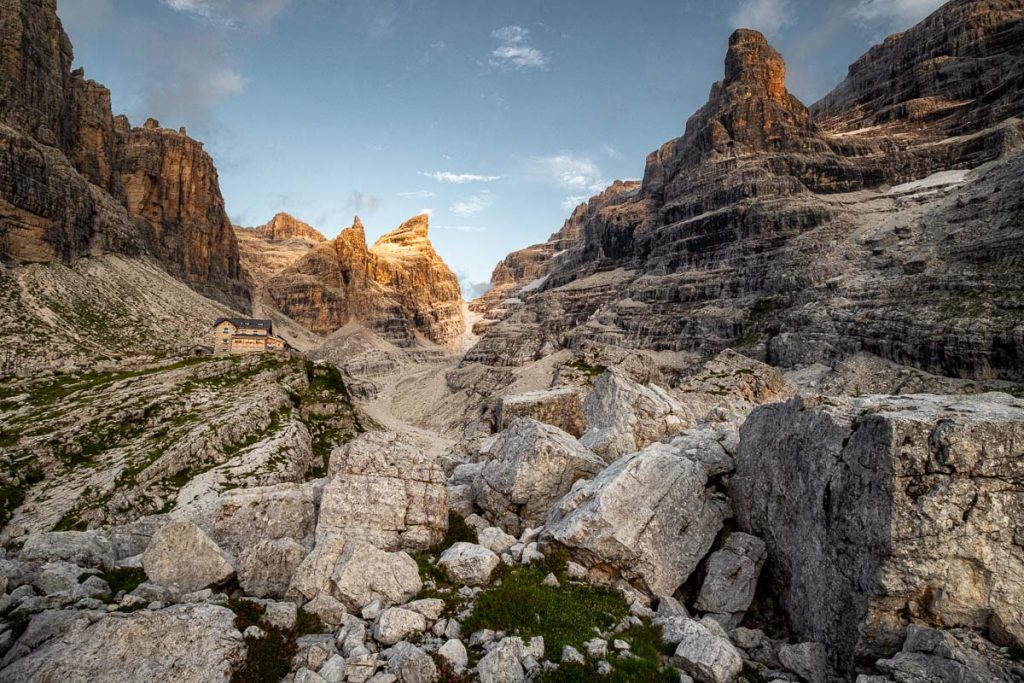
This cosy mountain hut, run by an Italian family, offers 115 beds to backcountry hikers. The hut belongs to the SAT club (La Società degli Alpinisti Tridentini), meaning you receive a 50% discount on accommodation if you are an Alpine Club member. All prices and contact info are on Rifugio Tuckett’s official website.
TIP: I have an article about what to expect when staying in an Italian mountain refuge. It will answer all your questions about this topic.
Day 2: Rifugio Tuckett to Rifugio Alimonta along via ferrata Sentiero SOSAT
- Distance: 7.5 km / 4.7 mi
- Walking time: 3.5 – 4 h
- Elevation gain: 560 m / 1840 ft
- Elevation loss: 260 m / 850 ft
- Path numbers: 303, 305B, 323
- Via Ferrata section: intermediate
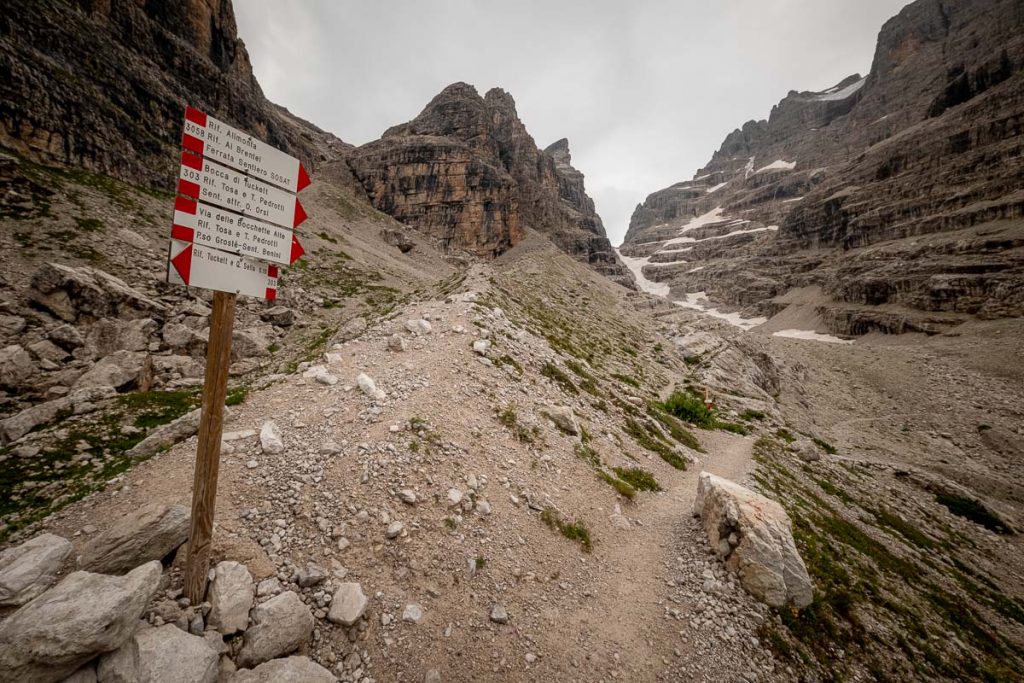
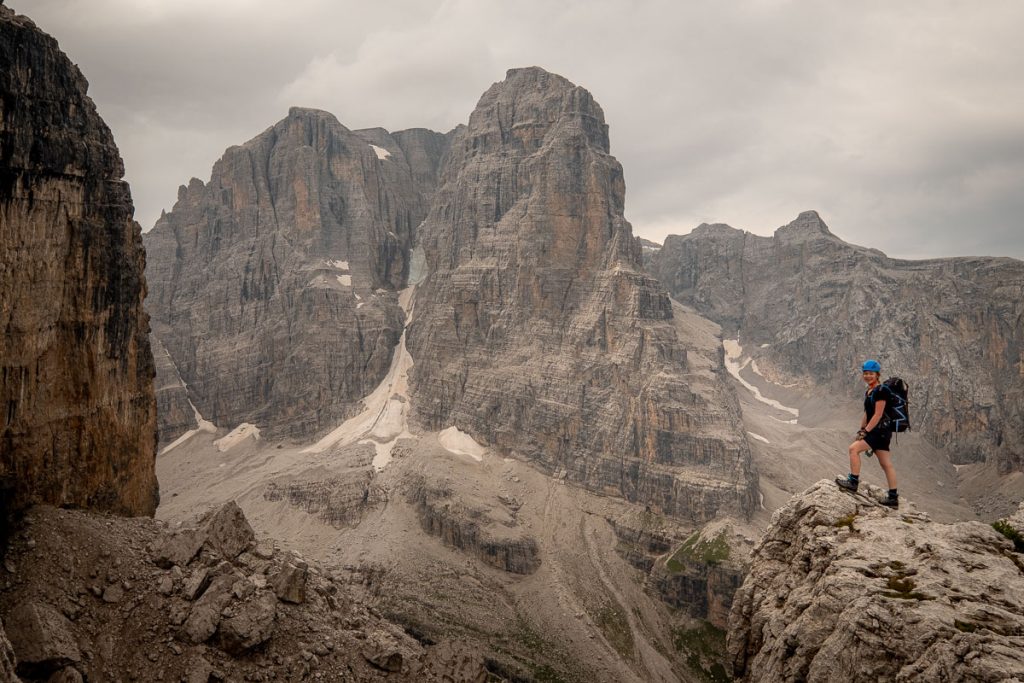
Start the day by retracing your steps from the previous day along path no. 303. Around 10 minutes into the hike, you will reach a fork. This time, you need to take path no. 305B, which leads to the via Ferrata SOSAT.
After crossing a glacier moraine, you will reach the first ladders. For the next hour, you will be circling the western face of Punte Di Campiglio. Mostly, it’s just a hike with occasional cable protection until you reach the Ferrata SOSAT.
The ferrata begins with a narrow gully offering fantastic views towards Cima Tosa. It is the highest peak at 3173 m a.s.l (10410 feet).
There are quite a few ladders and iron rods, including a 20-meter-high vertical ladder, but the whole route is very well protected, and you can stay clipped in for the entire time.
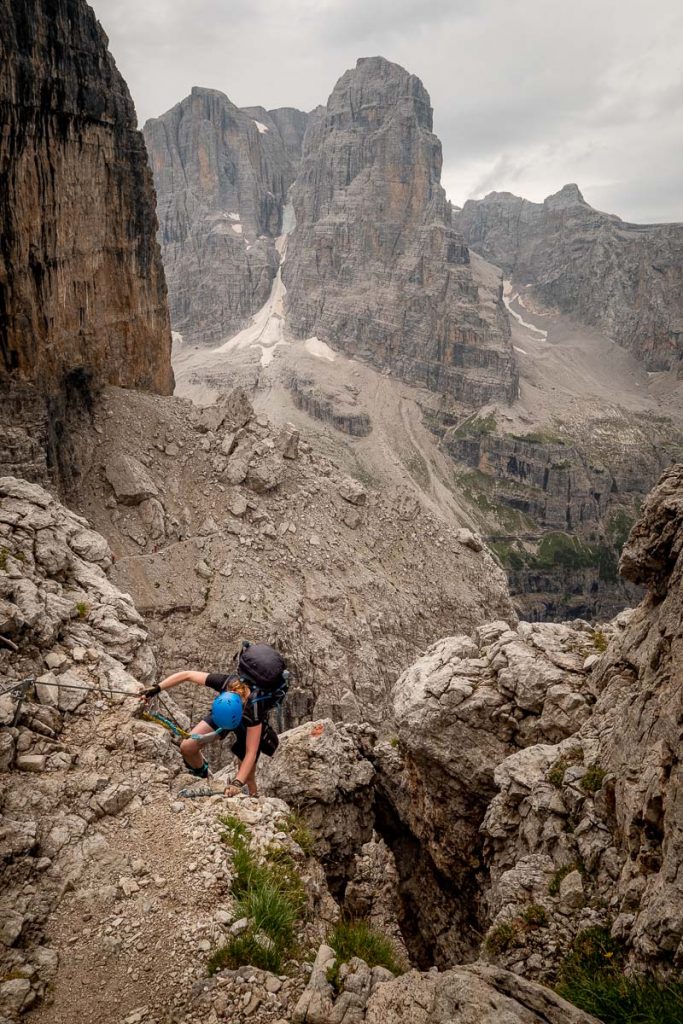
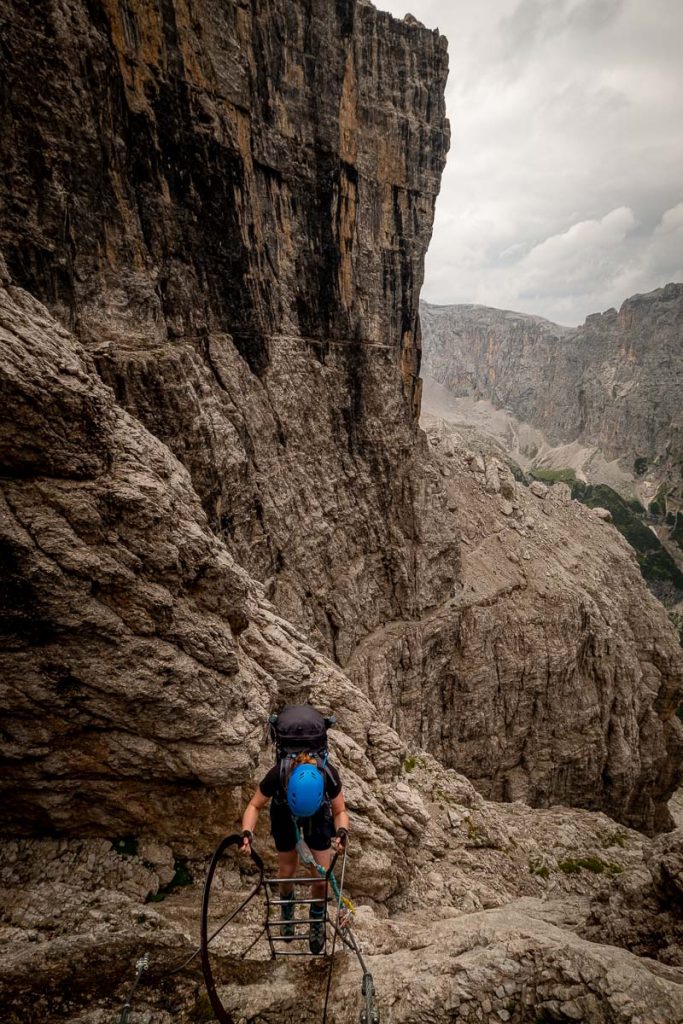
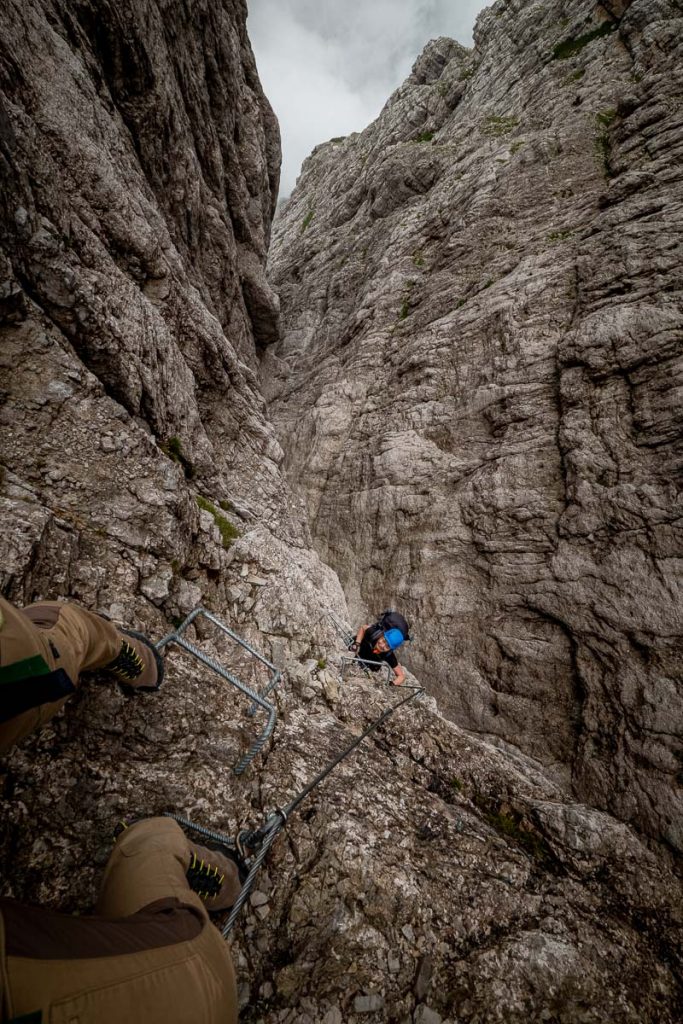
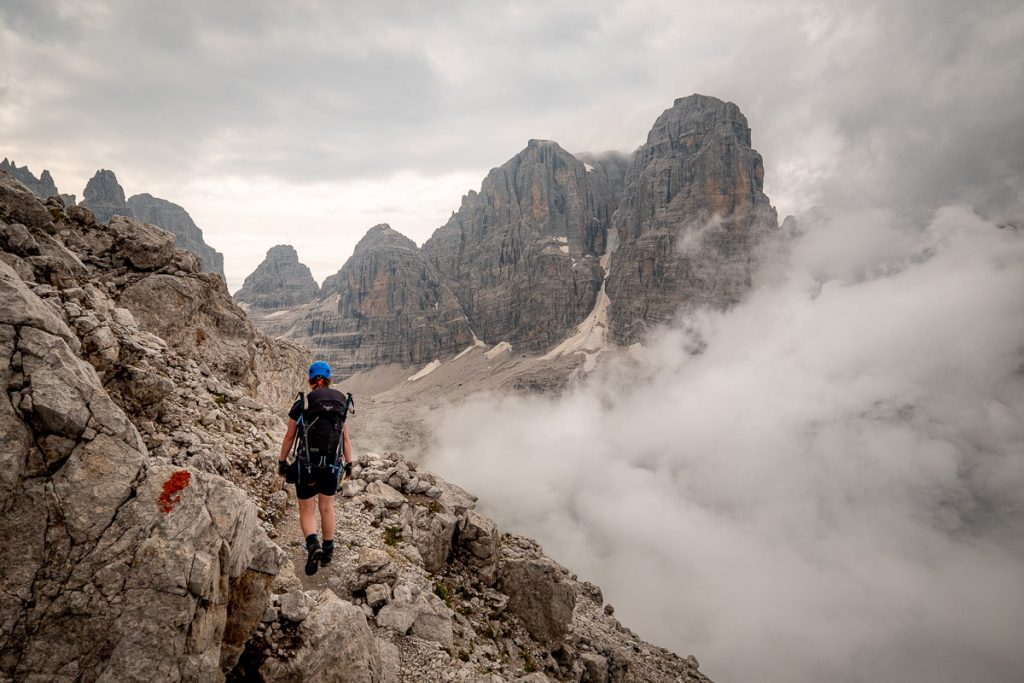
For the most part, you will be down-climbing this Via Ferrata, rather than going up. The entire route is marked with red paint, and both ends are designated with a plaque.
After climbing up the long vertical ladder, you will follow a narrow ledge for about 20 to 25 minutes, followed by a wider path and a fork.
Follow signs for Rifugio Alimonta, continuing up on path no. 323. Further, 30 minutes along the route, you will face a mountain that reminds me of deer hooves. From here, the refuge is only 5 minutes away.
It may seem like a short day, but don’t worry; the next three days will be a lot more demanding, so it’s good to take it easy at the start.
Night 2: Rifugio Alimonta
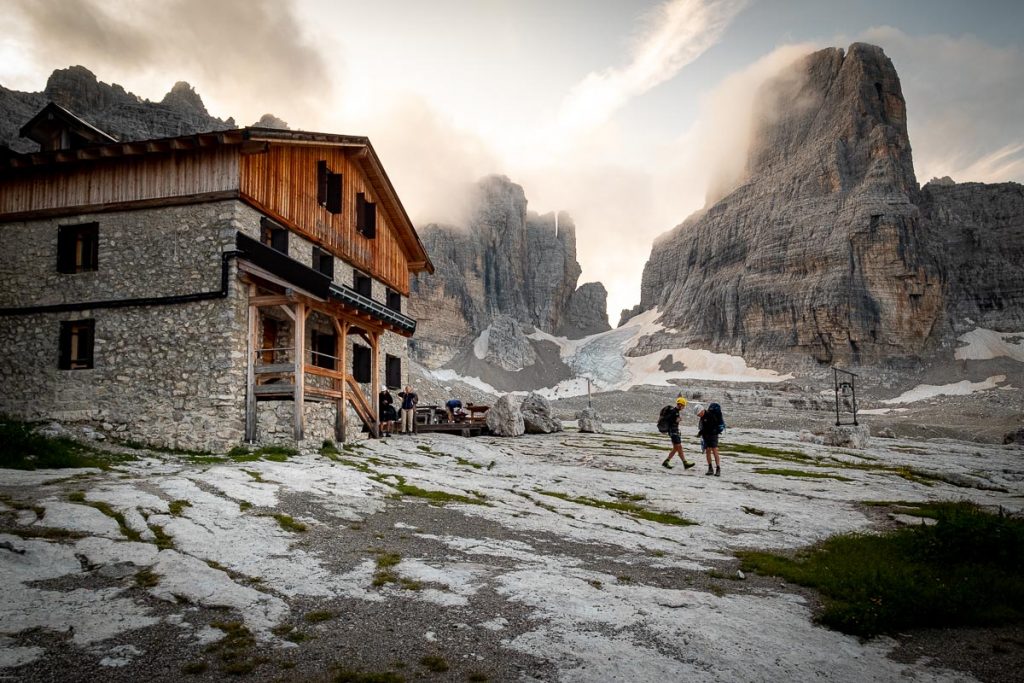
Rifugio Alimonta was my favourite hut on the traverse, and I was glad I stayed there for two nights (the second and fourth nights of the traverse).
It’s located in a stunning setting at 2580 m a.s.l. (8464 feet). You can check the prices and availability directly on Alimonta Hut’s website.
Make sure to try their homemade cakes baked by the hut owner. They were delicious and very different from the cakes served at other mountain huts (usually limited to Apfelstrudel, Linzertorte, or Sachertorte).
It’s also an excellent hut for showering. One token gets you 30 litres of hot water. I had to try hard to use it all, so we split the shower time in half.
Day 3: Rifugio Alimonta to rifugio Agostini along via ferratas delle Bocchette Centrali and Sentiero Attrezzato Brentari
- Distance: 10 km / 6.2 mi
- Walking Time: 5-6 h
- Elevation gain: 710 m / 2330 ft
- Elevation loss: 905 m / 2970 ft
- Path numbers: 323, 305, 358
- Via Ferrata section: intermediate
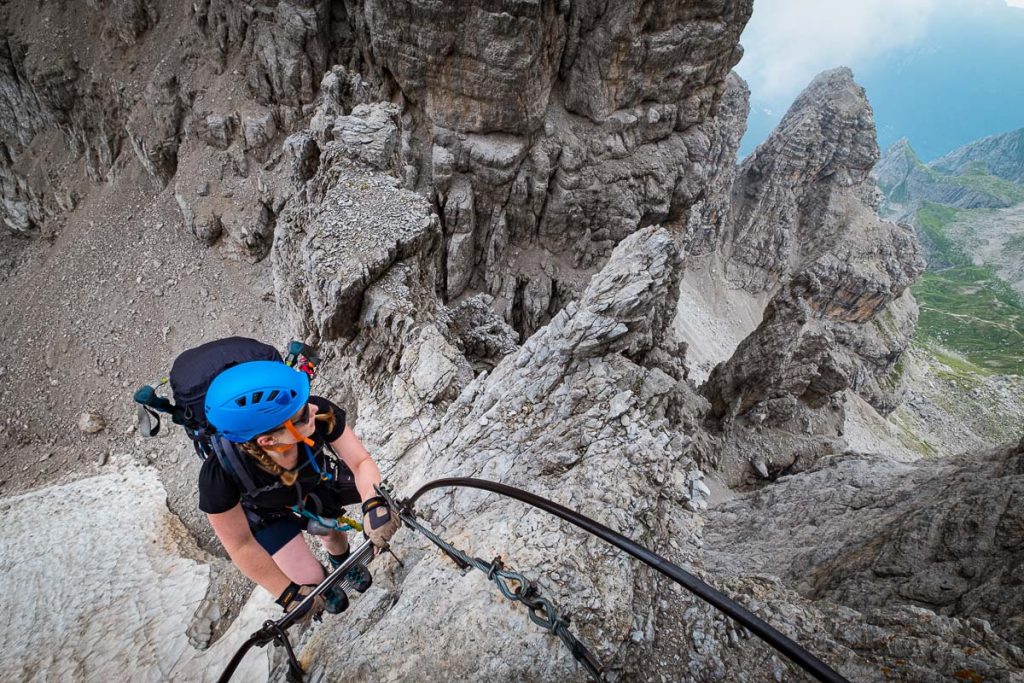
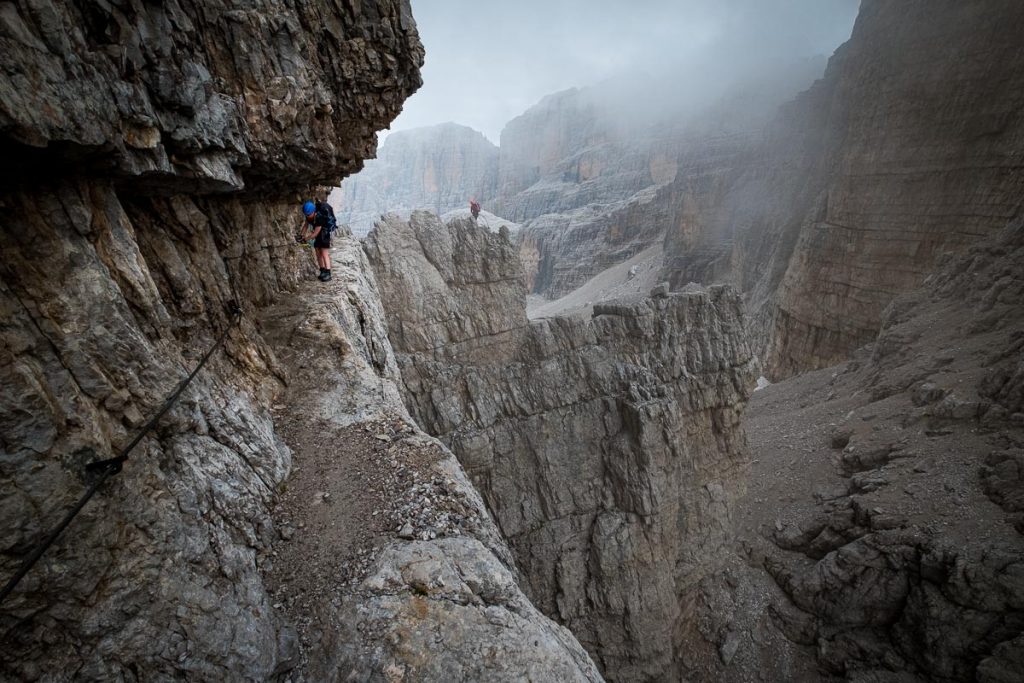
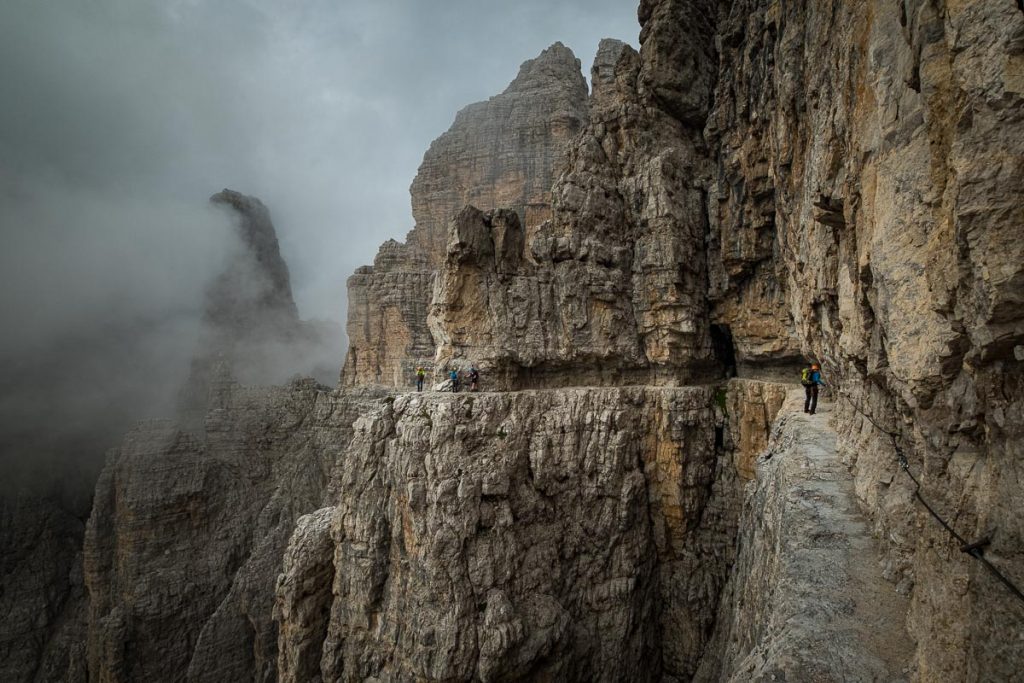
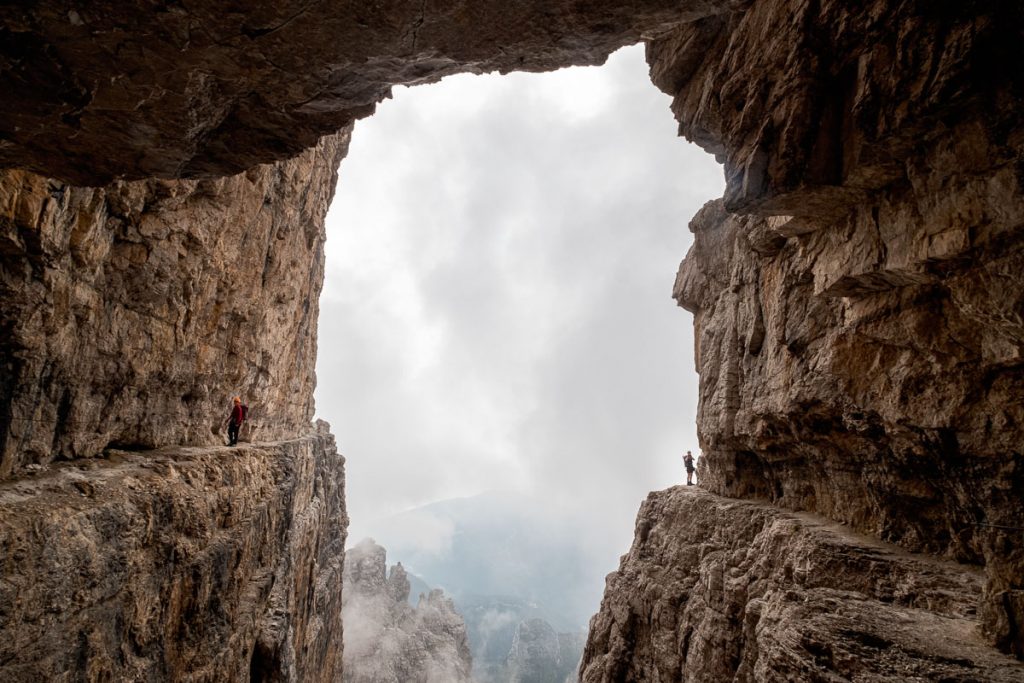
The weather looked promising as we were leaving the refuge, but as soon as we reached the first pass, the clouds rolled in, and for the next two hours, we hiked in the clouds.
Even though we didn’t get the views I had hoped for, the mist created an unearthly atmosphere and made for some great photos.
Day 3 is fascinating but challenging, so get a perfect rest the night before. The first objective is via Ferrata Delle Bochette Central, one of my favourite intermediate via ferratas in the Dolomites.
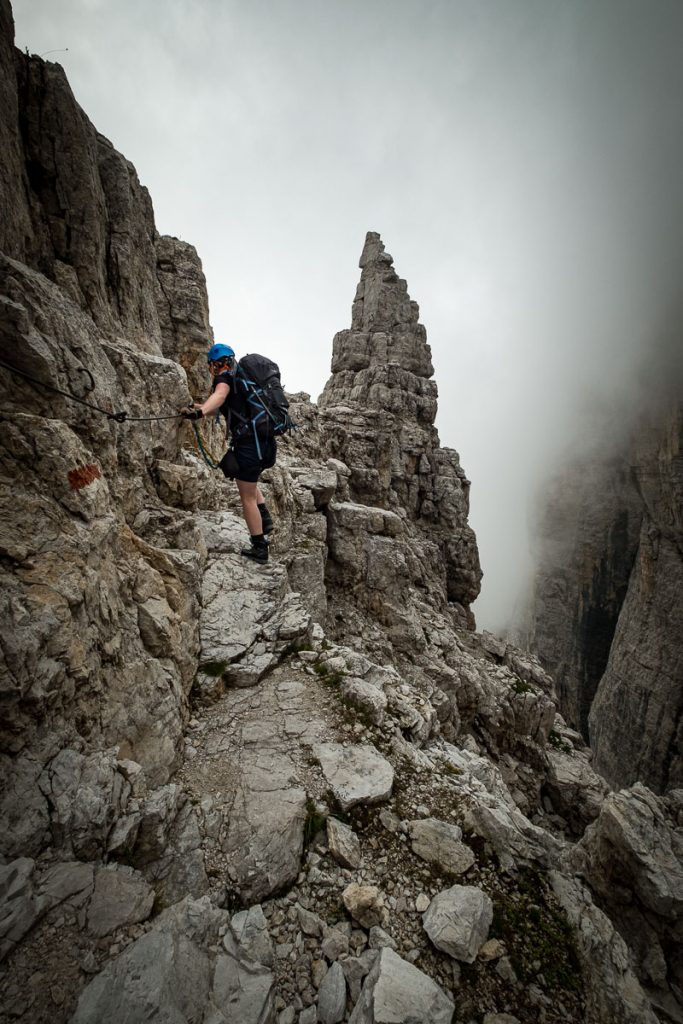
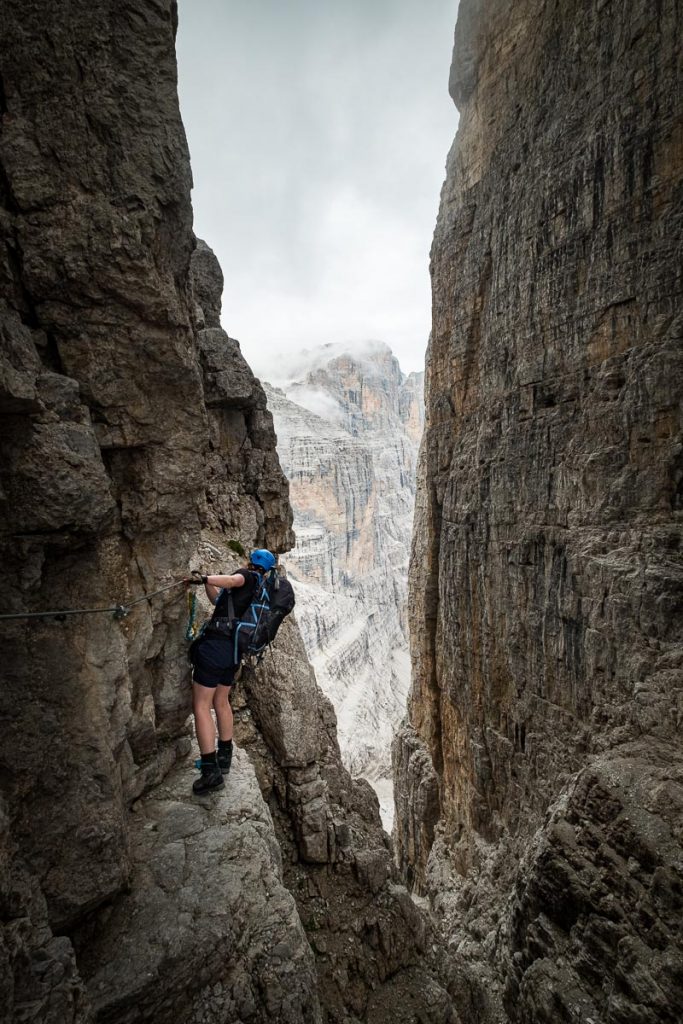
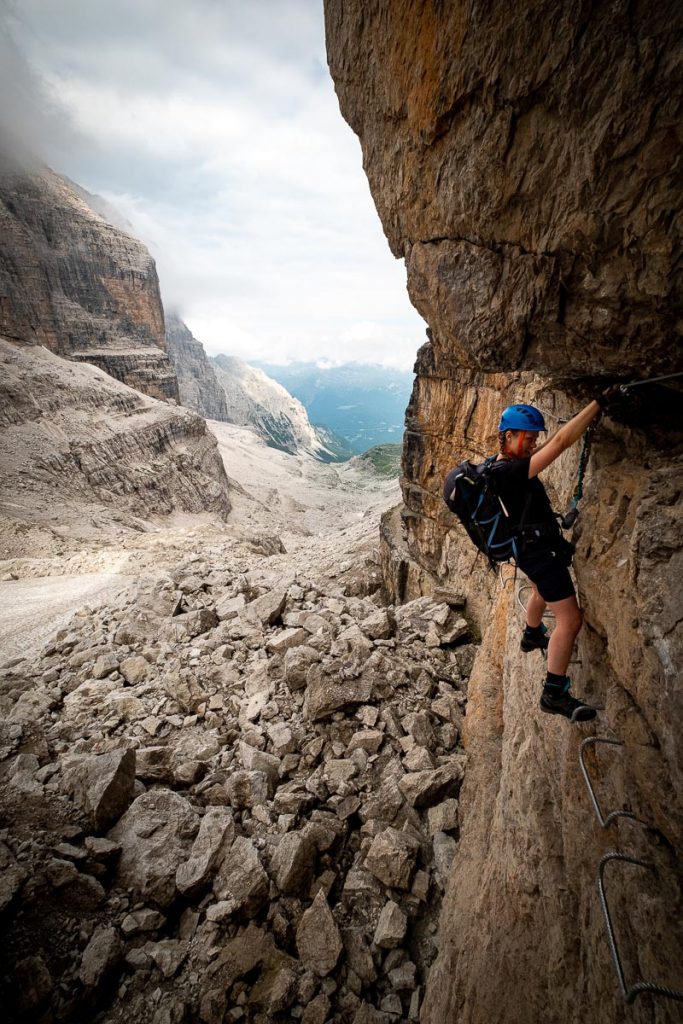
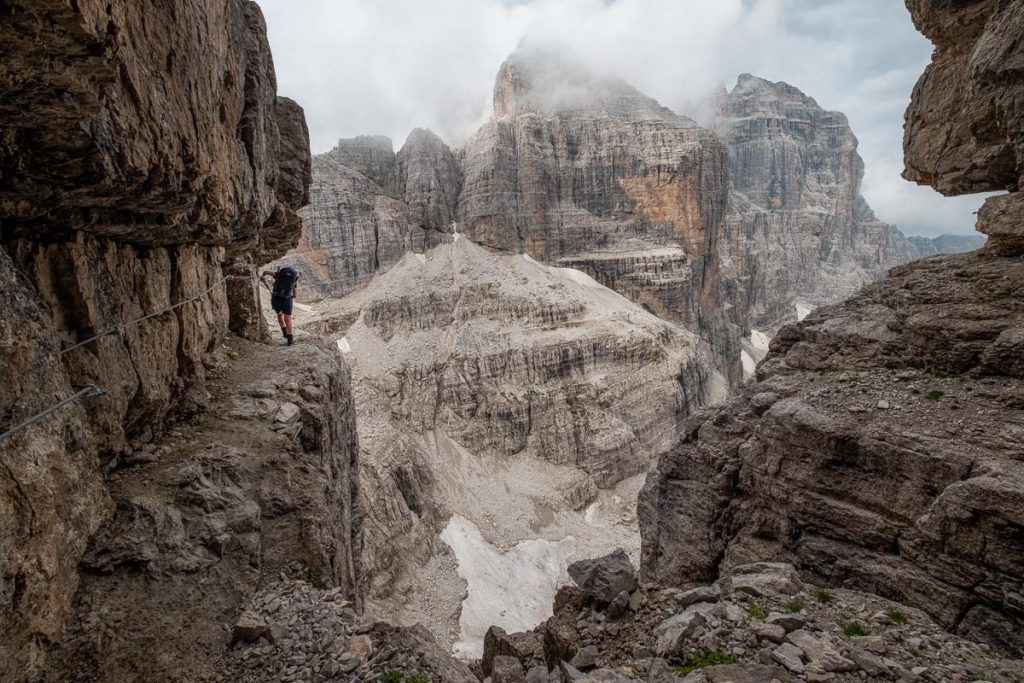
After leaving the Alimonta hut, head for the Vedretta di Sfulmini glacier (or what’s left of it) on path no. 323.
A well-trodden path goes mostly around the remaining ice. We didn’t need any additional equipment to cross it. Around 20 minutes after leaving the refuge, you will reach the Bocca dei Armi pass, where the Ferrata starts.
Starting with a series of ladders, followed by a course of ledges, the route will carry you into the incredible landscape of the Dolomiti Brenta with beautiful rock formations. Via ferrata delle Bochette Centrali bears no. 305, and as usual, the whole traverse is signalled with painted red marks.
In approximately 3 hours, you will reach Rifugio Pedrotti, a great place to stop for a break and grab lunch before continuing with the second part of the day.
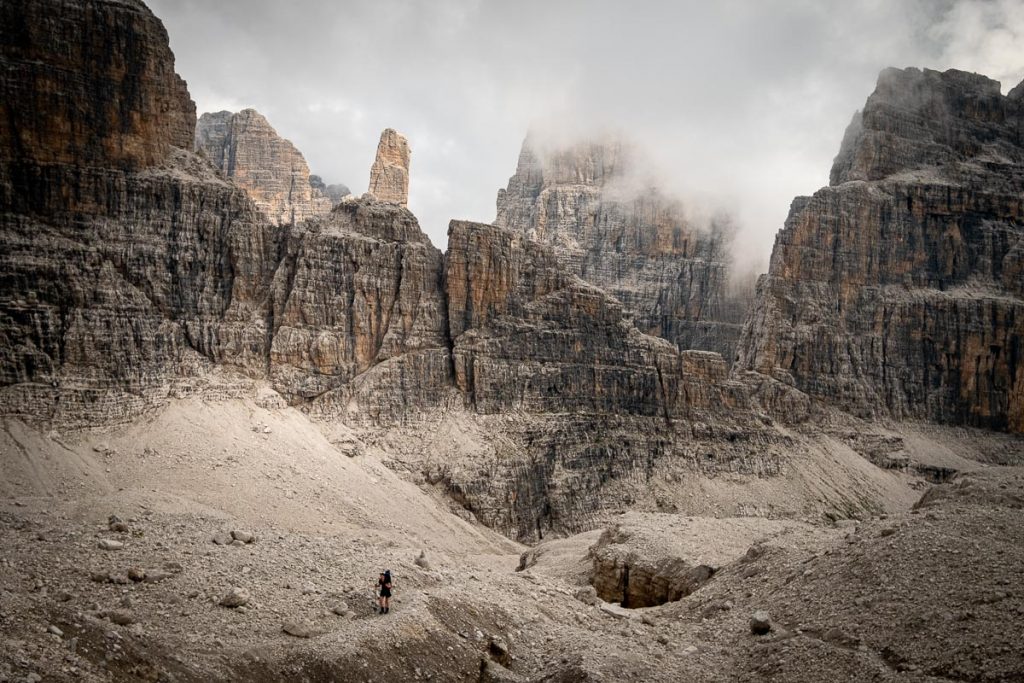
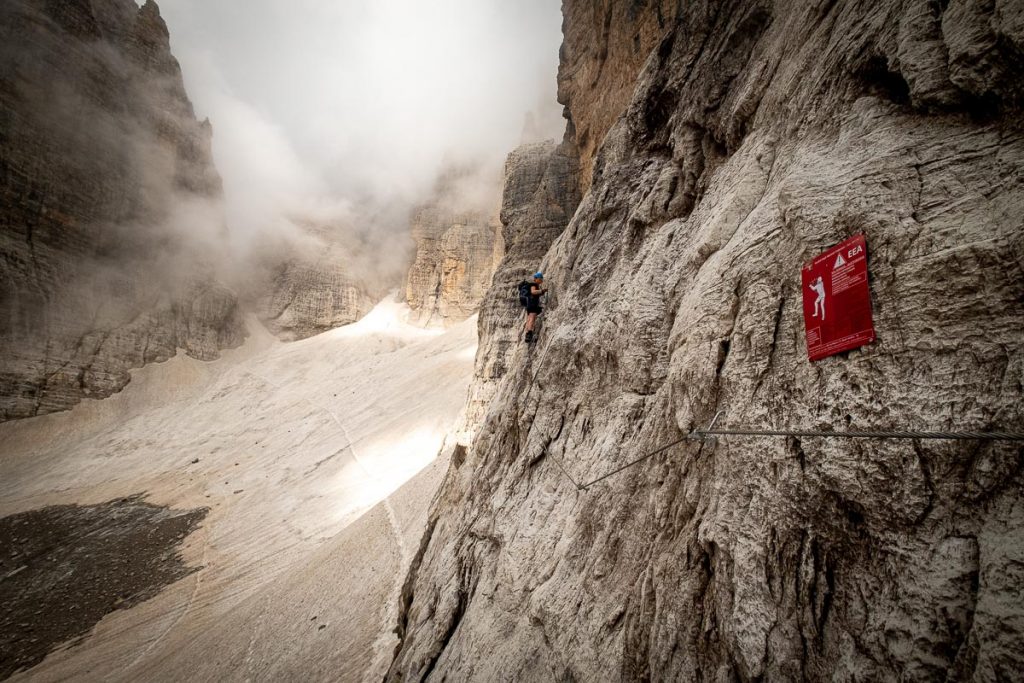
From Rifugio Pedrotti to Rifugio Agostini, your accommodation for the night, you must follow path no. 358. For the first 45 minutes of the hike, you will have Cima Tosa in front of you.
Around one hour after leaving Rifugio Pedrotti, you will reach the Sella di Tossa pass. Follow a series of well-protected ledges from here, then descend the iron rods and ladders onto the Vedretta Di Ambiez glacier.
Once again, this is not the type of glacier that requires special equipment to cross. A good pair of hiking boots and a pair of stability poles will suffice. There is no crevasse danger.
It’s another 30 minutes from here to the refuge following glacier moraines. Pay attention to the red marks. Just as we descended, we got caught in an extensive rainstorm. With the visibility down, we had trouble following the signs. My GPS came in handy at the time.
Night 3: Rifugio Agostini
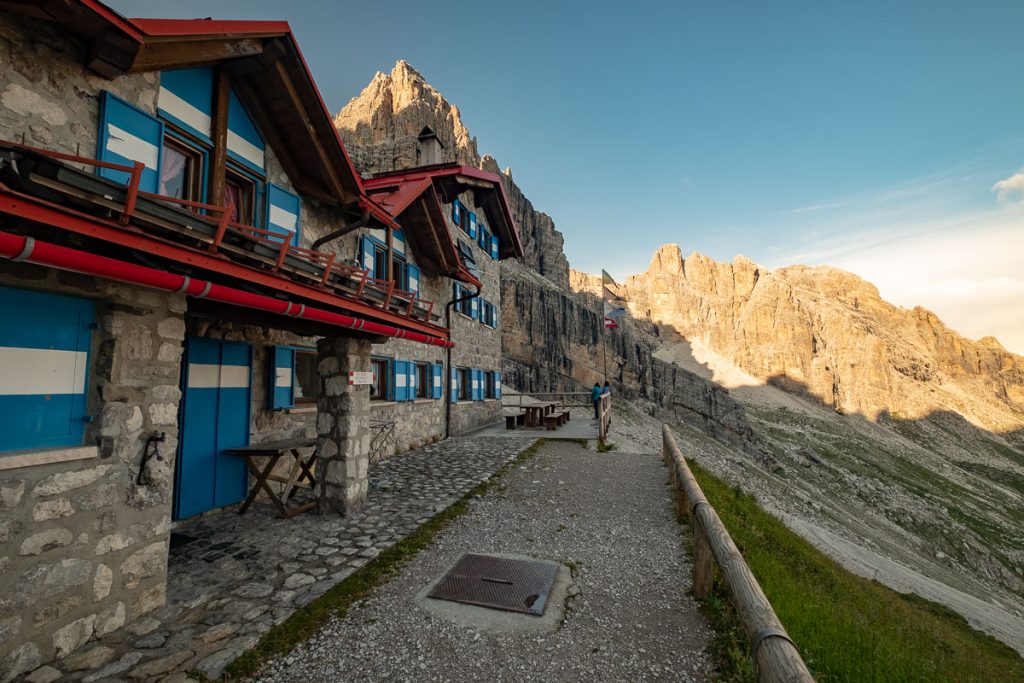
Another cosy hut along the traverse! It was also quiet in comparison to the other two. Due to its location in the southern part of the Brenta Dolomites and with great access to many climbing routes, it is favoured amongst climbers.
Rifugio Agostini’s website is available in English, and you can place your booking request on their contact page. During the opening season, I would recommend calling directly.
The hut belongs to the SAT club and offers discounts on accommodation to the Alpine Club members.
Day 4: Rifugio Agostini to Rifugio Alimonta along Via Ferratas Castiglioni, Sentiero Attrezzato Dell’Ideale, Sentiero Alp. Martinazzi
- Distance: 12.8 km / 8 mi
- Walking time: 5-7 h
- Elevation gain: 1300 m / 4260 ft
- Elevation loss: 1120 m / 3670 ft
- Path numbers: 321, 304, 327, 323
- Via Ferrata section: intermediate
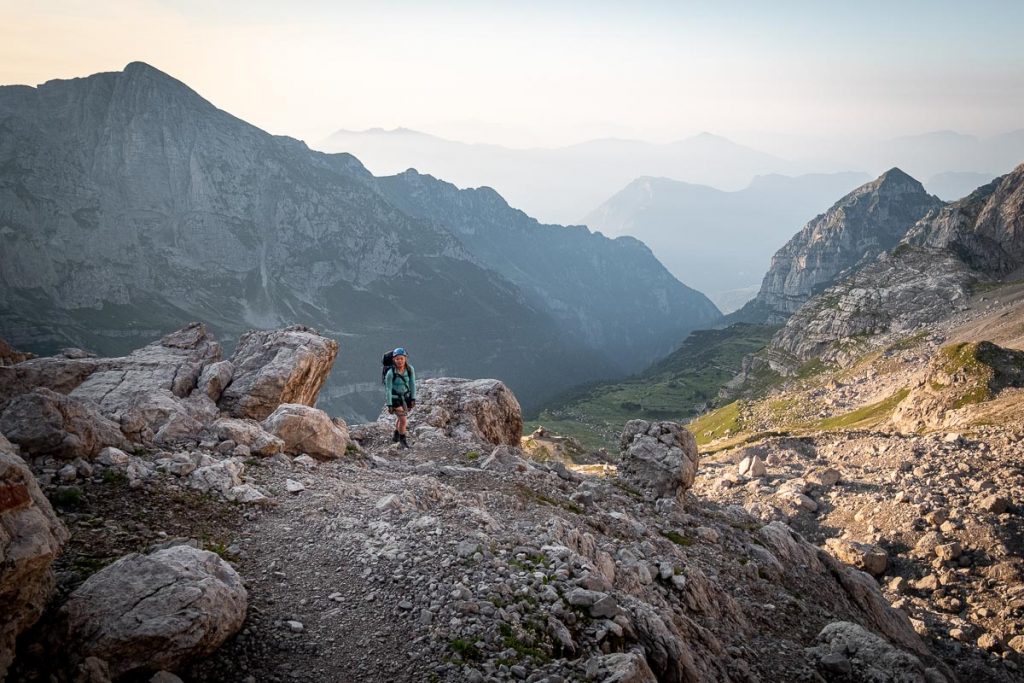
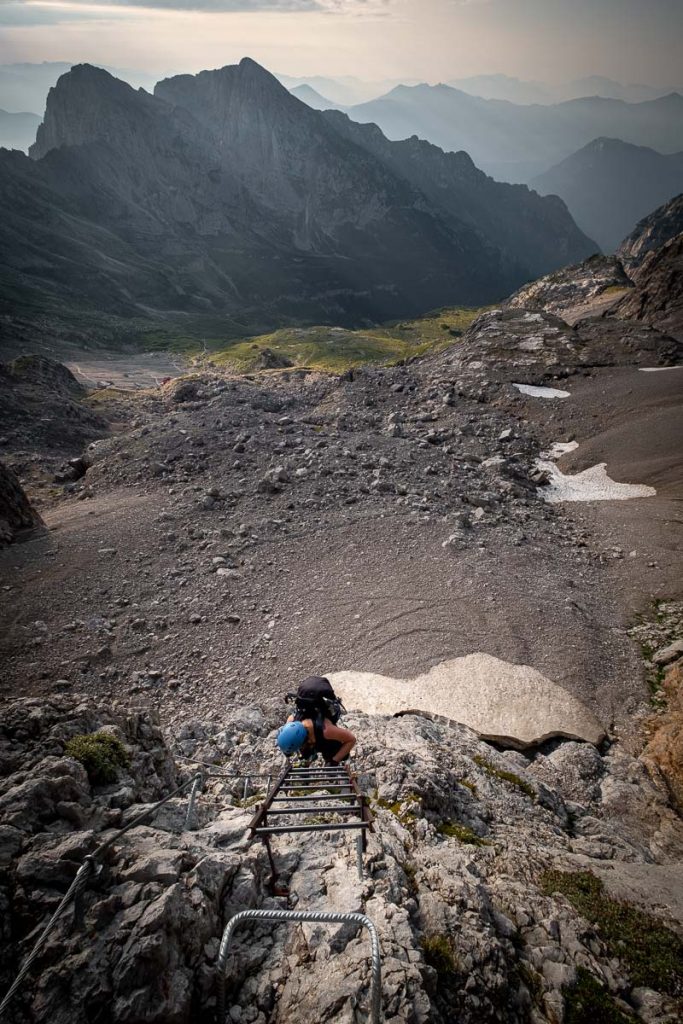
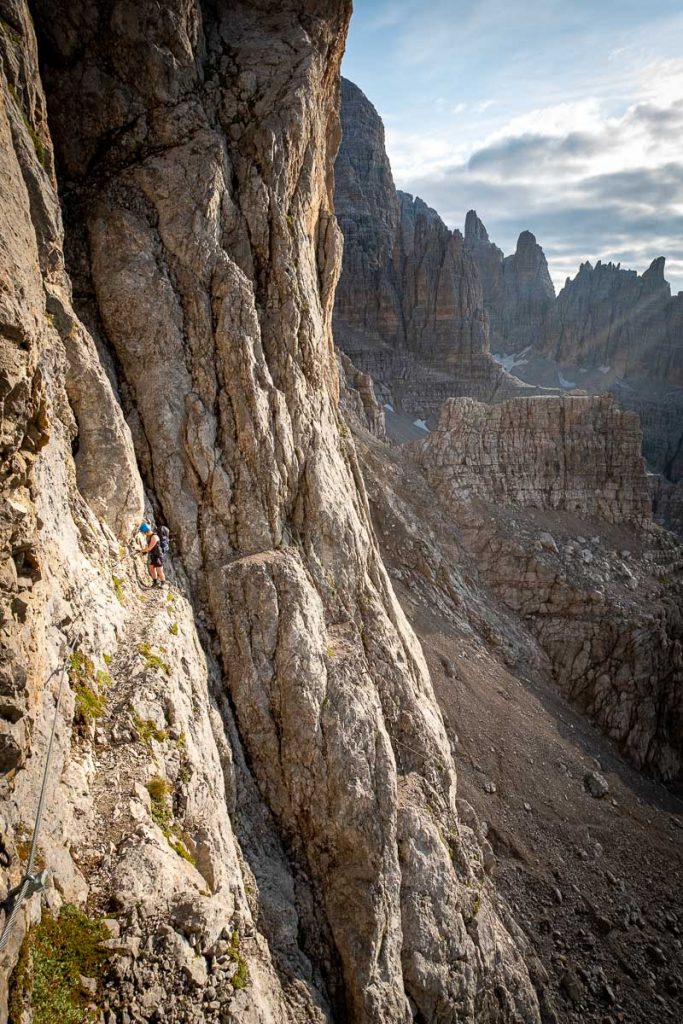
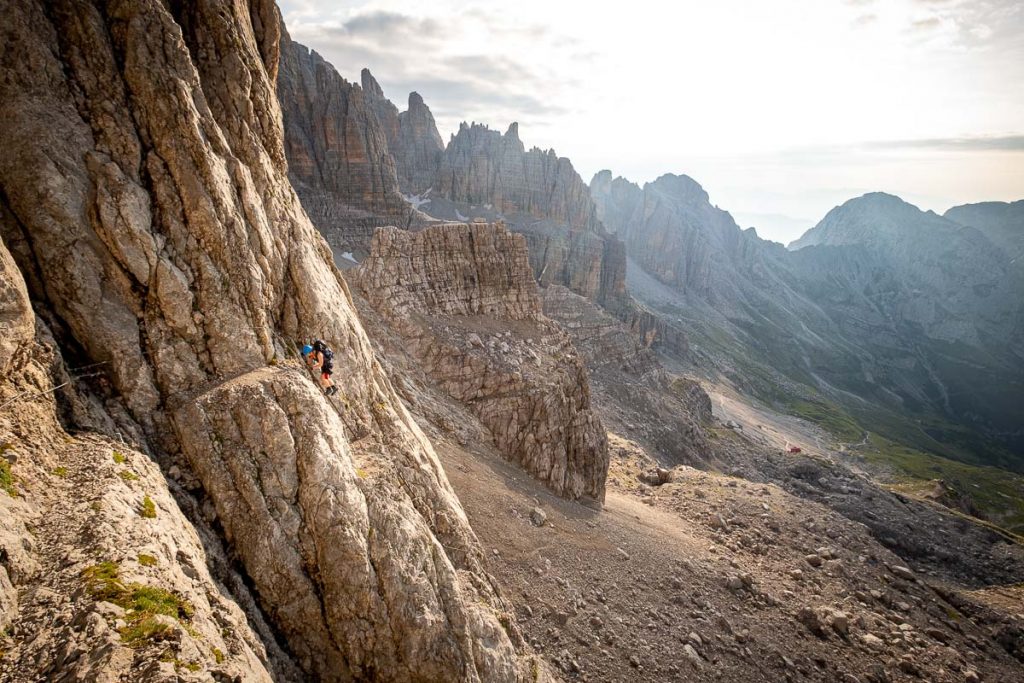
Rifugio Agostini is the southernmost point of this traverse. Over the next two days, you will slowly head back North to Passo Grosté, where this trip began.
Another fantastic day awaits this time, with not two but three via ferratas to tackle. Don’t worry, though. Two of the three iron paths are very short, and by combining all three, you will spend much less time attached to a cable compared to the previous day and more time just hiking.
From Rifugio Agostini, you have to take path no. 321 in the direction of Rifugio XII Apostoli. The first via Ferrata for the day is called Ettore Castiglioni.
Although it was technically pretty easy, this route features many vertical ladders, so I hope you don’t suffer from vertigo.
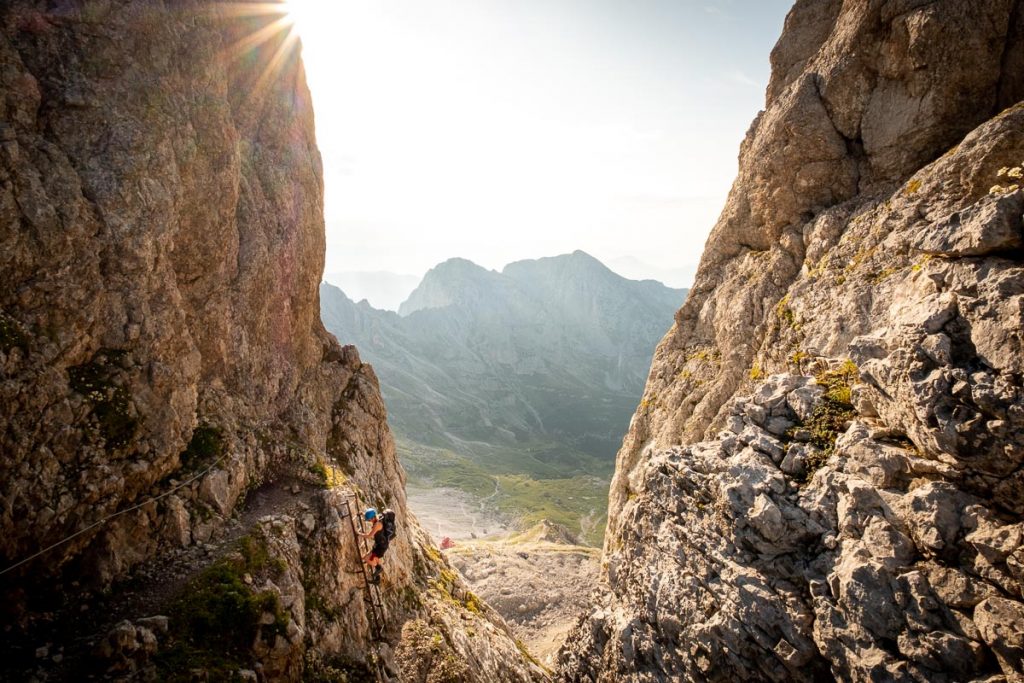
If you are lucky with the weather, be prepared to get distracted by the incredible views! The highest point on this Ferrata is the Bochetta dei Due Denti pass (2859 m a.s.l. or 9380 feet). It took me approximately 1.5 hours to reach it from leaving the Agostini hut.
The descent from the pass involves a short cable-protected section (after that, you can take off your via Ferrata kit) and then a downhill hike on scree and rocky slopes to the XII Apostoli hut.
On good weather days, the hut is visible from the pass, so you know exactly where you are heading. Otherwise, follow the red paint marks.
Take a break at the hut before continuing on path no. 304 in the direction of rifugio Brentei and via ferrata Sentiero Attrezzato dell Ideale – the second iron path of the day.
You ascend gently for the first 40-50 minutes to Bocca dei Camosci Pass. Once you reach it, it’s time to kit up again.
A well-protected cable route from the pass descends to the Vedretta Dei Camosci glacier in 10 minutes. Keep your gear on because the next Ferrata is close by.
A short and uncomplicated glacier crossing going north, underneath the western face of Cima Tossa, will take you to path no. 327. The third and last via ferrata for the day – Sentiero Attrezatto D. Martinazzi.
Like the previous one, the Ferrata part lasts only a few minutes and takes you down a few ledges. We spotted a big herd of Chamois on the ridgeline of Cima Francinglo. Seeing them in these mountains is common, so keep your eyes peeled.
Keep following path no. 327 all the way to Rifugio Brentei. You should reach the hut around 2,5 hours after leaving the XII Apostoli hut.
This is a good spot for a second break before the last push-up on path no. 323 to Rifugio Agostini. The difference in elevation between the two huts is around 400 meters (1300 feet), and it will take another hour to reach your final destination.
You might recognise that you have done a short section of this path on the second day of this traverse.
Night 4: Rifugio Alimonta
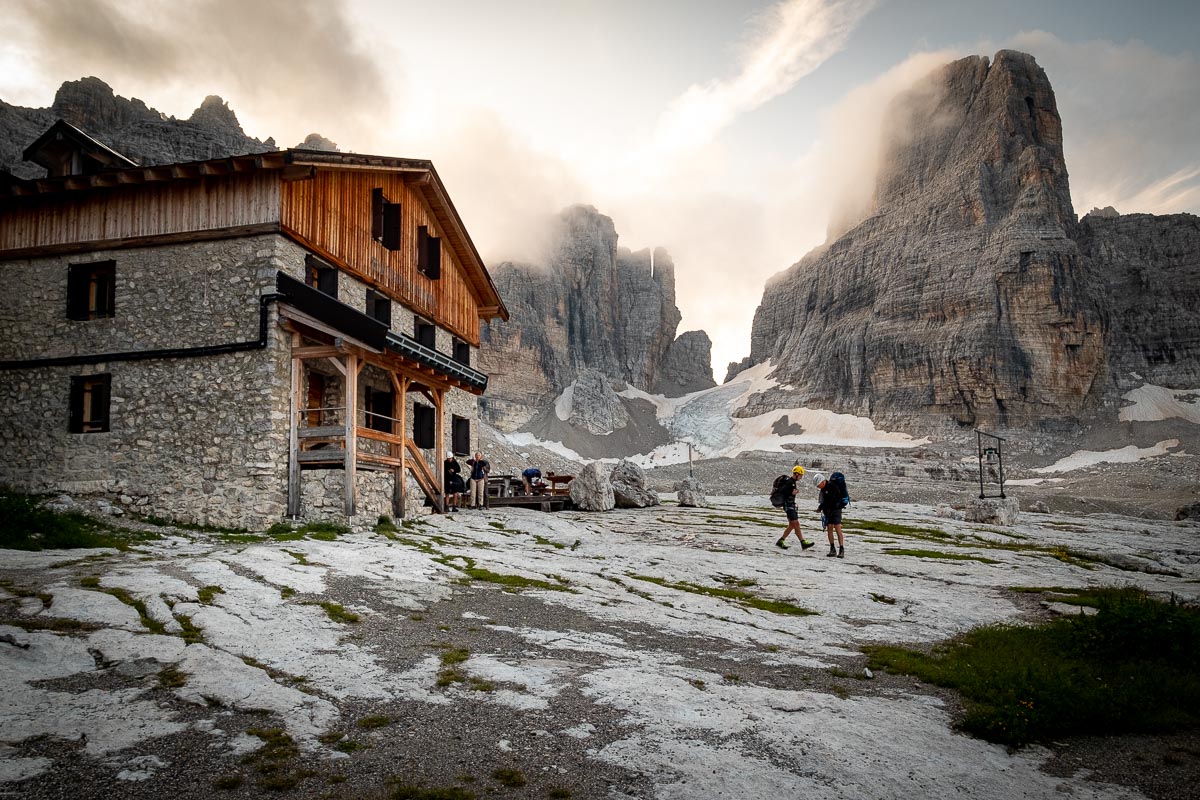
This is the same refuge where you will stay on day 2. There are three reasons I have decided to stay in this hut twice.
The first reason is that I knew the last day of the traverse would be the most scenic and demanding, so I wanted to be as close as possible to the start of the last via ferrata.
The other two reasons were the excellent shower and, of course, the homemade cakes! I even ordered a couple of pieces to take away with me and had them as a snack on the last day.
TIP: If you can’t get a spot in Rifugio Alimonta, stay in Rifugio Brentei instead.
Day 5: Rifugio Alimonta to Passo Grosté along via ferrata Bocchette Alte
- Distance: 14 km / 8.7 mi
- Walking time: 6-7 h
- Elevation gain: 790 m / 2600 ft
- Elevation loss: 1000 m / 3280 ft
- Path numbers: 323, 305, 303, 316
- Via Ferrata section: advanced
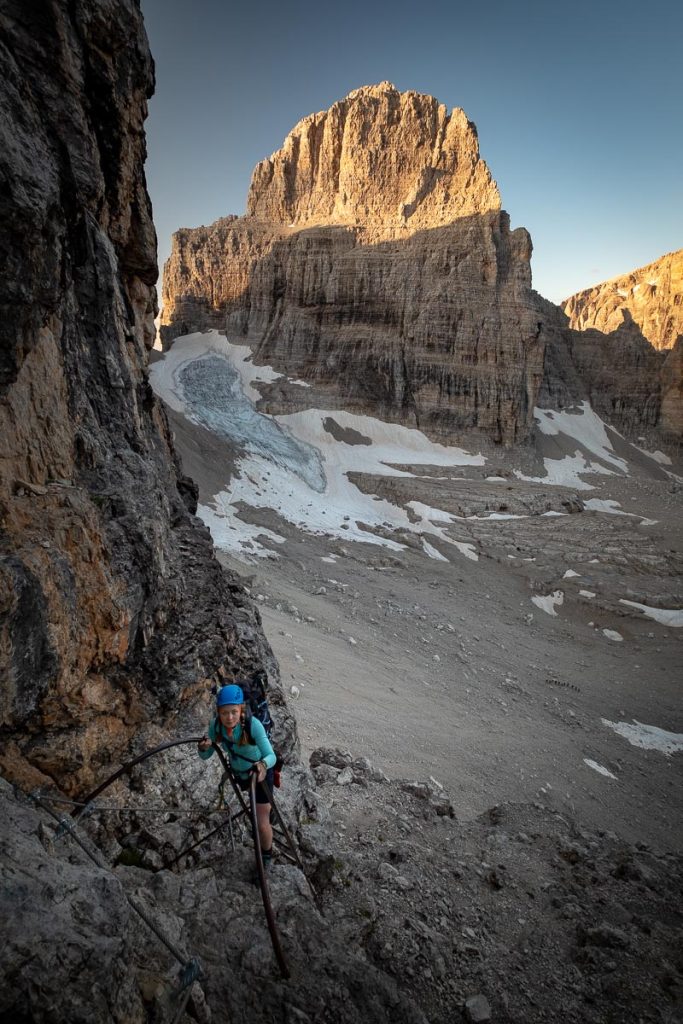
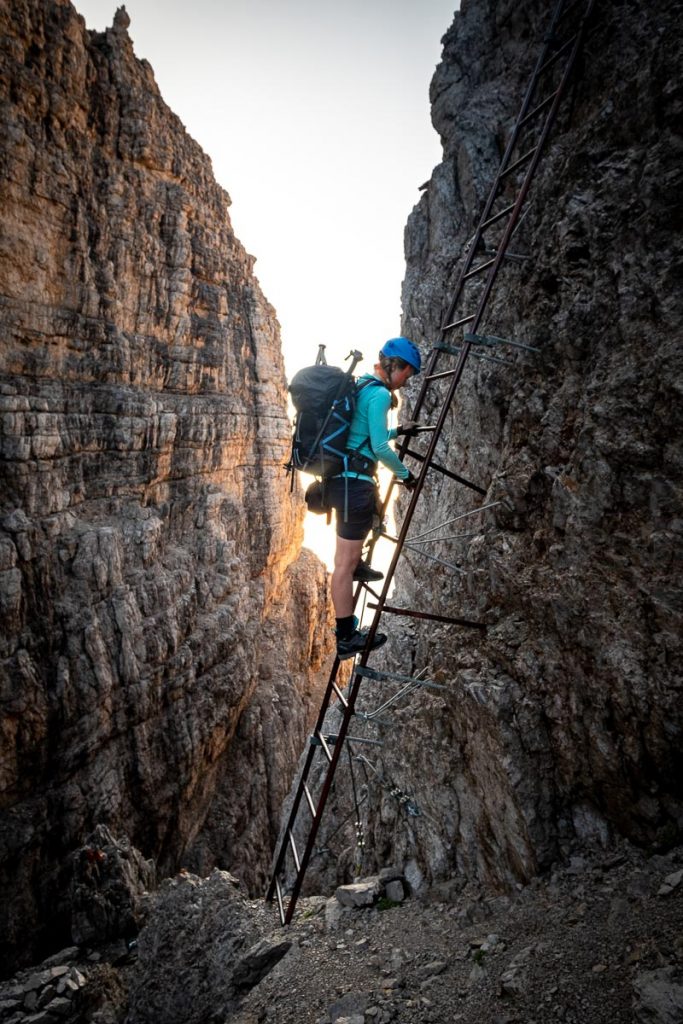
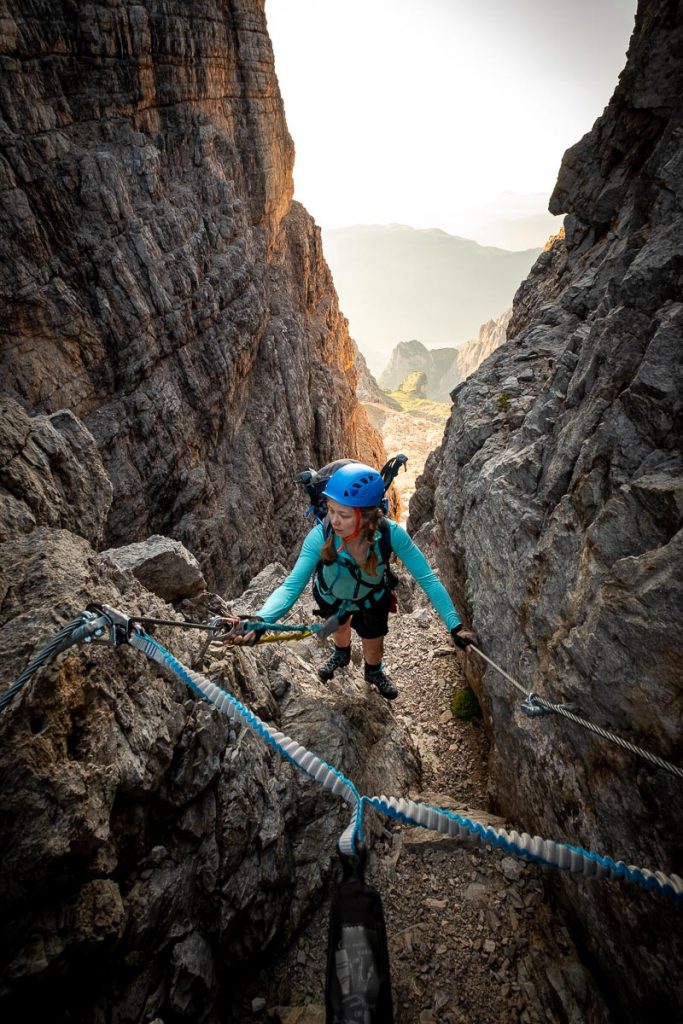
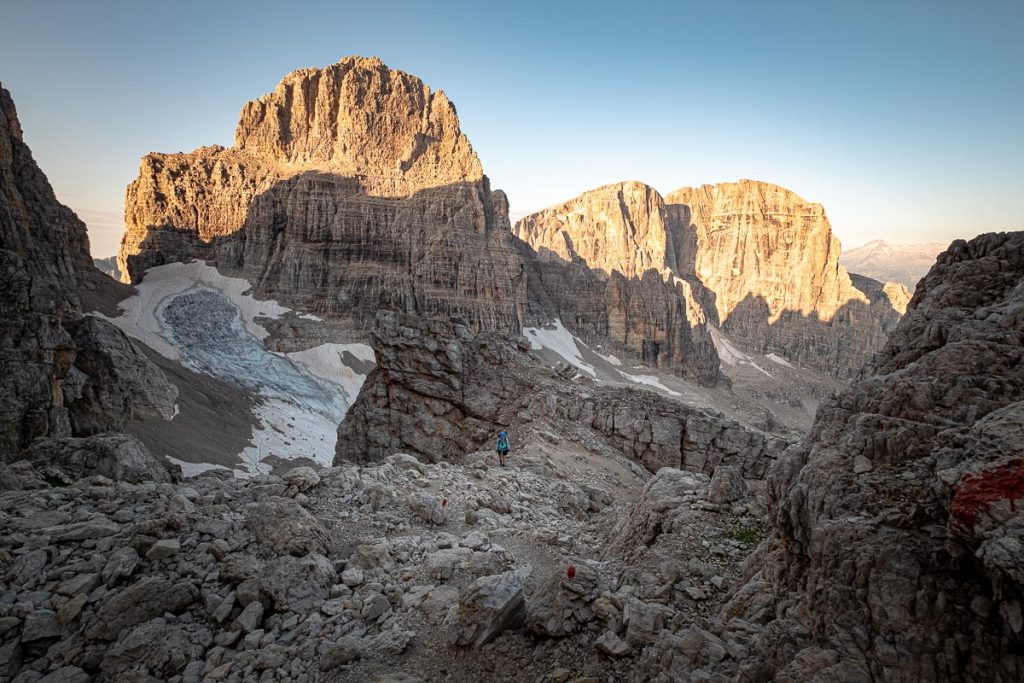
The last day did not disappoint in terms of views! We were lucky to wake up to clear blue skies. To make the most of it, we skipped breakfast at the refuge.
Instead, I stocked up on the cake the night before (you can’t beat having cake for breakfast), and left right after sunrise to catch the good light.
It turned out to be the perfect decision. By late morning, we were in the cloud, and I felt sorry for the people passing us, going in the opposite direction. I knew they wouldn’t witness what we had done just a few hours before. Remember, the early bird catches the worm!
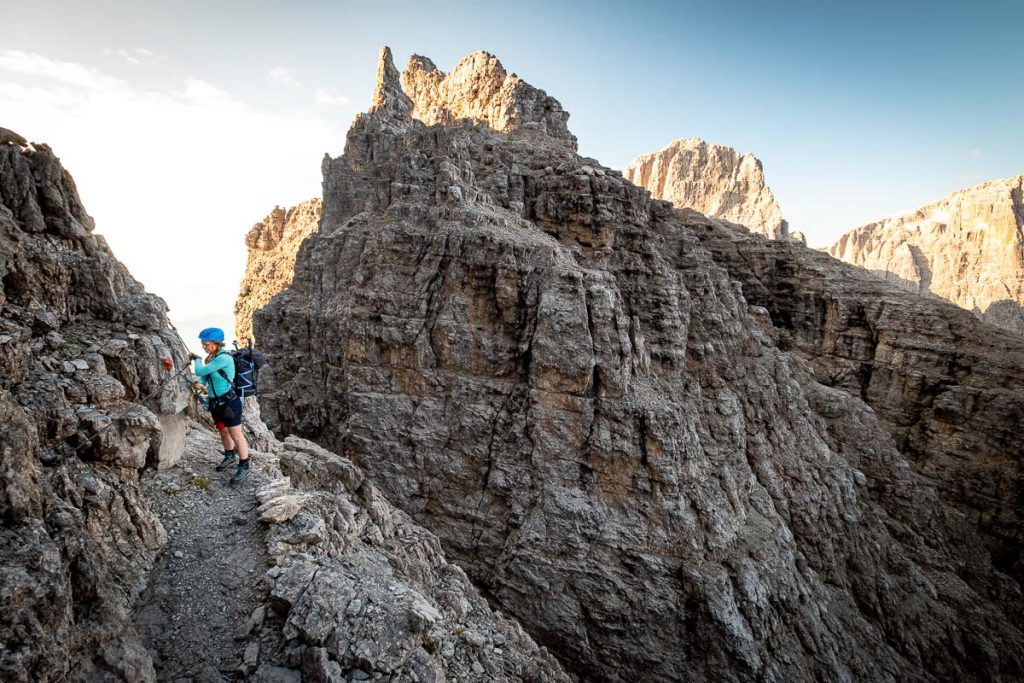
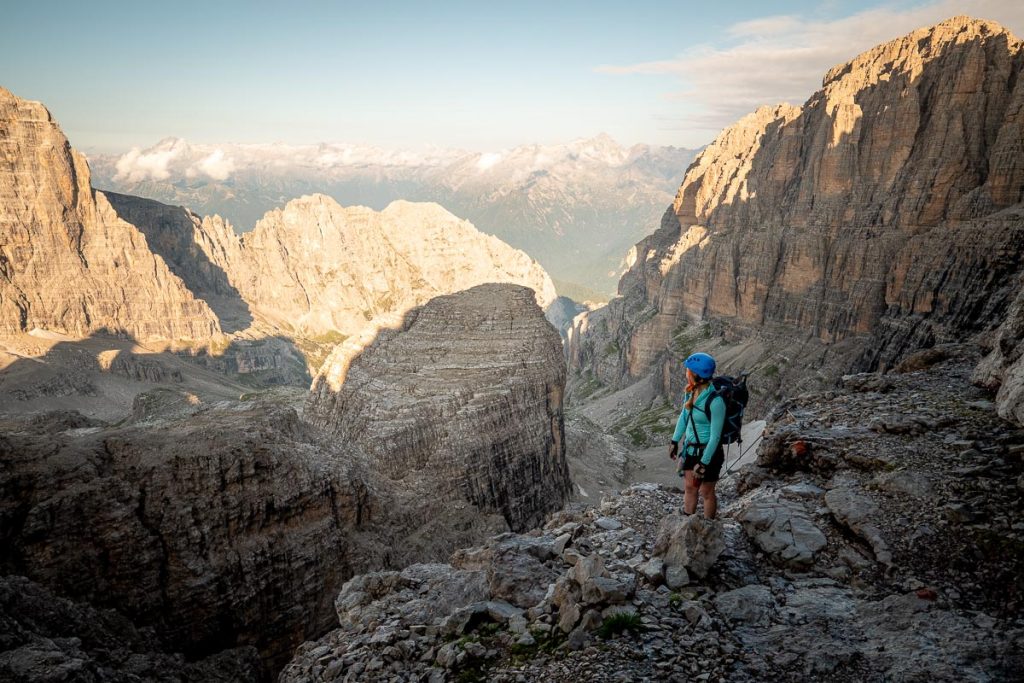

Via Ferrata Bocchette Alte is a high alpine traverse, but if you complete all the other iron paths along this backpacking trip, you won’t have any trouble with it. However, tackle it only when the conditions are right, because even the simplest of routes can turn deadly in adverse weather.
The path begins behind the refuge and follows Track No. 323. However, after the first few minutes, it breaks away and turns onto path no. 305. The climbing along cables and ladders begins very early, offering great views of Cima dei Armi behind you.
My favourite sections of the route were the Bocchetta Bassa dei Massodi pass, approximately one hour into the Ferrata, and the long ladder leading to Bocchetta della Valazza, which offers dramatic views of one of the spires of Cima Brenta directly ahead.
We reached the second pass around 2 hours after leaving the refuge. From the Bochetta Della Valazza pass, it is another hour traversing along the ledges of the western face of Cima Brenta. On a good weather day, you can see Lake Molveno, close to 2000 vertical meters below!
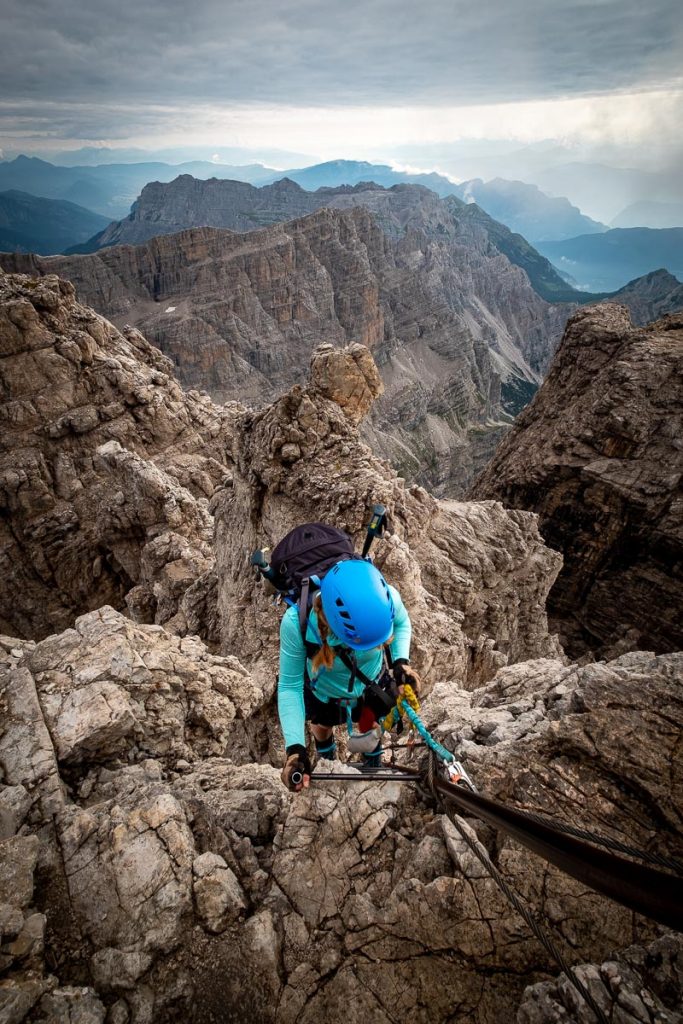
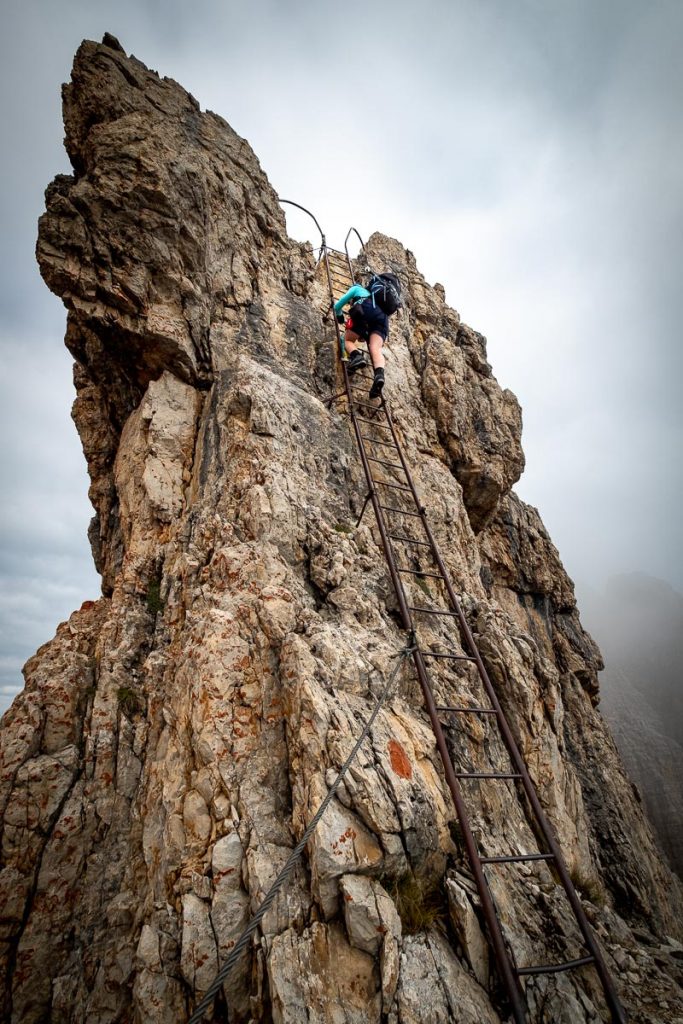
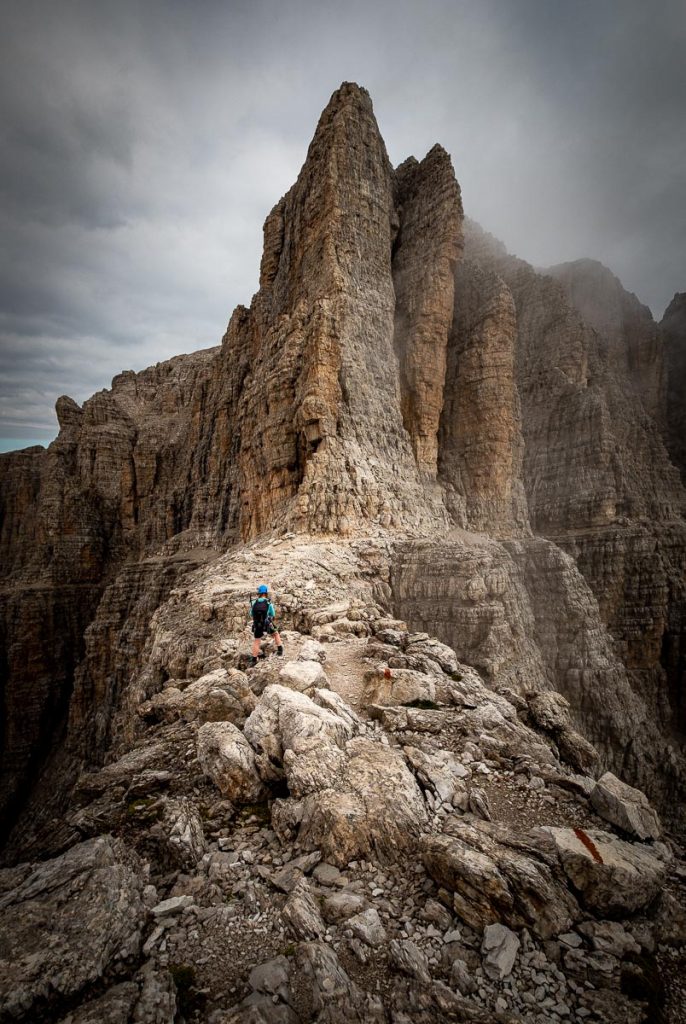
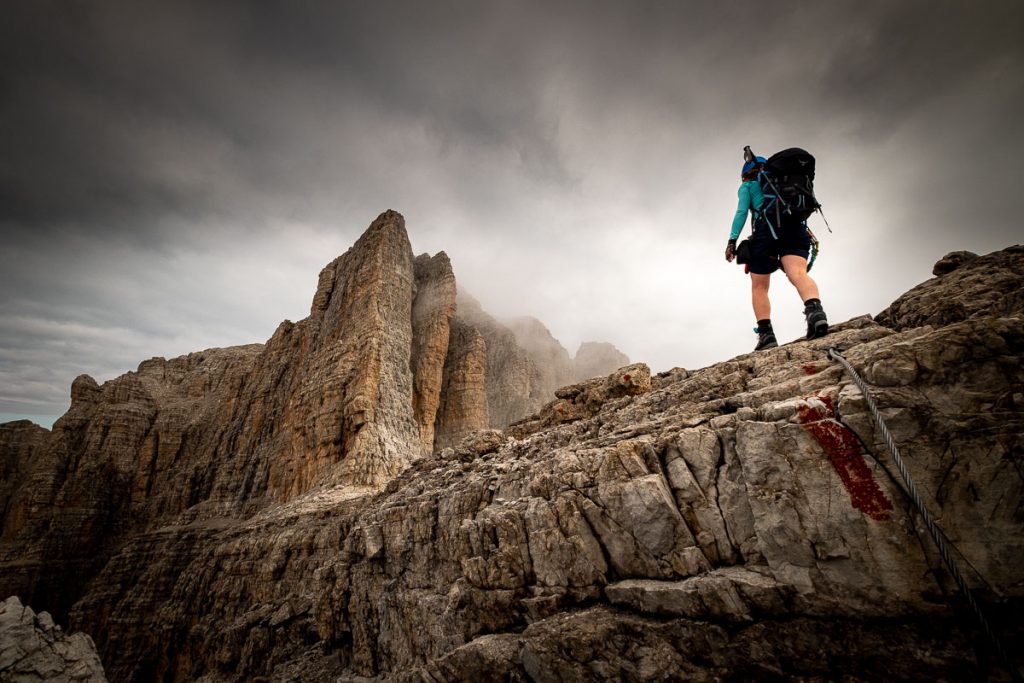
The last 45 minutes of the Ferrata consist of a sharp descent to Bocca del Tuckett. From there, as you enter the Sentiero Attrezzato Della Sega Alta (O.Orsi), you will face the most tricky part of the traverse – a descent down Vedretta di Tuckett – a year-round snowfield.
Take extra care when going down, and place your steps securely. While it’s not a sharp descent, you want to avoid sliding down as much as possible. This is the only time I wished I had crampons, but my hiking poles helped with keeping my balance.
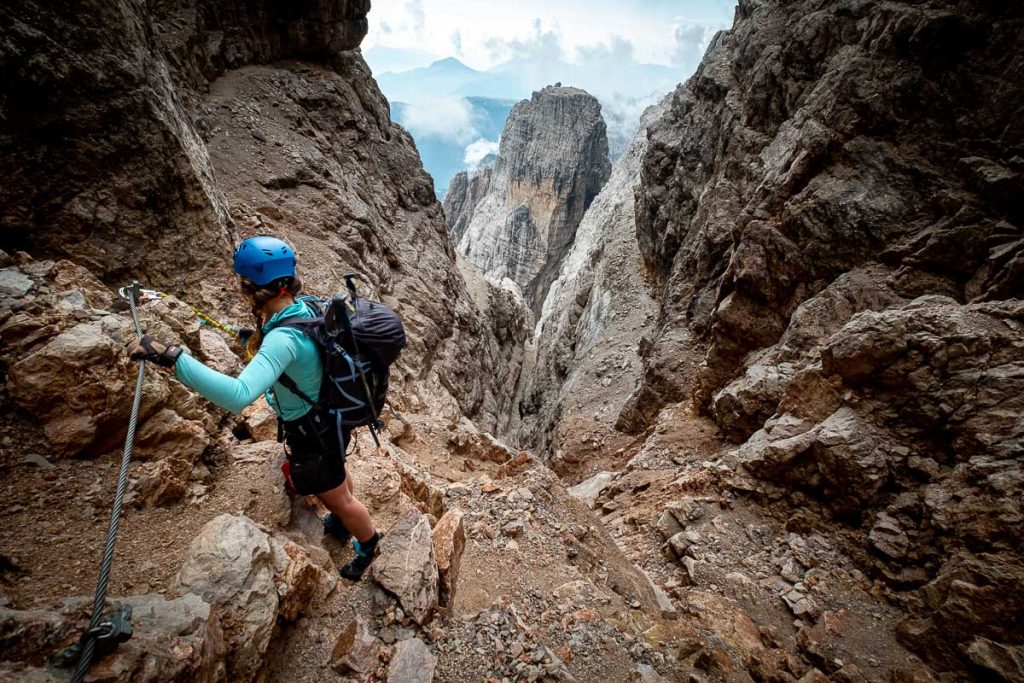
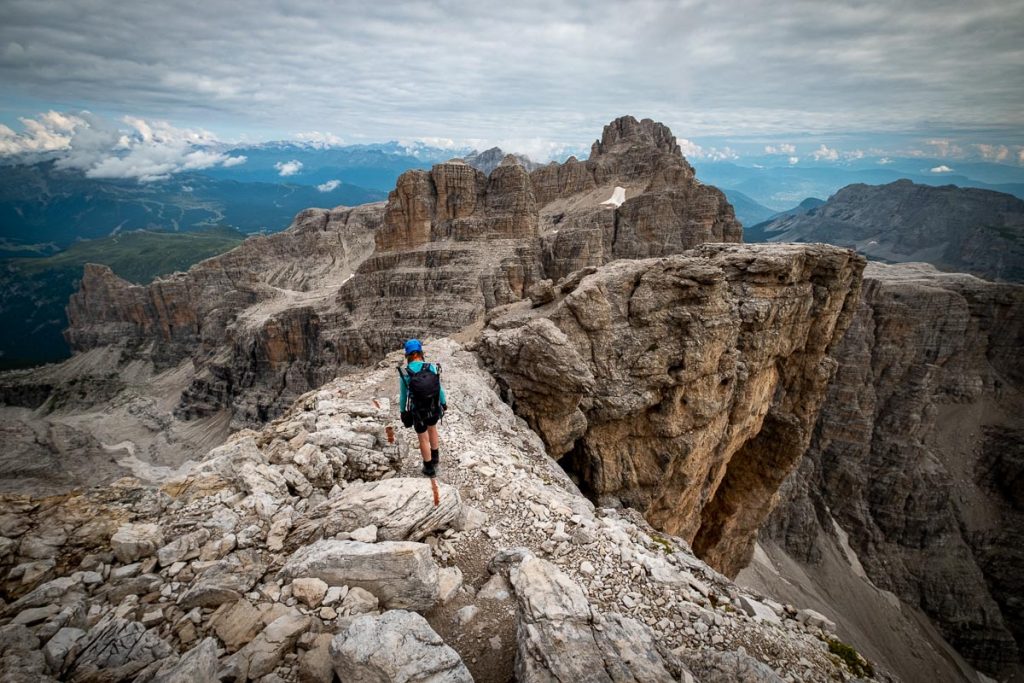
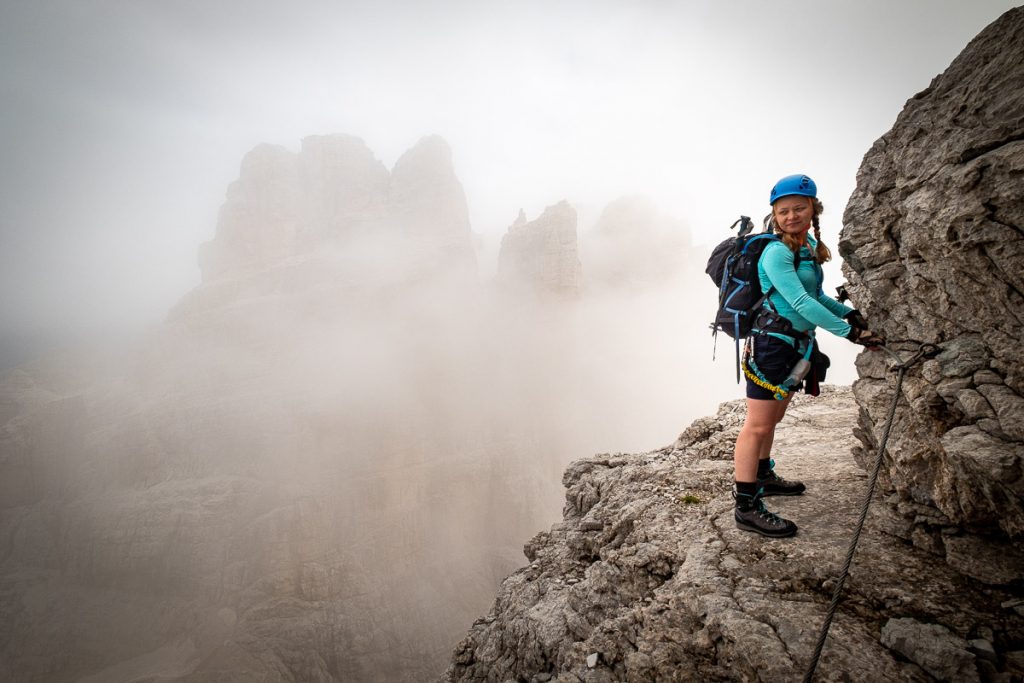
Forty minutes after leaving Bocca del Tuckett, you should arrive at Rifugio Tuckett, where you will spend your first night! Don’t drink that victory beer yet, though!
From Rifugio Tuckett, take path no. 316 to Passo Grosté, where you started the traverse! Aptly named Rifugio Stoppani, it is a great location to stop, celebrate, and reflect on your extraordinary adventure before you take the gondola back down to Madonna di Campiglio!
The Stoppani hut can be reached within 60-90 minutes after leaving Rifugio Tuckett. Luckily, it’s a gentle ascent. My knees were killing me from already descending 1000 meters that day. The pain was quickly forgotten, though, and looking back at it today, I would do this traverse again in a heartbeat!
Alternative hut configuration on the Dolomiti Brenta Traverse
If you studied the map, you will have noticed that there are two additional huts along the Brenta Traverse: Rifugio Pedrotti and Rifugio XII Apostoli. If you are having trouble securing reservations as per my article, here is the alternative hut configuration:
- Night 1: Rifugio Tuckett (No change)
- Night 2: Rifugio Pedrotti
- Night 3: Rifugio XII Apostli
- Night 4: Rifugio Alimonta or Tuckett
How to shorten the Dolomiti Brenta Traverse?
This is probably the most frequently asked question by my readers who plan to take this route. If you don’t have five days, consider the following ideas to shorten your trip.
TIP: If you would like to adjust this itinerary to your personal needs then use my trip planning services. We can schedule an online meeting and talk about personalizing the trip.
4-day option: Connect the first and second days
If you are a strong hiker, you can skip the first night in Rifugio Tuckett and head straight for the Alimonta hut, where you can spend the first night. This will amount to around 7-8 hours a day. The total elevation gain will be 1260 meters, and the elevation loss will amount to 1160 meters.
4-day option 2: Early exit to Pinzolo
After reaching the XII Apostoli hut, head on path no 307, which descends to the small town of Pinzolo. You can hike down, which will take around 2.5-3 hours.
If you are not a fan of hiking down, descend along path 307 and then 357 to the top of the Doss del Sabion chairlift. Take the chairlift down to the Prà Rodont gondola top station and then the gondola down to Pinzolo. Once you reach the town, you can catch a local bus back to Madonna di Campiglio.
3-day option: Skip days 3 and 4
On the third day, instead of venturing onto Via Ferrata Bochette Centrali, tackle the Via Ferrata Bochette Alta. It will take you back to Passo Groste.
Shop my hut-to-hut backpacking gear
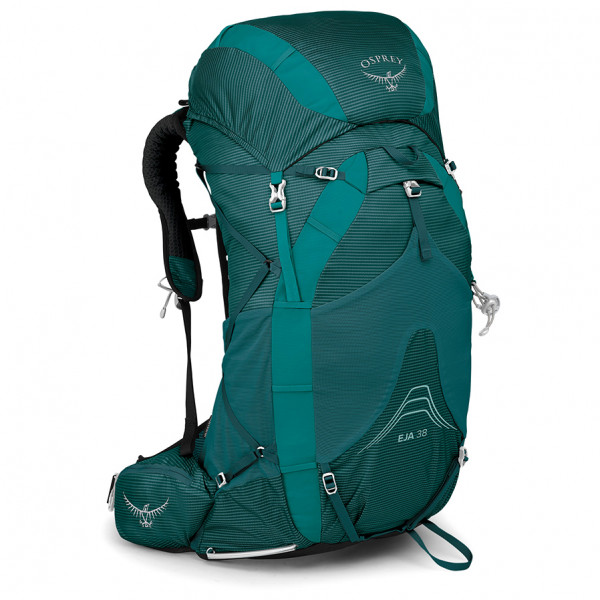
Osprey 30+ Litre Backpack
30-40 litre backpack should be more than enough to pack everything you need for a hut-to-hut trip in the Dolomites with plenty of room for water and snacks. If you can’t fit in, it means you are overpacking. I am a huge fan of Osprey backpacks and currently own the Eja 38-litre. Osprey has plenty of options in this storage volume range to choose from.
Shop on Osprey Amazon Store (Worldwide) / Backcountry (US)
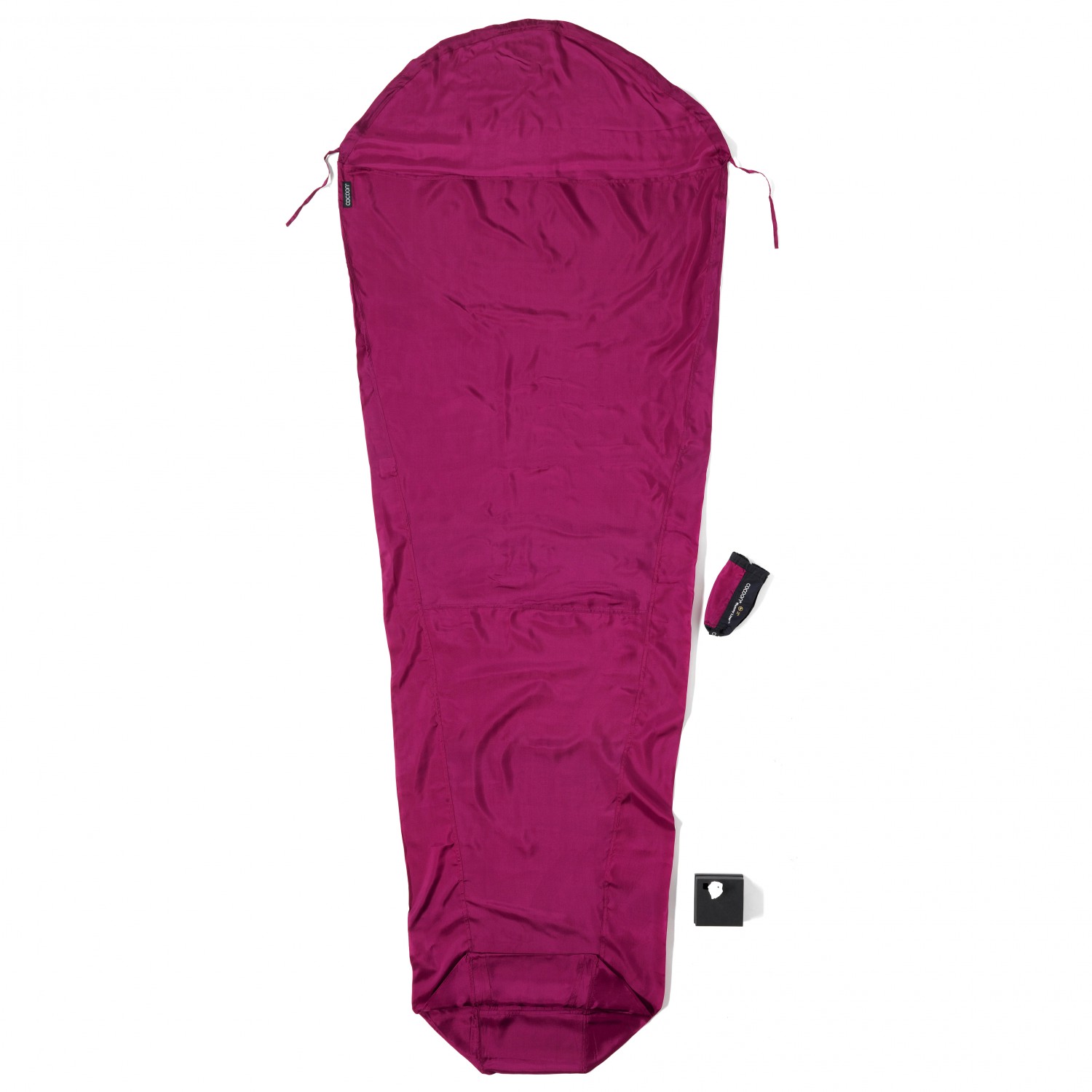
Sleeping Bag Liner
Sleeping bag liners are required for hut stays. Duvets and blankets aren’t washed after each guest who stays at the hut. Liners ensure that you don’t come in direct contact with the sheets and subsequently, it is more hygienic. Some huts rent or sell them, but it’s better to bring your own.
Shop on Amazon (Worldwide) / Backcountry (US)
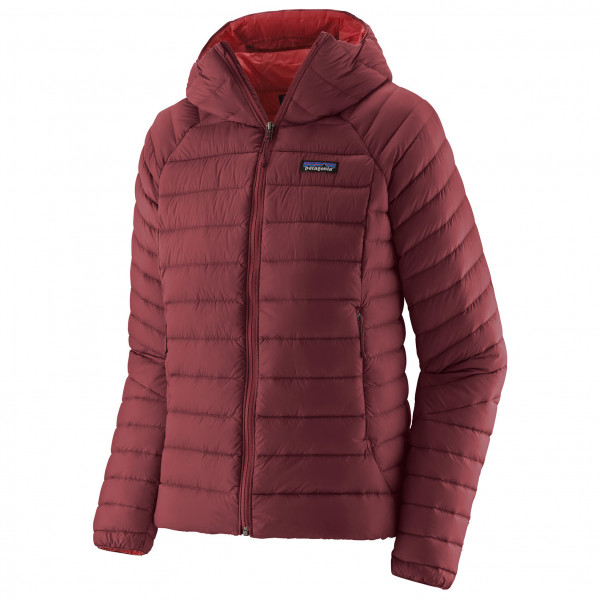
Patagonia Insulated Jacket
Even in the middle of the summer season evenings can be quite cold. If you don’t plan on venturing out of the hut in the evenings, you can skip this layer. I personally always bring one with me as I like to take sunset photos outside.
Shop on Backcountry (US)
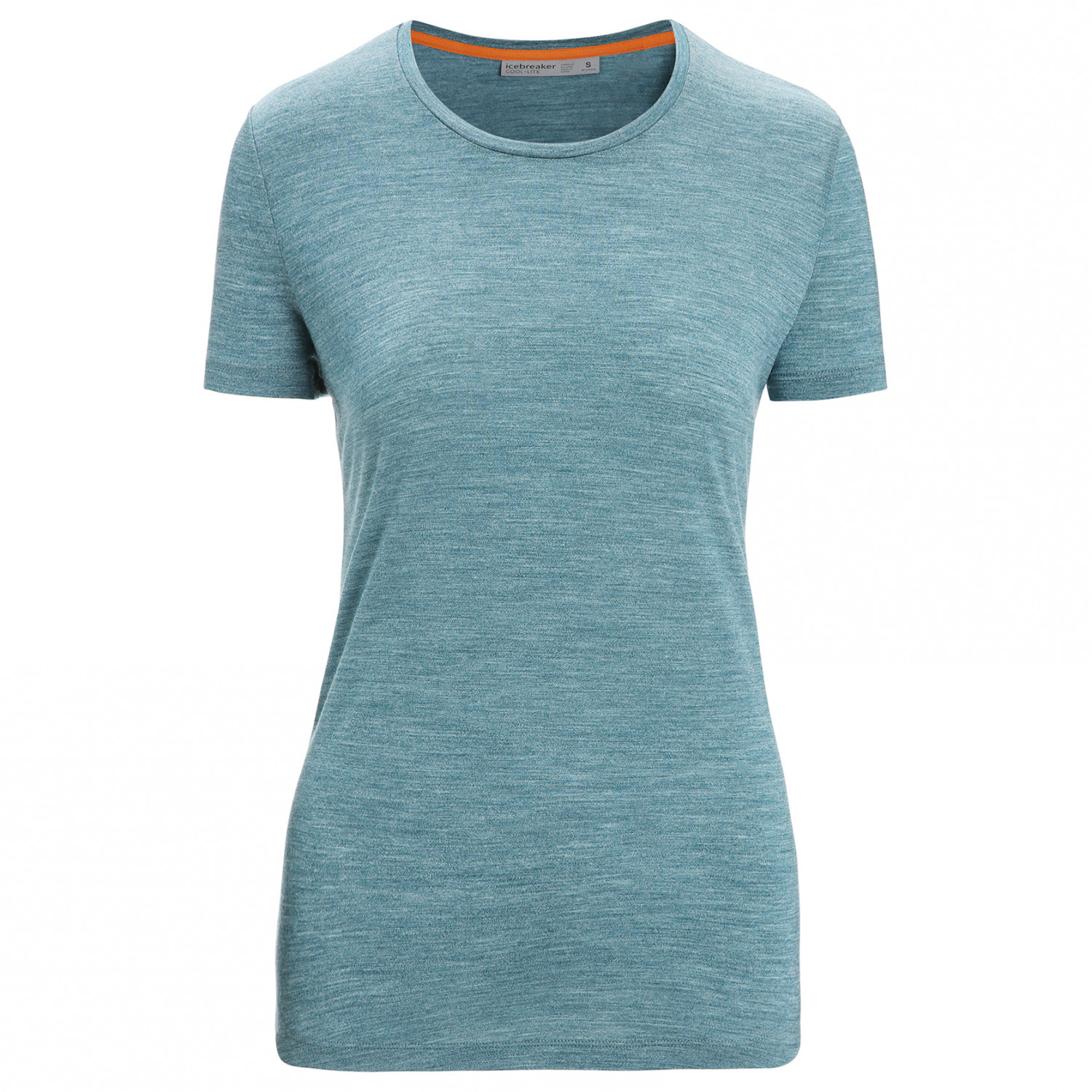
Merino Wool T-Shirts
Having a couple of Merino Wool T-shirts which you can alternate and then wash at the hut each day will be more than enough to keep body odors at bay. I am personally a big fan of the Icebreaker brand, however these days plenty of other brands have Merino products in their inventory.
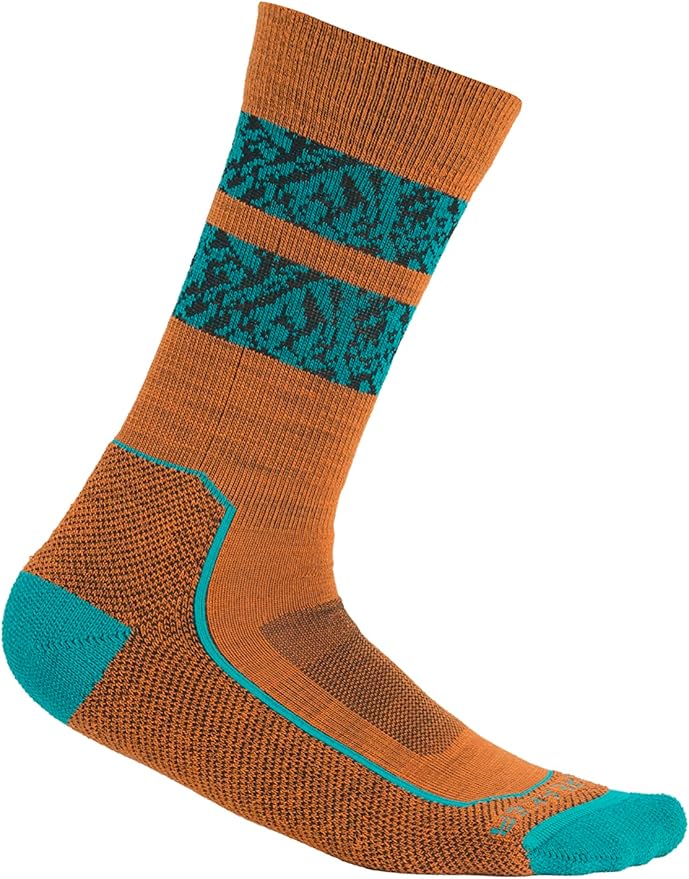
Merino Wool Socks
I always carry 2 pairs of socks in my backpack and one on me during multiday backpacking trails. Merino wool fibers and their unique properties are resistant to odors. Merino wool socks also prevent getting blisters as opposed to cotton socks.
Shop on Amazon (Worldwide) / Backcountry (US)
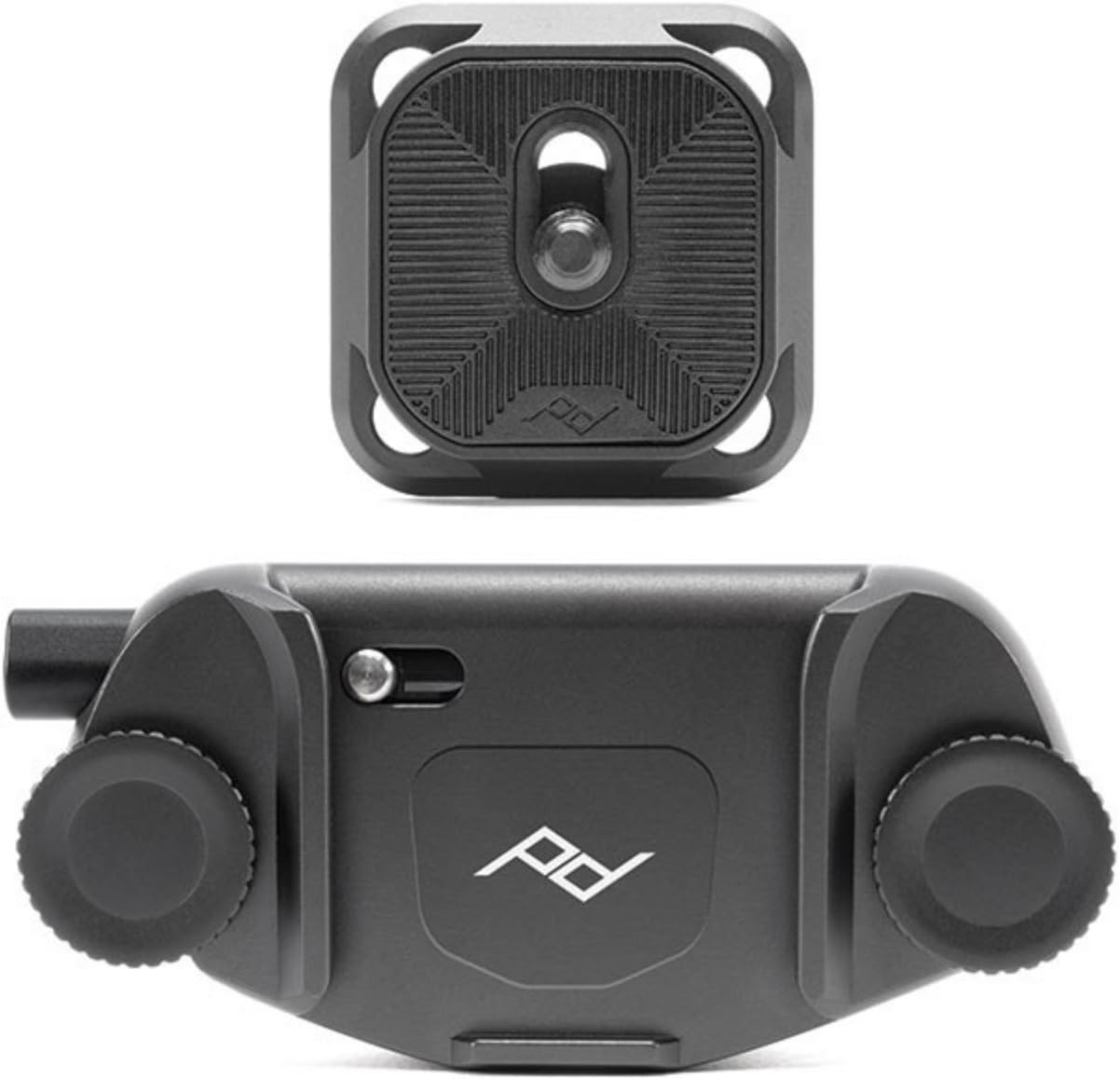
Peak Design Camera Clip
A must-have for any mountain photography enthusiast who is tired of carrying a camera around their neck. The peak design capture clip allows you to attach your camera to a backpack strap. That way you don’t have to take your backpack off and take your camera out every time you want to take a photo. You will always have it handy.
Shop on Amazon (Worldwide)
Other backpacking trip ideas in the Italian Dolomites
- 3-5-day Rosengarten Traverse
- 3-4- day Tre Cime National Park Traverse
- 2-4-day Pale Di San Martino Traverse
- 3-4-day Monte Popera Circuit
- Alta Via 1 (11 days)
- Alta Via 2 (14 days)
- Alta Via 4 (6-7 days)
Hello Marta,
We just finished the Brenta Group, and we wanted to thank you for your well-written guide here! We will be back again and again – that was a powerful experience!
We wanted to let you know two changes to the trail:
1. We learned a few days before our start date that the first day’s via ferrata—the Benini via ferrata route (paths 305, 315, 316, and 331) — was closed following a 36,000-cubic-meter rockfall in late July 2025, closing trails 305 and 331 along the route in the area around Cima Falkner. The route is closed indefinitely due to permafrost melting and destabilizing the rock walls.
Here’s a link to the article about it:
https://www.yahoo.com/lifestyle/articles/rockfall-brenta-dolomites-closes-trails-163146836.html?guccounter=1&guce_referrer=aHR0cHM6Ly93d3cuZ29vZ2xlLmNvbS8&guce_referrer_sig=AQAAAJSy2pq56PzlF1uZ7daj_58ZSi-ovDYJqFcP0AJnxB2IIoGMVIKEl0wLVLKzIkYttEYPMCB2PMAGZsVfJCI17YRWLSS59jT1R3ejwZgLxrwGvLPvsU9fvQjDIDBtqrDv_Qakg0efRbCThIkw1loRQnMBEmbkOdG1Nu9QX5pL_mKR
2. A new suspension bridge was built along a more exposed and challenging section of the Via delle Bocchette traverse. The path was closed for the month of June while the bridge was built.
From the path (Tuckett to Alimonta), one climbs down the face of a cliff wall to the bridge. It’s the most challenging section of the day’s trek. The bridge was installed to protect climbers from rock slides and snow avalanches in the deep canyon.
Also, Rifugio Brentei stole our hearts more than any other along the way. We will be back, even if it’s only to sit at the edge of that verdantly gorgeous valley and dream.
Thank you again!
Kris Parfitt and Dan Travers
Hi Kris! Thanks so much for providing your feedback and report. I have hear about the Benini being closed due to rockfall. I will certainly give an update on that soon for the next summer season. It seems like it will be a permanent thing. The melting permafrost is a huge problem here in Tirol too. It is very sad to see those mountains crumble.
I am so glad to hear you had a great time despite the challenges. Happy hiking!
Hey Marta,
Thanks for the excellent hike. We’re planning to go on this hike in 3 days. Looking forward! Is there a gpx file available for download somewhere? (I noticed someone asking in the comments section. But couldn’t find a mail adres of you.)
Best!
Ward
Hi Ward. Unfortunately I do not share GPX files, but I recommend just getting a regular map, which will give you a much better overview than any GPS device. Everything is very well marked and if you know where you are going it is impossible to get lost.
No worries. The paths were clearly marked. And I was able to extract the Google maps info and turn it into a gpx. It’s not super accurate but did the trick, in combination with a good old map. 😉 It was an amazing hike! Thank you.
Also wanted to let you know that the Ferrata Sentiero Alfredo Benini is inaccessible because a cliff came down last week. (1st day Ferrata). But you can easily do the hike around instead of the ferrata. Cheers!
Thanks for leaving the feedback. Sorry to hear about the Benini ferrata being closed, but I am glad you could walk around it. There were quite a lot of landslides in recent weeks due to a very rainy July, so I am not surprised to hear that. I am glad to hear you enjoyed the trip!
Hi Marta,
Your website is amazing thank you so much! I did your Rosengarten Traverse hike back in 2023 and it was beautiful! Im planning to do the Brenta Traverse on the 04/08/24. However, having a bit of a nightmare. The Alimonta Refugio only has private rooms for 6 which would cost 600 euroes for the 2 of us. So i was planning to push onto Pedrotti Refugio, but this is now closed for summer renovations. Do you have any suggestions on what i can do? Do you think we could get from Refugio Tuckett to Refugio Agostini in 1 day instead of 2 days? Me and my partner are quite fit. Or do you have any other suggestions on what we can do?
Hi Emma. Thanks for visiting. This is a very weird approach from Alimonta refuge. I have never heard of them just renting the entire dorm, instead of single beds.
Your best option is to stay for that night in Brentei instead after staying in Tuckett. It will add around 1 hour to your next day, but should still give you enough time to reach Agostini. You will have a pretty chill previous day to regain your strenght too. I hope that helps!
My girlfriend and I had an amazing time following a variation of this itinerary! To cut down some time, we didn’t stay at Agostini and instead traveled from Brentei to the Bocca di Brenta where we joined the Via Ferrata Bochette Centrali. We experienced every type of weather from sun to thunderstorms to snow, but the trek was beautiful and a very fun challenge. We could not recommend Rifugio Brentei enough. It was definitely our favorite. Thanks for the advice Marta!
Hi Vijay! Thanks for your trip report. I am so glad to hear you had an awesome time!
Hi Marta, Great website! So helpful. We were wondering what the rifugio reservation protocols are when having to change one’s plans on very short notice. We have a group participant who might need to skip day 3 and four and stay at Alimonta for several nights while the rest of us go to Agostini and back the next day. I’ve heard that have to let you stay, but might not have a bed. Any thoughts on that would be helpful. Thanks! -Daniel
Hi Daniel. The Dolomites have become very busy after the pandemic so having a reservation is necessary. Normally if you cancel on a short notice, you lose the deposit (whatever the hut required to pay). All huts however have their own policies and it’s best to ask them directly. Sorry I couldn’t help further.
Hi,
Your blog has helped me plan via ferrata tours 2x already near Tre Cime, and now I’m going for the trilogy! (Just the 3 day version)
We are thinking of swapping the first and last day – doing bocchette Alte from Tuckett to Alimonta, and the sosat on the last day to make the day slightly easier. From description online, it even seems like this would be the preferred direction to do Bocchette Alte. – any thoughts?
Thanks so much for the great blog!
Hi Ingrid. Welcome back. I am so happy to hear you find my blog useful. I have met people who were doing it in the opposite direction. I don’t think it matters much. Whichever direction you will be going on Bochette Alte you will be faced with downclimbing, which is what makes it challenging. I hope that helps!
Hi Marta! Thank you so much for the informative write-up. Do you think it would be feasible to trek from Rifugio Tuckett to Agostini while passing Rifugio Brentei and Apostoli XII? From your time estimates, it appears it would be a long day (7-10 hours) but I wonder what your thoughts would be. Thanks in advance!
Hi Ryan. Sorry I am having trouble understanding your plan. It doesn’t make sense. Could you try explaining again?
Hi Marta,
Thanks for the great write up. I will be visiting Dolomiti di Brenta next month in late June.
You mentioned there is a shuttle from BGY airport to Madonna di Campiglio. Can you share a link or resources to find this?
Thanks
Hi Roy, I would suggest checking for buses from Bergamo to Trento and then Trento to Madonna Di Campiglio. I hope that helps!
Hi Marta,
I was overwhelmed by the endless options for a multiday via ferrata, but with your advice, I’ve committed to this exact journey—with one adjustment. I’m splitting the last day into two, staying an extra night at Refugio Tuckett. This will allow me to walk to the gondola (60–90 mins), get down and drive to Venice Airport (4.5 hrs) for my 7pm flight.
It all looked perfect on paper… but I just realised the gondola stops operating before I return to Stoppani (last lift is on 19th Sept). Rather than rearranging my trip, it means that I’ll need to walk down instead.
I’ve checked a 3D map, and it seems doable, but how long do you think this descent would take?
Finally, how do I buy you a coffee? You’ve been incredibly helpful.
Thanks again,
Marcus
Hi Marcus. According to the Madonna Di Campiglio site the lifts run until September 21st this year (exactly 19.06 until 21.09.2025.) so you will be fine. Maybe you had the dates from last year.
Hi Marta,
I’m looking into this as a backup to AV4, where I may be too late with hut bookings. I would like to do a longer trek than 5 days though. Could this route be extended? Either by staying longer on the route, doing more side quests, or by continuing on a different nearby route after finishing this loop. I’d love to do more via ferratas. What do you think?
Hi Alex. Yes you could stay an additional night in Rifugio Stoppani then head North and do an additional Via Ferrata (I don’t remember its name, but it is well marked on the map of the Brenta Dolomites). I hope that helps!
Hi Marta, thank you for your amazing site! We are s excited to be coming from New Zealand for a 3-4week trip to the Dolomites 2025. We hope to start with the AV4, followed by the Brenta circuit and finally the Pale di San Marino group (weather permitting!). We can either come to Italy in June ready to start walking 17th June OR we can come the last weekend of August ready to start walking early September. Just looking at the current forecast in Corvara it is mostly rain and even some snow this week! Given we are coming from NZ do you recommend we come for June or September. We did the AV1 and AV4 in June/July2018.
Hi Judy. The Brenta traverse will be tough to do in June. There will still be lots of snowfields, which are dangerous. Av4 might be just borderline. I did AV1 in June. You can look at the photos and how much snow we still had in places. In September the weather is generally more stable. I did the Monte Popera Circuit last year at the end of September. I would also suggest that you look at the photos. In June you have lots of thunderstorms. With that said I cannot guarantee you good weather. Last year September was amazing with lots of sunshine and blue bird days. This year we have crazy anomally with loads of rain, floods and snow down to 1500 meters. Particularly this week. This snow won’t stick around though. Next week it should be back up to 20 degrees again.
PS I know your site recommends September for walking in the dolomites but maybe it is colder and wetter than usual this year? Day time temps in Corvara this week range between 3 and 16 degrees Celsius and the night time range is between -2 and 9 degrees plus snow and rain for 2 days so i would only assume it will be colder higher up in the rifugios. It is so far coming from NZ that we want to pick the right time – either June or Sept. Totally stoked you have hiked in NZ as well. We are so lucky.
Hi Judy. Yes this September is quite cold comparing to the last few years.
Hi Marta,
what a impressive and complete itinerary! I thoroughly enjoyed reading your article, it must have been a lot of work! my friends and i are planning to do this tour late july this year:)
is it possible for you to share the GPX file for planning the tour on our garmin, if we copy it from your google maps it doesn’t show up quite right:/
thanks in advance!
Michiel
Hi Michiel. Please e-mail me directly via my contact page and we can take it from there.
Hi Marta,
Thank you for this great itinerary. I’m planning to do this tour exacly as you described it in late August this summer. I am an experienced rock climber and hiker and have enough via ferrata experience to handle this route. I have experience hiking and climbing solo and I plan to do this trip by myself. The only thing I’m unsure about is the glacier crossing you mention on day 4. I don’t have any real glacier experience. Could you give me any more information on this glacier and how long, difficult and risky the crossing is?
Thanks in advance.
Hi Job. I didn’t have any special equipment with me (I did the trip at the end of August too). The glacier is not the type of glacier one has immediately in mind (crevasses etc). It is so small it will be gone in a the next years. You can see the picture of the snowfield we descended on from the Sella di Tossa Pass. You can distinctly see the footpath on it and how small it is. We just stuck to the footpath. The thing that one can benefit from are crampons/spikes to prevent sliding. The snow/ice was very soft when we descended on it so out boots sank a little. I hope that helps!
Hi Marta,
Many thanks for your excellent info and beautiful photos. Your trip reports have inspired us to venture to the Brenta Dolomites in late August! We have already booked our nights at Tuckett and Alimonta. I just received a reply from Pedrotti saying they will be closed for overnight use in summer 2024, but open for drinks and lunches. Our plan was Pedrotti night 3, then Agostini night 4. Maybe now instead we will stay 2 nights at Alimonta and then straight to Agostini in a longer day? The last day (day 5) we would hike over to Pinzolo then bus back to Madonna. Are there any other alternative routes you would recommend? Also, does each leg of the via ferrata route have a reasonable alternative hiking/scrambling route, if the weather is questionable? I am a lifelong climber, as is my wife, but she sometimes wants to have a second option if the weather is a concern or she feels the exposure is too great.
On a side note, we have been to many of the places you list in Iceland, Lofoten, and the Canadian Rockies. You certainly have a knack for picking the most beautiful places, and noting the important details! Also, love the pics with your buddy Jasper! Thanks in advance for any advice you can share!
Hi Nate. Thanks for visiting and for your great feedback. I am glad to hear I inspired you to visit the Brenta Dolomites. Since the second day between Tuckett and Alimonta is relatively easy I would just push from Alimonta to Agostini in one day. If you leave at 8AM you should reach the hut by 2 or 3 PM.
As for alternative routes, there are some, but the detours would be quite long and probably even more strenuous than the ferratas. I would recommend that you get the map of the Brenta Dolomites to study the routes.
On day 4 you could hike from Agostini to XII Apostli hut and stay there for the night before heading to Pinzolo on day 5. or Keep following the route to rifugio Brentei and then take a hiking route to MAdonna Di Campiglio on Day 5.
I hope that helps!
Marta, Thank you for all the time you have put into making these guides 🙂 I was just wondering what time of year you did this hut-to-hut trek and if you think doing it in the last possible time of year (3rd week of September) would be pushing it too late?
Hi Rhea. Thanks for stopping by. I did it at the end of August. As long as the huts are open it is possible to do those treks. Last year I did the Monte Popera Circuit at the end of September and we had very warm days and blue skies every single day.
It is of course possible to get snow at high elevations even in the middle of the summer because of high temperature fluctuations between day and night, but those kind of snowfalls don’t stick around and the snow usually melts by late afternoon. I hope that helps.
Hi Marta,
I did the Rosengarten and Tre Cime hikes last summer and now I’m hooked! Planning on doing the Brenta this summer. I’m just not sure about the last day (VF Bocchette Alte). If I don’t feel I can tackle it(considering how I did on the previous VF) or if the weather is not conducive, is there another exit strategy from Rifugio Alimonta? Maybe re-trace day 1&2? You mention an earlier exit on day 4, but I would like to compete the 3 VF of day 4, they seem like fun and less challenging. I appreciate your insight, thank you!
Hi Simone. I am so glad to hear that you are hooked and that you are coming back for more. Bochette Centrale isn’t as scary or that much for difficult than the rest of the ferratas. It is just long with many cable sections. Yes you can exit from Alimonta down to Madonna Di Campiglio via a different route. You will find the route on the Dolomiti Brenta map. I hope that helps!
Dear Marta,
Thanks for the great instructions! I’m planning on doing the trek at the beginning of July. And I feel very well informed after reading your blog 🙂
Couple of questions:
– Are the distances of Day 1, 3 and 4 correct? When I enter them in outdoor active the distances are as followed: 6,4, 7,5 and 11 km’s (instead of 9,5, 16 and 16,5 km’s). I have the feeling I’m missing something however the elevation gain is the same…
– Do you know how to find out wether you need crampons? If you need them I’m happy to take them but if it’s not necessary it safes me some space and weight 🙂
Hi Nienke. Thanks for visiting. The distances are based on my personal data which I gathered using my GPS. Garmin states on their website that there might be 5% inaccuracy. I do not know where outdoor active takes their data from, but considering how many posts they have on their sites I hardly doubt they are based on their personal experiences.
As for crampons I did this trek at the end of August and could have used the crampons on the very last day so I’d say it won’t hurt to take them especially since you are going at the beginning of July. I hope that helps!
Hi Marta, are crampons necessary or would traction spikes be adequate?
Hi Fred. Spikes should be enough as you will be crossing the snowfield in the afternoon when the snow is a lot softer, however I cannot give you a 100% guarantee on the conditions as it depends on many things. There is still quite a bit of snow in the mountains at the moment. More than last year.
Hello Marta, thank you so much for the information in your blogs and the beautiful photos you have shared with us!
We are planning on doing the Brenta trek in about a month’s time (relatively last-minute, we know…) and have a few questions to ask the expert! Firstly, would it be possible to do the trek in 7 days and without any via ferratas? If so, how would that look? Secondly, what do you think our chances are of being successful in booking accommodation in the rifugios so last-minute?
Sincerely,
Ieva
Hi Leva. Thanks for stopping by. You could possibly bypass the via ferratas but it would be a completely different trek. To plan that you would need a map of the Brenta Dolomites. If you need help planning out a trek I do offer this kind of help. Here is the link to my travel planning services. As for reservations. Brenta Dolomites aren’t as busy as the main Dolomites so if you aren’t going in a group your chance of booking a hut are high.
Thank you so much for a wonderful site, very helpful.
After vi noticed your site last year, me and my boyfriend went hiking for the first time in the Dolomites last summer, and vi absolutely loved it!
I was wondering how this route is compared to the Alta via 4 (as we did last year).
Are the Via ferrattas more technical and exposed? (its the vertigo that is a bit troubling for me)
Thank you so much in advance!
Hi Julie. Thanks for coming back to my site. I am so glad you loved AV4. Now how does it compare? there is definitely a lot more scrambling in the Brenta Dolomites as you have 8 different ferratas across 5 days, but they are all a lot of fun. The most difficult one comes on the last day, but there is a possibility to walk out via a different route and skip it altogether. The views are amazing throughout with lots of spires. If you are looking for something less intense try The Rosengarten Traverse or the Pale di San Martino. Both can easily be extended to 5 days.
Marta what a wonderful site thanks for doing this, so very helpful. A friend and I were looking for a 3-4 night trek. Though the tre cime seems really cool, it looks like the Rosengarten and Brenta would be a little less traffic. If choosing between Rosengarten or Brenta what would you recommend? This would be our first time in the Dolomiti and first time doing VF’s. We do have a lot of hiking experience, scrambling skills, and crampon and ice axe knowledge, but definitely aren’t rock climbers or true mountaineers. If you recommend Brenta, is there a way to shorten the trek above by one night? Thanks in advance for your help.
Hi Bill. thanks for visiting and for your lovely feedback. If you are looking for less traffic then the Brenta traverse will be more suitable for you. Yes, you can walk out to Pinzolo from Rifugio XII Apostoli on day 4 to shorten the itinerary. Then from Pinzolo, you take a bus back to Madonna di Campiglio. Let me know if you have more questions!
Hi Marta!
Thank you so much for all your amazing guides. They have all been a true inspiration and led to a few hut-to-hut trecks in the Dolomites already!
Quick question: Did you ever do any of the multi-day hikes only by yourself? It seems a bit irresponsible at first to do routes with ferratas all alone but I have to admit I’m considering it anyways. I know it’s ultimately everyone’s own responsibility, but just wanted to hear your opinion on and experiences with this matter.
Thanks again!
Hi Markus! Thanks for your great feedback. As for your question, I only did solo day hikes, but when doing multiday hikes I always did them with a friend.
I did meet solo hikers in huts though and they usually just team up with someone else along the route, so maybe that would be an option for you? Also carrying some kind of satellite device like the Garmin Inreach Mini would be a good idea. There are spots in the Brenta Dolomites without cell phone coverage. I hope that helps!
Hello Marta (and Jasper)
First off, thank you for your excellent, well thought out and presented website, Great job. I am traveling to this area with my brother and sister just after mid June and we had planned on hiking this route. We have a couple of questions. First off do you think it will be open this early, or is it annually specific as to the amount of snow that has fallen that year or is there a definite opening date? This is relevant both in terms of whether the route is actually passable and also if the rifugios are open. Do you have any advice on this? Also with this route specifically and the greater Dolomites in general, is it necessary to pre book your rifugios, particularly at this time of year? (Had a bit of a language laugh trying to book one there a few years back, I was trying to ask if it was necessary to have “schlafen bagens” ((sleeping bags)) the poor woman had’nt a clue what I was on about. ) Anyway, it would be great if you could help out. Also if you think that this route is out of the question, could you recommend something similar for this time of year.
Many thanks.
Jethro
Hi guys! Thanks for visiting my site. Rifugio Brenta and Alimonta the first two on the itinerary open on June 17th. If you travel earlier you won’t be able to stay in the huts.
For the last day Via Ferrata Bochette Alta, I would pack an Ice Axe and crampons because the snow field might be still deep. I still had lots of snow there in August! You can skip the last part by exiting Madonna Di Campiglio earlier. As with prebooking rifugios, I definitely would if your travel time falls over the weekend. Agostini is much quieter but Brenta and Alimonta were busy. You can easily call and make reservations in English. I always did. These days English will get you further than German. Particularly in the Italian Parts of the Dolomites. You can also look at my AV4 guide, Tre Cime Traverse, or Rosengarten Traverse if you are looking for alternatives.
Marta, this information is very helpful and we can now continue our trip as planned. Also, obviously we know that many things can be subject to change in mountain environments. I may be back with another question or two between now and then. Thanks again, appreciated.
No worries! Thank you for your support on Ko-Fi. Have fun and stay safe.
Hi Marta
Thank you so much for your article (and the others you have written) – these are super helpful! My friends and I are keen to complete the route you have listed above (if we can get and spaces in the huts that is), are you able to give a rough estimate of costs for the above? Also, what gear do you recommend we purchase (I can see you are wearing helmets in some photos and snow grips), other than the typical hiking gear?
Many thanks in advance
Hi Madison, Thanks for visiting. The rough cost for a hut stay is minimum of 60 euros/per night, but if you also decide to eat lunches or have drinks in each hut then add another 20-30 euros per night. As for your second question, I have a whole detailed post about what to pack on hut-to-hut hikes including what ferrata gear I use. Do check it out. If you plan on doing this traverse in July – mid-August then I would also recommend packing a pair of crampons (black diamond has good ones) and possibly an ice axe for the last bit of the via ferrata Bochette Alta. There is a snowfield that you have to go down on. I didn’t have either with me and it was totally fine but I did this traverse towards the end of August when the snow level was minimal. You might also want to check out my beginner’s guide to ferrata climbing in the Dolomites. Let me know if you have any more questions.
Hello Marta,
I will be traveling with my family to the Brenta group this August and looking for a 2 night, 3 day hut hike. Something that doesn’t include cables, ladders or serious exposure. Could be a loop, end to end or out & back. We are experienced backpackers and do challenging non technical hikes throughout the Sierras but want to keep it simple but stunning. Maybe in the range of 20-30km. Any suggestions would be much appreciated. Thanks, John
Hi John. Thanks for visiting. Do you already have a map of the Brenta Dolomites? Are you looking to do 20-30 kilometers a day or across the 3-day trip? What is the elevation gain that you normally do per day?
Last but not least due to the high volume of custom itinerary requests I am starting to offer a service to help create itineraries for my readers. If that’s something you are interested in, please send me a private e-mail through my contact page!
Hello! This blog is very helpful, thank you so much for creating it. My two friends and I are doing this trip this year. I was wondering does this route access the lago di sapris please? If so, at what point and how much extra time would it add to the journeys?
Thank you!
Hi Ellie! Thanks for visiting. No, the Brenta Dolomites are nowhere near Lago Di Sorapiss. If you would like to have the lake included in your hut-to-hut trip then I recommend checking out the Alta Via 4. Let me know if you have any more questions!
Hi Marta, After a wonderful trip to Iceland this summer, mostly driving with only one hike which was awesome, my son and I pictured a trip this coming summer where we could ‘just’ hike ;). Since he is an athletic teen and I’m an adventurous 57 yr old whose past 5 years included two cancers (good to go now, however, do have some energy limits) I hope to find a VF route that is exciting for my son while manageable for me. This route looks like it may possibly be just the right mix however we have friends who did Via Alta 4 this summer whereby they shifted route after a couple/few days due to fear at when the hit a section with loose rocks also noting there were sections where they felt a Via Feratta, which was not present, would’ve made them feel more secure. I believe, overall, my son and I are more adventerous and would be alright. I was initally drawn to Via Alta 1 but he and I both truly enjoy the lesser explored places and in reading your awe inspiring blog about Brenta Traverse I am drawn to being there. The only Via Feratta type work he or I have done was on a fantastic ropes like adventure in Quebec and a wee little bit on a route in lovely Solvenia’s Alps. When we hike in general we each have some comfort in scrambling (my comfort is greater going up than down but if clipped in I’d feel more confident). If possible, a suggestion for another 4-5 day route which would, perhaps, warm us up to this route – perhaps something more ‘classic’ Dolomites as a means for VF practice – I’d be super grateful. Also, the times in your blog – I don’t know if I should double the time or up them by 50% as given my age I am starting to recognize that the writer is generally in great shape and in their 30’s. ;).
Thanks for listening and considering….
Warmly,
Sheri
Hi Sheri! thanks for visiting. Adamello Brenta traverse is perhaps not the best idea if you are under the impression that AV4 is difficult. AV4 is easier than Brenta traverse. Brenta was probably the most fun I have ever done but don’t underestimate the 8 via ferratas you have to go across in 5 days 🙂 Whilst being clipped in always adds a lot of confidence, there are always some sections when there are no cables yet it is still quite steep.
Av4 is a better choice for practive. What I would actually recommend is starting with Tre Cime NP traverse (you can find it on my site) including the alternative start along via ferrata Strada Degli Alpini, then finishing in rifugio Fonda Savio and via ferrata Merlone. This is an awesome route with some via ferratas that can be done as extensions which means you can first leave most of your stuff in the hut before going out again and climbing a via ferrata without a heavy pack.
You can make it easily into 5 day route. Simply from Fonda Savio combine the route with AV4 and continue to Vandelli on day 4 then San Marco on day 5 and exit on day 5 to the valley.
As for times. I usually write walking times in brackets so 6-8 hours. If it says that, then you can assume it took me 6 to hike it 🙂 Breaks are never included.
Let me know if that helps and if you have more questions!
Hello Marta. Do You think, that it would be possible to do a 1 day trip on via ferrata from Passo Groste to Rif. Alimonta without stopping at Rif. Tucket?
Hi Michał! Thanks for stopping by. Yes, it is possible to do it for someone fit. It is a full day excursion, but if you are fit you could do it with no problem. The final decision however belongs to you, as you know your abilities best. let me know if I can help further!
Hi Marta, very nice blog you made! 🙂
We want to do this hike as you have inspired us! Could you maybe tell us if we can rent the feratta gear in Madonna di Campiglio? Or a village nearby?
Thank you!!
Hi Giel. Yes you can rent gear in Madonna. Search for places that are called nollegio (rental places). The set up is usually around 20-25 euro a day. Make sure to get your own gloves though. Renting them might be a bit gross and I find gloves are essential on VF routes. Tip: gardening gloves work pretty well too 🙂
Hello Marta, thank you for the very helpful information and photos!
Do you have a suggestion for a 1-2 night trek in the region that doesn’t require tracking on advanced via Ferrata trails?
Thanks,
Katie
Hi Katie. Could you let me know if you are only after the Dolomiti Brenta region or all of the Dolomites? cheers
Hi Marta, Your Via Ferrata pages are really useful and great photos! I’ll be following this Brenta route or something very similar (and probably some of your other recommendations) as it looks great, so just a note to say thanks for providing this!
Hi Kieran! Thanks a lot for your feedback. Do let me know how your traverse goes! Have lots of fun hiking and let me know if you have any questions!
Hi Marta,
Your guides are a life saver. I am super interested in doing this traverse this week and have it mostly planned, but Alimonta just got back to me and said they open the day after I would need to be there. Do you have any thoughts on how to do the route without stopping at Alimonta the second night? I could bring food and a sleeping bag if I needed to bivy.
Really excited to spend time in the Dolomites : )
Hi Sarah. Sorry but those huts remain closed for a reason. This traverse might not be passable at this time of the year due to snow. There are many gullies to cross where the sun doesn’t melt the snow even well into July and if you are going this early I would suggest bringing an ice axe and crampons with you (and mountaineering experience). Rifugio Ai Brentei is the closest to Alimonta. It would make day 2 shorter but day 4 longer by around 1 hour. Maybe that one already opens.
Hi Marta,
Such a nice and inspiring blog you’ve made!
My sister and I have planned exactly the same trip as you’ve done. We’re both in good shape (early thirties) but we’ve no experience with via ferrata.
What are your thoughts on that? We have hiked before in The Dolomites though, so we are kinda aware of what it’s like over there…
Thanks in advance! Thijs
Hi Thijs. Thanks for your great feedback. I wish I could give you a straight answer but I can’t because I have no idea who you are, what your mountain experience is and whether you have ever scrambled or used via ferrata gear or not. I can only tell you what I did when I first got into doing via ferratas. I chose day routes to ease into it. If it was me I wouldn’t have gone for a multiday route, but chose some easy day routes first to practice using the via ferrata gear and safety. That’s just me, what you will do is entirely up to you.
Hi Marta
Thanks for your reply:) Do you know if there is a shop where we can rent via ferrata gear in Madonna di Campiglio? Do you have any recommendations on where to rent our gear?
Tanks again,
Thijs
Hi Thijs. Yes, you can rent gear in Madonna. Search for places that are called nollegio (rental places). The set-up is usually around 20-25 euros a day. Make sure to get your own gloves though. Renting them might be a bit gross and I find gloves are essential on VF routes. Tip: gardening gloves work pretty well too. I have my own via Ferrata gear, never rented one, but my friends did.
Hi Marta!
Firstly I just want to say that your guide is amazing! My husband and I are planning a trip to the Dolomites and we’re using your guide as our main reference – thank you! We’re hoping to tackle this 5-day trek and was wondering if you recorded/wouldn’t mind sharing your gpx file with us? We bought a mini2 🙂 Otherwise no worries, we will try and set our own course. Thanks in advance! -Kim
Hi Kim. Thanks for your feedback. Please email me directly hello(at)inafarawayland.com
Hi Marta,
Like many others, I want to thank you for the time and effort you put into your articles. They are extremely well written and beyond helpful, particular for foreign travelers like my wife and I.
We are traveling to the Dolomites in August 24, and based on your recommendation have decided to do this hike. Are you able to please share the .GPX file with us? It would make planning and navigation much easier. I have sent you an email just in case you haven’t received it. Thanks again.
Hi Ryan. Thanks for stopping by. I received your email and will be catching up on answering them all today. Sorry for the delay.
Hello Marta! Would you say Alta Via 4 or Brenta for a ±1 week hut2hut trek? Thanks for your great site! Bart
Hi Bart. I loved both. Brenta is definitely a bit more off the beaten path, and AV4 crossed through more of the classics across the Dolomites. Also, Brenta is harder but more exciting with plenty of Via Ferrata choices. Personally, Brenta takes the spot for me 🙂
Hello! Is it possible to make this a 3 night trek by arriving at rifugio Alimonta on the first night? We are fast/strong hikers.
Hi Leanne, Yes absolutely. It will be around 6-7 hour day, but definitely doable if you are fit. Just make sure to leave early, the best is to take the first gondola up.
Thanks so much! I’ve decided to go that route. I’m having a bit of trouble booming trains to and from my destinations. any suggestions? mainly i need one from Venice to the start of Tre Cime hut2hut, from the end of Tre Cime hut2hut to Verona, from Verona to beginning of Brenta hut2hut, and then the alternate end of my Brenta hut2hut back to Verona 😭 you see where my stress is coming from.
Hi Matt. I can imagine the stress. From Venice you can travel by shuttle bus to Cortina D’Ampezzo then by local buses to Sesto to start the hike. Once you finish the hike in Misurina, catch a bus to Cortina and then look at flixbus from Cortina to Trento. From Trento you should be able to travel by local buses to Madonna Di Campiglio, then after finishing the Brenta trek, travel back to Trento and from Trento by train to Verona. You will mostly have to travel by buses not trains. The summer bus schedules might not be available yet, but you can either use Sued Tirol Mobil website or simply google maps to map out the bus routes. I hope that helps a little!
Me again! lol, was wondering if any of the 3 hut to hut huts had electricity. If not i will just bring a bagillion batteries for it would reduce a lot of weight if i didn’t have to for all my equipment!
Hi Matt. All of the huts had electricity, but some of them only have plug sockets in common rooms, and the electricity is usually turned off at night. Make sure to charge everything as soon as you arrive at the huts. You might also find this article helpful! https://inafarawayland.com/mountain-huts-in-the-dolomites-info/
Hi! Thank you so much for helping me plan my trip. After thinking it through and planning a bit, i have come to the conclusion I can only do two of them and have chosen Brenta and Tre Cime. Do you have any suggestions that include more advanced and intermediate via ferratas that could possibly extend the Brenta trip by a day or two? Or have an alternative to somehow shortening the Rosengarten trip?
I really just want to see the Vajolet Towers and explore around there a bit if I could somehow do Brenta and then make it over by the Towers. I am just new to all this Dolomite stuff and somewhat pressed for time and am all over the place. Your blog has helped so much, pretty much using it as a base template!
Hi Matt in this case maybe consider Dolomiti Brenta and Alta Via 4? Alta Via 4 is very similar to Tre Cime traverse I have described on my site, it just continues for another 2-3 days. Have a look at it. Basically from Fonda Savio hut you can just keep going to Lake Sorapiss and then through via ferrata Alfonso Vandelli and via Ferrata Antealo. Both super fun!
You can do Vajolet towers as a day trip, The fastest way to approach them is through via ferrata Passo Santner which I have a separate article on in the via ferrata category on my site. Check it out!
What would you suggest if I had to extend only the Dolomiti Brenta? My buddy and I are doing Tre Cime and then going to Sardinia to visit his family (have to on those dates for his personal reasons so it kinda splits the trip. main reason why Rosengarten had to get cut out.) for a few days and then heading back to do Brenta!
gotcha. Yes there is a way to extend Brenta Traverse. You can extend it by a day by starting in a different spot. Instead of taking the gondola from Campo Carlo Magno as I suggest in my post you can hike up path 334 then 336 then across via ferrata Gustavo Vidi and spend the first night in rifugio Stoppani. Then from Stoppani continue as per post. You could also start in Folgarida and hike from there on paths 329 then 336 and spend the first night in Bivacco Bonvecchio (food and sleeping bags required as it is only a bivouac) then continue the next day across from Bivacco Bonvecchio to rifugio Stoppani across via ferrata Gustavo Vidi. This is the northern part of the Brenta Dolomites. I have not done this part myself but I am just looking at the map in front of me. You could also stay a couple of nights in rifugio Agostini and do hiking day trips from there. I would highly recommend that you order the Brenta Dolomites Tabacco map no. 53 to visualise the route I am talking about. Let me know if I can help further!
Hi! I was wondering what order you would do these in if say you combined 3 of the treks you went on. This one, Schlern-Rosengarten, and Tre Cime. I love how you had them all laid out plus I like the mix of some semi-challenging via Ferratas in there. Thought doing 3 all back to back to back would be fun
Hi Matt! Thanks for stopping by. That will be quite an exciting challenge. I did AV1, AV2 and AV4 back to back in 2019 and it took me 6 weeks. As for your question. It depends where you are coming from. I’d say Tre Cime traverse will be the easiest then Rosengarten then Brenta is the hardest. If it was up to me I would have gone in that direction. You could fly to innsbruck then get a train to Sesto. After you finish you could travel by local bus to the start of the Rosengarten Traverse, then again bus to Madonna and then from Madonna travel to Bergamo and fly out of there. Unless you are driving of course.