
If I were to play a word association game with the Italian Dolomites, via ferrata would be my first pick. These mountains serve as a cradle for via ferrata climbing, a sport that has gained popularity in recent years.
During the First World War, the soldiers constructed these routes to gain strategic strongholds over the enemy. The Great War eventually ended, claiming thousands of lives, but the iron secured on the mountainsides remained. The routes eventually evolved into tourist attractions, with more advanced and longer tracks being continually established.
16 Things You Ought to Know Before Venturing Onto Your First Via Ferrata
With circa 50 via ferratas under my belt (and counting), today I am going to share with you everything I learned about these routes. Hopefully, this article will help you gain the confidence to try your first via ferrata. I am sure you will get hooked, or should I say clipped!
1. What is a Via Ferrata?
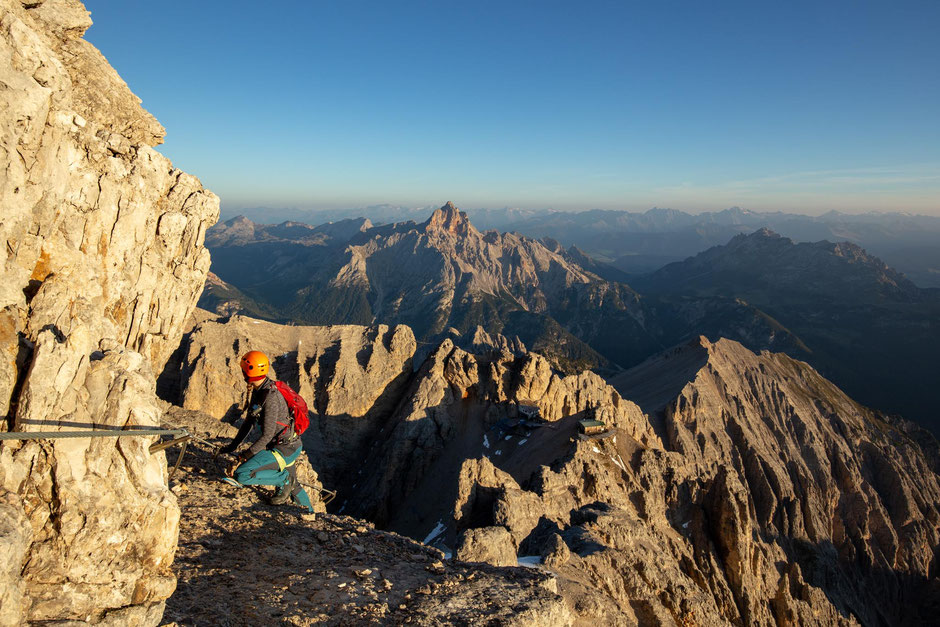
A via ferrata is an assisted scrambling route on fixed cables that have been professionally attached to the side of a mountain. All routes have different grades and lengths, offer varying amounts of views, and are frequently checked and maintained by the Italian Alpine Club.
The fact that the implements the soldiers used, such as ladders, cables and rods, were made of iron, paved the way for the name Via Ferrata, which translates from Latin to “Iron-Road” or “Iron-Way”.
As they were initially created for soldiers who wore heavy boots and carried large quantities of supplies, they weren’t meant to be technical at all times of the year. After the war ended, the old, often steel and wooden equipment was replaced with safe modern solutions.
Since German is another official language spoken in the Dolomites, in some parts you can find signs pointing to a “Klettersteig”. It means via ferrata in German.
Another way used for describing a via ferrata is “Sentiero Attrezzato” meaning “an aided path/traverse” an example of this is Sentiero Massimiliano or Sentiero Carlo Minazio on the Sorapiss Circuit.
2. Do I need climbing experience to tackle a via ferrata?
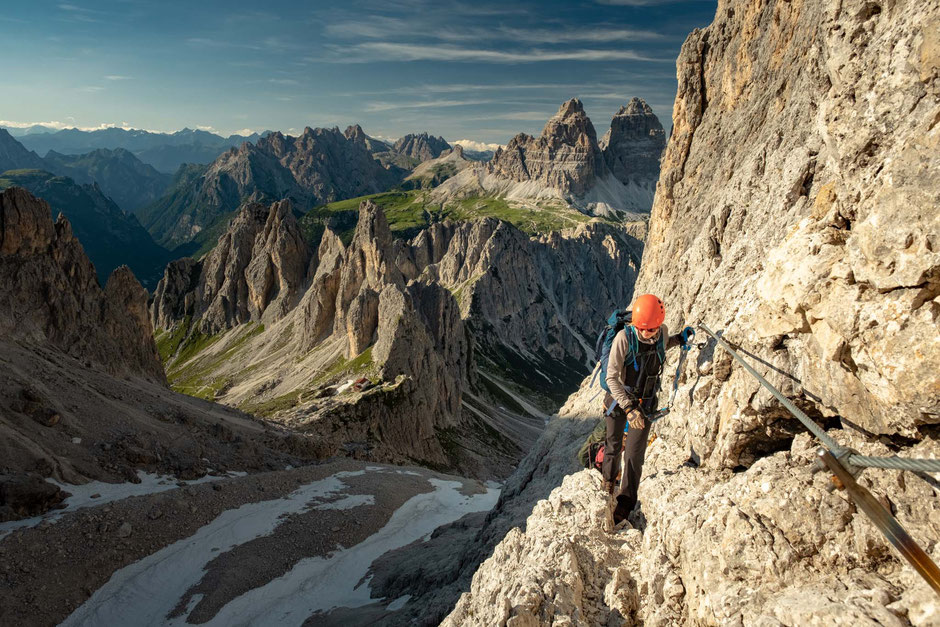
The quick answer is no, you don’t. Don’t expect to have to dangle from a ledge, only holding yourself with one finger.
Even though the objective of regular climbing and via ferrata is often the same – to reach the summit of a mountain, undertaking a via ferrata doesn’t require any prior climbing experience.
The biggest difference I can think of between climbing and via ferrata climbing is that a significant part of the former involves practising safe falling.
Whilst you do wear safety equipment on a via ferrata, which is supposed to be a lifesaver if you lose your footing and fall, the existence of ladders, stemples, and other apparatus ensures that you DO NOT fall in the first place.
Undertaking a via ferrata requires sure-footedness, an adventurous spirit, and some stamina. If you suffer from vertigo and standing on steep ledges with a couple of hundred-meter drops below makes you want to faint, then maybe you should choose one of the day hikes in the Dolomites instead.
3. I have never done a via ferrata before. Do I need to hire a guide?
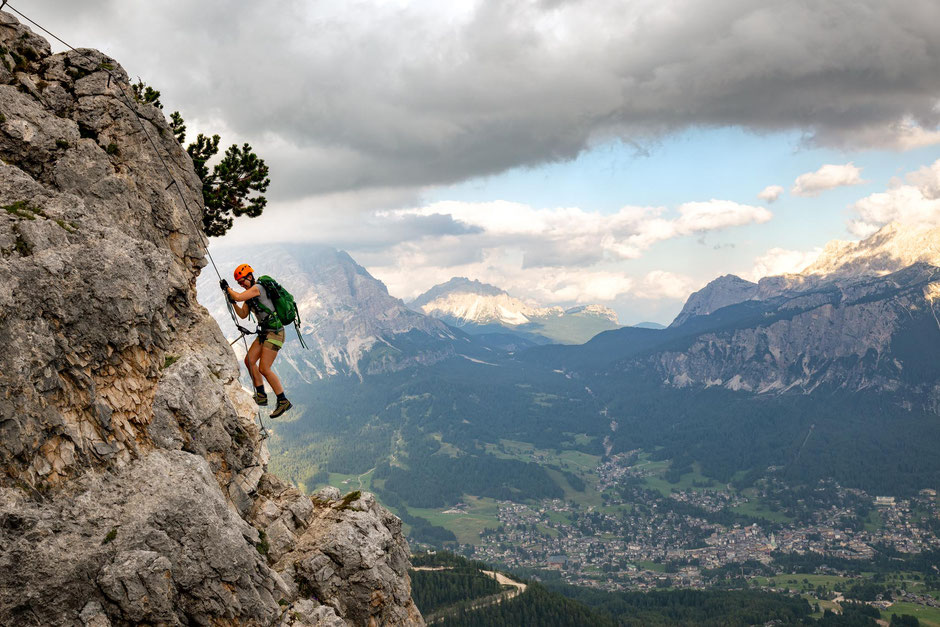
Regarding my knowledge of via ferratas in the Italian Dolomites, this is the question I am often asked. I won’t give you a straight answer because whether you need a guide depends on several factors.
Ask yourself, what is your risk tolerance? If your answer is low, hiring a guide is a good idea.
However, if you are a seasoned hiker, have a pretty good orientation in the mountains, can follow route markings well, and have done good prior research on how to use via ferrata equipment or have a friend coming along, who can teach you, then hiring a guide might be a waste of your money.
Start with one or two beginner paths, and you will quickly move on to intermediate or advanced ones. This was my strategy, and I am still alive and well.
My friend first introduced me to the world of Italian via ferratas. A couple of years prior, he taught himself how to use the equipment using a YouTube video.
Neither of us has had any prior climbing experience, but we have spent a lot of time hiking in New Zealand and the Canadian Rockies, and we feel comfortable being in the mountains.
4. What equipment do I need for via ferratas?
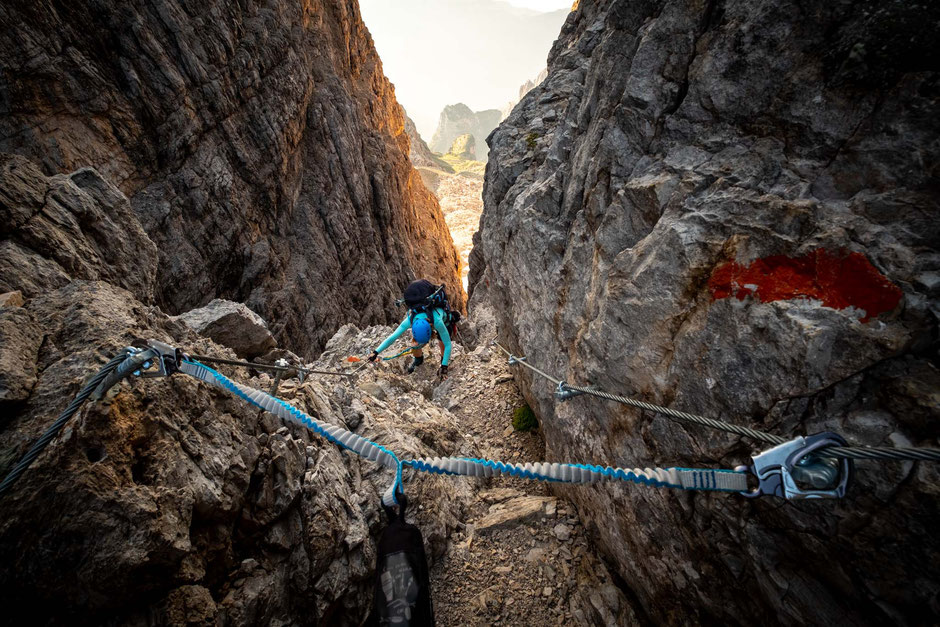
Before you set off on any route, you need the right equipment. This is a good opportunity to note that via ferrata equipment, unlike climbing equipment, is intended solely for emergency use in the event of a fall. Remember, it only works if you have it on and use it properly!
Stripping it down, there are 4 mandatory items, and they are:
Climbing Helmet
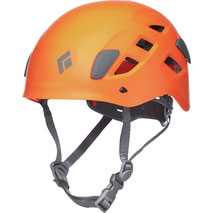
Black Diamond Half Dome Helmet
Rockfall is a major concern on these routes; unbeknownst to you, other climbing groups may be hundreds of meters above you. Even if they accidentally dislodge a small golf ball-shaped rock and send it hurtling down the mountain, if it hits you on the head, it could have serious consequences. A helmet placed on your head (not inside your backpack) is a must!
On almost every route, there are memorial plaques dedicated to people who have died on that route. Let’s try not to add more.
As a note: A cycling helmet does not offer the same type of protection a climbing helmet does and it is not recommended, in case you were thinking about it.
Harness
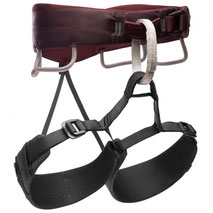
Black Diamond Momentum Harness
There are different types of climbing harnesses, all of which will work for via ferrata. Your main choice will be between a sport harness and a traditional harness. Interestingly, one of the main considerations when buying a harness is how long you’ll be sitting while climbing. Providing nothing goes wrong, whilst doing a via ferrata, you should never have to sit in it.
You also don’t need any extra or larger gear loops. Something light that packs up small is perfect.
Another important thing to note is that climbing harnesses go out of date. Even if not used, the material perishes; the life expectancy of a harness with regular use is 3 years. Personally, I’d never buy second-hand either.
Via Ferrata Lanyard
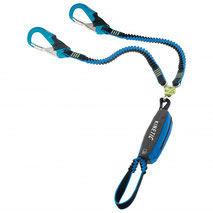
Camp Kinetic Rewind Pro Via Ferrata Lanyard
Also known as a Cow’s Tail. A via ferrata lanyard consists of four main components. A strong loop to attach it to your harness, an energy-absorption system, and two carabiners on the end of the lanyard arms.
The attachment loop is pretty straightforward. It’s used to attach to your harness.
The energy absorption system is used in case of a fall. It’s filled with an extra coil, so in the event of an accident, it reduces the stress on other parts of the gear and on the climber. Hopefully, you’ll never need it!
The two carabiners at the end of the lanyard arms, which usually have some elasticity for convenience, are used to clip into the cable (details will be provided later in the post).
Climbing Gloves
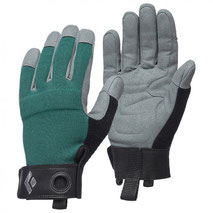
Black Diamond Crag Gloves
If you’ll be hauling yourself up on a cable all day without gloves, within a few hours, your hands will be red, raw, and blistered.
Fingerless climbing gloves are suitable for via ferrata, as they still allow for dexterity on the rock while providing protection from cable burn.
However, personally, I prefer these full-fingered gloves because I have cut my fingertips a few times when a piece of wire was sticking out on a cable. Extra protection never hurt anybody, right?
Harness and helmet are the two items you should try before buying to ensure a safe and comfortable fit, but with free shipping and returns, you don’t have to drive to the stores personally.
Some via ferratas have subterranean sections, so you’ll also need a head torch because there is no natural light to guide you. The two examples are via ferrata Giovanni Lipella and via ferrata De Luca.
Also, if you get lost and it gets dark, a torch is a very useful item to carry with you.
There are numerous reputable brands that manufacture via ferrata equipment, including Black Diamond, Petzl, Mammut, Edelrid, Camp, and Salewa. The last two were established in the Dolomites. You can mix and match brands as much as you want! The ones I linked to above are the ones I own myself and highly recommend.
5. Can I rent via ferrata equipment in the Dolomites?
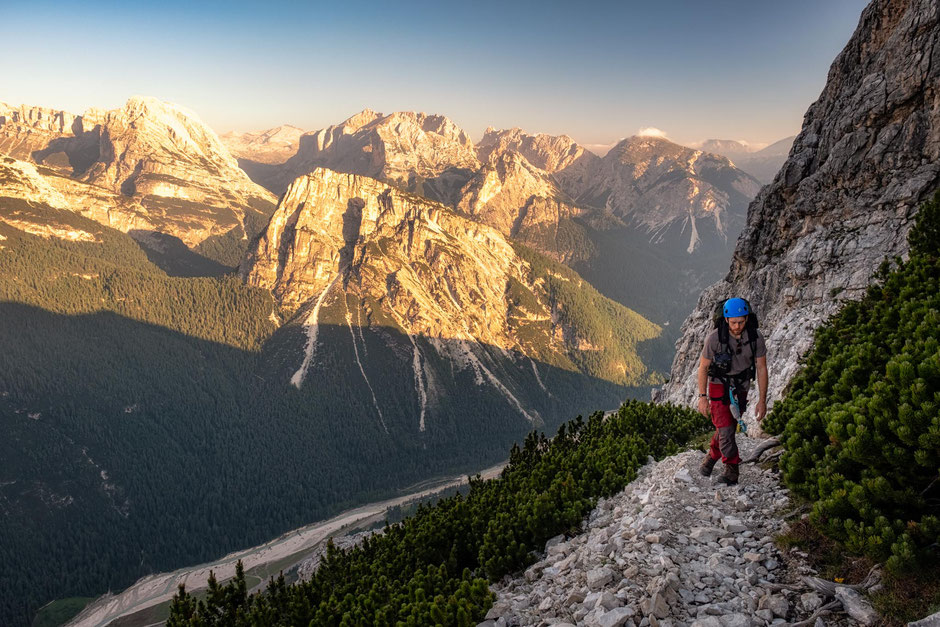
Yes, you can. Most towns have outdoor rental shops where you can rent gear. Look for anything that says “noleggio,” which means “hire” or “rental” in Italian.
Rental equipment costs around 35€ daily for a via ferrata lanyard and a harness. If you plan to tackle multiple via ferratas or are considering taking up via ferrata climbing as a hobby, it may be more cost-effective to purchase your gear. The entire via ferrata kit costs approximately 250 Euros.
As you can see, the price point is approximately equivalent to 6-7 days of renting to pay for your kit, ultimately. If you’re planning on doing a few via ferratas this holiday, it might be better to have your own gear instead of old, smelly gloves that have been worn by a hundred people. After all, it will be an investment.
TIP: If you plan on hiring a guide, the price includes a via ferrata kit rental.
6. How do I use a via ferrata lanyard?
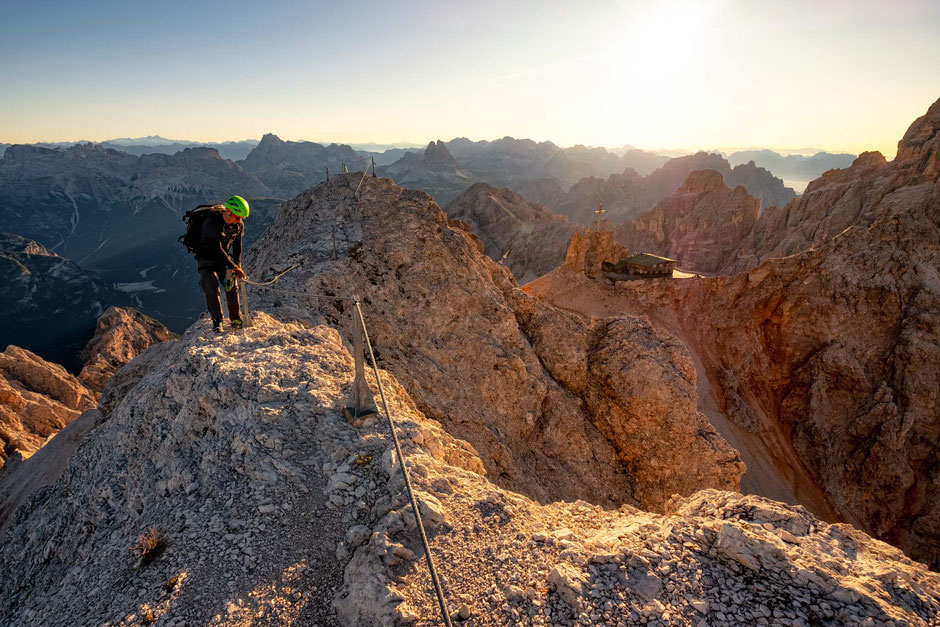
First, you attach the via ferrata lanyard to the harness through the belay loop. All via ferrata lanyards will have detailed instructions on how to do this. It’s a straightforward knot called a cow hitch.
As you may have noticed, after playing with the carabiners, they are designed to be automatically locked. This means they won’t open whilst on the cable.
They can be opened by pressing your palm into the release and opening the carabiners with your fingers. It’s a technique that you’ll end up using hundreds of times and will become second nature, but it’s good to practice with your lanyard at home.
As you approach the first section of cable, properly harnessed up, with your helmet and gloves on, and your via ferrata lanyard attached, you’ll attach both carabiners to the cable.
After a few meters, you’ll get to the first fixed cable loop (where the cable is attached to the mountain, usually by resin screws). Unclip one carabiner and clip it back into the other side of the loop, then repeat the action with the second carabiner.
The important thing is you always do it one carabiner at a time. The good way to do this is by using only one hand; that way, you will eliminate the possibility of unclipping both carabiners at the same time.
I’ve seen people on via ferrata routes only having one carabiner attached at a time, alternating the lanyard arms between the cable sections. This is wrong. In the event of a fall, having only one attachment doubles the stress on the lanyard, potentially rendering it ineffective.
Try to use only one hand for clipping and unclipping the carabiners, just as you should use only one foot when driving an automatic car.
I know it can be difficult to envision words. I recommend that you jump onto YouTube and watch this great video, which shows the use of a lanyard and carabiners. Just don’t be put off by the difficulty of the ferrata showcased in the video! As the guys mentioned at the beginning, this is probably the toughest of the toughest ferratas out there!
As with everything, it takes practice to become good at something. I remember on my first few routes, I always forgot to clip out and back in on the different sections, which resulted in me getting ahead in the route, but my lanyard stayed behind. I then had to climb down to the last section to do it.
Later, I figured out it’s easier to rest the carabiners on the palm of my right hand (the one I use for clipping in and out of the cables) and slide them along the cable. Cables are there to help you with climbing, and using them to get ahead is definitely a good idea, especially if you are a beginner.
7. The climbing protocol along a via ferrata
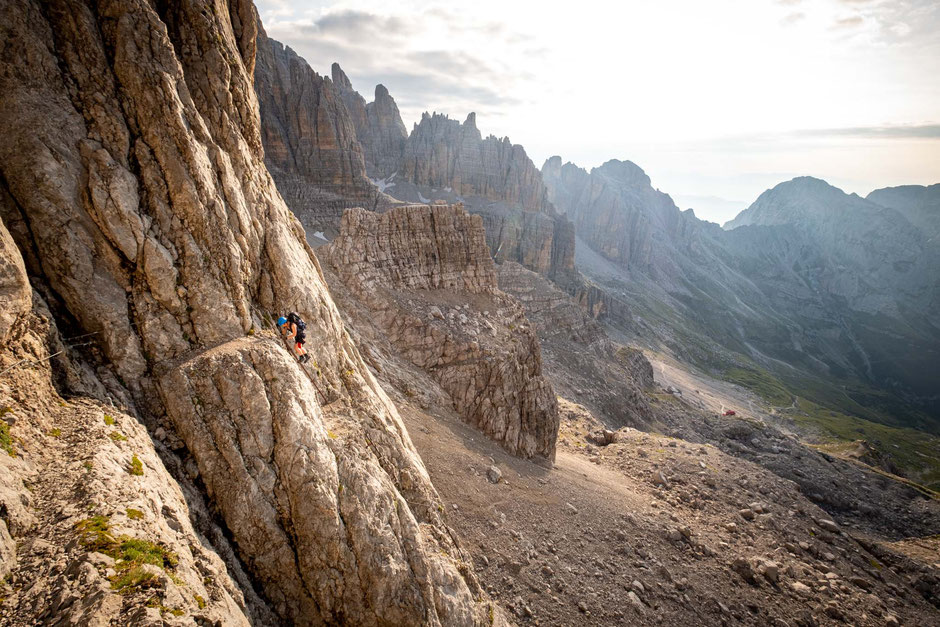
Do you know that asshole who will tailgate you, thinking it will make you drive faster, even though you are already driving at the speed limit, eventually overtaking you in a sketchy spot a couple of minutes later, so you can catch up to him at the next traffic light intersection anyway? Yeah, we all do.
Occasionally, you will meet those in the mountains, too. Fortunately, this is more of an exception than the norm. Generally, mountain folks are friendly and chill.
If you need to pass someone along the route, ensure you do so in a safe location (for example, a wider ledge). The person being passed usually just has to stop and wait, whilst the other climber clips one, then the other carabiner around them. This often results in a brief hug with a stranger, but it’s part of the experience.
The safest way to climb with a partner is to always stay clipped into separate cable sections and maintain a safe distance. That way, if one person loses their footing and falls, the other person isn’t pulled with it.
If you happen to set off some loose rocks, shout ‘below’ like climbers do. That way, anyone who might be in the lower sections will look down, not up.
8. Is there an official grading of the route difficulty?
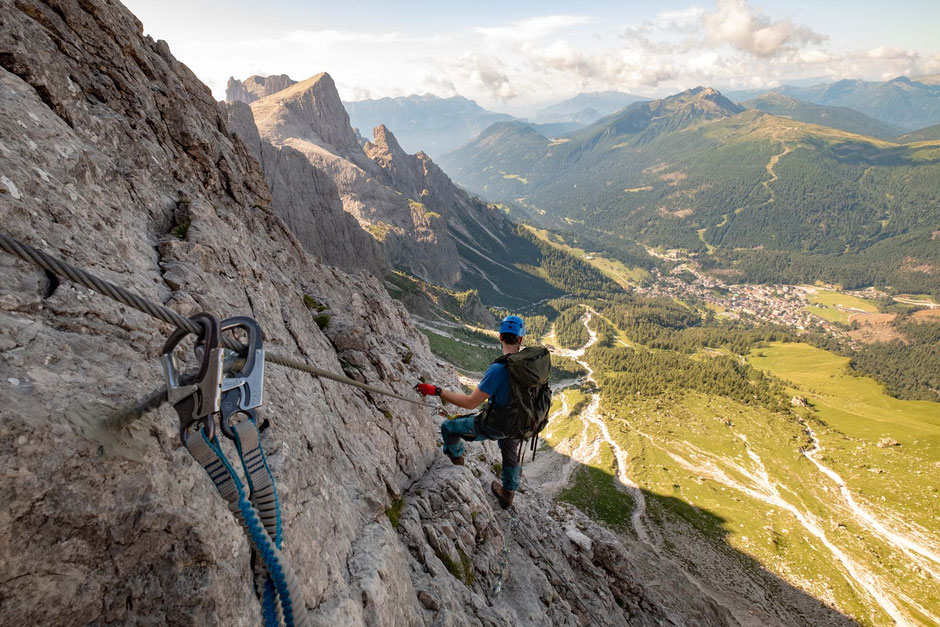
At times, it seemed to me that there is only one grade for a via ferrata amongst the locals, and it’s called via ferrata. If it involves cables and ladders, it’s marked with crosses on the maps, and if the route requires the use of a via ferrata kit to complete it, then that’s it!
Funnily enough, the International Climbing and Mountaineering Federation (UIAA) adopted the Italian scale for grading the difficulty of a via ferrata as its international standard.
Yet, I’ve never seen a plaque at the start of any of the routes with information on the difficulty grade of a via ferrata using the scale created by the Italians. To me, this immediately poses the question: What’s the point of having a scale if you are not going to use it?
Another unofficial grading system is the Smith/Fletcher rating, developed by the authors of the Cicerone guidebooks for via ferratas in the Italian Dolomites. The scale uses numbers 1-6 and letters A through C. But what do they mean?
The number reflects the technicality of the climb. Number 1 is a walk that may be exposed in parts, and numbers 5 and 6 have sections of vertical or near-vertical climbing where sustained arm strength is required.
The letter represents “seriousness”. This is mainly a measure of how quickly you can return to civilisation in an emergency. So, a C would represent a long, remote climb, potentially with no escape routes. An A would represent a shorter climb near civilisation with several escape routes.
The Smith/Fletcher rating is much better than the official international standard grading, but it isn’t perfect. I imagine rating a via ferrata difficulty is difficult because many variables come into play.
Sometimes, I felt that some 4C ferratas were easier than a 3B, but at the time, factors such as my current experience, fitness level, or even how ‘pumped’ I felt on a particular day when tackling a route could influence my judgment.
9. Does it matter which way you follow a route?
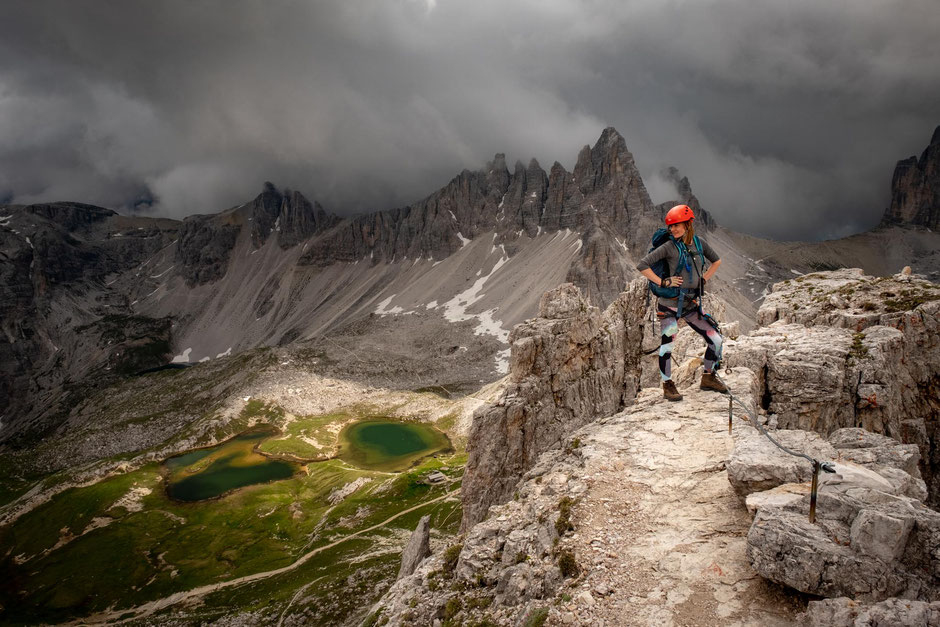
Yes, it does. Some routes should only be done in specific directions. This is because of passing issues. If two groups go in different directions with no safe place to pass, it can take a long time logistically and potentially be dangerous.
This is especially true on popular via ferratas such as Torre di Toblin.
If a particular direction is recommended, it will be reflected in the literature and sometimes on the tobacco maps with a solid arrow in the permitted direction of travel.
10. Are via ferratas dangerous?
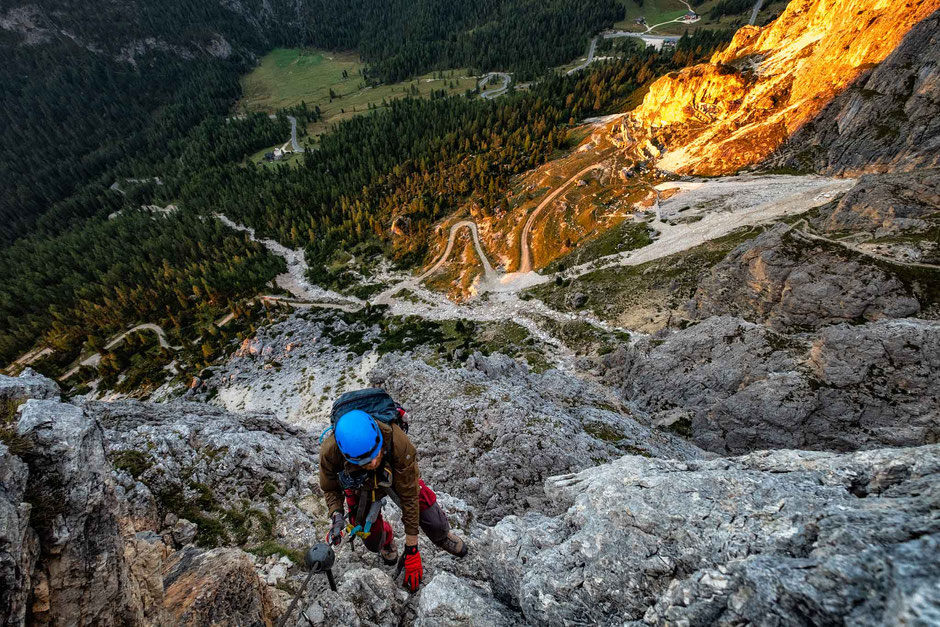
All climbing has inherent risk; anyone saying “Yes, they are safe” would lie. That being said, if you are adequately prepared, well-kitted, and choosing routes within your limits, the chance of an accident is low.
Falls can still be bad, though. If you’re at the upper end of a cable and slip, you will travel the length of the cable down, plus the length of the via ferrata lanyard, which can be several meters.
It’s worth noting that after a fall, your via ferrata lanyard should be replaced, as it will have become weakened. You should frequently check your energy absorption system. On the inside, there’s a tear-off label indicating whether it fits the purpose.
If the label is broken, do not use it. You should also regularly check your harness and via ferrata lanyard for knots, cuts, tears, wear, rust, chips, or missing parts.
Always carry adequate insurance that covers mountain search and rescue. Regardless of the insurance you purchase, always read the terms and conditions carefully, as some policies may have restrictions.
11. Are via ferratas suitable for children?
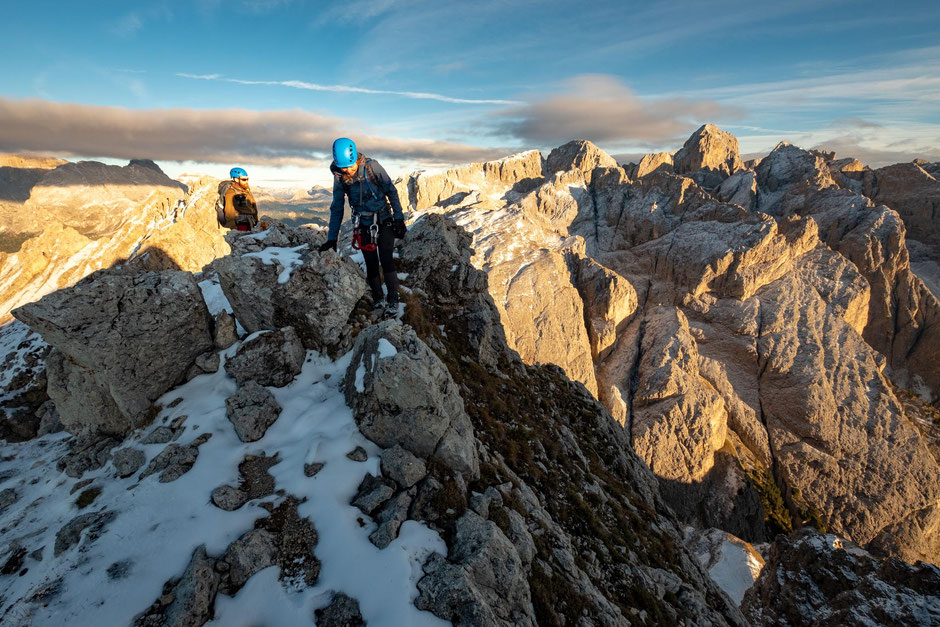
Yes, absolutely. I have seen plenty of children on via ferratas, more frequently on easier grades. The process is the same as for adults.
You should take extra time to explain the procedure and practice with them several times, so they understand not only the procedure but also the implications of not following it.
Remember that your group is only as strong as your weakest climber. Don’t take an inexperienced child on a 5C via ferrata even if you are a pro.
I recall once seeing a teenage girl on a route covered in tears, stuck on one of the ledges, too terrified to continue. I felt sorry for her. Her party overestimated her abilities.
What I occasionally see is that not only are the children using the lanyards to clip onto the fixed cables, but they are also tethered to their parents for extra security. If a child forgets to clip in or clips in incorrectly and slips, they are still attached to their parent (who will hopefully be correctly clipped in).
12. How can I find via ferratas in the Dolomites?
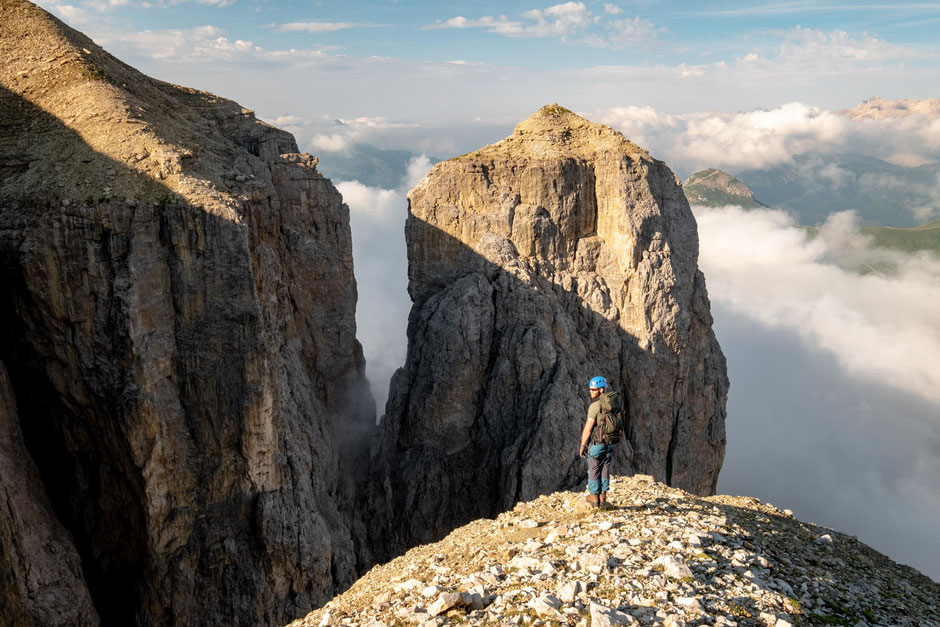
I have created three lists to get you started. They are categorised as beginner, intermediate, and advanced via ferratas. Each article links to separate posts describing an individual route.
If you prefer a tangible version to carry with you, I highly recommend the Cicerone guidebooks, particularly volume I.
I have used them myself on several occasions, and although I sometimes found the grading a little bit off, this is mainly due to my personal experience, not the professional eye of a mountain guide.
- Via Ferratas Of The Italian Dolomites: VOL 1 by James Rushforth
- Via Ferratas Of The Italian Dolomites: VOL 2 by Graham Fletcher & John Smith
13. How to dress for a via ferrata
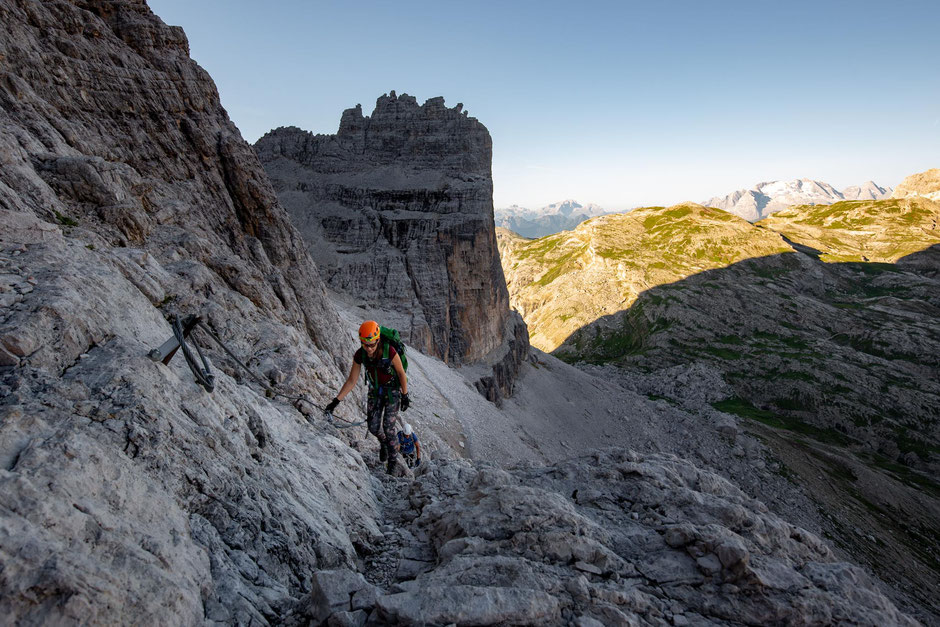
Weather accordingly and comfortably. You want to be able to lift your legs without tearing a hole in your crotch (speaking from experience here).
I always like to wear long hiking trousers or leggings, even on warm days, to prevent any cuts and scratches on my legs caused by sharp rocks.
My favourite go-to brands for hiking trousers are Fjallraven and Revolution Race. Both are Scandinavian brands, and when it comes to the outdoors, the descendants of Vikings know their stuff.
I always have a wind and rainproof jacket in my backpack, as well as a down vest or jacket, because once I stop moving, I tend to get cold on the summits.
Wear synthetic or Merino wool shirts, never cotton. They dry much quicker and better absorb any funky smells. Sweating bucketloads is part of the experience!
Ensure you have UV-protective sunglasses and a hat to cover your head. The sun in the mountains is unforgiving, and I try to avoid sunburns at all costs.
I often get asked what boots to wear on via ferratas. There are a few dedicated boot designs for via ferratas, but to be honest, any hiking boots will do—as long as they have a good grip and are comfortable.
14. Do I need a map to tackle a via ferrata?
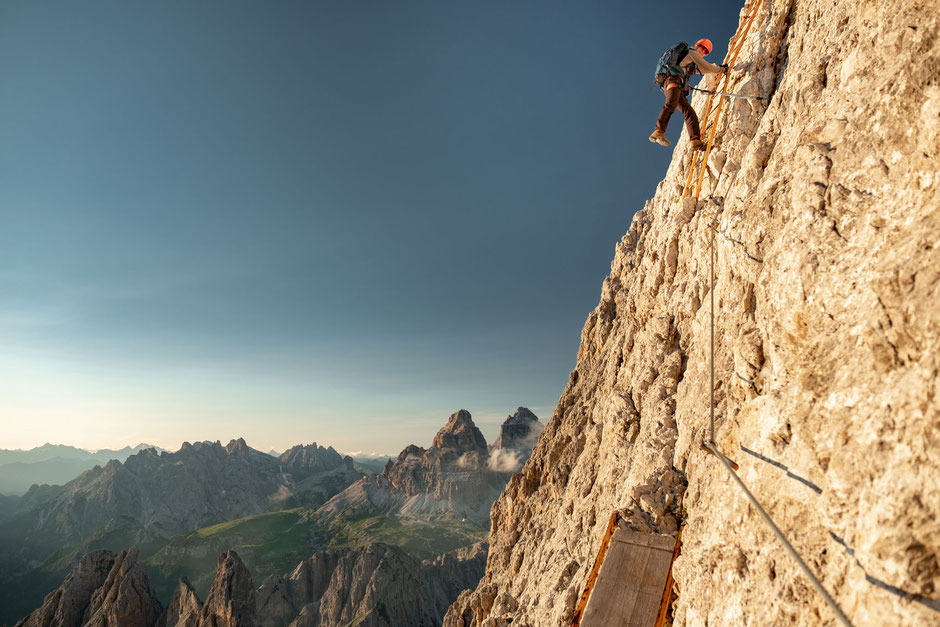
Waymarking in the Italian Dolomites is excellent. Signs are on every fork, and red/white or blue/white paint marks are on the rocks along the paths. As long as you pay attention to where you are going and know the name of your destination, you should be fine without a map.
However, I am a big fan of printed maps. I have a whole collection of maps from the Italian Dolomites, and I always encourage people to purchase them. It gives me a sense of security.
Of course, there are plenty of online choices and apps nowadays, but I prefer not to rely on my phone’s battery. My inner geek also enjoys studying maps for the names of the surrounding peaks.
During the numerous routes I took in the Dolomites, I only lost my way once, and it happened because I didn’t have an adequate map with me on that day.
15. What if I have an accident while on a via ferrata?
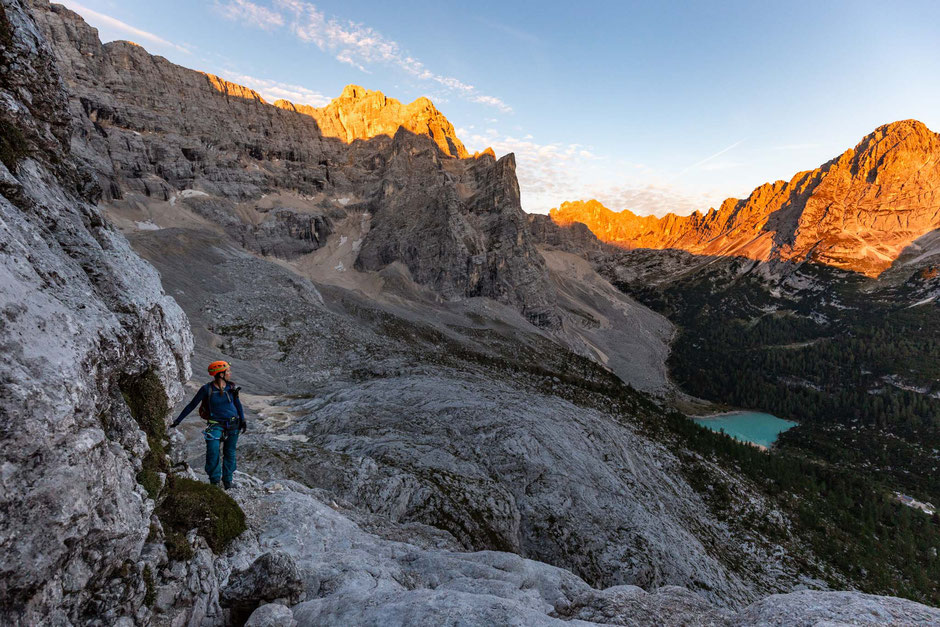
In an emergency, the most crucial number to keep saved on your phone is 112. This is the so-called Pan-European emergency number, which will redirect you to the emergency service line in the country you are currently in.
118 is the direct number for Medical Emergency and Ambulance services in Italy.
Whilst the phone reception is generally pretty good in the Dolomites, please don’t count on it entirely. There are many spots where there is still none, especially on longer and remote routes.
TIP: I recommend downloading an app called SOS AU ALP. It’s a great tool that connects you with emergency services and sends them your coordinates. Not only does the app make it possible to receive help quickly and efficiently, but it is also free to use. Please register all your details after downloading the app.
If you spend a lot of time in the mountains, consider investing in a GPS device, such as the Garmin InReach Mini, with a month-to-month plan. And once again, don’t forget about the insurance. Joining the Alpine Club as a Member has its perks, as it often comes with mountain search and rescue insurance.
16. When are via ferratas accessible?
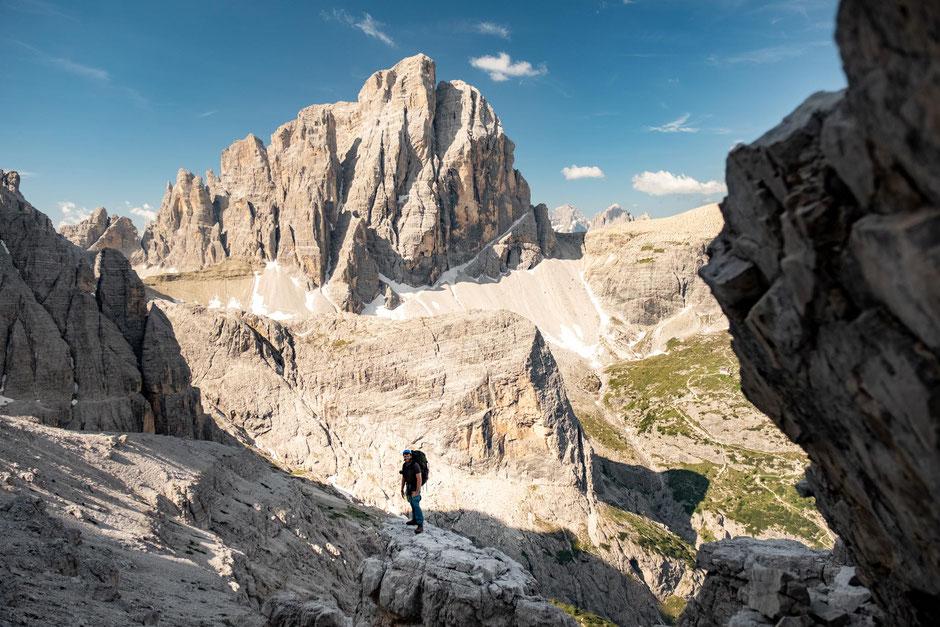
The official hiking and via ferrata season in the Italian Dolomites is relatively short, typically spanning from June to the end of September, or in some parts, extending into October.
If you were wondering why it’s so short, it’s because the snow in the mountains doesn’t melt entirely, even well into July, and then starts falling again in September/October (although you can even expect it in the middle of the summer. If you plan to visit the Dolomites in the spring, pack your skis instead of your via ferrata equipment.
Always plan your excursions for early in the morning. Not only will you avoid the midday sweltering heat on your climbs, but you will also be safely back down before the thunderstorms roll in.
Thunderstorms are a big part of the Dolomiti weather cycle; expect them in June, July, and even August. Generally, the most stable weather is in September.
October is a bit of a gamble. It can be absolutely amazing on warm and sunny days, but it can also bring lots of snow and road closures with it. Most of the chairlifts already stop operating before the winter season kicks off, which often results in prolonged approach times on some of the via ferrata routes.
That’s pretty much all you need to know about via ferratas. However, if you do have any questions, please put them in the comments below. I take pride in thoroughly responding to every comment on my website.
Support my website!
Hi Reader! If you found any of my articles about the Dolomites useful please consider using the affiliate links below (at no extra cost) when booking your holiday. Thank you
- Reserve your hotel with Booking.com
- Book your rental car with Discover Cars
- Buy your outdoor gear with Backcountry.com (US readers)
If you have any questions, leave them in the comments below!
hi
really great guide-thank you and it helps one immensely to prepare and plan. Q: do most routes once traversed to the top, allow for a standard walking trail back to the start or is it more VF back down? thinking of timeframes, energy levels, safety etc
many thanks
Donncha
Hi Donncha. thanks for your great feedback. Yes, they do, but there are some exceptions for example via ferrata Merlone or Via Ferrata Marino Bianchi. Best is to always study the maps before heading out.
Thank you so much for your insightful post! My husband and I will be in Cortina in mid-June. We love hiking and would consider ourselves decently fit. We have done indoor bouldering and rock climbing, but we are by no means expert climbers. Between the time of year and our experience level, what route would you recommend? We won’t have time for more than 4-5 hours for a VF as there are many things on our list for the Dolomites! We also like to feel “accomplished” at the end of a hike, so we don’t mind pushing ourselves. We would consider a guide if it would be time-efficient and affordable. Thanks again!
Hi Shelby. Thanks for visiting. If you are have done rock climbing than even advanced via ferratas would be fine for you. Via ferratas are not climbing routes, they are protected scrambling routes.
I really like the Via ferrata Marino Bianchi close to Cortina. The views from the summit are amazing. the only downside to it, is the long approach on a scree slope, but thanks to that you will meet very few people on this route. Another one of my favourites is via ferrata Merlone which isn’t a long drive from Cortina.
I hope that helps!
Thank you Marta! Is there anything you don’t know?
I’m in the early stages of planning my first hut-to-hut hike, but I really have no need for the adventure and exposure (to say nothing of carrying extra kit!) of via ferratas. Generally speaking, do the routes identify the via ferratas? You mentioned the crosses in the maps, are they reliable? Will there be any chance I start a route without marked via ferratas but find that I have to navigate one?
Thanks!
Andy
Hi Andrew! Ha, I do not know everything unfortunately 🙂 Yes, via ferratas (and short sections with assisted cables) are marked on the maps. If you don’t want any of those you can plan a part of Alta Via 1 (i have a guide for it), which doesn’t include any via ferratas. I hope that helps!
Hi! Thank you for all of the information! I’m planning to hike the Alta Via 4 and will be starting from San Candido. Since the route includes a few via ferrata sections, I wanted to ask if it’s possible to rent the necessary gear along the way.
Also, I’ll be finishing my hike in Tai di Cadore, so I’m wondering how I can return the equipment if I rent it somewhere along the route.
In this case do you think it’s better to rent the gear or would you recommend buying my own equipment for the hike?
Hi Lena. Some huts do rent gear, but you have to return it to the hut, so that wouldn’t make sense. If you want to rent your best bet would be Cortina, then getting by bus to San Candido on the day of the start. It is much easier to get back to Cortina from the end of AV4 than to San Candido. To be fair though renting gear for 6 days will cost you around 180 euros. For a little bit more you can just buy the whole set (especially now during cyber week). I hope that helps!
Thank you so much for all this information! It is so very helpful. As a first timer doing Via Ferratas I wondered if you thought this itinerary was doable. Going at the beginning of next month and during a hut to hut section have the following VFs in this order:
day 1: Strada Degli Alpini
day 2: Innerkofler and Torre di Toblin
day 3: Sentiero Bonacossa and Merlone
Does that sound doable in terms of time and also ability for first timers? The second VFs on day 2 and day 3 are optional but wondering how feasible it is to do both. We’ve done lots of hard hikes and scrambles but one in our group is a little bit nervous with heights and exposure. Thanks again for sharing your knowledge!
Hi Lisa. Thanks for visiting. You are basically dollowing my Tre Cime Nature Park traverse. If you stay in Pian Di Cengia on night 1 then you can easily do both Innerkofler and Torre di Toblin on day 2 (providing you are fit).
I hope that helps. I am keeping my fingers crossed for good weather!
Great thank you! Yes hoping for good weather!!
Hi!
We originally wanted to go in september. But now things are looking like first week of october.
Are there areas where via ferratas are still doable or do we have to sacrifice altitude regardless of where we go?
My original plans are scuppered since some of the higher rifugi are closed after sept.
Are there any lower areas that are fully open in october with good via ferratas?
Thank you!
Matt
Hi Matt. Sorry for the late reply. I was on a hut-to-hut trek. Look into my Rosengarten Traverse. The huts there are open until mid or even the end of October. It connects nicely with many great beginner via ferratas. I hope that helps!
Hello Marta:)
Firstly, thank you for taking the time to detail your vast experience!!! the time and effort you have put into your site is commendable and an absolute gem of a find for visitors like us!
Can you please suggest 1-3 best Via options for medium experienced day trips from Venice???
With car rental and gear pick up, realistically we will only have 3-4 hours to climb at best:(
We are here now, (July.3), hoping to go tomorrow as weather has improved.
Looking forward to your response
Hey Grant! Thanks for your fantastic feedback. Cortina can be reached quickly by car when driving from Venice. An excellent intermediate via ferrata which doesn’t take much time is Ra Bujela or Degli Alpini Al Col Dei Bos. There isn’t anything else that comes to my mind that would only take 3-4 hours and is of intermediate level. Other two via ferratas near Cortina that are short and easy are Ra Gusela and Averau.
Hi Marta, do we need our own equipment for via ferrata or is there some shop that rent equipment?
Thank you!
Hi Noemie. Please read question and answer no. 5 🙂
Haya,
I’m trying to find info about public transport in the dolomites, specifically for via feratta loops. You don’t know a source do you? I’m finding nothing
Hi Oli. For checking connections you can use google maps, Sued Tirol Mobil Info website and mooveitapp. The first two are best though. Let me know if that helps!
Hi Marta, I have really enjoyed reading your posts. Thank you. My son, 13, and I did the Sentiero Roma last sommer – a wonderful trip with via verrata on all passes. In looking for something similar I came accross the Dolomiten tours 1-10. We are both fit and good with footing and hights, but I am uncertain of the difficulty of the tours (apart form 1 and 2) as the ferrata are longer and rather exposed and apparently include sections of climbing level II. At present I am tossing up between 3 and 4. Can you give your impressions of these tours and especially an opinion on the sections supposed to be level II. Thanks, Peter
Hi Peter. thanks for stopping by. I’ve never heard of Sentiero Roma. Just had to check it out and looks lovely but I won’t be able to compare it to Alta Via 4. If you are unsure about your abilities then I would recommend you look into Alta Via 2. It has only beginner via ferratas along the way and you can enter or exit at any given day, no need to walk all 14 days at once. I am not exactly sure what climbing level II is, but I am yet to do a via ferrata route in The Dolomites that is as hard as climbing. They are all scrambling routes with extra protection using via ferrata lanyard. I hope that helps.
thank you for the thorough guide! i’m really interested in via ferrata at the dolomites, and also a hut to hut experience. as it will be my first time, i am unsure whether i would need a guide for this trip? i’m trying to do as much research as possible but i know this wont substitute for someones real world experience
Hi Victor. Thanks for visitng. Just start easy with beginner routes, see how you like it and then if you decide you are ready for harder routes do them next. You definitely need to know how to use the gear but a simple youtube instruction video explains how to use it. Everyone is different. Some people get into advanced routes right off the bat, some need longer time because they don’t trust their feet:). One thing to bear in mind is that via ferrata is not climbing (many people mix the two). Climbing requires a lot more skills and knowledge.
Hi Marta!
I had a question regarding via ferreta lanyards. If I do have a fall with the lanyard, and the safety mechanism is deployed meaning I am no longer able to use it, should I be carrying an extra lanyard in my bag? I know the hope is to not fall but I can’t imagine falling in the middle of a route and having no protection for the way out!
Let me know your thoughts!
Hi Rhea. Thanks for visiting. Yes, once the safety mechanism deploys the set is not usable anymore. With that said I never had it deployed. Unlike in climbing where you practice falling during a via ferrata you are never meant to fall, because even with a lanyard secured to the cable one would bruise up pretty badly during a fall. Via ferratas are scrambling with extra security. If you would feel better you could look into getting a climbing webbing sling and another carabiner with you which would give you extra security. Those are meant to be used on really difficult ferratas where sometimes one might have to rest on a harness without putting their weight onto the lanyard or when crossing suspension bridges. Hopefully you would never have to use it though. I’ve only done a couple of via ferratas where a webbing like that would have come in handy, otherwise there were always places where i could just rest on my feet.
Hi, thank you very much for the guides, they have heavily shaped the Europe trip that I am currently on. We are about to head to the Rosengarten group for a brief 3-day hut to hut hike (from Carezza to Alpe de Suise), and I was wondering if you know if any of the Rifugios in that area allow hikers to rent or borrow via ferrata gear. We are travelling as budget-conscious as possible, and it seems like a waste of money (and weight in our packs) to be renting gear for 3 or 4 days that we may only use once or twice. The hiking trails we have selected do not include any mandatory via ferrata, but we are hoping to do them as more of a bonus excursion at the end of our hiking day. Any info on this topic would be great.
Hi Evan. Thanks for your great feedback. I am stoked to hear you are heading to the Rosengarten. Unfortunately I don’t know whether the huts rent gear. I know some huts offer guiding tours, but never heard of them renting the gear. You might want to contact them directly and ask.I would be interested in knowing that as well to be honest.
Hiya! I’ll be heading to the Netherlands in mid November for my sister’s wedding and was planning on traveling around a few countries and doing a via ferrata, ideally in the Dolomites. However, after reading your wonderful breakdown of the via ferratas, im assuming November is probably not going to be a great idea or even possible for the Dolomites. Any suggestions of other via ferratas in surrounding areas/ countries?
Hi Katrina,
Thanks for visiting. Yes since most of the via ferratas in the Dolomites are at high elevations November is usually off limits. Last year the weather in the mountains in November was very mild and I was still hiking even in December so it really is a matter of what the weather is doing. I suggest that you check out the Geierwand Klettersteig in Haiming, Austria. It is close to where I live and at low elevation. Quite sun exposed too. If the weather aligns it should be doable in November too.
Hi Marta!
Are there any via ferratas near Lake Como?
Hi Kaibab! Yes there are many, but I am not familiar with that area of Italy.
How ne nice if these trails were shown on a map. One pic worth 1000 words.
Hi Rick. Thanks for visiting. I link to individual guides for each via ferrata where you can find the info of the Tabacco Map Numbers that you will need for these routes. The routes are marked on the maps. I hope that helps.
Thank you for providing so much detailed information on this site! So much useful knowledge! Do you know if there is a 2 to 4 day hut to hut hike that does not rely heavily on difficult via ferratas? My partner and I are both avid hikers, but we have different risk/heights tolerance.
Hi Lily. The Tre Cime Traverse and Rosengarten Traverse only has beginner via ferratas in it so look into those two. Let me know if that helps.
Hi Marta,
Thanks for the excellent overview and information! My wife and I and our daughter (17) will be in the Dolomites for 5 days from 30 June to 5 July. We plan on hiking a lot (including a 2-day hut-to-hut in the Tre Cime) , but would love to do at least one, if not two Via Ferratas. We are experienced hikers (have “climbed” Kilimanjaro and Mt. Fuji, plus some 14ers in the US). We have also done a couple of Via Ferratas (one in the Canadian Rockies and part of one in the Dolomites on a trip 6-8 years ago.) We do pretty well with heights and some exposure. Is there one or two routes you might suggest that might be appropriate for us? Perhaps in the Cortina area, though we will have a car and can move around. We feel like a beginner route might not be a real adventure for us, yet we don’t want to tackle something that is too advanced – or something that is going to take more than about 4-6 hours total. If you have a thought or two, we welcome it! Thanks for helping us out with such great information!
Carl
Hi Carl. Thanks for visiting. If you are doing an overnight in Tre Cime then I recommend the VF Torre Di Toblin and Via Ferrata Innerkofler extensions.
Once in Cortina I would recommend considering either via ferrata Giovanni Lipella and Ra Bujela.
One of my personal favorite via ferratas is via ferrata Merlone.
I hope that helps. Please consider supporting my site if you can.
Fabulous summary. Could you advise, my daughter and I have some bouldering experience but no lead climbing experience. Could you suggest a good beginner route, preferably somehting that could be a day or two trip from Venice?
Hi Michelle. Thanks for stopping by. Via ferrata is not climbing. It’s protected scrambling. You don’t need to tie any ropes etc. As per my post 😉
I would suggest that you look into via ferratas around Cortina D’Ampezzo. For example Averau or Ra Bujela will be great. There is a shuttle that runs from Cortina to Venice daily so you could visit it for a couple of days. Let me know if that helps!
For day hikes and trips along a via Ferrata….how much water do I need to bring?
Hi Pablo. Thanks for visiting. I personally always bring at least 3 liters with me and most of the time I drink it all, but I always get very thirsty. It obviously depends on a via ferrata. Some take the whole day some take 2 hours. Quite often you also have the possibility to buy drinks in huts. You have to adjust to the condition. The general rule however for me is 3 liters. I also often mix it with some rehydration powder and electrolytes. I hope that helps!
Hello, I know you said that the season doesn’t start till June. But are there certain via ferrata that are lower and can be done earlier in the year? We plan on being there in may. Thanks
Hi Trenton. Thanks for visiting. The only one I know of and have seen pictures of people doing it even in Winter is via ferrata Degli Alpini Al Col Dei Bos . Averau faces East too so it might be possible but I can’t give you a 100% answer. It highly depends on the amount of snow. The webcams from Rifugio Lagazuoi face Mount Averau so you will be able to see how much snow there is in the area. Last year at the start of May there was still a lot.
We are planning a route (thanks to one of your other posts) and are debating about what combination of packs to bring for our family. I have viewed some videos and see people carrying day packs which wouldn’t work for us in doing a hut-to-hut hike where we will need to carry the essentials for several days. Some of the spaces look like they could be difficult to maneuver with a full backpack on. Any advice regarding this? We are looking at beginner and intermediate level VFs.
Hi Kate! Thanks for visiting. I have a full packing list for hut-to-hut hikes. At the very end, you will find my backpack suggestions. I always use this backpack on via ferratas and am yet to get stuck 🙂 Let me know if you have more questions!
Marta, Thanks for this – I have mountain experience and trad cliombing but know little of VF. I’m planning a trip here. I’ll probably hire a guide for the first day or too but it’s important to understand the needs and requirements. It’s a really good beginners guide … Tx G.
Hi Gary! I am stoked to hear it! Thanks so much for your feedback. Have lots of fun on the VFs and stay safe!
Hey Marta,
Curious, coming from Canada and I have my own gear but logistically – this is only part of a bigger trip and I won’t need my gear for the rest of the trip. Is there places to rent that allow you to drop the gear off at the end of your trip, I’m looking at the Alta Via 4 so I’m wondering if, to your knowledge you can pick up gear in San Candido and drop off in Pozale. Similarly, do you know any way to ship gear (that isn’t being used for hiking) from town to town.
Hi Will. Thanks for stopping by. Unfortunately, I don’t know of any rental companies which allow you to drop off gear at another location. They are usually small, family-owned gear rentals. As for gear shipping, when I was in the Dolomites for the whole season and I didn’t have an address I used to ship my orders to a post office and picked it up there. I used the post office in Cortina and it worked well.
What I usually recommend to my readers is to stay the night in Pozzale first and leave the gear that you don’t need at a hotel, then use the public transport to the start of AV4 and end the trek in Pozzale, where your gear will already be waiting. Pozzale has a train station so it’s easy to travel to from wherever you are coming. Let me know if I can help any further!
Having just got back from a weekend away in the Alps, I wish I’d seen this post first! We did a couple of via ferrata, the first one very elementary and the second one much harder; almost entirely vertical with at least a metre between each rung! We’d been told to bring “lightweight gloves” but I hadn’t quite realised what they were for. Thinking it was for the temperature at altitude, I packed some cycling gloves. It was only halfway up the first section that I realised that they had no grip so I took them off. Halfway up the mountain, my hands were bleeding and I couldn’t continue. Our guide told us that we’d reached the last point at which we could take the easier path so off I went down the easy path whilst the rest of my group carried on.
I’m still undeterred though and will definitely be buying myself and my son a harness, lanyard and helmet, not forgetting the ever important gloves! I’ll definitely head over to the dolomites to check them out, I’ve yet to visit and want to try out my new hobby there!
Great post, I’ll be sure to keep updated with your adventures! Thanks!
Hi Dave! Thanks for your input. I think gloves are really underestimated when it comes down to via ferrata. I never go without a pair and I have already worn out two pairs. I have also learnt the hard way how important they are when I forgot to pack them. Blisters and cuts on my hands. In the summer they absorb the sweat and in autumn they actually do help with the cold! Definitely check out the Dolomites. The via ferratas there are amazing!
Hey Marta, thank you for such a thorough explanation of everything. I have used your site as my ‘bible’ for planning our first ever hiking trip that includes via ferratas. We will be following your 4 day hut to hut excursion across Tre Cime National Park in July 2022. As a beginner I’m a little nervous but your packing list, equipment and trail suggestions fill me with confidence and excitement as the adventure draws nearer. Thanks again, you’re a champ 🙂
Hi Mike! Thanks so much for your awesome feedback. I am so glad I was able to help! Remember practice makes perfect. Take your time, practise clipping in etc. It’s a pretty straightforward process! Definitely take full advantage of the cables, which are provided for everyone’s safety. Let me know if you have more questions and do let me know how your trip goes! I am sure it will be epic!